
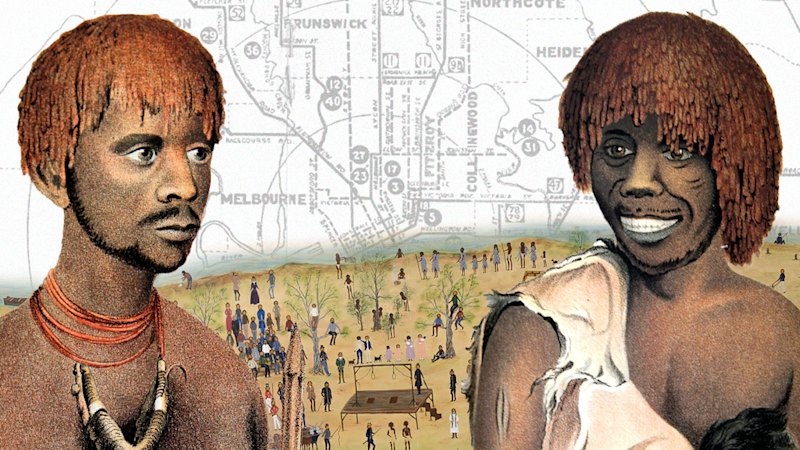
Timme, Aunty Patsy says, is the correct name for the young man who was known by a series of other names bestowed upon him during his short life.
He is called Maulboyheenner in history books, and was known by colonial authorities and early reporters also as Robert, Bob, Timmy and Jimmy.
But even Maulboyheenner was never Timme’s real name, says Aunty Patsy; that was simply a corruption of language meaning “he’s a small boy”.
Timme was a slight boy aged just 16 when he was captured by a colonial raiding party and taken to Launceston jail in 1830.
Timme’s Canoe sits close to Bass Strait, over which Timme was taken from Tasmania via Flinders Island to his fate in Melbourne in 1842.Credit: Mark Rippon
He was the single survivor, Aunty Patsy says, of a massacre at a time when Aboriginal people were being rounded up in an attempt to eradicate them from Tasmania, then known as Van Diemen’s Land.
Timme was taken from jail by the controversial Protector of Aborigines, George Augustus Robinson, who orchestrated the removal of some 200 of Tasmania’s surviving Indigenous people to exile on Flinders Island, the largest of the Furneaux group of islands in Bass Strait.
The settlement on Flinders Island eventually foundered, its dying residents afflicted with European diseases, homesickness and cultural dislocation.
Robinson abandoned the settlement in 1839 and moved to the Port Phillip District – which would become Victoria – as the inaugural Chief Protector of Aborigines.
He took with him 15 Tasmanian Aboriginal people, including Timme/Maulboyheenner and a man from north-west Tasmania, Tunnerminnerwait, also known as Jack.
But Robinson soon lost contact with “his” Tasmanian Aboriginal people.
Timme/Maulboyheenner and Tunnerminnerwait, in company with legendary Indigenous woman Truganini and two other Tasmanian Aboriginal women, Planobeena and Pyterruner – all three of whom had previously been abducted and treated brutally by sealers – set off to Westernport.
They raided huts and outstations and assembled a small armoury of weapons. Eventually, in 1841, they killed two whale hunters, William Cook and a man identified only as “Yankee”.
The three women were found not guilty, but Maulboyheenner and Tunnerminnerwait were sentenced to death, having been denied the right to give evidence at their trial.

Maulboyheenner and Tunnerminnerwait, a painting by Marlene Gilson.Credit: Sate Library of Victoria, Marlene Gilson.
They were hanged before about 5000 people, many of them described as in a festive mood, from an outdoor scaffold on what was called “Gallows Hill”. A group of Aboriginal people watched silently from trees nearby.
A memorial to Maulboyheenner and Tunnerminnerwait can be found at the spot, near the present-day corner of Franklin and Victoria streets.
The jury urged mercy, but Judge Walpole Willis said the executions were designed to “inspire terror [and] to deter similar transgressions”.
The hanging was certainly terrifying. The scene as the men were forced to climb to the scaffold with hands tied behind their backs was, according to a reporter later, “a gross outrage of public decency”.
Timme went to his death visibly petrified.
The execution itself was botched: the men initially did not fall the length of their ropes, and the crowd abused the executioner as Tunnerminnerwait was slowly strangled to death, according to newspaper reports.
Now, Timme’s spirit is finally home and at rest forever, says Aunty Patsy, brought back to his country by the creation of a sculpted canoe that sits near a high point above the sea from which can be seen the Bass Strait islands, including on a clear day, Flinders Island.
Laura Murray, an artist from Tebrakunna country, had cultural oversight of the construction and design of Timme’s Canoe. Professor Emma Lee secured much of the funding through a grant from Federation University.
“The canoe is more than a sculpture,” says Aunty Patsy. “It is a story as big as this land.
“It is a commitment to those who were taken, to those who were silenced and to those whose spirits still walk.”
In far north-west Tasmania, at Circular Head, the spirit of Tunnerminnerwait is also commemorated on his traditional land by an impressive painting on a rock.
Start the day with a summary of the day’s most important and interesting stories, analysis and insights. Sign up for our Morning Edition newsletter.
Discover more from PressNewsAgency
Subscribe to get the latest posts sent to your email.