

Laundry might not be the most glamorous job in a hotel, but it turns out teaching a robot to handle a pair of tangled jeans is no small feat.
China-based ACE Robotics (also referred to as Daxiao Robot in Chinese media) unveiled a system that automates hotel laundry from room pickup to clean delivery, according to QbitAI. By pairing a physics-aware digital twin called Mundo with a “dual-brain” AI setup, the robot navigates narrow hallways, loads machines, and returns fresh clothes without human hand-holding.
How the dual-brain system works
Traditional robots often choke on deformable items like clothes or need manual reprogramming when a basket moves. ACE Robotics sidesteps this by splitting heavy reasoning from fast physical action:
| Mundo (World Model) | Turns hotel photos into interactive 3D twins with real mass and friction. | Trains bots before physical deployment. |
| GPT-Astra (Cloud Brain) | Plans strategies in simulation and diagnoses real-world failures. | Cut from 30+ minutes to local execution. |
| Local Executor | Runs saved “skills” directly on the robot hardware for real-time speed. | 18.648 seconds per action cycle (97x faster). |
| BotAgent (Dispatcher) | Sequences tasks around elevator status, room locations, and machine queues. | 200+ workflows from 53 atomic actions. |
“The laundry service involves pick-up, handling, equipment operation, washing and drying, returning to the room and other links, and has high requirements for the robot’s spatial understanding, fine operation and long-process task planning,” ACE Robotics Chairman Wang Xiaogang told QbitAI.
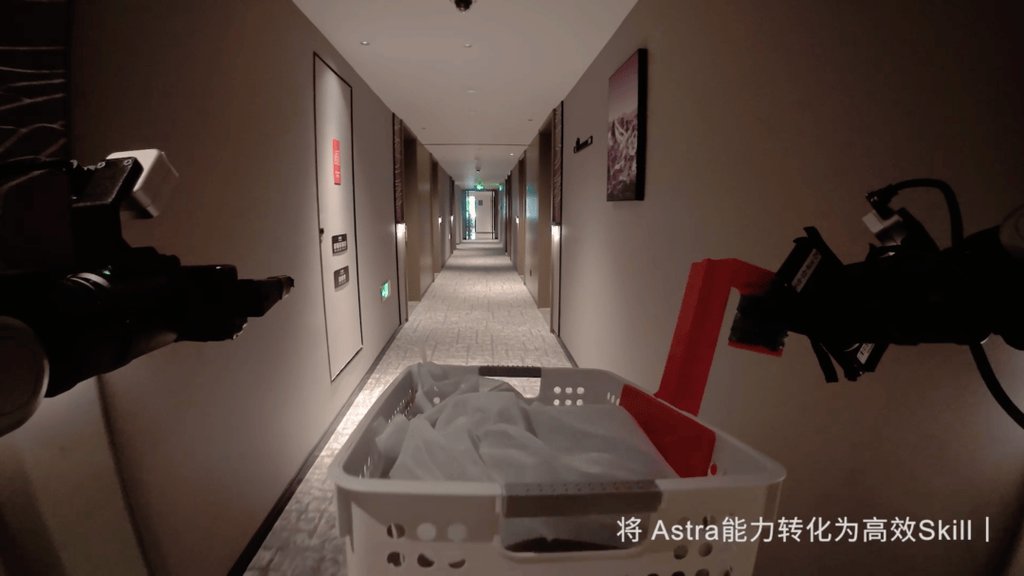
Learning from tangled jeans
Instead of waiting for engineers to patch bugs, the robot uses recursive self-improvement (RSI) to learn from mistakes:
- Camera switching: When the robot’s wrist blocked its own view of a basket, Astra switched to an overhead camera.
- Grip adjustments: After pant legs snagged inside a dryer drum, the system tweaked fingertip angles and lifting paths.
- Autonomous resets: The bot tosses clothes back into the dryer to reset its own practice rounds, while a separate evaluator model rolls back bad updates.
Across 165 dryer-unloading trials conducted over 57 hours, the company reported that the average proportion of jeans left behind fell from 48% to 32%, with a best reported result of 19%.
The improvement suggests the system can refine its movements through repeated practice, although the results also show that reliably handling loose clothing remains a challenge.
Why separating cloud AI from robot movements matters
One of the biggest challenges in AI-powered robotics is balancing sophisticated reasoning with the need to act quickly.
Cloud-based AI models can help robots plan complicated tasks and respond to unexpected situations, but repeatedly sending requests to remote systems introduces delays.
ACE Robotics attempts to address that problem by separating planning from execution. Its cloud-based model develops and refines robotic skills, while a smaller local system handles movements the robot has already learned.
The approach could make robots more responsive without requiring every physical action to involve a fresh round of cloud-based reasoning.
However, the company’s reported performance gains still need independent testing across different environments and tasks.
What this means for hospitality and retail operators
For hoteliers battling night-shift shortages and seasonal surges, pre-training robots via photographs promises faster deployment without mapping every hallway manually. Wang noted to QbitAI that instant retail is a prime next target, as warehouses share similar multi-step demands.
Still, buyers should weigh current limits before overhauling operations. The 18.6-second figure covers a single solidified operation rather than a full wash-and-dry cycle, dryer unloading still takes 170 to 210 seconds, and all performance metrics remain company-reported without independent verification.
For businesses considering this technology, the bigger questions are whether the robots can maintain that performance across different facilities, handle unexpected obstacles reliably and deliver enough savings to justify deployment.
The robot may be getting better at handling tangled jeans, but turning those demonstrations into dependable, everyday hotel operations remains the next challenge.
Other news: Apple is charging Creator Studio subscribers $49.99 for additional access to select AI features once they exhaust their monthly allowances.
Discover more from PressNewsAgency
Subscribe to get the latest posts sent to your email.