

European Commission President Ursula von der Leyen says the European Union can lend Tunisia more than 1 billion euros ($1.07 billion) with the lion’s share positioned as “macro-financial assistance” designed to salvage the faltering economy from Tunisia.
He potential packagewhich was announced on Sunday during von der Leyen’s visit to Tunisia with Italian and Dutch Prime Ministers Giorgia Meloni and Mark Rutte, is part of a larger EU effort to stem the flow of refugees, mainly from sub-Saharan African countries. trying to reach the Italian coast.
Here’s what you need to know about the proposed aid package:
What is included in the package?
The package includes 900 million euros ($967 million) in “macro-financial assistance” designed to bail out Tunisia’s state finances, as well as an immediate 150 million euros ($161 million) to support a reform agenda set by the Fund. International Monetary Fund (IMF).
The EU has offered another 105 million euros ($113 million) for border management, search and rescue operations and anti-smuggling initiatives.
What is the state of the Tunisian economy?
Tunisians have endured more than a decade of economic stagnation since the revolt that toppled the former ruler. Zine El Abidine Ben Ali in 2011.
Chronic shortages of basic foods have marked the financial crisis.
In May, inflation reached 10 percent, while unemployment rose in the first quarter to 16.1 percent, compared with 15.2 percent in the fourth quarter, according to official figures.
The country’s debt is estimated at around 80 percent of its gross domestic product.
In October, Tunisia reached an agreement in principle for almost $2 billion in aid from the International Monetary Fund (IMF), but discussions over the aid package have since stalled.
The IMF has called for legislation to restructure more than 100 state-owned companies, which hold monopolies over many parts of the economy and, in many cases, are heavily indebted.
This month, President Kais Saied rejected what he called IMF “dictatorships” and proposed tax the country’s wealthiest citizens instead.
Meloni has pressured the IMF to ease the terms of the loan.
Why does the EU want the deal?
The EU, and in particular Italy, has been seeking to reduce the growing number of people fleeing conflict and poverty in Africa and the Middle East in the hope of finding security and a future in Europe.
The EU border agency Frontex has said it has observed a significant change in migration patterns in 2023 with a 292% growth in crossing attempts from Tunisia compared to last year.
Italy is the destination of most departures from Tunisia, and blocking this route has been a priority for Italy’s far-right leader.
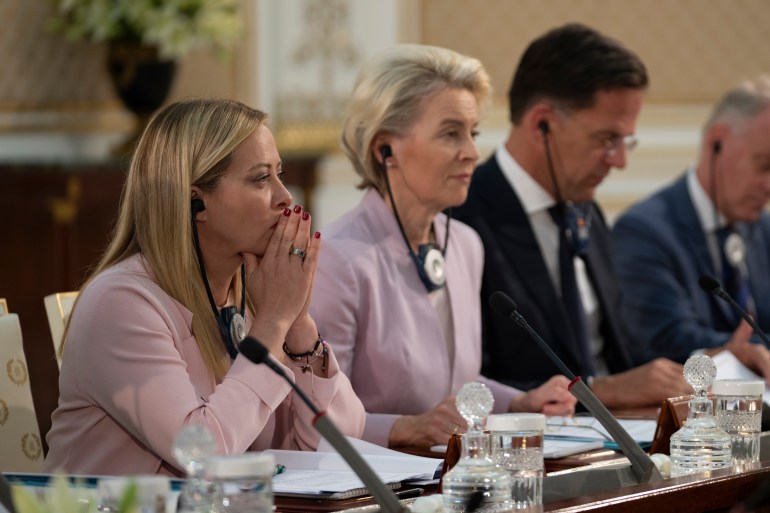
On Thursday, Meloni expressed concern that the social unrest in Tunisia would lead to more crossing attempts: “Destabilization in Tunisia would have serious repercussions on the stability of the whole of North Africa, and those repercussions inevitably reach here.”
Do people leaving Tunisia reach Europe?
In recent months, the Tunisian coast guard has recorded an unprecedented number of refugee bodies washing up on the country’s shores.
Last week, the coast guard said it had recovered nine bodies and rescued 29 people whose boats capsized off the coastal city of Monastir as they tried to reach Italy.
In March, 29 people die trying to cross into Italy from Sfax, a city on the Tunisian coast and an important departure point for refugees.
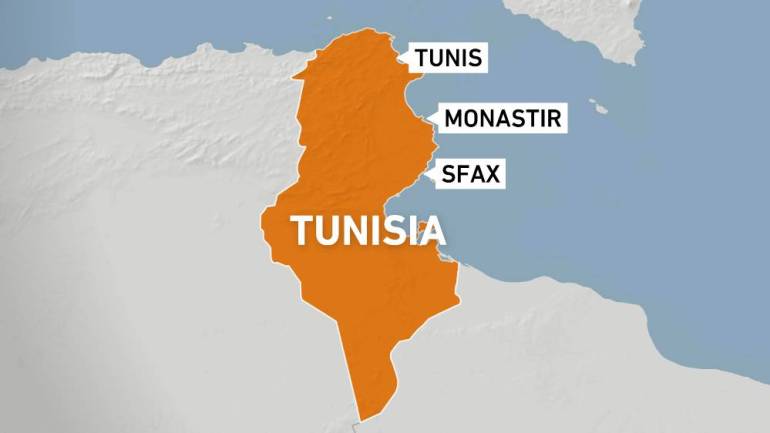
In April, the coast guard said 210 the bodies had washed up on the nation’s shoreline in less than two weeks.
Most of the asylum seekers come from sub-Saharan Africa.
Are these asylum seekers treated well in Tunisia?
Saied has stoked anti-foreign sentiment in Tunisia in recent months.
On February 21, he delivered a speech urging the security forces to to take action against people from sub-Saharan Africa, saying they threatened to “change the demographic composition” and turn Tunisia into “just another African country that no longer belongs to the Arab and Islamic nations.”
They would bring with them “all the violence, the crime and the unacceptable practices that that entails,” he said.
After this speech, the police detained hundreds of people in a large-scale crackdown, and racist attacks increased dramatically across the country.
Discover more from PressNewsAgency
Subscribe to get the latest posts sent to your email.