

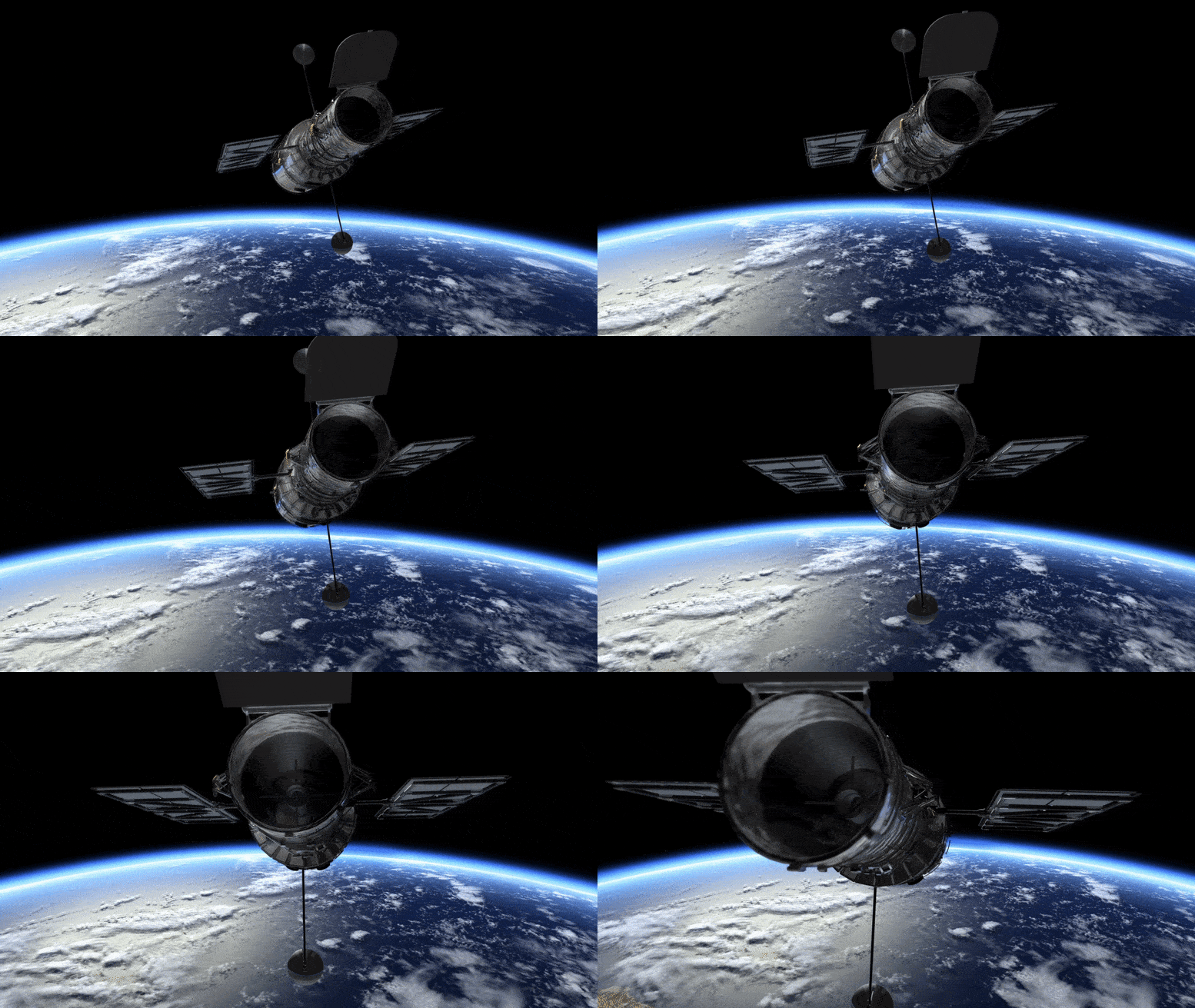
NASA’s Hubble Telescope precisely measured LTT 1445Ac, an Earth-sized exoplanet in a close-by triple star system. Initially found by TESS, this rocky planet is comparable in dimension to Earth however a lot hotter. The analysis enhances our data of exoplanets and their atmospheres. Credit score: ESA/Hubble (M. Kornmesser & L. L. Christensen)
Hubble Telescope confirms the dimensions of Earth-like exoplanet LTT 1445Ac, providing new insights into its composition and the potential for additional atmospheric research.
A number of planets round neighboring stars aren’t seen straight. As an alternative, they’re discovered once they briefly cross in entrance of their dad or mum star, an occasion known as a transit. In the course of the transit they block out slightly bit of sunshine from the star, primarily casting a shadow to Earth-watchers.
Astronomers be taught rather a lot from these transient occasions. They will measure the planet’s orbital interval, research its environment, and estimate its dimension. What’s difficult is that the planet might solely graze the sting of the star throughout a transit, giving an inaccurate measurement of its diameter.
One such close by exoplanet, LTT 1445Ac, solely 22 light-years away, was first recognized by NASA’s Transiting Exoplanet Survey Satellite tv for pc (TESS). However TESS doesn’t have the required optical decision to pin down the planet’s precise diameter by refining its trajectory throughout the face of a star.
Alongside got here Hubble with its sharp imaginative and prescient to exactly measure the planet’s diameter to be just one.07 occasions Earth’s diameter. This makes it a cousin of Earth by way of dimension. However that’s the place all similarity ends. LTT 1445Ac is simply too near its purple dwarf solar for habitability. Floor temperatures are roughly 500 levels Fahrenheit – the temperatures inside a pizza oven.

That is an artist’s idea of the close by exoplanet LTT 1445Ac, which is the dimensions of Earth. The planet orbits a purple dwarf star. The star is in a triple system, with two carefully orbiting purple dwarfs seen at higher proper. The black dot in entrance of the intense light-red sphere at picture middle is planet LTT 1445Ac transiting the face of the star. The planet has a floor temperature of roughly 500 levels Fahrenheit. Within the foreground at decrease left is one other planet within the system, LTT 1445Ab. The view is from 22 light-years away, trying again towards our Solar, which is the intense dot at decrease proper. A few of the background stars are a part of the constellation Boötes. Credit score: NASA, ESA, Leah Hustak (STScI)
Hubble Area Telescope Measures the Dimension of the Nearest Transiting Earth-Sized Planet
NASA’s Hubble Area Telescope has measured the dimensions of the closest Earth-sized exoplanet that passes throughout the face of a neighboring star. This alignment, known as a transit, opens the door to follow-on research to see what sort of environment, if any, the rocky world may need.
The diminutive planet, LTT 1445Ac, was first found by NASA’s Transiting Exoplanet Survey Satellite tv for pc (TESS) in 2022. Nonetheless, the geometry of the planet’s orbital aircraft relative to its star as seen from Earth was unsure as a result of TESS doesn’t have the required optical decision. This implies the detection might have been a so-called grazing transit, the place a planet solely skims throughout a small portion of the dad or mum star’s disk. This is able to yield an inaccurate decrease restrict of the planet’s diameter.
“There was an opportunity that this method has an unfortunate geometry and if that’s the case, we wouldn’t measure the correct dimension. However with Hubble’s capabilities we nailed its diameter,” stated Emily Cross of the Middle for Astrophysics | Harvard & Smithsonian in Cambridge, Massachusetts.
Hubble observations present that the planet makes a standard transit absolutely throughout the star’s disk, yielding a real dimension of just one.07 occasions Earth’s diameter. This implies the planet is a rocky world, like Earth, with roughly the identical floor gravity. However at a floor temperature of roughly 500 levels Fahrenheit, it’s too scorching for all times as we all know it.

This diagram compares two eventualities for a way an Earth-sized exoplanet is passing in entrance of its host star. The underside path exhibits the planet simply grazing the star. Finding out the sunshine from such a transit might result in an inaccurate estimate of the planet’s dimension, making it appear smaller than it truly is. The highest path exhibits the optimum geometry, the place the planet transits the complete disk of the star. Hubble Area Telescope’s accuracy can distinguish between these two eventualities, yielding a exact measurement of the planet’s diameter. Credit score: NASA, ESA, Elizabeth Wheatley (STScI)
The planet orbits the star LTT 1445A, which is a part of a triple system of three purple dwarf stars that’s 22 light-years away within the constellation Eridanus. The star has two different reported planets which can be bigger than LTT 1445Ac. A decent pair of two different dwarf stars, LTT 1445B and C, lies about 3 billion miles away from LTT 1445A, additionally resolved by Hubble. The alignment of the three stars and the edge-on orbit of the BC pair means that all the things within the system is co-planar, together with the recognized planets.
“Transiting planets are thrilling since we are able to characterize their atmospheres with spectroscopy, not solely with Hubble but in addition with the James Webb Area Telescope. Our measurement is essential as a result of it tells us that that is possible a really close by terrestrial planet. We’re trying ahead to follow-on observations that may enable us to raised perceive the range of planets round different stars,” stated Cross.
This analysis has been printed in The Astronomical Journal.
Reference: “HST/WFC3 Mild Curve Helps a Terrestrial Composition for the Closest Exoplanet to Transit an M Dwarf” by Emily Ok. Cross, Jennifer G. Winters, David Charbonneau, Aurelia Balkanski, Nikole Lewis, Maura Lally, Jacob L. Bean, Ryan Cloutier and Jason D. Eastman, 25 September 2023, The Astronomical Journal.
DOI: 10.3847/1538-3881/acf561
The Hubble Area Telescope is a mission of worldwide cooperation between NASA and ESA. NASA’s Goddard Area Flight Middle in Greenbelt, Maryland, manages the telescope. The Area Telescope Science Institute (STScI) in Baltimore, Maryland, conducts Hubble science operations. STScI is operated for NASA by the Affiliation of Universities for Analysis in Astronomy, in Washington, D.C.
Discover more from PressNewsAgency
Subscribe to get the latest posts sent to your email.