

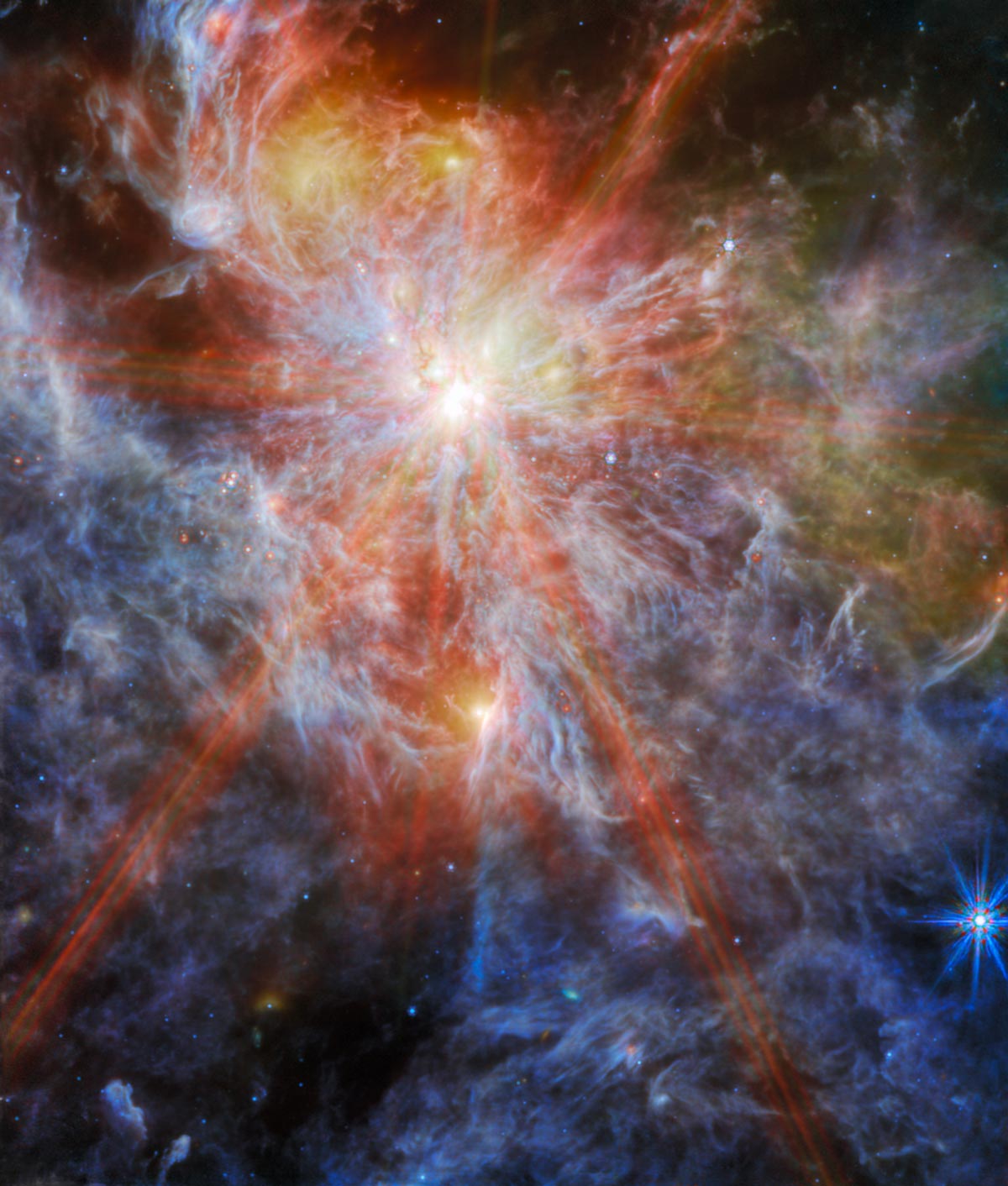
The James Webb House Telescope has captured a shocking picture of N79, a vibrant star-forming area within the Massive Magellanic Cloud, highlighting its potential as a youthful model of the Tarantula Nebula. This remark, revealing the realm’s glowing gasoline and dirt by way of mid-infrared mild, presents useful insights into the early Universe’s star formation processes and chemical compositions, differing markedly from these in our Milky Method. Credit score: ESA/Webb, NASA & CSA, O. Nayak, M. Meixner
The James Webb House Telescope reveals the internal workings of N79, a key star-forming area within the LMC, showcasing its effectivity and chemical uniqueness in comparison with the Milky Method.
This picture from the James Webb House Telescope options an H II area within the Massive Magellanic Cloud (LMC), a satellite tv for pc galaxy of our Milky Method. This nebula, referred to as N79, is a area of interstellar atomic hydrogen that’s ionized, captured right here by Webb’s Mid-InfraRed Instrument (MIRI).
N79 is an enormous star-forming complicated spanning roughly 1630 light-years within the typically unexplored southwest area of the LMC. N79 is often considered a youthful model of 30 Doradus (also referred to as the Tarantula Nebula), one other of Webb’s current targets. Analysis means that N79 has a star formation effectivity exceeding that of 30 Doradus by an element of two over the previous 500,000 years.
This specific picture facilities on one of many three large molecular cloud complexes, dubbed N79 South (S1 for brief). The distinct ‘starburst’ sample surrounding this brilliant object is a collection of diffraction spikes. All telescopes which use a mirror to gather mild, as Webb does, have this type of artifact which arises from the design of the telescope.
In Webb’s case, the six largest starburst spikes seem due to the hexagonal symmetry of Webb’s 18 main mirror segments. Patterns like these are solely noticeable round very brilliant, compact objects, the place all the sunshine comes from the identical place. Most galaxies, regardless that they seem very small to our eyes, are darker and extra unfold out than a single star, and subsequently don’t present this sample.
Webb’s Mid-Infrared Insights into Stellar Formation
On the longer wavelengths of sunshine captured by MIRI, Webb’s view of N79 showcases the area’s glowing gasoline and dirt. It is because mid-infrared mild is ready to reveal what is occurring deeper contained in the clouds (whereas shorter wavelengths of sunshine could be absorbed or scattered by mud grains within the nebula). Some still-embedded protostars additionally seem on this area.
Star-forming areas comparable to this are of curiosity to astronomers as a result of their chemical composition is much like that of the large star-forming areas noticed when the Universe was only some billion years outdated and star formation was at its peak. Star-forming areas in our Milky Method galaxy should not producing stars on the identical livid charge as N79, and have a distinct chemical composition. Webb is now offering astronomers the chance to match and distinction observations of star formation in N79 with the telescope’s deep observations of distant galaxies within the early Universe.
These observations of N79 are a part of a Webb program that’s learning the evolution of the circumstellar discs and envelopes of forming stars over a variety in mass and at completely different evolutionary phases. Webb’s sensitivity will allow scientists to detect for the primary time the planet-forming mud discs round stars of comparable mass to that of our Solar on the distance of the LMC.
This picture consists of 7.7-micron mild proven in blue, 10 microns in cyan, 15 microns in yellow, and 21 microns in purple (770W, 1000W, 1500W, and 2100W filters, respectively).
Discover more from PressNewsAgency
Subscribe to get the latest posts sent to your email.