

A Chinese theme park is becoming a real-world testing ground for hundreds of robots.
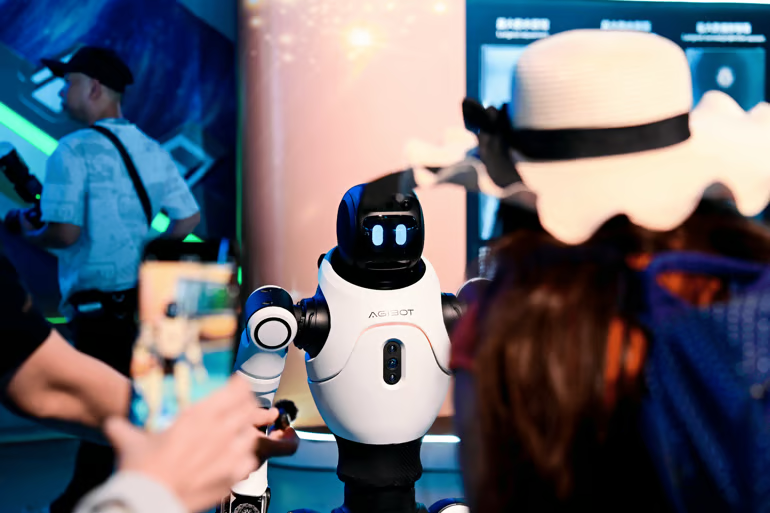
The deployment brings more than 300 robots to Chimelong Spaceship Park in Zhuhai, where AGIBOT and Chimelong Group are putting embodied AI to work across entertainment, education, visitor services and hotel operations.
The companies said more than 300 robots are being deployed across seven areas, including live entertainment, science education, guided tours, retail services, AI companionship, hotel services and sports competitions.
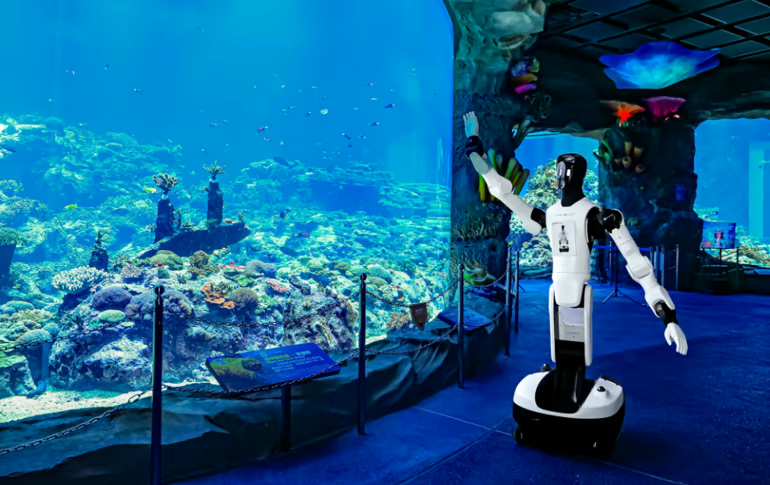
Visitors can watch robots perform martial arts, gymnastics and tai chi, or interact with them through activities such as table tennis and manipulation challenges. Other robots can answer questions, introduce exhibits, provide directions and guide guests around designated areas.
The project also extends into the park’s hotel operations, where robots can welcome guests and hold multi-turn conversations.
From robot demo to commercial operation
The significance of the deployment is less about any single robot performance and more about how the machines are being incorporated into an existing commercial environment.
Instead of treating robots as isolated attractions, Chimelong uses them at multiple points in a visitor’s journey. A guest could encounter a robot during a performance, use another for directions or education, and interact with a different system at a hotel.
AGIBOT and Chimelong also announced a joint research institute focused on embodied AI in culture and tourism. The institute will study new applications, technologies and operating models based on experience from the deployment.
The companies said the project will provide a foundation for expanding robotics across Chimelong’s entertainment, hospitality and visitor-service operations.
The infrastructure behind the fleet
Operating hundreds of robots in a busy public venue requires more than capable machines. AGIBOT, Chimelong, and China Mobile have established a dedicated 5G-A network to support connectivity in high-traffic areas, while centralized coordination manages robots across the park and hotel environments.
The deployment also includes measures covering network security, privacy, charging and fire safety. However, the companies have not disclosed detailed operating data such as intervention rates, uptime, maintenance requirements, or how many robots will operate simultaneously.
The announcement also does not identify which robot models are assigned to each task or confirm that all 300-plus machines are humanoids.
What the deployment could reveal
The project gives AGIBOT something a laboratory cannot easily provide: repeated exposure to unpredictable human behavior in a commercial setting.
That makes staff intervention and reliability important measures to watch. A robot performing a scripted routine is one thing; maintaining useful conversations, navigating crowds, recovering from interruptions, and staying available throughout a busy operating day is another.
The deployment could therefore provide a clearer picture of what it actually takes to operate embodied AI at scale, including the human support and infrastructure required alongside the robots.
More about Innovation
What it means for visitors
The immediate impact for visitors is a more interactive park experience, with robots potentially taking on roles that range from entertainment and education to navigation and hospitality.
The more consequential test will happen behind the scenes. If hundreds of robots can remain available and useful without constant employee intervention, similar deployments could become more practical across hotels, attractions and other customer-facing businesses.
If maintenance, charging or human supervision remain substantial requirements, the economics of large fleets could look very different.
The launch also coincides with AGIBOT’s 20,000th production robot rolling off its assembly line, marking a manufacturing milestone for the company.
Other news: Humanoid robot sales reached about 7,000 units globally in 2025, but many machines remain in research programs and small workplace pilots rather than productive commercial roles, according to the International Federation of Robotics.
Discover more from PressNewsAgency
Subscribe to get the latest posts sent to your email.