
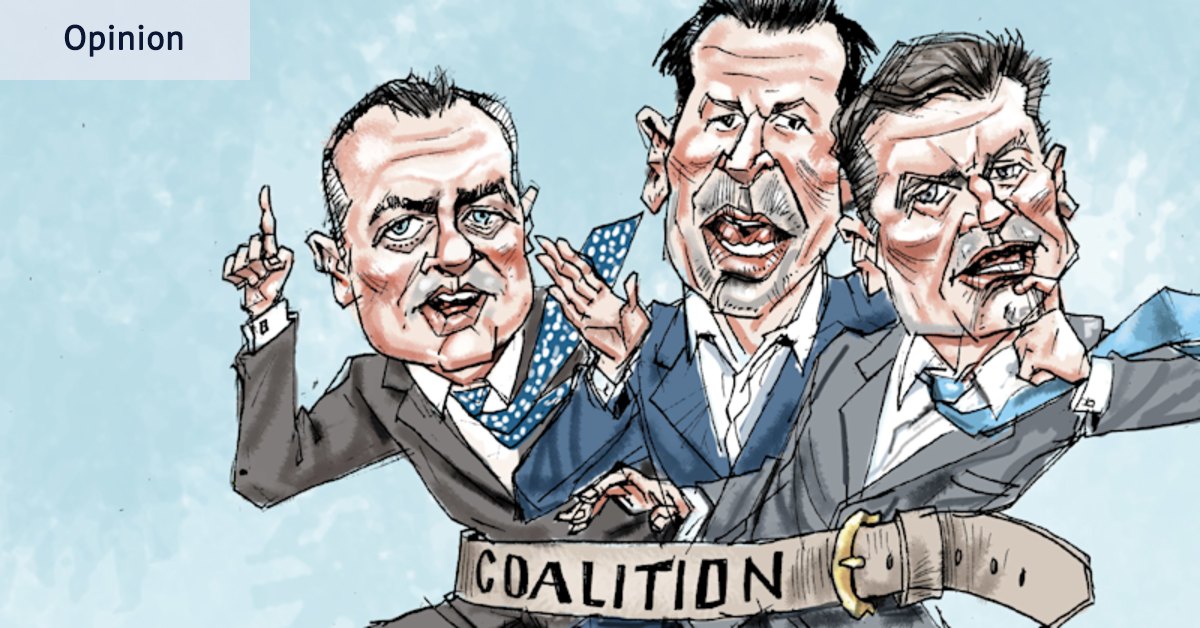
Let’s start with the good. Last week, asked by the ABC’s Sally Sara about the revenue boost from the Coalition’s new tobacco policy, shadow treasurer Tim Wilson was able to explain it would be $2 billion a year. But then came the surprise: asked to give more detail, specifically on the budgetary impact of the policy’s vaping aspect, Wilson said he didn’t have the number in front of him. Not a huge sin, perhaps, but also not really very much to ask, on the day a major policy was being released, of a man who wants to be treasurer.
Then came the second surprise. Asked about economic conditions, Wilson said: “What we can’t allow to continue to happen is for the government to stoke inflation because it’s their pathway to secretly raise tax revenue. Their active inflation agenda is focused on stoking inflation, then taxing the inflation, then spending the inflation because they know that it’s a pathway to sneak more tax from Australian hip pockets into their own revenue.”
Wilson has been saying things in this vicinity for a while. The “active inflation” phrase isn’t bad, turning something dry and abstract into something concrete for which the government deserves blame. But now Wilson seemed to be arguing that Labor was deliberately (somewhat sinisterly) keeping inflation high so that it could (secretly) raise revenue and spend it.
Come again? Remember now that the government suffered significant political damage in its first term from inflation. It is now suffering significant damage from inflation again. With Wilson’s latest formulation, he seemed to enter the realm of conspiracy theory, suggesting his opponents were doing all this for eventual political benefit, playing 5D chess.
Economics is central to the Liberals’ political strategy right now. Some polling suggests it leads Labor on the topic. That means Wilson – intelligent and able to make sharp arguments interesting – is central to his party’s hopes of remaining relevant. Yet here he is, delivering silly stuff – moreover, when it is completely unnecessary. Labor is vulnerable here. Why complicate the task by making unduly complicated arguments? Though that complication is also perhaps his saving grace: the case was so labyrinthine that most voters won’t have noticed.
Unfortunately, the same was not true of last week’s intervention by his colleague, Nationals leader Matt Canavan. Schoolboys, Canavan said, were consuming misogynist content online – entering and becoming attached to the “manosphere” – because the school curriculum had become “feminised”. This was in part, it seemed, due to the “Respectful Relationships” course.
Alongside this, Canavan made reasonable (if debatable) comments about getting more male teachers into schools. But the reasonable parts of what he had to say don’t make respectable the addled logic of his fundamental argument.
The fact that boys and young men are uninterested in pursuing respectful relationships can be blamed, it seems, on a course designed to teach them how to have respectful relationships. The responsibility for the appeal of misogyny, Canavan suggests, falls on the shoulders of the people trying very hard to tackle it.
After a bleak few weeks, in which alleged rapes and alleged sexual assaults have been at the centre of national debate, this was an unserious contribution to a topic that demands seriousness from our leaders.
Compounding this impression, on one key issue raised by Canavan’s comments, Liberal leader Angus Taylor seemed to want to sit on the fence. Asked several times on Thursday afternoon if he believed consent should be taught in schools, he wouldn’t answer clearly or he said something that headed in that direction without quite saying so. Had he not been prepped for this? Thought he could simply dance around it?
This was far too close to his behaviour, not that long ago, when asked about his stance on multiculturalism. Then, he wouldn’t answer, wouldn’t answer – before finally realising he would have to. On both occasions, he later clarified (he supports both multiculturalism and consent education).
Last week, he tried, as well, to drag the debate onto other ground, suggesting some teachers were pushing political agendas and wearing Free Palestine badges. This was, you might say, a little off-topic. Which was the theme of the Coalition’s week. Its intention, even some of its execution, was not bad. It announced a policy on tobacco that drove political debate and forced Labor to respond.
Which was the theme of the Coalition’s week – emphatically underlined with its Sunday announcement of new penalties for the destruction of flags and statues.
And yet on everything else, it seemed oddly committed to missing the point. There is an important debate to be had about the economy – but Wilson wanted to talk about Labor driving up inflation for political benefit. There is a serious discussion to be had about the “manosphere” – but Canavan wanted to talk about the “feminisation” of our schools. As Jacqueline Maley pointed out in this masthead, there are huge problems in education – and Taylor wanted to talk about teachers wearing badges.
Perhaps most emblematic of this flippancy, there are genuine challenges of atomisation and discontent that demand consideration – but Taylor wanted to talk about the Australian flag and statues of Captain Cook.
Sunday’s announcement points to the weakness at the heart of these various misplaced diagnoses. Yes, part of it is a naked attempt to match One Nation. But within that attempt seems to lie a belief that if Liberal figures can just perform their politics a little more emphatically, fill a few more minutes of airtime with glib rhetoric delivered with the right amount of anger, they can act their way back to relevance. Does the Coalition really think voters, so dissatisfied with the state of things, want it to skate across the surface? Did the Liberal Party learn nothing from its experience with Scott Morrison?
The last lingering political advantage the Coalition has is the fact it has been serious in the past: its status, not quite relinquished, as a party of government. At times, it has shown glimmers of this seriousness: in its tax policy, its tobacco policy and its recent work with Labor to pass policy. And it has opportunities. In recent weeks, we’ve seen the government announce one clear thing on artificial intelligence before immediately caving; we’ve seen it stumble repeatedly on immigration; and lock in an unfair GST deal. The government’s advantage, like Wilson’s, is that while these topics are of interest to voters, its mistakes have not been water-cooler material.
At some point, they will be. But the Coalition, in its current state, with its current personnel, seems unlikely to be able to make anything of them.
Sean Kelly is an author and a regular columnist. He is a former adviser to Julia Gillard and Kevin Rudd.
Get a weekly wrap of views that will challenge, champion and inform your own. Sign up for our Opinion newsletter.
 Sean Kelly is author of The Game: A Portrait of Scott Morrison, a regular columnist and a former adviser to Julia Gillard and Kevin Rudd.Connect via X.
From our partners
Discover more from PressNewsAgency
Subscribe to get the latest posts sent to your email.