

Manila, Philippines – Emelie Ann Ducabo, 57, a married mother and vendor in Metro Manila, has been forced to become an expert at saving pennies to feed her seven household members.
At the market, Ducabo buys pork, fruits and vegetables in the smallest possible quantities, but more expensive beef is totally out of the question. Instead of chicken legs and thighs, she opts for liver and neck, which she turns into noodle soup and hands out to her husband, two older children, her sister-in-law, and her mother’s 94-year-old caregiver. . Her mother follows a special diet of fruit puree and oatmeal.
“The important thing is to extract the protein from these chicken parts that our body needs,” Ducabo told Al Jazeera.
Everyone in the household drinks their morning coffee plain, without sugar, and the occasional sweet is limited to grated melon mixed with milk and crushed ice.
Despite her difficult circumstances, Ducabo is lucky to be able to care for her children and her mother. She works primarily from home as a buyer at a clothing firm. She and her husband own her 40 square meter (430 square foot) home.
The only items Ducabo doesn’t skimp on are his family’s laundry detergent: “I want my kids to smell clean!” – the little native bananas that are always on the table for anyone who is hungry and the adult diapers and her mother’s special diet.
Prices in the Philippines are skyrocketing, and faster than anywhere else in Southeast Asia aside from war-torn Myanmar and socialist Laos.
In February, inflation reached 8.6 percent, a hair less than the previous month, far exceeding Singapore, Malaysia, Thailand, Indonesia and Vietnam.
While most households buckle down, the situation for low-income families is particularly difficult.
While the wealthiest Filipino households spend less than two-fifths of their income on food, those in the bottom 30 percent of the income distribution spend nearly 60 percent of their income on sustenance, according to government statistics. .
Under a special Consumer Price Index (CPI) used to measure cost-of-living pressures for low-income households, inflation in February reached the equivalent of 9.7 percent, unchanged from the previous month.
The Philippines is especially vulnerable to inflation due to a combination of factors, including high consumption taxes and high production and distribution costs following the privatization of public services, said Rosario Guzmán, head of research at Fundación IBON, a center of economic studies.
“The government can no longer intervene in the pricing of water and electricity rates. We have the highest electricity rates in Asia after Japan,” Guzmán told Al Jazeera.
Then-President Rodrigo Duterte’s introduction of a special tax on all petroleum products in 2018, on top of the existing 12 percent value-added tax (VAT), had an especially severe impact on the poor, Guzmán said.
His think tank calculated that each increase in the Philippine peso at the pump generated an additional 400 million pesos ($7.3 million) a day for the government last year.
President Ferdinand Marcos Jr. He has dismissed calls to suspend the VAT or excise duty on fuel, blaming high bomb prices on the war in Ukraine and other outside forces.
Jonathan Ravelas, former chief market strategist at BDO bank and now managing director of eManagement for Business and Marketing Services, said the cost-of-living crisis had exposed the Philippines’ overreliance on imported food.
“We don’t have food security,” Ravelas told Al Jazeera, noting that the peso’s weakness against the dollar had raised import costs.
“Duterte did not undertake (a) food security (program), but simply imported,” Ravelas said. “Now, Marcos Jr. has no choice but to promote food safety.”
“Unfortunately, there are no shortcuts to food security and importation has its limits,” he added.
While the central bank of the Philippines raised its benchmark rate to 6.25 percent, Ravelas said it must go further to reduce inflation.
“From my point of view, the Bangko Sentral should still raise overnight rates close to 7 percent and not stop at 6.5 percent,” he said.

For Alfredo Barrun Pineda, Jr., 43, the rising cost of living was enough to convince him to stop driving an air-conditioned taxi. He now drives a motorcycle with a sidecar full of plastic buckets, tubs, and hangers that he trades for broken electronics and appliances, which he then sells to junkyards or repair shops. A megaphone announces his presence in middle-class neighborhoods.
“I earn as much from this as from a taxi,” Pineda told Al Jazeera. He stopped driving a taxi when he found himself paying 2,000 pesos to operate his vehicle for 300 kilometers. To cope with inflation, he said, his family eats “the cheapest vegetables.”
Pineda said she voted for Marcos, the son of former dictatorial leader Ferdinand Marcos, who had promised to lower the price of rice to 20 pesos a kilo.
“Yes, it’s still 42 (one kilo), but that’s okay. His father did a lot and all those (looting) accusations against him are not true.”
Some Filipinos have sought opportunity in the cost-of-living crisis.
Jan Carlo, 12, spends four days a week wandering the sprawling campus of the state university in the suburbs of Quezon City, balancing a giant plastic container on her head filled with fresh and expensive vegetable and strawberry salads from a vegetable stand that her stepmother has nearby. .
You’ve identified your target market: students and midwives jogging or biking on campus who don’t mind paying you 50 pesos ($0.92) per head of cauliflower or broccoli and 100 pesos ($1.84) for a small tub of fresh strawberries.
Her hustle earns her a little more than the monthly adult minimum wage, all of which she gives to her stepmother, though she’s recently cut back to free up her time for school, which she’s only attended for two years. .
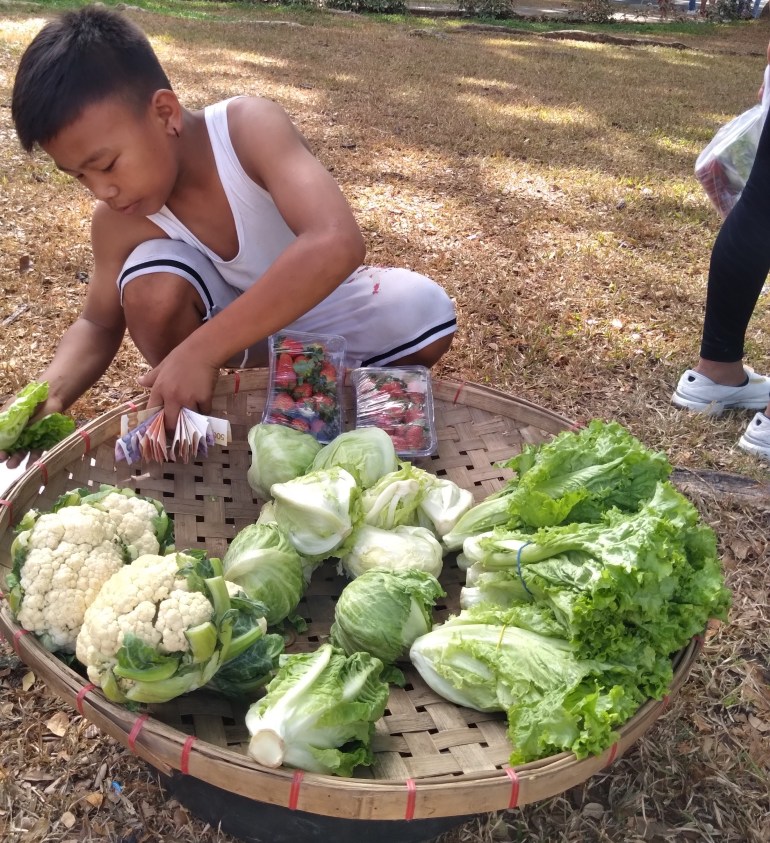
“All these vegetables that I bring, they are all profit, because we already recouped (our costs) at my mother’s stall,” he told Al Jazeera.
Meanwhile, families like Ducabo’s must constantly find their own ways to get by.
To save on transportation costs, Ducabo’s husband, Donato, a security guard, sleeps in the barracks his company provides most nights of the week.
Ducabo describes the one or two nights a week she spends at home as “our bonding time,” when she makes a special effort to stir-fry pancit noodles with chunks of vegetables and meat and make Shanghai-style spring rolls.
Ducabo said his situation was ironically somewhat better during the height of the COVID-19 pandemic because the government had given out free rice and other food.
“But now, nothing,” he said.
“If I get emotional about our situation and blame the government for the high cost of food, I would have a heart attack. So I decided to go with the flow.”
Discover more from PressNewsAgency
Subscribe to get the latest posts sent to your email.