

Four states and territories have now introduced snap lockdowns as Australia battles to control a rapidly spreading coronavirus outbreak.
Queensland is the latest state to announce a lockdown after recording two new cases of community transmission today.
The news comes after WA announced their own lockdown after a case from Sydney, infected with the Delta variant, visited several locations in Perth.
Parts of the Northern Territory and NSW are also under stay-at-home orders.
Meanwhile, borders around the country continue to snap shut as governments attempt to stop the spread of the Delta strain.
Here are the latest state-by-state rundown on border restrictions and lockdowns from around the country:
NSW has introduced new travel rules for anyone arriving from the Northern Territory, Queensland or Western Australia.
The state is currently the epicentre of Australia’s latest outbreak, the number of cases linked to Sydney’s Bondi cluster growing to 143 on Tuesday, with 19 new cases announced. Of those cases, 17 are linked and two under investigation.
But NSW Health has still issued new advice for people coming into the state from other regions under new restrictions.
From 12.01am on Wednesday, June 30, anyone travelling to NSW who has been in those areas in the previous 14 days must complete a declaration form — the same requirement already in place for people who have been in Victoria in the previous 14 days.
“Do not travel to NSW if you have attended a venue of concern as close contacts must isolate immediately, get tested and remain in isolation for 14 days, and contact the relevant health authorities in their state or territory,” NSW Health said.
“People subject to the stay-at-home measures in the Northern Territory, Queensland, and Western Australia should not be travelling to NSW unless they are permitted to do so by those state or territory’s public health orders.”
Those still permitted to travel to NSW from Wednesday and have been in areas that are subject to lockdown measures, must follow the stay at home orders in place in NSW for 14 days after being in the lockdown area.
The declaration form is available on the Service NSW website, and can be completed in the 24-hour period before entering NSW or on arrival.
Anyone living in Greater Sydney is subject to a two-week stay-at-home order, with residents only able to leave their homes for essential reasons including grocery shopping, exercise, receiving medical care and essential work and education that cannot be done from home.
Sydneysiders have been urged to avoid contact with others as much as possible.
“We encourage people, if you are ordering in food, keep the order contactless,” Premier Gladys Berejiklian said.
“While you are allowed to go out and get essential services and food items we are keen to not have people move around.”
Ms Berejiklian said it was unlikely the lockdown would be lifted before the two-week deadline, saying the health advice had been consistent on a fortnight being the time needed to stop the spread.
Victoria has so far managed to keep the new wave of the virus out with zero new cases announced and no further restrictions put in place.
However, the state is remaining vigilant, introducing travel restrictions with other states.
Chief Health Officer Professor Brett Sutton today announced the 11 Queensland Local Government Areas (LGAs) which are set to plunge into a three-day snap lockdown – spanning from the Gold Coast to Townsville – will be classed as red zones from 1am tomorrow.
The Perth and Peel regions will also move from orange zones to red zones.
A red zone classification means people are banned from entering Victoria unless they are Victorian residents who are willing to quarantine for 14 days.
All arrivals into Victoria must apply for a travel permit even if they are entering from a green zone.
Any close contacts of a positive COVID-19 case, including anyone who has been to a high-risk exposure site, are not allowed to enter Victoria.
Exceptions and exemptions are listed on Victoria’s travel permit website.
Darwin has also been declared a red zone, restricting non-Victorian residents from entering Victoria without an exemption. Large parts of NSW have also been declared red zones.
More than 200 officers have been deployed to the border to prevent anyone unlawfully entering Victoria.
Large parts of Queensland will enter a three-day lockdown from 6pm tonight.
The areas under lockdown include South East Queensland, Townsville city, Palm Island and Magnetic Island.
The announcement comes after the state reported two new locally acquired coronavirus cases.
One of the positive cases is a miner from Ipswich, a close contact from one of the 170 FIFO workers from the NT.
The other is an unvaccinated COVID-19 ward receptionist.
“There is a young woman, a 19-year-old casual clerical worker from the Prince Charles Hospital,” Premier Annastacia Palaszczuk said.
The LGAs impacted by the snap lockdown include:
- City of Brisbane
- City of Gold Coast
- City of Ipswich
- Lockyer Valley Regional Council
- Logan City
- Moreton Bay Region
- Noosa Shire Council
- Redland City
- Scenic Rim Regional Council
- Somerset Regional Council
- Sunshine Coast Regional Council
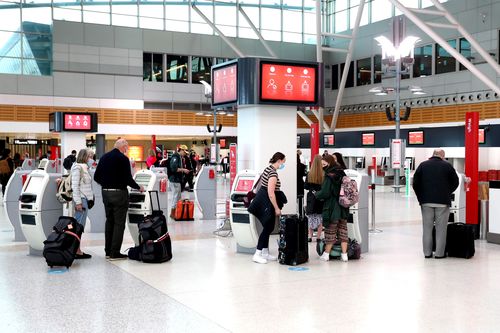
In addition, anyone who has visited Greater Sydney is also subject to the stay-at-home order currently in place in NSW.
The LGAs of Waverley, Woollahra, Randwick and the City of Sydney have also been a declared COVID-19 hotspot, backdated to June 11.
Anyone who has been in these LGAs will not be allowed to enter Queensland, unless they are a returning Queensland resident or have an exemption.
Anyone allowed to enter will need to go into hotel quarantine for a period of two weeks.
Restrictions remain fairly lenient in SA, with no cases of community transmission detected so far.
All indoor venues must adhere to the one person per two-square-metre rule.
Face masks are mandatory in high-risk settings such as health care facilities, residential aged care facilities, allied health, and when providing personal care.
Gatherings at a private home are limited to 50 people while the maximum attendance permitted at a wedding or funeral is 150 people (unless at a licensed premises, where the one person per two-square-metre rule applies).
The state has recorded no new local cases of COVID-19, however tough travel restrictions are in place for every state except Tasmania.
A hard border is now in place with NSW, the ACT, NT, WA and Queensland.
People who have visited Tier 1 or 2 exposure sites in Victoria are also prohibited from entering.
From 11am, Perth and Peel are considered hotspots in terms of travel to the NT and from 5pm, the areas in Queensland entering lockdown will also be declared hotspots.
While a territory-wide lockdown initially announced on Sunday will be extended for a further 72 hours, Chief Minister Michael Gunner has announced.
The lockdown measures, which were initially only expected to last 48 hours, will now be in place until 1pm this Friday.
Mr Gunner said the lockdown was “absolutely necessary” and that they were not “out of the woods yet”.
One new positive case of COVID-19 has been recorded in the state, the seventh linked to the mine outbreak site.
The new positive case in the NT is a 50-year-old man who worked at the mine exposure site on Friday, June 25.
It is understood he was infectious in the community for 36 hours.
For the first time, there are several public exposure sites in the NT, which will be released soon through public channels.
The lockdown area includes Darwin, Palmerston and Litchfield.
Residents will only be allowed to leave their home to receive medical care, receive a COVID-19 vaccination, buy essential goods and services, exercise or provide care to a family member.
Western Australia will reinstate its hard border with Queensland as of 3pm today, Premier Mark McGowan has announced.
Queensland is now classified as medium-risk with travellers now required to have an exemption to cross the border.
Returning WA travellers will be granted an exemption on compassionate grounds but must still undergo 14 days of quarantine.
A hard border has also been introduced with NSW.
The lockdown comes after WA Premier Mark McGowan confirmed that the original case in the outbreak — case 1022 — has the Delta variant of the virus.
The new case — case 1024 — is a man in his 30s who worked at the Indian Ocean Brewery and also ate there last Tuesday, the same night as case 1022.
There are now three cases in Western Australia as part of the new outbreak.
Masks will be mandatory in Perth and Peel unless you are at home, doing outdoor exercise or are in a vehicle with members of your own household.
The only reasons resindets in Perth and Peel can leave their home will be for work if you are an essential worker or service provider, purchasing essential goods, one hour of outdoor exercise per day within 5km of your home with up to one other adult from your household or to receive urgent medical care purposes.
All non-essential businesses including beauty, nail, hairdressing salons, gyms, casinos, nightclubs, entertainment venues and places of worship have been forced to close.
Restaurants, cafés, pubs and bars are permitted to remain open if they can provide takeaway service.
Several schools are among the listed locations visited by a positive COVID-19 case.
Mr McGowan yesterday confirmed there are 177 close contacts within WA associated with the NT mine outbreak.
Of these, 149 have been tested however authorities remain “very concerned” about the potential spread.
Face masks are now required in certain public settings within the ACT.
While there is currently no community transmission, masks will add another line of defence as we work to keep COVID-19 out of Canberra.
The ACT has now declared NSW, the NT, Queensland, Victoria and New Zealand as areas of concern.

Non-ACT residents who have been in the Greater Sydney, Central Coast, Blue Mountains, Wollongong and Shellharbour regions of NSW are not permitted to travel into the ACT unless they have an approved exemption.
The same restrictions apply to people in the NT and Queensland who have visited listed exposure sites.
Tasmania Premier Peter Gutwein said the state has designated the Perth and Peel regions as “high risk” areas from 10am today.
As a result of this, those who have been in high-risk areas in WA won’t be able to travel to Tasmania without an exemption.
Mr Gutwein said health authorities would continue to monitor the situation in other states.
“Over the past few days we’ve been reminded COVID-19 poses a real threat,” Mr Gutwein said.
Most NSW residents are restricted from entering Tasmania unless approved as an essential traveller.
The state has also closed its borders to Greater Darwin.
Tasmania has introduced a hard border with most of Greater Sydney.
“You need to be tested at least five days after you left the high-risk LGA and will be able to leave isolation if you receive a negative result,” the health department said in its latest alert.
For the NT, Darwin, Palmerston and Litchfield have also been listed as high risk with travel restrictions now in place.
Tasmanian health authorities have also listed a number of venues in WA, Victoria and Queensland.
Anyone who has visited the listed locations at the specified dates and times listed below will not be permitted to travel to Tasmania.
Discover more from PressNewsAgency
Subscribe to get the latest posts sent to your email.