

Bali, Indonesia – An unusual series of whale strandings has raised concerns in Indonesia, with three of the huge mammals stranded in Bali since early April.
It all started when the rotting carcass of an 11-meter-long (36-foot) Bryde’s whale was found on a beach on Bali’s southwest coast on April 1.
Then last Wednesday, a live 59-foot (18-meter) sperm whale was found washed up on a beach in the southeast. The locals managed to push him back into the sea, but hours later he was stranded on another beach, where he died.
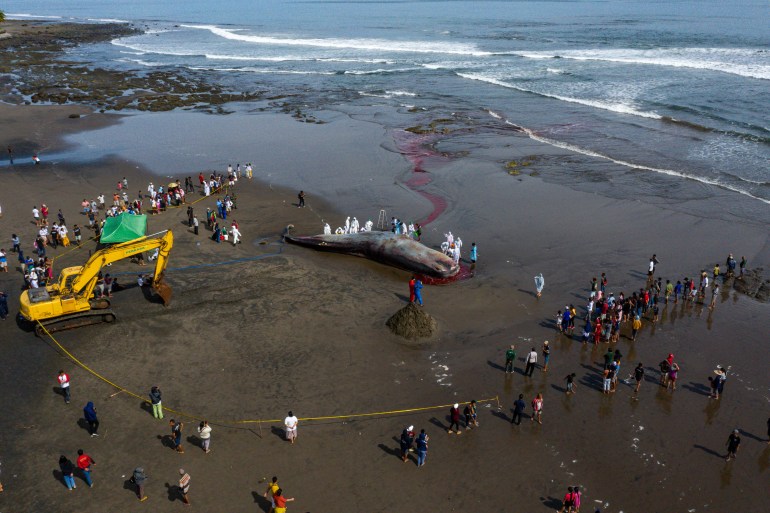
The most recent event took place over the weekend when the carcass of a 17-meter-long (56-foot) sperm whale, a deep-sea species that rarely strands, was discovered off Bali’s southwest coast.
The events are part of a broader phenomenon that has seen 21 unexplained whale strandings in Indonesia since the start of the year, according to the Ministry of Fisheries and Marine Affairs. They include the partial carcass of a 10-meter (32-foot) sperm whale that washed up on Bali’s southern coast on January 19 and the remains of a 10-meter (32-foot) sperm whale found floating off the coast of the Islands. Kangean, a small archipelago 120 km (75 miles) north of Bali, on Monday.
Permana Yudiarso, who has coordinated government responses to marine mammal strandings in Bali since 2012, said the frequency of recent strandings on the island was abnormal.
“Last year, we had nine incidents in Indonesia. We usually have less than 20 each year. But three cases in one week in Bali alone, it’s quite worrying,” Yudiarso, who is the head of the Bali bureau for coastal resource management at the Ministry of Fisheries and Marine Affairs, told Al Jazeera.
Post-mortem examinations are being carried out on samples taken from two of the three whales found on the island. But even when the results are made public later this month, they are unlikely to provide a definitive answer to the series of incidents.
Some wildlife advocates point the finger at plastics. indonesia is the world second largest source of marine plastic pollution after China, according to Indonesia’s Coordinating Ministry of Maritime Affairs.
“Plastic pollution, when plastic is found inside the stomachs of whales, and noise pollution, when the sonar used by whales to navigate is affected by underwater noise and they get confused and go to the beach, are two of the leading causes of death,” said Femke den Haas. , wildlife paramedic and co-founder of Jakarta Animal Network.
In 2018, a sperm whale was found dead in the waters of Wakatobi National Marine Park about 1,000 km (621 miles) northeast of Bali with 115 plastic cups, 25 plastic bags, four plastic bottles and two sandals on his stomach.
A smaller amount of plastic was also found inside the stomach of one of the sperm whales that washed up on West Bali earlier this month. “We still can’t say if the cause of death was plastic. It could be a disease,” Yudiarso said.
Still, he noted that there was something of a pattern to the strandings, which tend to be more common in the transition period between the wet and dry seasons.
“We are in the middle of that period now,” Yudiarso said. “It could be related to the tropical storm we had in Java last month or a more recent storm north of Australia in the Timor Sea. We also can’t rule out the effects of underwater earthquakes – we have them all the time in Bali. On Monday morning there were two earthquakes and that could have disturbed the sonar of the whales.”
‘whale trap’
Sumarsono, the head of the conservation section of Bali’s Natural Resources Conservation Agency, who like many Indonesians goes by only one name, shared an alternative theory.
“South Bali has many steeply sloping tidal flats where the difference between high tide and low tide is extreme, creating a natural trap,” Sumarsono explained.
“Many sea creatures get trapped close to shore and by the time they realize something is wrong, it is too late to return to the depths of the ocean. Bali is located in the middle of the migration route between Indonesia and East Timor, so getting stuck is a more likely cause of death than illness. It is statistically unlikely that three whales would die from disease in one week.”
Then there is the problem of rising sea temperatures caused by the burning of fossil fuels and the associated depletion of oxygen levels in the ocean due to the absorption of carbon dioxide.
A study, published in 2019 in the scientific journal Nature Climate Change, warned that warming oceans were increasing extinction risks and reducing marine biological richness. “Multiple regions in the Pacific, Atlantic and Indian Oceans are particularly vulnerable to intensifying marine heat waves due to the coexistence of high levels of biodiversity,” the study said. It identified Indonesian waters as one of the five most affected areas.
Ocean heat reached a record in 2022.
Karen Stockin, a professor of marine biology at Massey University in New Zealand, said it was important to differentiate between climate change and regular marine heatwaves – periods of abnormally high ocean temperatures relative to the seasonal average temperature caused by weather events. in the short term as El Niño events.
“They are quite different, but both have the potential to change the distribution of prey like squid, and that runs the risk that predators like whales that rely on squid will change their distribution in response,” he said. “If changes in distribution move whales closer to shore, that can potentially increase their risk of stranding.”
Sumarsono noted that two of the three whales that most recently beached in Bali had large amounts of squid in their stomachs.
But that’s not necessarily irrefutable proof, according to Stockin.
“The important thing to consider in strandings like these is that the causes are quite complex. It is seldom easy to point to a singular cause. In most cases, strandings are most often caused by a multitude of factors.”
Vanessa Pirotta, a wildlife scientist who has extensively studied whale strandings in the Australian state of Tasmania, an island that, like Bali, has been described as a natural “whale trap,” said the phenomenon remains largely a mystery.
“What makes the recent strandings in Bali even more interesting are the two very different species that have stranded: sperm whales have teeth and use high-frequency sonar to communicate and navigate, and Bryde’s whales, which do not. teeth and use low frequency sonar. So each stranding event could be completely independent and occur due to a variety of different reasons,” he told Al Jazeera.
“They may be connected, or they may have been a bizarre week of coincidences in which three whales ran aground on an island. Maybe something scared them. Perhaps one of them died of old age or was ill, but it’s too soon to make that call. The results of post-mortem examinations can help to understand the causes and identify a link, but that is not a given. In short, we will probably never know what caused their deaths.”
Discover more from PressNewsAgency
Subscribe to get the latest posts sent to your email.