

Youssef Jira, a fresh-faced 18-year-old in a hoodie and a scarf around his head, has high ambitions in a Libyan society where dictatorship and violence have ruled, rather than youthful creativity.
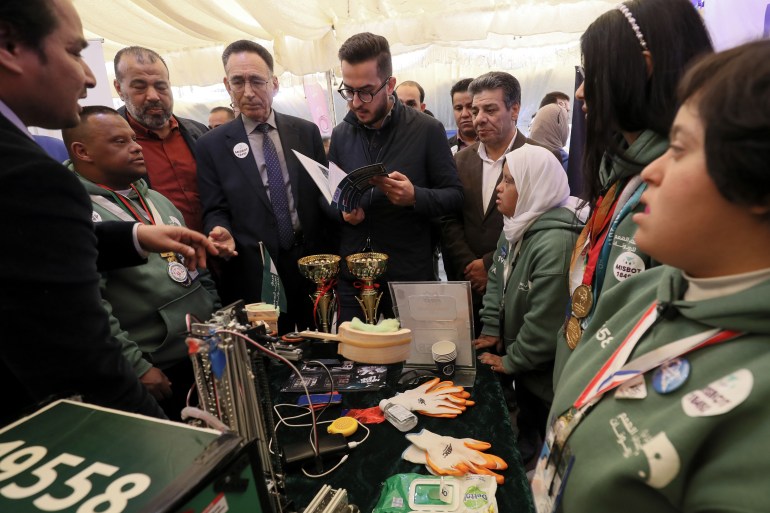
Jira is one of a group of young techies who participated in the Libyan Regional Robotics Championship in a Tripoli suburb this month. Some 20 teams of youth ages 12-18 competed in the inclusive event.
He wants to encourage other young people to use high technology to help modernize the divided and conflict-scarred country.
“We want to send a message to the whole of society, because what we have learned has changed us a lot,” Jira said, adding that he has gained new skills and learned about teamwork in pursuit of a common goal.
Libya has seen more than a decade of intermittent conflict since a NATO-backed revolt in 2011 toppled dictator Muammar Gaddafi, with countless rival militias, foreign powers and multiple governments vying for influence.
The country remains divided between a supposed interim government in the western capital Tripoli and another in the east, backed by renegade commander Khalifa Haftar.
‘It’s more than robots’
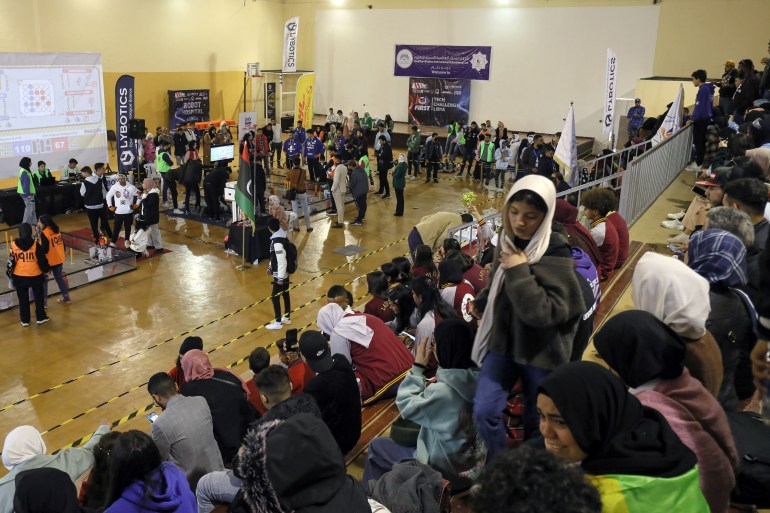
The event had the air of a high school sports competition, with fans cheering for their teams working out in a corral on the gym floor, against a backdrop of banners reading “Lybotics” and “First Tech Challenge” while music played. pop.
The robots were small contraptions with wheels and exposed circuitry that jerkily maneuvered around the pen in the center of the room.
Event coordinator Mohammed Zayed said such projects help “open new horizons” for Libyan youth.
“This is not just about simple robots,” he said. “These young people also had to manage their relationships and work for inclusion, unity and peace.”
Zayed said the event was aimed at “preparing the workers of the future and raising awareness in the country about the importance of technology and innovation”.
Under Gaddafi’s 42-year rule, universities emphasized the leader’s views on politics, the military and the economy rather than scientific advancement.
After years of violence, a period of relative calm since the 2020 ceasefire has allowed some to dream that Libya can start to move forward, despite the ongoing political divide.
At the competition, family, friends and government officials were on hand to cheer on the competitors and promote technology culture.
The event, funded by an international school and private sponsors, had been planned since 2018 but was repeatedly delayed due to riots followed by the COVID pandemic.
Shadrawan Khalfallah, 17, who was competing on a girls’ team, said she believed technology could help address challenges from climate to health and help women get ahead.
“We created our team to evolve our society and show that we exist,” he said, handing out “Change” stickers.
Libya is rich in oil, but decades of stagnation under Gaddafi and years of fighting have wrecked its corruption-ridden economy and left its people mired in poverty.
Little public money is spent on science and technology, but Nagwa al-Ghani, a science teacher and mentor to one of the teams, said that must change. “We need it if we want our country to develop,” she said, adding that education is the starting point.
They face numerous challenges, but the authorities in the capital, Tripoli, speak of “new initiatives” for digital development, focusing on youth.
“Libya lacks nothing, neither human resources, nor intelligence, nor the determination of the youth,” government spokesman Mohammed Hamouda said at the event.
“What is missing is long-term stability and a strategic vision to support young people.”
Discover more from PressNewsAgency
Subscribe to get the latest posts sent to your email.