
Opinion
It was a stark contrast this week between the two men competing to be the global colossus.
US President Donald Trump continued to thrash around, trying to disentangle himself from the war he started but cannot finish. No matter how often he says he’s crushed Iran – “militarily they are dead” – Tehran continues to fire on US bases and to control oil flows through the Strait of Hormuz.
In the process, Trump called the enemy “the Islamic Republic of Japan” this week. It was an unwitting illustration of how he struggles to distinguish between friends and enemies. Because he spent part of the week undermining America’s supposed allies in NATO.
He called the people of Spain “bad”; he laid claim to Denmark’s territory of Greenland once more; and he threatened that “we could remove all of our soldiers out of Europe”.
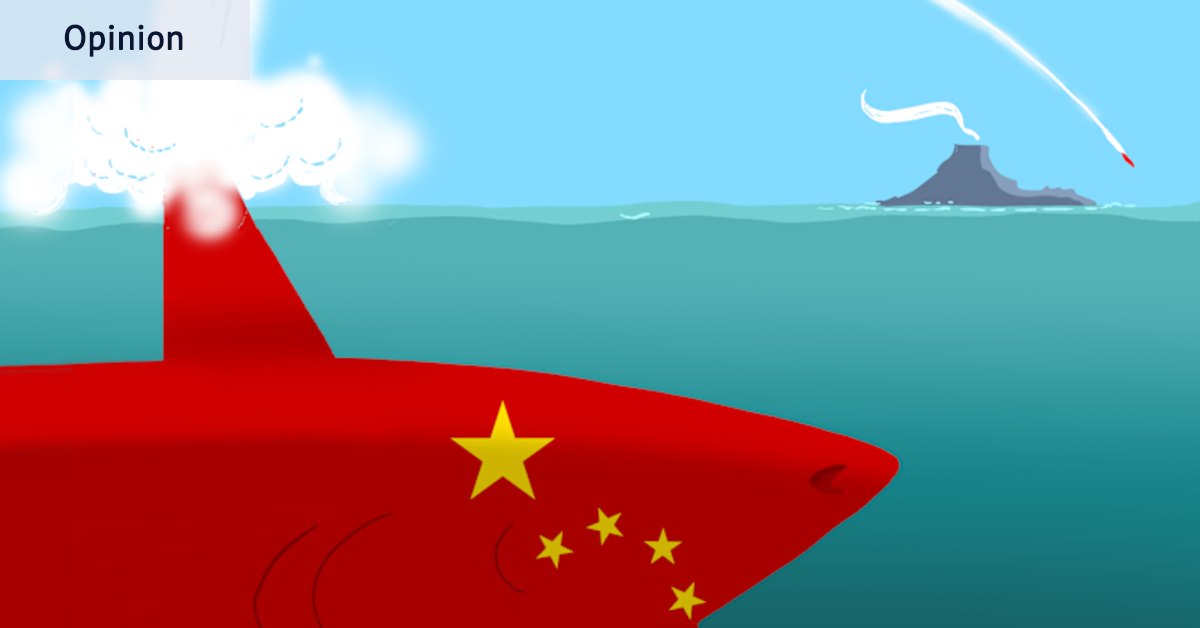
And the other man? Xi Jinping oversaw China’s successful advance into the exclusive club of first-rank nuclear superpowers. By test-firing a nuclear-capable intercontinental ballistic missile (ICBM) from a nuclear-powered submarine into the middle of the Pacific’s nuclear-free zone, Xi not only demonstrated contempt for all South Pacific island states but also Australia and New Zealand too.
He was also issuing a challenge to US hegemony. It was in the 19th century that the Pacific was first claimed to be an “American lake” as it annexed Hawaii and colonised the Philippines.
But Beijing has built the world’s biggest navy by vessel numbers and it is in the midst of a major expansion of nuclear capability. And now with the ICBM test, albeit one carrying a dummy warhead? China’s navy said it was a “routine” operation. It was anything but.
It demonstrated for the first time that the People’s Liberation Army Navy has the power and reach for its submarines to mount a nuclear attack on any target anywhere in the Pacific, including all of Australia.
“Xi is trying to create an exclusionary area in the Pacific,” says retired US general H.R. McMaster, Trump’s national security adviser in 2017-18 and now a fellow at Stanford University.
“And he’s trying to create the impression that the US is weak, or, beyond that, that the US is retrenching and retreating from the Indo-Pacific,” McMaster tells me. Although McMaster is not a frontline critic of Trump, he hasn’t hesitated to criticise his former employer, either.
“It’s part of an integrated effort by China – economically, diplomatically, militarily to say, in their way, ‘you in the West are finished. Your only option is accommodation of China and bandwagoning with China’. They are becoming more aggressive across the board.”
So while Trump is befuddled by an American enemy and while he undermines American friends in a blur of contradictory action and speech, Xi is methodically and deliberately pursuing the aim he set out in an internal speech to the Chinese Communist Party in 2013, published six years later.
He would, he said, lay “the foundation for a future where we will win the initiative and have the dominant position”. Trump and Xi are a study in confusion versus clarity.
Xi’s missile test was so brashly offensive that it obliged the Albanese government to dump years of claims that it had “stabilised” the relationship with China. The prime minister protested that “this is a provocative act which does destabilise the region”.
Stabilisation was only ever Anthony Albanese’s wish, never Xi’s policy.
Xi’s nuclear-capable missile test on Monday was a challenge to Trump, to US hegemony over the “American lake”, and to the status quo. So what has the US president said about it? By Friday afternoon, Trump had not said a word.
His only reference to Xi on the day of the missile launch was during an event in the Rose Garden where he explained why he needed his new ballroom ready by September: “What we need is a big ballroom. We could hold thousands of people to see him. Everyone wants to see him.”
We have to assume that it’s more important to Trump to host Xi in the ballroom than to reject his claim of Chinese hegemony over the Pacific. Or to reassure US allies that America would defend them.
The US State Department issued a note describing Xi’s missile test as an act of nuclear proliferation: “Beijing’s rapid and opaque nuclear weapons buildup is of great concern to the region and the world.”
Was the missile launch timed to unsettle Australia? It came a few hours after Albanese signed an important new security treaty with Fiji. The answer is no. As Canberra said, China had positioned a naval task group to monitor the launch weeks in advance. Japan and Fiji had tried to dissuade China in the brief two-hour notice period given by Beijing, but they had been ignored.
Beijing spoke true when it said the missile test was “targeting no specific country”. It was an offence against the entire Indo-Pacific.
Albanese’s sharp criticism led the global response. Half a dozen Pacific island leaders condemned the launch. They included Solomon Islands Prime Minister Matthew Wale, current chair of the Pacific Islands Forum: “Be our friend, but don’t threaten us.”
Others included New Zealand, Japan, Taiwan and NATO, whose secretary-general Mark Rutte said: “We cannot be naive about China.” He told Latika Bourke of The Nightly: “We see it also in the war with Ukraine, where China, North Korea, and Iran are key enablers of Russia’s unprovoked war of aggression against Ukraine.”
The moment actually crystallised Australia’s emergence as the country it has long claimed to be – the leader of the Pacific. In truth, Canberra had neglected the region, held under the spell of Australia’s traditional enemy – complacency.
Albanese had just brought to culmination an impressive network of agreements and alliances binding the Pacific island states to Australia. The Lowy Institute’s Connor Graham calls it “one of the most productive stretches in the history of Australia’s Pacific diplomacy”.
Recall Australia’s shock when Solomon Islands signed a security agreement with China in 2022? Scott Morrison was punished politically for allowing China to steal a march in Australia’s near neighbourhood on the very islands where Imperial Japan set up a military base to cut Australia off and bring it to its knees in World War II.
Now, Wale is not only committed to strike a deal with Australia, he’s also pressing for a security pact to bind all 10 South Pacific island nations with Australia.
Albanese has signed mutual defence treaties with Papua New Guinea and Fiji. The Fijian deal, Ocean of Peace Alliance, is structured to allow other countries to join. New Zealand immediately expressed interest.
And Canberra has struck separate security-related agreements with Vanuatu, Nauru and Tuvalu. In a moment showcasing the respectfulness and also the shrewdness of his Pacific diplomacy, Albanese hosted the leaders of PNG, Tonga and Samoa at the State of Origin footy on Wednesday.
Albanese’s week of diplomacy culminated in bear hugs from India’s Prime Minister Narendra Modi over an agreement for Australia to supply more uranium to underwrite India’s ambition for a tenfold increase in nuclear power output.
But all of Australia’s Pacific diplomacy, while a high priority for Australia, is essentially China denial. That is, moving preemptively to block Beijing from establishing any military presence in Australia’s near abroad.
Now, Canberra must work harder on China deterrence. AUKUS is an essential part of the plan, but much more is needed: especially with an America that is distracted and a president who is dysfunctional.
McMaster says he’d prefer that Trump “send a message of reassurance to US allies and a message of unity and determination” to confront Beijing, but he offers the consolation that he expects American sanity will return once Trump has left office.
Politically, the seriousness of Australia’s exposure presents the parties of government with an opportunity to demonstrate competence.
If they can, they will be in contrast to the bankruptcy of Pauline Hanson’s offering. For instance, she has said that Australia should cut off aid to any Pacific nation that also accepts aid from Beijing.
If Albanese had taken on such a condescending stance, he would have zero agreements with Pacific island states. And he’d have opened the door to China, instead.
Hanson has no answers. Labor is succeeding but it needs to do more to deter Beijing’s belligerence. The Liberals have the fortune to have one of their most impressive assets, James Paterson, as their defence spokesman. If the Coalition allows him free rein, he’ll give them something they’ve lost in recent years – credibility.
In the meantime, Xi is taking the initiative to exploit Trump’s dysfunction. As modern China’s founder Mao Zedong liked to say: “World in great disorder, excellent situation.”
Peter Hartcher is political and international editor. He writes a world column each Tuesday.
 Peter Hartcher is political editor and international editor of The Sydney Morning Herald and The Age.Connect via email.
From our partners
Discover more from PressNewsAgency
Subscribe to get the latest posts sent to your email.