

August 17: In Western countries we buy more clothes than ever before and keep them for less time. It has become a major problem and the numbers are scary. In the UK alone we generate enough textile waste each year to fill Wembley Stadium 17 times over. The waste cannot be reused: it is worn, damaged or of poor quality. It is estimated that some 200,000 tons end up in landfills or be incinerated. Worse yet, less than 1% of that amount is converted from old textiles into new products.
In my opinion, the idea of relying on consumers to massively reduce their fashion consumption is unrealistic. It’s part of the puzzle, but everyone needs clothes, and the majority of the population needs clothes at an affordable price.
Instead, what we need to do is find ways to transform this waste into a new textile raw material that can be used here in the UK, solving the waste problem and presenting a significant opportunity for the future of domestic manufacturing.
The technology already exists to convert waste into fiber. What is needed is an adequate collection and classification infrastructure that allows the capture and processing of this waste.
UKFT has been working closely with the British Fashion Council and other stakeholders to attract broad government support for a further 10-year term. Fashion Industry Sustainable Change Programfocused on creating a global leading circular fashion and textile ecosystem in the UK.
As a first step, the government recently announced a £5m Circular Fashion Program and, for the first time, this fund was created by several government agencies coming together to collaboratively support our sector: Innovate UK, the Arts and Humanities. Research Council and Natural Environment Research Council.
Bags of clothing are manually sorted at a recycling facility in Stourbridge, Britain. REUTERS/Phil Noble Purchase license rights
The first to receive support is a £6m project to develop and pilot a pioneering, fully integrated and automated textile waste sorting and pre-processing plant, known as ATSP.
The Autosort for Circular Textiles Demonstrator (ACT UK) is a two-year project that will support the transition from uneconomical manual sorting of clothing and textiles that are not suitable for resale to highly automated sorting and pre-processing, which can then be used as raw material. raw material for existing and emerging recycling processes.
UKFT is proud to lead the ACT UK project. We are part of a consortium of 20+ recycling technology partner companies, textile collectors and sorters, academics, data specialists, manufacturers, industry associations, and brands/retailers.
The current list of project partners includes Circle-8 Textile Ecosystems, IBM, Marks & Spencer, Tesco, Pangaia, Reskinned, Salvation Army, Oxfam, Textile Recycling International, Shred Station, Worn Again Technologies, English Fine Cottons, Alex Begg, Camira , the Center for Manufacturing Technology, the University of Leeds, the University of Huddersfield, the Textile Recycling Association and WRAP. Since we broke the news, we have been inundated with requests to join the project.
The idea of so many partners working together seems unlikely, but in truth, forming the consortium was one of the simplest things I’ve ever done. At first glance, many of the partners are competitors, but the size of the task at hand and the potential benefits are far greater than any one organization can tackle alone. The industry is increasingly aware of the value of collaboration in a pre-competitive environment.
Manual sorting of used textiles has a number of limitations. It is not possible to sort garments by fiber composition “by eye”, and the pre-processing (i.e. removal of buttons, zippers and trims) and sizing steps required by textile recyclers have not been optimized or customized to meet individual specifications. There is currently no process at scale that brings all this together in a single process or industrial facility.
ACT UK will build on grading methods currently coming onto the market in countries such as the Netherlands, Spain and Sweden. The UK approach will innovate, combine and promote new and existing supporting technologies to overcome current barriers to material circularity.
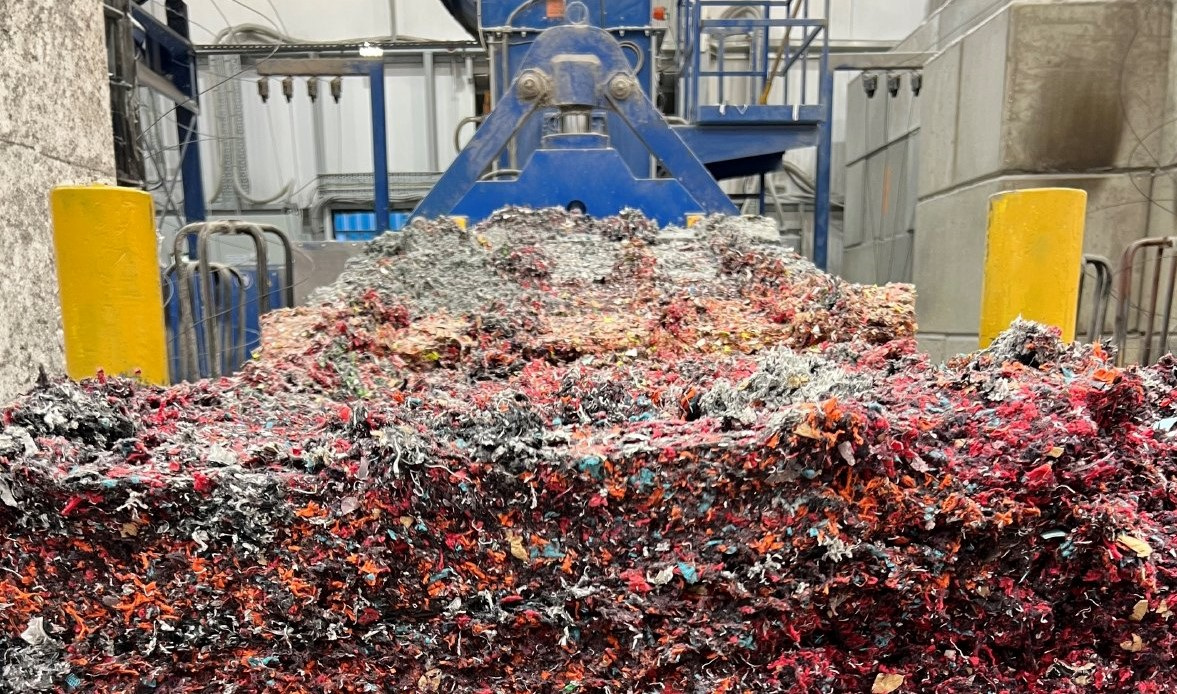
Shredded textiles at Shred Station, one of the ACT UK project partners. Shred Station/Handout via REUTERS Purchase license rights
The project will bring together and promote key technology components, including state-of-the-art optical scanning, robotics, artificial intelligence, size reduction and pre-processing equipment, all under one roof. It will create a world-class model that integrates the latest technologies and can be implemented across the UK and around the world.
We believe that by creating an ATSP we will develop a solution that is efficient, cost effective and paves the way for the UK to become an attractive home for other mechanical, chemical and biological recycling processes. If we provide a standardized raw material that recycling companies can rely on, this will stimulate significant investment and growth.
The ATSP will provide feedstock for chemical, mechanical, and biological recycling in a way that makes the recycling economy work. To give you an idea of the economics of recycling today: it costs textile sorters around £100 per tonne to process non-recyclable textiles. In developing the ATSP, we estimate that the value of one tonne of NRT will go from a cost of £100 to a value of up to £1000.
This project will be a pilot plant, but our ambition is to quickly scale it up to a point where it can process 50,000 tonnes of pre-processed and sorted textile waste a year. There are a number of consortia looking to build large scale recycling plants across the UK.
We estimate that in the UK alone there is already enough potential feedstock for seven ATSPs and a minimum of seven recycling plants.
In short, the ambition of the consortium is to change the concept of waste and, specifically, to turn non-recyclable textiles into a valuable resource.
Using the knowledge and innovation within our consortium, we will drive the transition from a linear textile sector to a fully circular one. The creation of the ATSP will cement the UK’s position as a world leader in textile innovation and circularity, creating new markets, new business, new jobs and new intellectual property.
Not bad for a bunch of old clothes, huh?
The opinions expressed are those of the author. They do not reflect the views of Reuters News, which, according to the Trust Principles, is committed to integrity, independence and non-bias. Ethical Corporation Magazine, part of Reuters Professional, is owned by Thomson Reuters and operates independently of Reuters News.

Discover more from PressNewsAgency
Subscribe to get the latest posts sent to your email.