
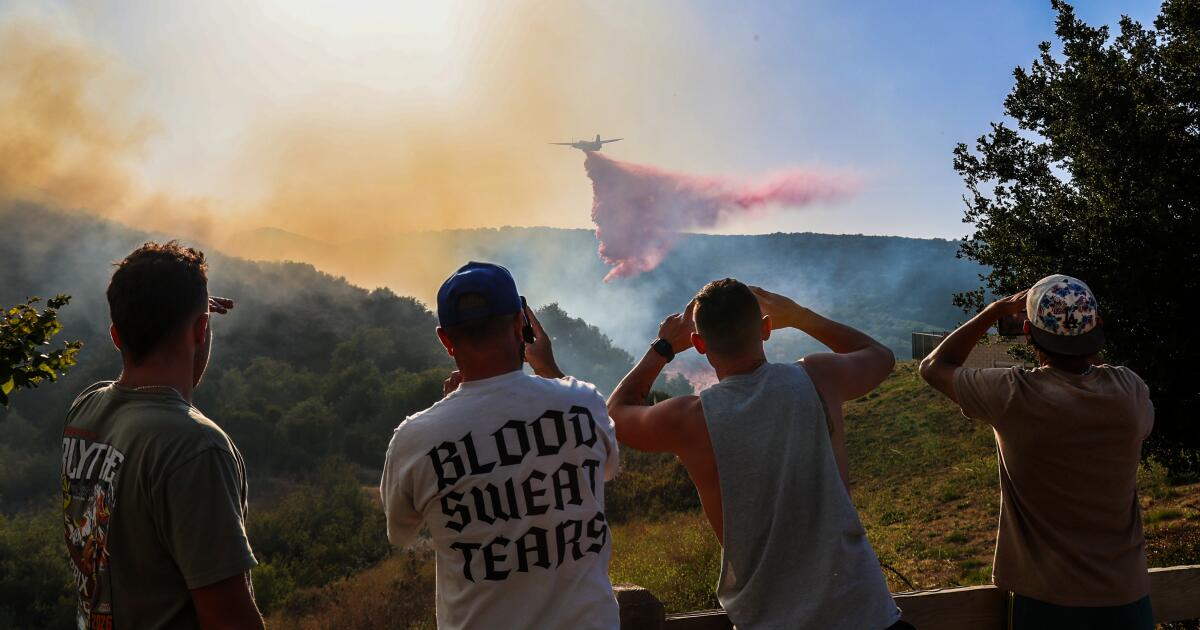
A wind-driven wildfire that forced tens of thousands of residents from their homes continued to spread in Simi Valley on Tuesday.
The Sandy fire was active on its southern flank, burning through a swath of backcountry and sending up a large plume of smoke, said firefighter Andy VanSciver, public information officer for the Ventura County Fire Department.
The winds and terrain have posed the biggest challenges in the fight, with dry grasses stoking flames and steep slopes helping them spread, he said.
The fire also flared to the north during the day, just south of Simi Valley, jumping Sequoia Avenue, said Nick Cleary, division chief with the Fire Department, in an evening update. Another “dynamic day” is expected Wednesday, when crews will be working to keep the fire from spreading into areas including the Santa Susana Field Laboratory and Box, Bell and Woolsey canyons.
Hand crews, dozers and helicopters will continue to battle the fire overnight, Cleary said.
Crews reported some progress early in the day, but parts of Simi Valley and Bell Canyon and other areas remained under evacuation orders Tuesday evening.
All that is left of a home after the Sandy fire, fueled by high winds,scorched parts of Simi Valley.
(Kayla Bartkowski / Los Angeles Times)
The fire began just before 11 a.m. Monday off Sandy Avenue and raced toward nearby homes within minutes, destroying one. It had burned across 1,698 acres as of Tuesday night and was 5% contained.
At one point, some 28,000 people were under an evacuation order, officials said. By Tuesday afternoon, that number was hovering around 17,000 residents.
Still, an evacuation warning in Ventura County was in effect in county-line areas near Agoura Hills, Calabasas, Hidden Hills, Chatsworth, West Hills and the Lake Manor neighborhood. Evacuation zones in Los Angeles County are listed on the county’s site. Information on evacuations in Ventura County are available on its website.
On Monday, the Los Angeles Fire Department pre-positioned resources in the San Fernando Valley just in case the fire grew out of control.
“While the Sandy Fire is in Ventura County, the Los Angeles Fire Department continues to closely monitor the situation and has deployed resources on the ground — including strike teams, a hand crew, and helicopters — to assist local crews in firefighting efforts,” L.A. Mayor Karen Bass said in a statement. “At this time, we do not expect the wildfire to reach the City of Los Angeles.”
Wind-driven fires on a dry landscape are extremely dangerous, as multiple fast-moving wildfires in the last two years have shown.

Raymond Sanchez looks over a smoldering hillside as the Sandy fire burns near Sunnyside Avenue in Simi Valley.
(Robert Gauthier / Los Angeles Times)
On Monday evening, Gov. Gavin Newsom announced that his office had secured a fire management assistance grant from the Federal Emergency Management Agency to bolster the response to the Sandy fire. Local, state and tribal agencies will be able to apply for 75% reimbursement of their eligible fire suppression costs.
The blaze is one of several that recently broke out in Southern California, which is on the precipice of its high fire season. Flames had scorched 16,942 acres of Santa Rosa Island as of Tuesday night, raising fears about its unique wildlife and sensitive ecosystem.
Two brush fires broke out in Riverside County on Tuesday and quickly spread, prompting evacuations.
The Bain fire started near the Santa Ana River bottom in Jurupa Valley and had grown to 1,375 acres by Tuesday night, with 10% containment. The Verona fire broke out in the unincorporated community of Homeland, between Menifee and Hemet, and spread to 439 acres by Tuesday night with 0% containment.
Four civilians and two firefighters were injured in the two Riverside County fires Tuesday, according to Cal Fire Riverside.
Although there’s “no perfect on/off switch” that determines when Southern California’s high fire season begins, fire agencies track vegetation moisture levels, which are the main drivers of the region’s fire activity, said Ryan Kittell, meteorologist with the National Weather Service in Oxnard.
“Right now, the latest readings show we’re right on the cusp of when most of the plants are ready to burn,” he said. “It’s still kind of a mixed bag, but we’re getting real close.”
Discover more from PressNewsAgency
Subscribe to get the latest posts sent to your email.