
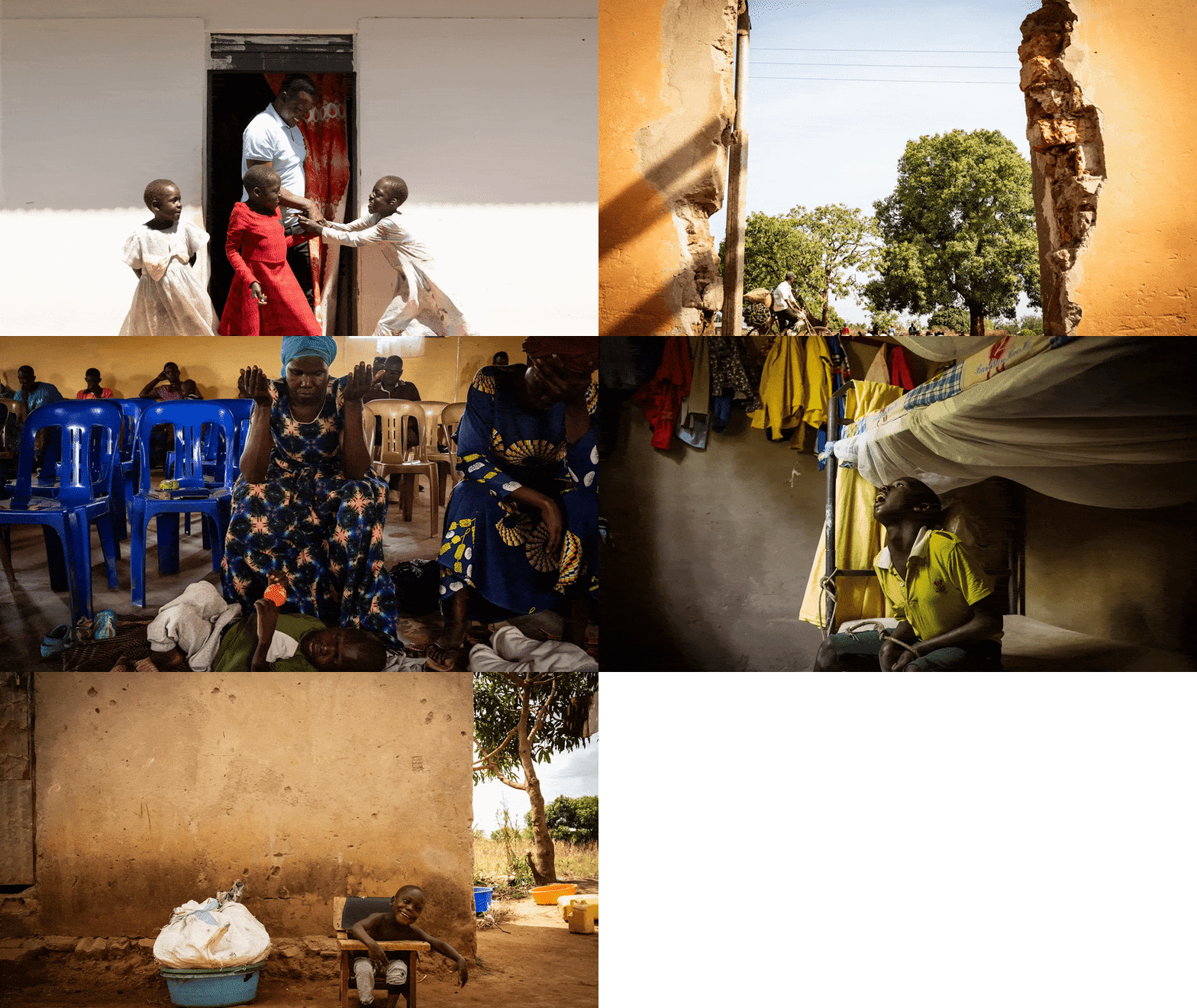
Pastor Fred Alimet surveys the repair work on his demolished church.
The recent storms that hit eastern Uganda sent a tree into its roof and back wall. Volunteers and parishioners in central Soroti, the region’s major city, are racing to reconstruct it for Sunday’s service.
It is already Saturday, and as storm clouds hover the roof has yet to be raised, but as with most aspects of his life, Alimet is resolute. “The people want it ready to pray tomorrow,” he says, after waving to a well-wisher cycling past. “It will be ready.”
Alimet is a man of God, but he is also a man of his people. His calling, he says, is to help children living with disability. This “calling” began when he heard about a mother who had given birth to conjoined twins in a nearby village.
In 2013, Esther Akello gave birth to Apio and Acen, conjoined at the hip, in the village of Omalla, outside of Soroti. With hospitals in Uganda unable to perform the surgery needed to separate the girls, Alimet reached out and shared the news on Facebook.
His network rallied and raised the funds to get the children to the United States and surgery in Ohio. He still visits the family regularly on their chicken farm just outside Soroti. He helps when called for, yet it is the support he gave the twins’ father, James, that Alimet finds especially rewarding.
“People were calling those children a curse. People were calling those children a misfortune. People spoke a lot of things, and that is what probably scared this young man, and he took off,” Alimet says.
“I started looking for him,” Alimet says. “When I got him, I began to encourage him. When I spoke to him, he came back home.”
James describes him as a man with “a good heart”.
There are almost 6 million Ugandans living with disability. In this country, they are widely considered to be a burden, stemming from a long-held cultural belief that disability is a curse or the result of being possessed.

About 15 kilometres from Alimet’s church in the village of Omalera, witch doctor Robert Apedu plies his trade, telling a mother he will heal her son’s “illness of the brain”. The boy’s name is Noah. He is 17, has hydrocephalus and cannot walk unassisted.
Inside the clinic is dark and shambolic, bottles and bowls scattered across the floor, a string of bird carcasses hanging from the ceiling. Apedu reaches out, dragging Noah onto a mat, and the boy’s mother watches as he massages a tonic of tree roots and water into the boy’s legs.
The mixture, the mother is told, will cure Noah’s disability. This is part of the health system rural Ugandans living with a disability rely on.
A life of giving
The eldest of nine children, Fred Alimet’s childhood was strict yet fair. His father, also a pastor, taught his boys to “value people who are less privileged”.
“I feel that drives me,” Fred says. “To be in the place where people with disabilities cannot be heard. I can be heard on their behalf.”

Sunday comes and despite Fred’s resolution the church restoration has halted due to a lack of funds. The parishioners sit on neat rows of plastic chairs in the shadow of a mango tree as Fred gives his sermon. They are hanging on his every word and passage, his calls answered by shouts of “Amen!”
The pastor’s sermon is heavy on religion yet cleverly underpinned with issues concerning Ugandan society. He connects proverbs of “speaking up for those who cannot speak for themselves” with issues of rape; and “defending the fatherless” with society’s attitude to those living with disability.
It was after one such sermon that Rose Akiro approached Alimet. “After the service she called me aside, and she was crying, and she was telling me that her husband wanted to kill her because she gave birth to a child who is not similar to other kids. I began to tell her about her child [who was eight or nine at the time], how beautiful her child was, and I told her that the child could be [the] opportunity for them to get back together again as husband and wife.”
That child’s name is Ketty. She is now 20 and is getting an education funded by Alimet’s charitable efforts. “Ketty right now is at school. She has changed this. The story has completely changed. Now the father reconciled with the mother [four years ago] after knowing that Ketty is now a person with value.”

Seeing the changes in Ketty’s family life convinced Alimet in 2024 to formalise his advocacy work by creating a small community-based organisation – Cherish Ikoku Uganda (“ikoku” translates to “children” in the local dialect).
“We are down at the grassroots,” Alimet says. “We get to children who are really hidden. We know most of the kids who are down there in the village, deep down in the village where people sometimes are scared to reach.”

They have identified Uganda’s transport system as a major factor in families being unable to access proper healthcare. Roads are often unusable, public transport is limited to major urban centres and there is no reliable ambulance service. The country has 178 ambulances. It needs 460 to reach its goal of one per 100,000 people.
Alimet was able to buy a secondhand four-wheel-drive, which Cherish Ikoku operates as a surrogate ambulance for families affected by disability.
“When the Lord blessed me with the car, I used that car as an ambulance to get kids from the health centres or from their villages, from their homes to the hospital whenever there’s appointments.”
Outreach
Alimet and social worker Esther Ibedu drive the 31 kilometres to Oukot village, the final 10 along dusty, potholed roads, to the home of Simon Okurut. Simon’s 13-year-old son Paul lives with cerebral palsy. He is immobile and mute. Alimet and Ibedu’s mission this day is to get Simon and Paul to the Soroti hospital for Paul’s check-up on his dislocated hip.

After picking up his passengers, Alimet expertly navigates the deeply rutted track. In the back seat Simon lovingly massages Paul’s hands and wrists, something he does instinctively to stop the muscles from forming debilitating contractures. As he cradles his son, he remembers a day when Paul required urgent medical attention.
“Paul was not OK, he had a fever, lost appetite, his eyes were red,” Simon says. He then carried Paul to the closest track and waited for a boda-boda, the local motorbike taxis, to take them the 30 kilometres to the Soroti hospital.
“We went to the roadside, it was evening, every motorcycle that came was already carrying. A teacher came and offered to take us to the main road. After reaching there, Paul fainted.”
Upon seeing Paul’s condition, boda-boda riders started asking for inflated fares.
Boda-boda, the common form of transport in Uganda, is fraught with danger and criminality; in a rural setting they are also unreliable and expensive. On this occasion Simon had no alternative.
Alimet and Ibedu delivered Simon and Paul safely to the Soroti hospital and while Paul’s hip is healing he requires medication for the pain, which presents another issue for Simon. Appointments at Uganda’s government-run health services are free but post-appointment treatments, including medicines and therapy, are not.
“When you go to the hospital there are no drugs. You have to buy them from the pharmacy or the clinics. These are the challenges.”

Sometimes Alimet can help with these costs but not often. He has 12 dependants at home to feed, school and care for. He has six children of his own but also has his youngest brother to care for, two internally displaced refugees, one of whom has a baby, and two orphans that he and his wife Ruth have taken in. Their compassionate nature means they don’t know how to say no when they see someone in need.
“I feel I have grown up in a place where it is hard for me to say no to a child who is really vulnerable,” Alimet says. “Even if I do, my wife may not be able to say no.”
The limits of care
It is deep in the rural village of Anyara that this lack of funding is clear. Teddy, 30, lives a subsistent life, catching whatever fish she can in the nearby marshlands with the hope of selling them locally.
Her five-year-old son Moses Elasu looks no older than two or three, his body malnourished, the back of his scalp raw with open sores. He is disabled and cannot walk or talk, and Teddy informs Alimet that he lies on the bare earth of the family’s corrugated iron hut while she is out working. He has never been formally diagnosed, but Alimet suspects he has cerebral palsy.

Teddy chats with Alimet and one of his village health agents, Mark Odai, about Moses’ life and what his immediate needs are: A CP (cerebral palsy) chair so he can sit upright to let the sores on his head heal, money for transport to Soroti for therapy (the trip would take two hours each way on a boda-boda) and food for a meal.
Alimet listens patiently and begins to explain to Teddy that they cannot give her any immediate help. “I was trying to tell her that we cannot help right now, but we [will] take her details. I was trying to explain that it is better to create some business, a small business, so she can help herself rather than rely on outside help.”
As he slips her 4000 shillings ($1.50) and says farewell, the reality that Alimet’s love and good heart can only go so far is sadly obvious.
Back in Omalera, the 4WD turns right off the Mbale road and passes the witch doctor’s clinic. Alimet drives until the road disappears into thick bush, the LandCruiser flattening the cassava bushes. As the bush begins to open it reveals a packed-earth compound with a modest yet comfortable brick-and-mud home.
An elderly woman with a shock of closely cropped white hair sits on the stoop, two of her teenage grandsons leaning on the veranda support behind her. Grace Ayaro, 71, frowns as Alimet asks after her grandson David. David is 18 and lives with an undiagnosed intellectual disability.

Grace explains that he had been getting increasingly aggravated and violent towards his eldest brother, so she has tied him up. Grace is left to care for David and his two brothers as their parents work away from home so they can afford to sustain the household, returning only on school holidays.
David sits quietly on the lower bunk, his wrists tethered by rope to the upright of the bed. He is silent and unresponsive, yet smiles when Alimet enters. The smile widens when Alimet gently unties the rope from his wrists.

Restraint and seclusion are accepted treatment methods in Uganda. For an elderly carer like Grace, who has little understanding of David’s condition and no government support, it is the only way she can control his violent outbursts and stop him from wandering off. “He gets so crazy and tough. He was kicking me; he was kicking me around. Caring for David is so hard. I have high blood pressure, and I am getting old.”
David was found by one of Alimet’s ‘village health agents’ after neighbours heard rumours of Cherish Ikoku and the assistance they could offer Grace.
“We are happy. We have identified him,” Alimet says. “We are happy we know whenever he gets so tough, he’s tied up, which is one thing that we wouldn’t want for any child. [So] we want to educate caregivers. We want to educate communities. We want to share wisdom and knowledge with the people who are having children with special needs. But we are limited financially, and it is normally hard to reach our goal when there are no finances.”
Aid organisations in the sector consistently refer to education as vital to implementing any real change for those living with disability in Uganda.
Alimet has begun outreach programs in the Soroti region, through which the families of those living with disability can not only receive medical support for their loved one but also learn from health professionals about certain conditions and therapies, become educated about disability and share that information when they return to their villages.

Local Soroti doctor Sam Ecengu volunteers at the outreaches. “Outreach is a very good thing in improving health delivery, especially in a country like Uganda because this makes it so [much] easier for people to access medical care, since you’re going to their doorsteps,” he says. “It’s going to improve the health of the children who are disabled, but also the socio-economic status of the parents, since it’s going to save them money and then also improve their awareness.”
While his challenges are many, Alimet’s commitment to these children is unwavering. “It is not easy to serve and administer and take care of children with disability. That’s why even the parents of these children leave them alone. You need to have a heart. You really need to want to see their lives be better.
“I have a heart for children with disabilities. I want to be a voice for children with disabilities. I want them to see a future.”
For more information on Cherish Ikoku, visit: cherishikoku.com
Chris Hopkins is a multiple award-winning freelance photojournalist.
Get a note directly from our foreign correspondents on what’s making headlines around the world. Sign up for our weekly What in the World newsletter.
Discover more from PressNewsAgency
Subscribe to get the latest posts sent to your email.