

EXPLAINER
Will the May 14 elections end President Recep Tayyip Erdogan’s 20-year rule of Turkey?
Millions will go to the polls next week to vote in Turkey’s presidential and parliamentary elections. electionsthat observers expect will pose the toughest test for the president Recep Tayyip Erdogan20-year term as the country’s leader.
The country’s struggling economy dealt a heavy blow to Erdogan, while his rivals, taking advantage of the panic, vowed to improve conditions. But Erdogan and his Justice and Development Party (AKP) still enjoy strong support among broad swaths of nationalists and religious conservatives, particularly in Turkey’s Anatolian heartland, who see a victory for the opposition as a return to an era in which they felt oppressed.
Here’s a summary of everything you need to know:
When are the Turkish elections?
- Presidential and parliamentary elections are held on the same day every five years. This year, the elections were initially scheduled for June 18, but were brought forward to May 14.
How does Türkiye’s electoral system work?
- In July 2018, Türkiye moved from a parliamentary system to a presidential one. In the new system, voters directly elect the president and the role of prime minister has been abolished.
- A candidate needs more than half of the presidential votes to win. However, if no one reaches the 50 percent mark, the top two candidates will meet in a runoff two weeks later.
- Voters will also elect 600 members of the Grand National Assembly, as Turkey’s parliament is known, through a proportional representation system, choosing a list of parties in their district.
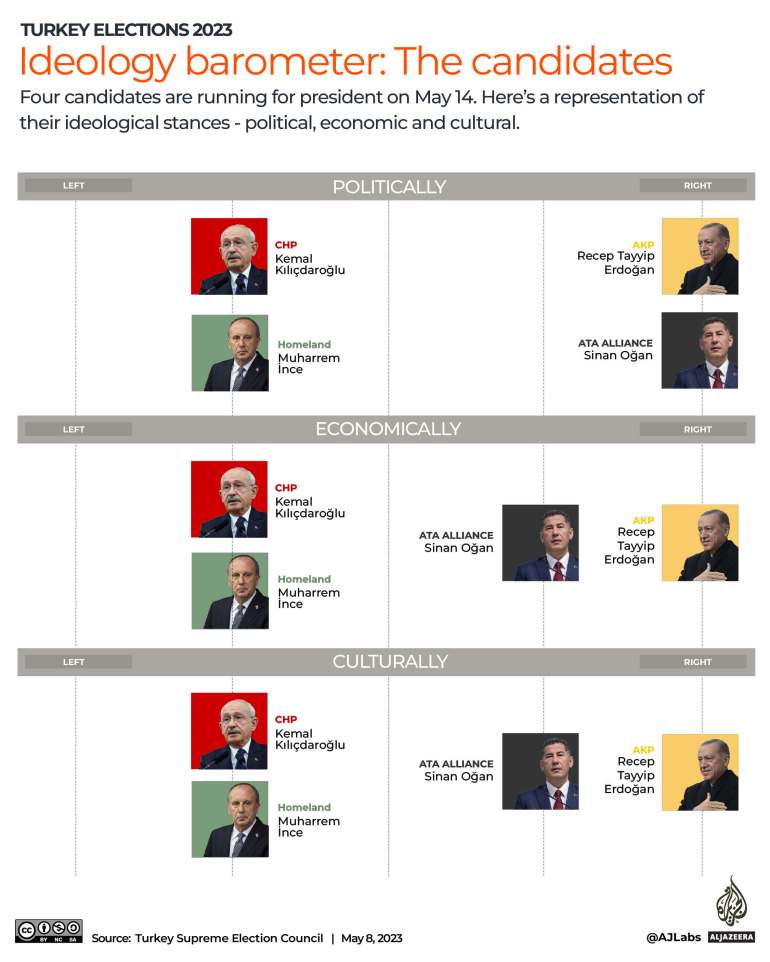
Who are the candidates and what do they promise?
Recep Tayyip Erdogan, 69 years old
- The incumbent is running for the People’s Alliance, a coalition of his AK Party and various right-wing parties.
- During his 20-year rule, Erdogan served as prime minister for 11 years, before becoming president in 2014.
- He led Turkey’s economic and institutional transformation in the 2000s and early 2010s. This has left Erdogan with much goodwill from supporters, who say their lives have improved. He is also seen as strengthening Turkey on the international stage and increasing the country’s influence.
- But the country’s struggling economy over the past 18 months has eroded his popularity.
- He has been accused of cracking down on opposition groups, though government supporters said the moves were necessary following a 2016 coup attempt and the threat of “terrorist” groups.
- Promises: Continuation of the presidential system, lower interest rates and a strong and independent Turkey with influence throughout the region.
Kemal Kilicdaroglu, 74 years old
- Erdogan’s main challenger and candidate of the six opposition parties of the National Alliance.
- He calls himself a “democrat” and is known for his anti-corruption rhetoric, but critics accuse him of being too close to the West.
- Kilicdaroglu has led the center-left Republican People’s Party (CHP) through more than a decade of electoral defeats.
- Critics say those election losses show he is not strong enough to defeat Erdogan and lead Turkey. A leading member of his own alliance, the head of the nationalist party Iyi Meral Aksener, initially rejected Kilicdaroglu’s candidacy in March, before changing position.
- Before politics, he was a specialist in the Ministry of Finance and then headed the Social Security Institution of Turkey for most of the 1990s.
- Promises: return to a “strong parliamentary system”, solve the Kurdish problem, send Syrian refugees back home and get closer to the European Union and the United States.
Muharrem Ince, 58
- The Homeland Party candidate, the only contender without an alliance to back him, calls his move the “third way.”
- Former CHP deputy and party candidate for the 2018 elections, where he came in second. He later parted ways with the party, of which he is critical.
- Ince says Turkish social democrats and secular nationalists should unite against “Islamist” political parties.
- His confrontational manner has led to fights with journalists, and Kilicdaroglu’s supporters believe he is taking away support for their candidate and helping Erdogan.
- Promises: send refugees back to their home countries and “restore” secularism in Turkey.
Sinan Ogan, 55
- Candidate of the three-party Nationalist Ancestral Alliance (ATA).
- Ogan has an international financial development and academic background.
- Former member of the Nationalist Movement Party (MHP), an ally of the Erdogan-led AK Party.
- As a candidate for the MHP, he was elected deputy for Igdır, a city in eastern Turkey, in 2011 and expelled from the party in 2015 due to internal opposition.
- He has been accused of having far-right and xenophobic policies, particularly when it comes to Syrian refugees.
- Promises: send refugees back to their home countries and support the unity of the Turkish states.
What are the key issues of the elections?
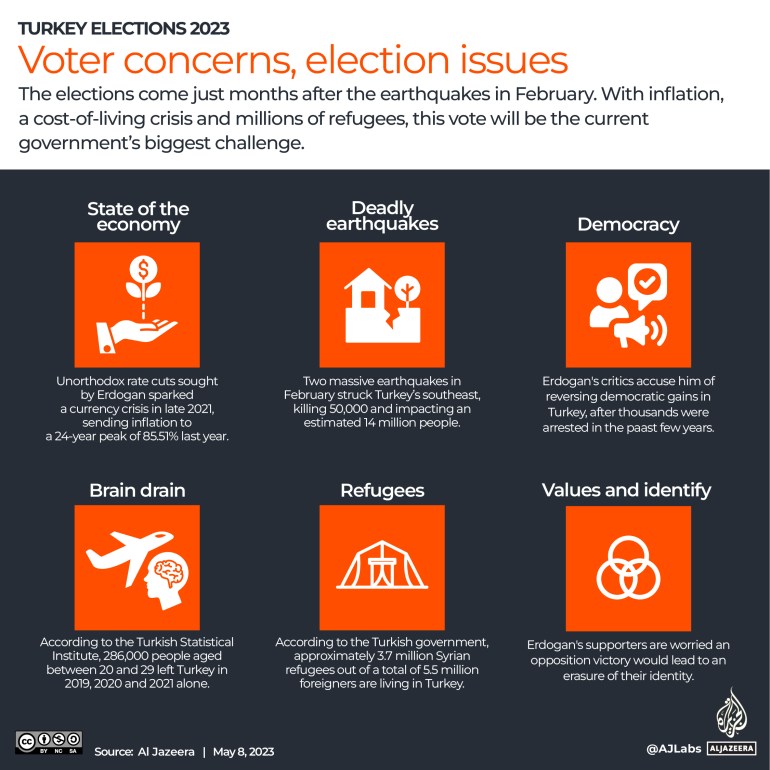
Economy
- Interest rate cuts sparked a currency crisis at the end of 2021, driving inflation to a 24-year high of 85.51 percent last year.
- But Erdogan’s supporters say he has revolutionized Turkey’s economy, built infrastructure and developed regions traditionally ignored by Turkey’s central government.
tremors
- Two massive earthquakes that struck southeastern Turkey on February 6 left more than 50,000 dead and widespread destruction – expected to cost billions of dollars to rebuild.
- An estimated 14 million people, 16 percent of the population, were affected by the earthquakes.
Brain drain
- An increasing number of the country’s highly-skilled and educated people are leaving the country for political and economic concerns.
- According to the Statistical Institution of Turkey, 286,000 people between the ages of 20 and 29 left Turkey between 2019 and 2021.
Values and identity
- Erdogan, as prime minister, lifted a ban on women wearing the hijab to work in the public sector in 2013, a move hailed by many as validation of their place in society and their religious observance.
- The CHP had previously backed the hijab ban and Erdogan says it could be reinstated, along with all the identity erasure it stands for, if he loses, as part of other measures that would threaten the values of the AKP fan base.
Democracy
- Erdogan’s critics accuse him of reversing democratic gains in Turkey, particularly after the failed 2016 coup attempt in which thousands of people were arrested.
- Critics also say press freedom has deteriorated, with 90 percent of all Turkish media outlets under the control of Erdogan’s government and businessmen close to him.
Refugees
- Anti-refugee sentiment is rising, with the rise reports of violenceabuse and crime between the Syrian and Turkish communities.
- According to the government, some 3.7 million of the total 5.5 million foreigners in Turkey are Syrian refugees. The government has been praised internationally for its refugee policy, but opposition candidates have been taking advantage of growing hostility towards refugees.
Discover more from PressNewsAgency
Subscribe to get the latest posts sent to your email.