

To print this article, all you need is to be registered or login on Mondaq.com.
1. Executive Summary
This legal and regulatory study was commissioned by the
International Sustainable Finance Centre of Excellence
(“ISFCOE“) to assist in the update of
the National Sustainable Finance Roadmap (the
“Roadmap“) in 2023. The content of this
study was a critical input in the updated Roadmap. This study is an
update and progress report on the report titled “Ireland as a
Global Centre of Excellence for Sustainable Finance – Legal
and Regulatory Report” produced in 2021 (the
“2021 Report“).1
We provide an overview of the global legal and regulatory
landscape (Section 3), an update on European and Irish legal and
regulatory developments since the 2021 Report (Sections 4 and 5
respectively) and outline pending and possible future developments
with respect to sustainable finance (Section 6). Sections 7 and 8
examine the opportunities and challenges for Ireland as a centre of
excellence for sustainable finance. In Section 9, we comment on the
progress made with respect to the recommendations made in the 2021
Report and we identify next steps and further implementation
efforts to advance the progress made in building Ireland’s
reputation as a leader in sustainable finance.
The sustainable finance legal and regulatory framework is
evolving at pace, with all stakeholders being required to adapt
quickly to new rules, often in the absence of finalised legal
requirements and regulatory guidance at European Union
(“EU“) or national level to assist with
compliance. The EU’s highly ambitious legislative
programme in this area, combined with delays in the legislative
process, has presented challenges to stakeholders, who must contend
with a complicated matrix of requirements. There is an ongoing lack
of clarity in relation to key concepts such as the definition of
“sustainable investments”. Many of the interpretation
issues arise at EU level, making engagement at EU level essential
to ensure that the issues are identified and adequately addressed.
There may also be scope for further guidance and clarity from the
Central Bank of Ireland (“Central Bank“)
relating to its expectations on implementing the various
legislative requirements. It is necessary to understand the overall
legal and regulatory context and the challenges facing market
participants in order to identify measures that can be taken to
maintain Ireland’s position as a centre of excellence for
sustainable finance.
Underlining the constantly evolving nature of the sustainable
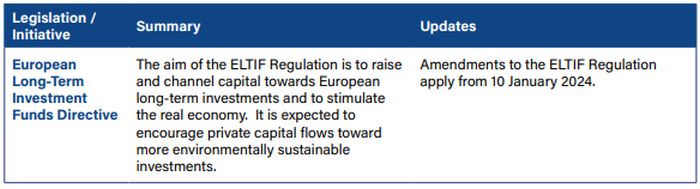
finance framework, we have outlined in the table in Figure 1 some
key upcoming legal and regulatory developments. These developments
are examined in further detail in section 6 (Horizon Scanning).
Figure 1 Summary of upcoming legislative and regulatory
developments
The inter-relationship between the various legislative
initiatives must also be understood, as the disclosure requirements
applicable to many financial market participants, for example,
cannot be viewed in isolation from the reporting requirements of
their underlying investee companies. The misalignment between the
timing of the application of disclosure and reporting requirements,
as well as a lack of consistency and coherency between third-party
data providers, has led to significant data gaps and data
challenges for market participants.
Continued government impetus to build on the outstanding success
of financial services in Ireland to date has sustained the focus on
innovation in the international financial services sector, backed
by sound and prudent regulation. Ireland’s coherent, consistent
and reliable policy and regulatory framework means that Ireland is
well-positioned to take advantage of opportunities presented by
sustainable finance and to maintain and develop its reputation as a
location of choice for domiciling and distributing sustainable
financial products that meet growing investor demand for
sustainable solutions. Ireland is internationally recognised as one
of the world’s most advantageous jurisdictions in which to
establish international investment funds and is the
jurisdiction of choice for the establishment of special purpose
vehicles for a variety of debt issuance transactions.
In light of the inter-relationship between sustainable finance
legislative initiatives and the impact of the sustainable finance
agenda across various government departments, a holistic,
multi-disciplinary, cross-governmental approach best utilises the
opportunities and addresses the challenges presented by the
sustainable finance agenda. Ensuring that our regulators and
representatives have a prominent place in international fora
discussing sustainable finance matters will afford an opportunity
to input on and shape the agenda and ensure that Ireland has a
leadership role in the development of legal and policy
initiatives.
Ongoing constructive engagement with stakeholders’ systemic
knowledge development and addressing the evolving competencies
required of regulators, senior managers, those making investment
decisions and giving financial advice and service providers,
including legal professionals, will also play a role in developing
Ireland’s leadership status in relation to sustainable
finance.
2. Introduction
This study is one of a number of studies commissioned by the
ISFCOE to assist in the update of the Roadmap. The Roadmap, first
published in October 20212 sets out targeted measures
with a view to Ireland being a leading sustainable finance centre,
informed by extensive research and stakeholder engagement. The 2021
Roadmap outlined how public-private sector collaboration can
develop talent, prepare industry, leverage digital solutions,
enhance the enabling environment, and promote and communicate
Ireland’s sustainable finance priorities and capabilities.
We will examine the legal and regulatory landscape,
opportunities and challenges in sustainable finance and how Irish
laws, regulations, guidance and policies might exploit those
opportunities and address those challenges and successfully and
efficiently implement EU level initiatives. This study builds upon
the 2021 Report. An overview of the legislative and regulatory
changes since the publication of the 2021 Report is included in
Section 4 (Update on European Developments).
Impetus for financial services markets to help combat climate
change has come from a series of global and EU initiatives derived
principally from the United Nations Sustainable Development Goals
(“SDGs“)3 and the 2015 Paris
Agreement (the “Paris
Agreement“)4 which indicated that the
ability to meet the targets set out in those initiatives was
dependent on “making finance flows consistent with a
pathway towards low greenhouse gas emissions and climate-resilient
development“.
The EU has outlined that it will need additional investments of
around €700 billion every year to meet the objectives of the
European Green Deal. The objective of the European Green Deal is to
transform the EU into a modern, resourceefficient and competitive
economy, ensuring no net emissions of greenhouse gases by 2050,
economic growth decoupled from resource use and no person and no
place left behind. The bulk of the required investment will have to
come from private funding.5 Sustainable development is a
core principle of the Treaty of the European Union and a priority
objective for the EU’s internal and external policies.
In light of these objectives and the EU’s international
commitments, the EU published a Sustainable Finance Action Plan in
March 20186 and a Renewed Sustainable Finance Action
Plan in 20217 (the “Action
Plan“) with a view to reorienting capital flows
towards a more sustainable economy. Various legislative initiatives
have been adopted under the Action Plan, including the
SFDR,8 the EU Taxonomy9 Regulation and the EU
Green Bond Standard
(“EUGBS“).10
Investor preferences are also changing in line with increased
public awareness of the climate crisis. Morgan Stanley’s 2020
Sustainable Signals survey11 found that around 95% of
institutional asset owners are integrating or considering
integrating sustainable and impact investing in all or part of
their portfolios. Indeed, many customers of corporates and
financial institutions are demanding that they establish and pursue
binding sustainability targets.
Market indications are that sustainability will feature heavily
in the recovery from the COVID-19 pandemic. The Commission has
attached “green strings” to the agreed “Next
Generation EU” €750 billion post-pandemic recovery
plan.
Very detailed and ambitious legislative requirements have
therefore been set out in EU law, many of which take the form of EU
regulations which have direct effect in Ireland and are not
required to be transposed into Irish law. There is therefore
limited scope, from a legal and regulatory point of view, for
Ireland to devise a framework that differs to other EU member
states and that would render Ireland a more attractive centre for
sustainable investment products. Goldplating, ie, imposing
additional legal requirements to supplement the framework
established at EU level, would present challenges to financial
market participants
(“FMPs“)12 who operate on a
cross-border basis. Divergences in approach at national level
create operational and compliance challenges for these FMPs.
Due to the fact that many aspects of the sustainable finance
agenda are dictated by EU law, together with the Commission
harmonisation objective and aim of achieving a “level playing
field”, the opportunities for individual member states to
differentiate themselves are limited from a legal point of view,
but significant opportunities lie in areas where Ireland has
already established a strong reputation eg, a knowledgeable and
prudent financial regulator and a skilled, highlyeducated talent
pool supported by a wellestablished financial services
infrastructure.
Ireland’s coherent, consistent and reliable policy and
regulatory framework means that Ireland is well positioned to take
advantage of opportunities presented by sustainable finance and to
maintain and develop its reputation as a location of choice for
domiciling and distributing sustainable financial products that
meet growing investor demand for sustainable solutions.
Consideration must also be given to how the legal and regulatory
environment can operate to incentivise and promote sustainable
investment in Ireland so that sustainable projects such as
renewable energy infrastructure can be financed to facilitate the
transition to net zero.
To ensure that Ireland can maintain and develop its reputation
as a centre of excellence for sustainable finance, a holistic,
multi-disciplinary, cross-governmental approach best utilises the
opportunities and addresses the challenges presented by the
sustainable finance agenda. Ireland, as a small, open economy has
the benefit of being capable of a nimble, flexible approach,
drawing on input across the many governmental departments and
economic sectors impacted by sustainable finance.
Ensuring that our regulators and representatives have a
prominent place in international fora discussing sustainable
finance matters affords an opportunity to input on and shape the
agenda and positions Ireland to take a leadership role in the
development of legal and policy initiatives.
Furthermore, our continued focus on systemic knowledge
development and addressing the evolving competencies required of
regulators, senior managers, those making investment decisions and
giving financial advice and service providers, including legal
professionals, contributes towards building Ireland’s
reputation as a centre of excellence for sustainable finance.
Ireland’s coherent, consistent and reliable policy
and regulatory framework means that Ireland is well positioned to
take advantage of opportunities presented by sustainable finance
and to maintain and develop its reputation as a location of choice
for domiciling and distributing sustainable financial products that
meet growing investor demand for sustainable
solutions.
3. Overview of Global Legal and Regulatory Landscape
As more data has become available on the financial impacts of
climate change, international regulators and supervisors have
increasingly focused on how the legislative and regulatory
framework can be adapted to respond to those impacts and make a
positive contribution in the transition to net zero. The EU has
sought to be a global leader in this regard and to put in place a
legislative framework to further global initiatives such as the
SDGs and the Paris Agreement. The ambitious nature of the EU
measures and the pace at which they have been adopted has presented
significant implementation challenges, including challenges arising
from the misalignment in the timing of the introduction of
obligations. For example, the EU has sought to impose detailed
disclosure requirements on FMPs under the SFDR at a time when there
are no corresponding reporting obligations on investee companies,
creating significant data gaps and resulting in less comparable,
comprehensible disclosures for investors, undermining the purpose
of the EU disclosure regime. The pace of change also presents
challenges, with disclosure requirements introduced in 2021 (SFDR
Level 1) and early 2023 (SFDR Level 2) already under review by the
Commission, leaving little time for market participants to become
familiar with the requirements and for the framework to bed in.
The tables below provide an at-a-glance overview of the various
initiatives adopted at global13 and European level in
relation to sustainable finance. National measures have not been
set out in this section, as the legislative landscape in Ireland is
dictated by European developments, many of which are of direct
effect and allow for no member state discretion in their
implementation. Ireland’s response to the evolving sustainable
finance framework is, however, addressed in Section 5 (Update on
Irish Developments). The European initiatives referred to in the
table below are addressed in more detail in Section 4 (Update on
European Developments) and a more complete list of relevant
European legislation is set out in the appendix to this report.
To view the full article click here
Footnotes
1. Available at https://sfskillnet.sustainablefinance.ie/wp-content/uploads/2022/11/Regulatory-Study_Final.pdf
2. Ireland’s Sustainable Finance Roadmap October
2021. Available at https://www.skillnetireland.ie/
wp-content/uploads/2021/10/Irelands-Sustainable-Finance-Roadmap-October-2021.pdf
3 Available at: https://sdgs.un.org/goals
4 The United Nations webpage on the Paris Agreement is
available here: https://unfccc.int/
process-and-meetings/the-paris-agreement
5. European Commission Questions and Answers on
Sustainable Finance package 13 June 2023. Available at https://ec.europa.eu/commission/presscorner/detail/en/QANDA-23-3194
6. Communication from the Commission to the European
Parliament, the European Council, the Council, the European Central
Bank, the European Economic and Social Committee and the Committee
of the Regions Action Plan: Financing Sustainable Growth
COM/2018/097 final. Available at https://eur-lex.europa.eu/legal-content/EN/TXT/?uri=CELEX:52018DC0097
7. Communication from the Commission to the European
Parliament, the Council, the European Economic and Social Committee
and the Committee of the Regions Strategy for Financing the
Transition to a Sustainable Economy Com/2021/390 Final. Available
at https://eur-lex.europa.eu/legal-content/EN/TXT/?uri=CELEX:52021DC0390
8. Regulation (EU) 2019/2088 of the European Parliament
and of the Council of 27 November 2019 on sustainability-related
disclosures in the financial services sector
9. Regulation (EU) 2020/852 of the European Parliament
and of the Council of 18 June 2020 on the establishment of a
framework to facilitate sustainable investment, and amending
Regulation (EU) 2019/2088
10. An earlier Legal and Regulatory Report commissioned
by Sustainable Finance Ireland provided a full overview of the
action plan, which is not addressed in detail in this study.
Sustainable Finance Ireland Legal and Regulatory Report 28 May 2021
available at https://sfskillnet.
sustainablefinance.ie/wp-content/uploads/2022/11/Regulatory-Study-Final.pdf
11. Available at
https://www.morganstanley.com/content/dam/msdotcom/
sustainability/20-05-22-3094389%20Sustainable%20Signals%20Asset%20Owners-FINAL.pdf
12. Financial market participants are defined in Article
2 of the SFDR to include an insurance undertaking which makes
available an insurance-based investment product (IBIP); an
investment firm which provides portfolio management; an institution
for occupational retirement provision (IORP); a manufacturer of a
pension product; an alternative investment fund manager (AIFM); a
pan-European personal pension product (PEPP) provider; a manager of
a qualifying venture capital fund registered in accordance with
Article 14 of Regulation (EU) No 345/2013; a manager of a
qualifying social entrepreneurship fund registered in accordance
with Article 15 of Regulation (EU) No 346/2013; a management
company of an undertaking for collective investment in transferable
securities (UCITS management company); or a credit institution
which provides portfolio management.
13. The table does not purport to cover all global
developments relating to sustainable finance, which is beyond the
scope of this paper. We have sought to highlight some of the key
developments at a global level. The United Nations Global
Sustainable Finance Observatory has established a hub for data and
resources on sustainable finance which includes information on
national strategies, sustainable finance frameworks, taxonomies,
product standards and sustainability disclosure regimes in
different jurisdictions – accessible at
https://gsfo.org/#:~:text=The%20Global%20Sustainable%20Finance%20
Observatory,exchanges%2C%20standard%2Dsetters%2C%20and
Originally Published by International Sustainable Finance
Centre Of Exellence
The content of this article is intended to provide a general
guide to the subject matter. Specialist advice should be sought
about your specific circumstances.
Discover more from PressNewsAgency
Subscribe to get the latest posts sent to your email.