
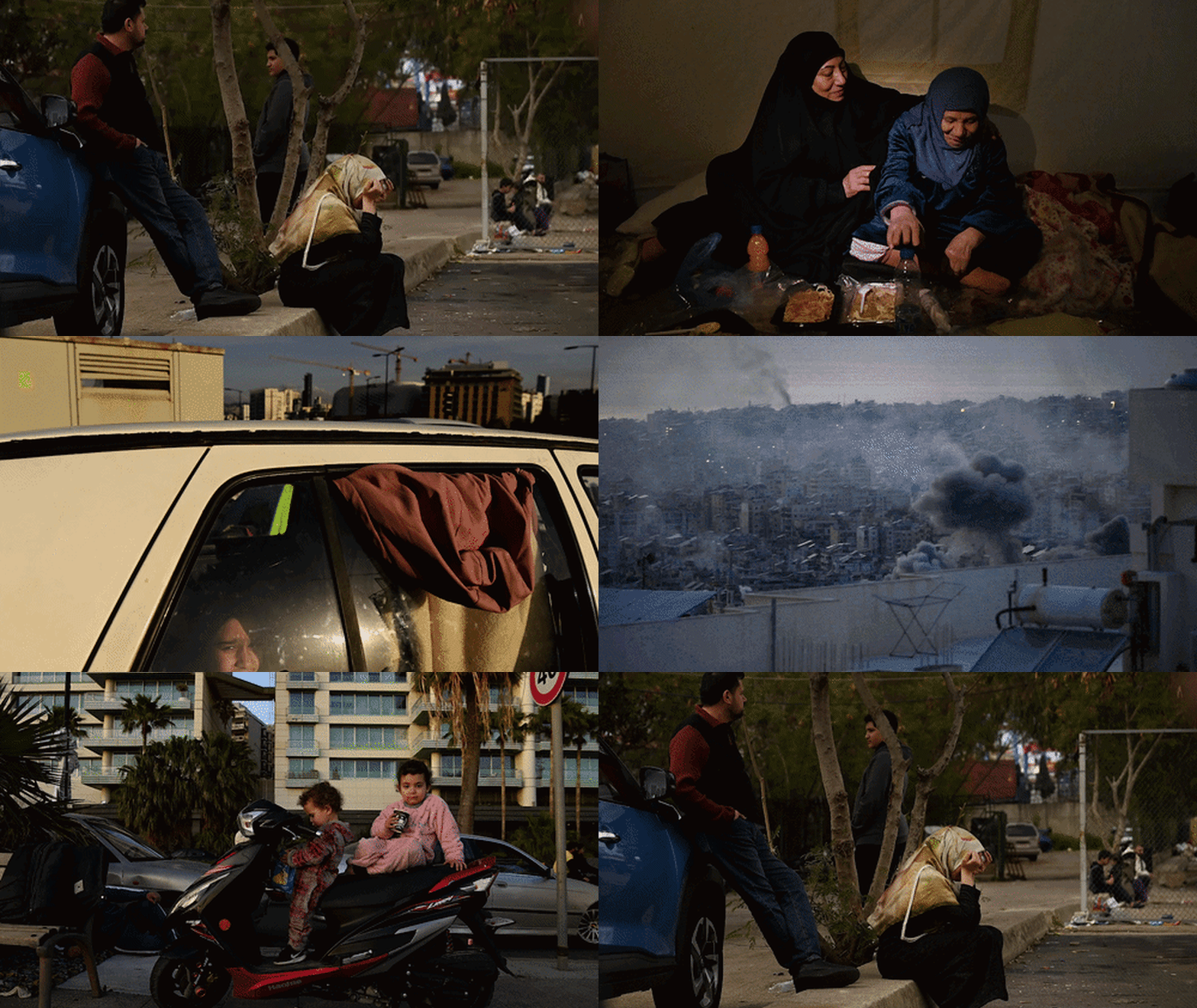
Beirut: Families are jammed into tents on the concrete paths of an old school in Beirut that is packed with more than 1200 people who fled their homes after a new outbreak of war with Israel.
“We spent five days sleeping in the street before we came to this shelter,” says Zahra Issa, 54, who had to leave her home in southern Lebanon after Israeli forces struck her district.
Issa sits with her mother, Um Ahmad, 90, while children play football in the courtyard outside. There are five floors of classrooms above, all serving as temporary housing in a growing crisis as families struggle to find food and shelter.

A long way from the war on Iran, but it is just one flashpoint in the violence that has swept the Middle East since US President Donald Trump and Israeli Prime Minister Benjamin Netanyahu ordered strikes on Tehran on February 28.
Lebanon is caught in the crossfire after Hezbollah fighters launched strikes on Israel last Monday. Israel responded by moving troops across the border and flattening Hezbollah targets in the southern suburbs of Beirut.
Issa is in no doubt who is to blame. “We came from the south because of Israel’s brutal aggression,” she says. Others like her, forced to live on the streets or in shelters, are adamant that Israel wants to destroy their land in the same way it reduced parts of Gaza to rubble.
There seems to be no end to the violence when every missile strike brings vows of revenge from those who survive.


More than 454,000 people have been forced from their homes, according to the Lebanese government, spreading anger and anxiety across this country of 6 million people.
Desperate families now sleep at night on the footpath along the Corniche, the historic boulevard with spectacular views over the Mediterranean and a line of prestige apartments.
Iman al Mawla, 21, is sleeping on a footpath with her aunt, Zainab, while her young cousins spend the night in the family car next to them.
“The schools are full. Everywhere is full,” she says. “Even the pavements on the street are full. Where can we find a place to stay? We have no idea.”
Zainab’s children – Alaa, 11 months, Ali, 2, and Baloul, 4 – smile and play on the rug that is now their temporary home. Al Mawla says it would cost up to $US2000 ($2840) a month to find an apartment, far beyond the family’s means.


As she speaks, black smoke rises from the suburbs in the distance. This stretch of the Corniche has a clear view of the southern suburbs of Beirut, where Israel has been striking targets daily. The acrid smell from each explosion drifts over the city.
The death toll rose to 339 on Saturday, according to the Lebanese health ministry, after Israeli strikes killed another 45 people. The ministry says more than 1000 have been injured since March 2.
Israel, in turn, is blaming Hezbollah, the Lebanese Shiite militant group backed by the Iranian regime, for firing rockets and drones into civilian areas of northern Israel. On Saturday, Hezbollah warned the residents of one Israeli town, Kiryat Shmona, to leave or face attack.
This renews the conflict that began when Hamas fighters crossed from Gaza into Israel on October 7, 2023, and killed more than 1200 people. Israel responded with the war in Gaza, which has claimed the lives of more than 70,000 people, while Hezbollah launched strikes on Israel. The ceasefire on the northern border, reached in November 2024, is now over.


The war has left parts of Beirut seemingly untouched. The shops in the city centre are still selling clothes, luxury watches, carpets and antiques. Expensive motor launches keep the yacht club busy. Many restaurants along the Corniche remain open.
The destruction, however, is apparent from the hills of the Hadath district, where the visiting media gather to record the explosions. The strikes came suddenly and randomly on Friday night, sending flames into the air in the Dahiyeh area of southern Beirut. An Israeli surveillance drone is almost always heard over the city.
The humanitarian crisis, already severe, appears likely to grow worse.
“Everyone is coming towards Beirut,” says aid worker Aline Kamakian, as she supervises an emergency kitchen to feed thousands of people. “The shelters are all saturated. We don’t have places any more. People are on the street. And still there are new evacuation areas.”
Kamakian, 56, leads the World Central Kitchen in Lebanon. She has been doing this work for six years, since her apartment and restaurant were destroyed in an Israeli attack, and has endured waves of violence. But she thinks this conflict is worse than in 2024.


Now, she says, there are people displaced from more parts of Lebanon. There is less aid money, in part because the Trump administration shut down USAID. And the Iranian attacks across the region have made it harder for Gulf States to send food and other help.
Kamakian talks to this masthead in a commercial kitchen built to make food for restaurants, but now producing free meals for the displaced. Her colleagues prepare rice, beans, beef, chicken and a vegetable stew. The kitchen can prepare 10,000 meals a day, but the team has only enough ingredients to make 3000. Supplies will run out without more help.
“We’re trying as much as we can to reach those people without disrespecting them,” she says. “Honestly, it’s very difficult to receive. It’s very easy to give.”
Kamakian knows tempers become raw when so much of the population has been displaced.
“They’ve left their homes. They had to drive around for hours on a road where it usually takes one or two hours to drive. They have nothing. They are uncomfortable. They have their kids to look after, and they have no work, nothing,” she says.
“This is not a world that they chose. And there is a high risk that they will never be able to return back home.”
Kamakian is from an Armenian family that has been in Lebanon for generations, and she believes the community is greater than its sectarian differences. She is making food for all.
“I don’t see the differences between the ethnic groups,” she says. “Most Lebanese don’t see the difference between Christian, Muslim, Shiite or whatever you want to call it – they’re just the political ways of manipulating people.”
For others, however, faith is essential to their identity and fundamental to the way they respond to the Israeli attacks.
“Death has been imposed on us,” says Hind al Harakeh, as she sits in a shelter for hundreds of displaced people near the wharves and warehouses of the Beirut docks. “The enemy has destroyed our homes.”
Al Harakeh sits with her family under a eucalyptus tree while children play on the bitumen between temporary homes made of sheet iron.
“Anyone who is under repression has the right to resist,” she says. “So it is our right to resist. If anyone assaults us, or assaults me, then I have the right to fight them.”
Her brother, Abu Ali al Harakeh, 67, lies on a bed inside one of the rooms. He is recovering from prostate surgery and is still on medication to deal with complications. Family members sit in the room with him, beneath a shelf that stores their belongings in bags that were hastily packed when they fled their homes on Thursday. The room measures about three metres by four metres and sleeps about six.

Their house still stands, he says, but others are not so lucky. His daughter, Arbab, who lost her home in the 2024 attacks, dismisses the idea that there was ever a genuine ceasefire to that conflict and blames Israel for continuing the attacks.
“They’re still killing young people, children,” she says. “They make it look like the war is against a specific sect, but it’s a war against all of Lebanon.”
This is the volatile reality from more than a week of war. Israel is determined to destroy Hezbollah, just as it eliminated Iran’s supreme leader, Ayatollah Ali Khamenei, and so many other leaders of the Islamic Republic. After hitting Tehran, it is targeting its militant Shiite allies in Lebanon.

Netanyahu vowed on Saturday to keep up the “full force” of the attacks on the Iranian regime, and demanded that the Lebanese government disarm Hezbollah.
“If you do not do this, Hezbollah’s aggression will have disastrous consequences for Lebanon,” Netanyahu said in a broadcast.
The Lebanese government is divided. Some members are aligned with the militants, while others see a chance to weaken a group that wields its own military power within the Lebanese state.
On Monday, Prime Minister Nawaf Salam declared that Hezbollah must operate only as a political entity and that there would be a ban on all its “military and security” activities. On Saturday, reports emerged that Justice Minister Adel Nassar was considering taking legal action against Hezbollah secretary-general Naim Qassem to enforce this ban.
The conditions are set for a confrontation between the government and the militant group. If the Lebanese government does not try to curb Hezbollah, the Israel Defence Forces will try even harder to destroy it. The outcome depends on whether the Shiite militants can withstand these dual pressures when their allies in Tehran are under existential threat.
One theory in Beirut is that the Israeli bombardment is designed to fuel so much unrest that it will force popular action against Hezbollah, as people hold it responsible for the black clouds over the city.

The strikes, however, appear to have provoked even greater anger from those who side with the Shiite cause and believe Trump and Netanyahu are to blame for unleashing war.
“Trump is a crazy man, and he’s just taking advantage of his position – he doesn’t care about any of the people,” says Nada Izeddine, 53, one of the mothers at the shelter by the Beirut docks. She is standing in a dimly lit corridor between the rooms, underneath an iron roof. Children run through the improvised hallways and play football on the bitumen outside.

“What’s been done from the Lebanon side is about defending. They are not attacking,” she says. “Trump feels strong, and he’s like a pharaoh – he wants to rule the whole area. In the south, we love peace. We do not like war.”
Izeddine counters the criticism of Hezbollah for launching attacks on Israel last week, answering questions from this masthead by posing a question.

“If someone came and attacked you, beat you, took your property, hurt your family or others, what would you do?” she asks.
“That is the answer. Hezbollah is not a party; it’s a community. It is not imported. Hezbollah is us. Now, for example, if the Israeli soldiers dropped here, who would defend us? I would send my son.”
Izeddine says this while her son, a polite 16-year-old, stands next to her. It seems as if the Israeli strikes of the past week have defined his fate.

The war in Iran has unleashed death and chaos in the Middle East. The US and Israeli strikes on Tehran have brought Iranian retaliation on a dozen cities or nations in the region, from Turkey to Oman. In Lebanon, the conflict is widening, and there is a grave danger of an even greater humanitarian crisis.
Some have seen too much war already. Ibrahim Al Haj Mohammad, 71, lived through the civil war that left 150,000 dead from 1975 to 1990. Sitting against the wall of the old school playground in Beirut, not far from the tents serving as emergency housing, he sees today’s conflict as a continuation of the last.
“It’s a series of wars, and it’s been running for years, and it’s not showing any results,” he says. “It is a shame, what is happening to the people of Lebanon, and even to those on the other side. What’s the use? What’s the benefit of this? They should find solutions.”

Mohammad has found shelter here with his wife. He is a Palestinian man born and raised in Lebanon after his family left their homeland decades ago. He laughs when he watches the children, while smoking an arguileh, otherwise known as a hookah or shisha.
What does he think of what Trump and Netanyahu have done? “They’re no good. Things could have been solved, you know, quietly, in a different way,” he says.
Does he think Hezbollah has the answer? He considers this for a moment, and his answer is almost silent. “No.” He takes another puff from the carved timber mouthpiece.
“The solution is only in the hands of America,” he says. “Whatever they say – it applies.”
Get a note directly from our foreign correspondents on what’s making headlines around the world. Sign up for our weekly What in the World newsletter.
Discover more from PressNewsAgency
Subscribe to get the latest posts sent to your email.