

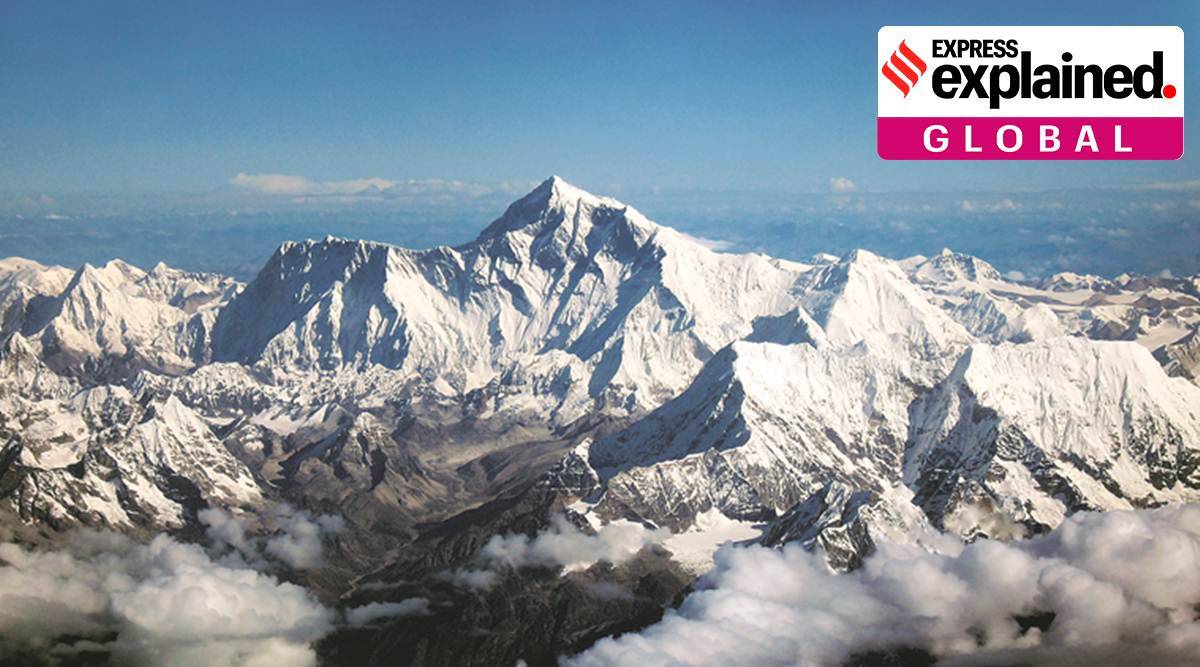
 In 1954, the Survey of India determined that the elevation of Everest is 8,848 m (29,028 ft). This came to be recognised worldwide. Except by China. (File)
On December 8, Mount Everest got a new announced elevation at 8,848.86 m above sea level — or 86 cm higher than the previously recognised 8,848 m. Nepal and China jointly announced the new elevation, the result of a survey, in the process also settling a dispute between the two countries.
Measurements over the years
In 1856, during the Great Trigonometrical Survey, Indian mathematician Radhanath Sikdar determined Everest is the highest mountain in the world. Until the advent of GPS, attempts to measure its height used instruments such as the theodolite and the surveyor’s chain, and trigonometrical calculations.
In 1954, the Survey of India determined that the elevation of Everest is 8,848 m (29,028 ft). This came to be recognised worldwide. Except by China.
China’s contention was that the elevation of Everest should be taken as 8,844 m (29,017 ft) — 4 m shorter than the recognised elevation. This was the finding of a Chinese survey in 2005.
And while the mountain rises from the border between Nepal and China, there was also a third estimate from far away, which was even higher. In 1999, a US team put the elevation at 29,035 feet (nearly 8,850 m). This survey was sponsored by the National Geographic Society (of the US) and it will still be used by the Society until the new measurement is verified, National Geographic reported on Tuesday.
In addition to varying measurements, “there also are philosophical differences about whether Everest’s snow cap should count toward its heightâ€, the Wall Street Journal noted in a 2011 article.
Nevertheless, it was the Survey of India’s 1954 finding of 8,848 m that has been the gold standard internationally. Until now.
The newest elevation
The elevation announced on Tuesday is the finding of a survey to put the final, definitive word on the mountain’s elevation. The survey was also necessary because the height of the mountain was believed to have changed after a devastating earthquake (magnitude 7.8) that hit Nepal in 2015.
China and Nepal have conducted their own surveys. According to the South China Morning Post, the two sides have been comparing notes to lay to rest the long-running controversy.
The measurements by the Survey Department of Nepal, completed last year, deployed elaborate, multiple techniques. A team scaled Everest and deployed a GPS receiver, along with radar to measure the depth of the snow. At eight other sites, teams captured views of the summit to determine its elevation with modern laser theodolites, National Geographic reported.
📣 Express Explained is now on Telegram. Click here to join our channel (@ieexplained) and stay updated with the latest
Later last year, it emerged that China and Nepal would cooperate in re-surveying the mountain, delaying the revelation of the new height. The Chinese survey was conducted on the north side of the mountain this year, and used China’s network of Beidou satellites.
Tuesday’s announcement came in a joint statement by the Survey Department of Nepal and Chinese authorities.
© IE Online Media Services Pvt Ltd
Discover more from PressNewsAgency
Subscribe to get the latest posts sent to your email.