

Terms of reference
The court has set seven terms of reference for the committee, which are essentially facts that need to be ascertained to decide the issue.
These range from determining who procured Pegasus and whether the petitioners in the case were indeed targeted by use of the software, to what laws justify the use of such spyware against citizens.
The court has also asked the committee to make recommendations on a legal and policy framework on cyber security to ensure the right to privacy of citizens is protected.
Newsletter | Click to get the day’s best explainers in your inbox
The committee is expected to submit its report in eight weeks.

Why a committee?
Decisions in cases seeking enforcement of fundamental rights are based on facts. The task of determining these facts, when they are disputed or unknown, are often assigned to committees, which act as an agent of the court. Such committees or fact-finding teams can summon individuals, prepare ground reports, and inform the court.
The government has rejected the global media investigation into the use of Pegasus, but has not supplied any facts in the matter. The case involves technical questions, and requires extensive fact-finding for the court to determine whether fundamental rights were violated, and to pass suitable orders. The Centre’s refusal to file an additional affidavit means the court will require more assistance from the committee.
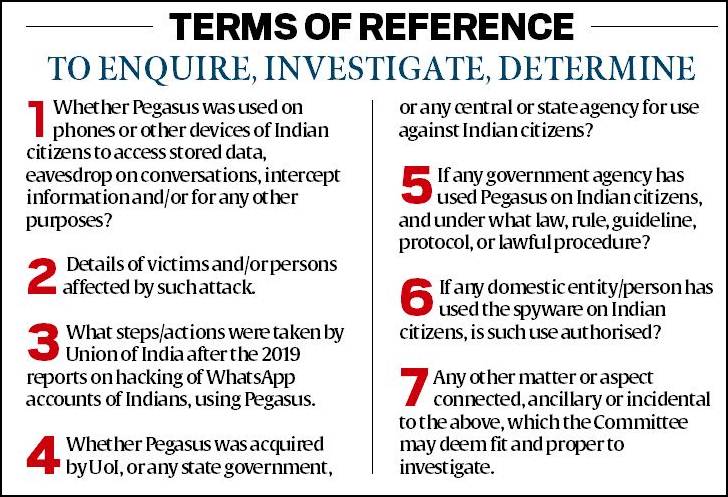
Once the committee answers the fact-based questions, the court will examine questions such as: If the government indeed used Pegasus, can it be justified under law? If not, what relief must be granted to the petitioners?
Will government respond?
The government had argued that since matters of national security were involved, it would not file any further affidavit in the case, but it would be willing to disclose all information before a committee of technical experts.
However, the government had sought to appoint the technical committee itself — which the court has not allowed, saying “such a course of action would violate the settled judicial principle against bias, i.e., that ‘justice must not only be done, but also be seen to be done’.â€
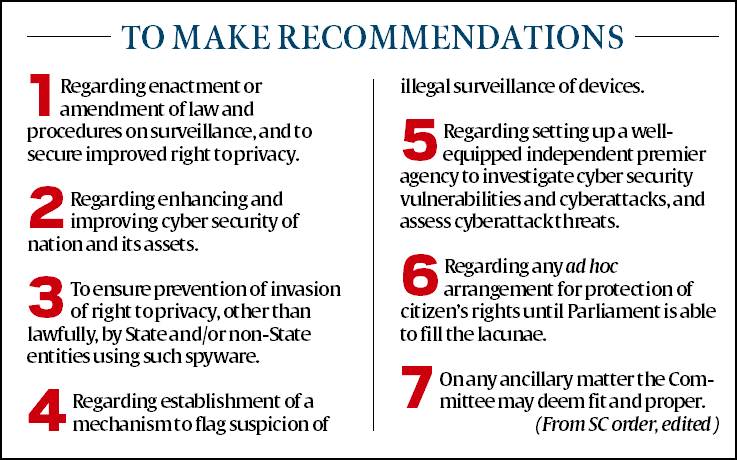
Justice Raveendran’s committee could now seek the government’s response afresh. However, probe committees set up by courts into government excesses — such as extra-judicial killings — are often faced by a lack of cooperation from the government.
Committees, therefore, often engage with other parties and stakeholders; the Justice Raveendran panel has been empowered to “take the assistance of any serving or retired officer(s), legal expert(s) or technical expert(s)â€.
The West Bengal panel
In July, the West Bengal government set up a Commission of Inquiry comprising former Supreme Court Justice Madan B Lokur and former Calcutta High Court Justice Jyotirmay Bhattacharya to look into the same allegations.
Although the Supreme Court has not stayed this probe, the West Bengal government has told the court that it would voluntarily pause it, and that “nothing will happen†till the SC hears the batch of PILs on Pegasus.
Discover more from PressNewsAgency
Subscribe to get the latest posts sent to your email.