

The Indian Prime Minister is in the US and the atmosphere is saturated with optimism and hope for what the two countries can achieve together. From the Indian perspective, there is much to be gained from the US both from the perspective of countering China and otherwise.
However, there are some policy choices that India should not learn from the US. One of them has to do with how to prevent poverty from spreading from one generation to the next. That’s because even though The United States is the largest economy in the world and has the highest per capita income — and should, as such, be India’s policy guide on how to become a richer country at a time when Prime Minister Modi has decided to make India a developed country in the next 25 years — new research shows that the US does rather poorly in alleviating intergenerational poverty compared to other rich countries.
Intergenerational poverty essentially refers to the probability that children who grow up in poverty end up living in poverty as adults. There is overwhelming evidence to suggest that children exposed to poverty are more likely, compared with children who are not exposed to poverty, to end up poor even in their adult lives. But it is also true that this “persistence” of poverty from one generation to the next is weaker the richer a country is.
Of course, in any rapidly growing country or economy, one would expect this probability to weaken more and more as time goes on. In rich countries, compared to poor countries, this probability should be lower.
However, even within rich countries, there must be a gradation, and it would tell us a lot about different rich economies, such as the United States.
According to a new research paper, titled “The Intergenerational Persistence of Poverty in High-Income Countries” and published by the IZA Institute for Labor Economics, the intergenerational persistence of poverty is notably stronger in the US relative to other high-income countries.
“Spending an entire childhood in poverty in the US is associated with a 43 percentage point increase in the median poverty rate in early adulthood (ages 25-35),” says the study by Zachary Parolin , Rafael Pintro Schmitt, Gøsta Esping-Andersen. (all three associated with Bocconi University) and Peter Fallesen (Rockwool Foundation and Stockholm University).
He TABLE next to it captures the findings.
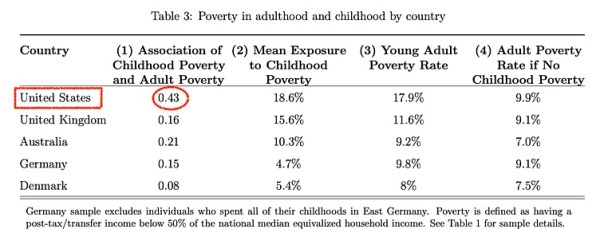
Column 1 of the table shows that the intergenerational persistence of poverty is 0.43 in the US. According to the authors, this indicates that if a child spent their entire childhood in poverty in the US, they are more likely to who is also a poor adult. To be precise, he is 43 percentage points more likely than a child with no exposure to poverty.
Compared to other rich countries, this level of probability is quite high. “This is four times stronger than in Denmark and Germany, and more than twice as strong as in Australia and the UK,” they state.
Contradictory as it may seem, this finding – that a poor child in the US is much more likely to remain poor when they grow up than a poor child in other rich countries – is not where the key lesson for India lies.

What India needs to learn (or not learn) from US policy choices is found in the paper’s second finding. The researchers also investigated the question: What explains the greater persistence of intergenerational poverty in the US relative to other rich countries?
Of course, a poor child can become a poor adult for a variety of reasons.
For example, you may not get a decent education because your parents did not have enough money to meet both daily consumption and educational needs.
Similarly, it could also be that some families, even if they have the same resources or resource limitations, tend to value education more than others. Some parents may value consumption and leisure more than investments in their children.
So where a child grows up could also play a crucial role. Some neighborhoods or areas are especially disadvantaged and it is difficult to get out of that.
Similarly, the ability or inability to earn an educational degree and the chances that such degrees will help overcome poverty are also crucial factors in determining which child can beat the odds. This group of factors is called the mediation effect.
But beyond all these factors there is also a political factor and it refers to the role of taxes and government money transfers. The authors state that direct government revenue transfers are considered among the most powerful interventions to address poverty and inequality.
When the authors broke down all of these reasons, this is what they found: “The US’s comparative disadvantage is not driven by family history effects or mediation effects; instead, the US disadvantage is rooted in weaker tax/transfer insurance effects and a stronger residual poverty penalty. While Denmark and the UK use taxes/transfers to reduce intergenerational poverty persistence by 10 and 16 percentage points, respectively, the US reduction is only 2 percentage points through taxes/transfers.
This is shown in the CHART where the persistence of intergenerational poverty (black bar) is shown together with the factors that explain it. In all countries, the effect of government tax and transfer policies (blue bar) has an effect in reducing this persistence of poverty. But this effect is weaker in the US, and considerably so.


The authors conclude that the greater persistence of intergenerational poverty in the US is primarily due to the US’s comparatively weak welfare state. They argue that if the US government used its taxes and transfers in the same way than the UK does, would have reduced persistence by a third of current levels.
Result?
The United States has long been held up as an example of how an economy should grow. To a large extent, this has been justified by its long record of strong economic growth. But at the same time, the US has also witnessed rising inequalities. The high persistence of intergenerational poverty is just another example of what afflicts the political decisions of the United States.
For India, already the country with the most people living in extreme poverty and one of the most unequal nations on the planet, the US may be a poor role model when it comes to breaking the shackles of poverty. poverty. If India does not actively use its tax and spending policies in a way that reduces the persistence of poverty, it will witness a further worsening of inequalities in society.
See you tomorrow,
kanakanmani
Discover more from PressNewsAgency
Subscribe to get the latest posts sent to your email.