
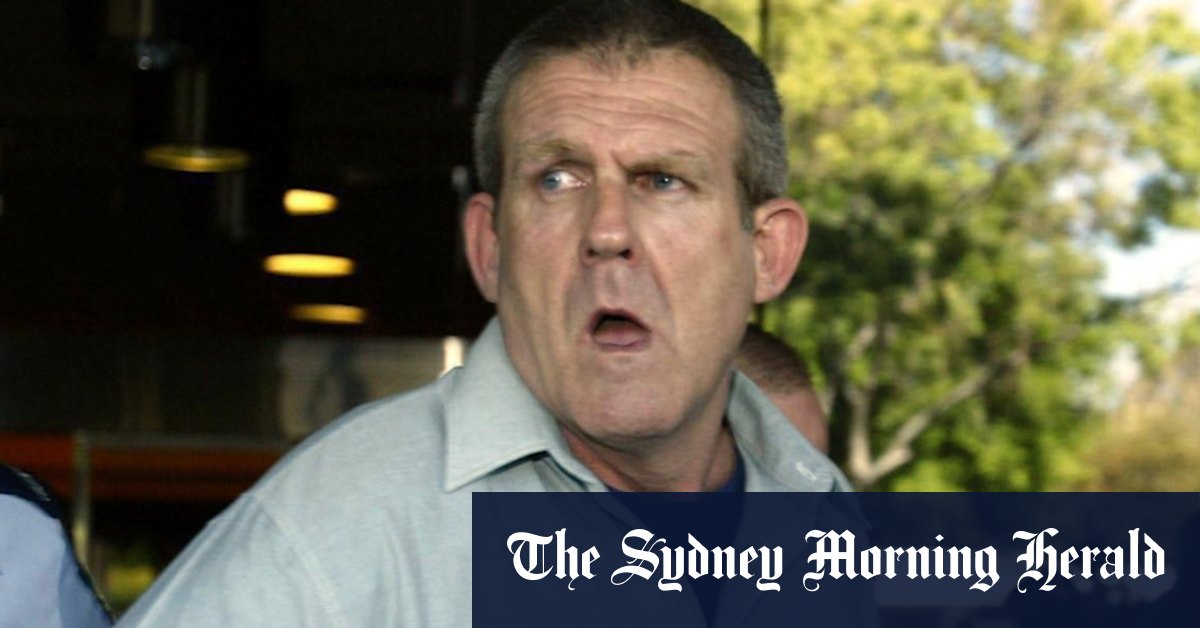
“He was deeply loved. He will be deeply missed,” the statement concluded.
But the former Northern Territory police officer who led the investigation, Colleen Gwynne, said Murdoch’s “prolonged refusal” to cooperate with police to provide the information needed to find Peter Falconio’s body had caused “prolonged … agony to the Falconio family”.
“It’s something that’s with them every day … and you can hear it in their voice,” she told ABC’s News Breakfast on Wednesday.
Police say Falconio was shot on a remote stretch of the Stuart Highway near Barrow Creek, about 300 kilometres north of Alice Springs, in July 2001. Falconio’s blood was found where police believe he was murdered before his body was moved.
The British backpacker was travelling around the country with his girlfriend Joanne Lees, who survived Murdoch’s attack. The pair, both from Yorkshire, had travelled across South-East Asia before arriving in Australia.
Lees told police that at about 7pm on July 14, 2001, the pair became aware that a car was following them as they travelled north up the Stuart Highway towards Devil’s Marbles in their orange Kombi van.
Driving a white Toyota 4WD ute, Murdoch gestured at Falconio, who was driving the van, to pull over, which he did. Murdoch then told Falconio he’d seen sparks shooting out of the Kombi’s exhaust.
Lees was sitting in the front of the parked van when the two men went to examine the exhaust, and she heard a loud bang. Murdoch then appeared in the front window, brandishing a silver handgun, which he pointed at Lees’ head.
“I just kept thinking this was not happening to me. I couldn’t believe that this was happening. I felt alone. I kept shouting for Pete and thought I was going to die,” Lees told the jury at Murdoch’s 2005 trial.
“I was more scared of being raped than being shot by the man,” she said.
Murdoch moved Lees to his vehicle and tied her wrists behind her back, punching her in the head as she struggled. Murdoch then became distracted, with Lees reporting that she heard “gravel scraping on the ground, as if he was moving something”.
Lees slid out of the vehicle, dropped to the ground and scrambled to a hiding spot behind a bush where she stayed for up to five hours in the dark. Once she was sure Murdoch was gone, she flagged down a truck that took her to Barrow Creek.
A widespread manhunt was launched, and the search for Falconio’s body began. The case received intense media interest, both in Australia and the UK, with Lees facing particular scrutiny over her recounting of the attack.
The murder is cited as one of the inspirations for the 2005 Australian horror film Wolf Creek.
The first breakthrough came early in the investigation when a man reported that Bradley John Murdoch was responsible for the crimes.
Murdoch was under arrest in South Australia, facing charges over the abduction and rape of a 12-year-old girl and her mother. A DNA sample was taken in the hopes it could be linked to evidence found at the Northern Territory crime scenes.
While Murdoch has always maintained his innocence, his defence was ultimately undone by his decision to keep an elastic hair tie that belonged to Lees, which an officer had noticed wrapped around Murdoch’s holster in a search of his positions. Gwynne speculated to the ABC in 2016 that he might have kept it as a “trophy”.
In 2003, Murdoch was acquitted of the South Australia rapes and immediately rearrested and extradited to the Northern Territory, where he was charged with Falconio’s murder.
In 2005, Bradley John Murdoch was convicted of murdering Falconio, and assaulting and attempting to kidnap Lees. He was serving a life sentence in Alice Springs prison with a non-parole period of 28 years when he died.
A court sketch of Bradley John Murdoch giving evidence during the trialCredit: Liz Howell
“Your conduct in murdering Mr Falconio and attacking Ms Lees was nothing short of cowardly in the extreme,” Northern Territory Supreme Court Justice Brian Martin said in his sentencing.
Murdoch never revealed the location of Falconio’s body, and under the Northern Territory’s 2016 “no body, no parole laws”, he may have never been granted parole.
On Wednesday, Gwynne told the ABC Murdoch’s refusal to disclose the details of what he had done with Falconio’s body was evidence of his “narcissistic” personality.
“The night that Joanne escaped and we lost Peter, he lost control. And as a result of that, he felt wronged, and he felt angry.
Loading
“[His way] to gain some control was to never cooperate, and to have that power over the Falconio family by not disclosing any details of what he did with Peter to allow us to narrow that search.”
Murdoch twice appealed to overturn his convictions, but was unsuccessful.
Born in the West Australian town of Northampton in 1958, Murdoch spent most of his life in Broome working as a mechanic.
Murdoch had a history of violent crime, serving time in a Western Australian jail in the mid-1990s for shooting at a crowd of Aboriginal football fans.
As with all deaths in custody, Murdoch’s death will be investigated by the Northern Territory Coroner.
On Tuesday this week, Luciano Falconio pleaded for assistance in locating his son’s body so that Peter could be buried while he and his wife are still alive.
“I still hope, yeah I still hope, but I don’t know if we [will] live long enough”, he told News Corp.
“I wish I could find him and make an end to it, bury him.”

Luciano Falconio and Peter’s brother Paul visit the bush crime scene on July 19, 2001, five days after the murder.Credit: AAPIMAGE
In a statement, NT Police said it was “deeply regrettable” that Murdoch had died without ever disclosing the location of Peter Falconio’s remains.
“His silence has denied the Falconio family the closure they have so long deserved. Our thoughts are with the Falconio family in the United Kingdom, whose grief continues,” the statement read.
“The Northern Territory Police Force remains committed to resolving this final piece of the investigation.”
Less than a month ago, NT Police upped its cash reward to $500,000 for information that would lead to the discovery of Falconio’s remains.
Loading
“We recognise the passage of time that’s transpired, however it’s never too late to reach out and start that conversation with police,” NT Police Acting Commander Mark Grieve told a press conference on June 25, adding that he still had hope.
“You just never know how beneficial that information that you may hold, may be – essentially, you just don’t know what you know.”
The renewed bid for information was made amid reports that Murdoch was in palliative care in Alice Springs Hospital.
Grieve said Murdoch had never positively engaged with the police despite “numerous approaches” including in the same week.
“There may be someone out there that he’s confided in – whether that’s family and friends – we just don’t know,” Grieve said.
“We think there’s still people out there that may hold some information.”
The Morning Edition newsletter is our guide to the day’s most important and interesting stories, analysis and insights. Sign up here.
Discover more from PressNewsAgency
Subscribe to get the latest posts sent to your email.