

FinMin shares current account surplus of $72m, IT exports at $4.5b as economy shows broad-based recovery
Finance Minister Muhammad Aurangzeb unveiled the Pakistan Economic Survey on Thursday, reporting that the economy grew at 3.7% during the fiscal year – the highest rate recorded in the past four years – despite floods, regional conflict and global uncertainty.
“There was uncertainty surrounding tariffs, while two other unexpected developments also emerged,” Aurangzeb said, adding that Pakistan faced three major challenges and addressed them effectively. “These factors affected not only Pakistan and the region but the entire world,” he said, noting that global growth had also slowed.
The finance minister said there had been a broad consensus that GDP growth would exceed 4%, but the conflict in the Middle East affected the outlook. “We have not only increased the size of the economy but also achieved broad-based recovery,” he said, adding that the country had reached the largest economic size in its history.
Per capita income has reached $1,901. The agriculture sector recorded growth of 2.9%, with good growth seen in the crops sector.
Aurangzeb said 16 of the country’s 22 manufacturing sectors recorded growth during the current fiscal year. Large-scale manufacturing growth hit 6.1%, the highest in four years. “The services sector also recorded its highest growth in four years,” he noted.
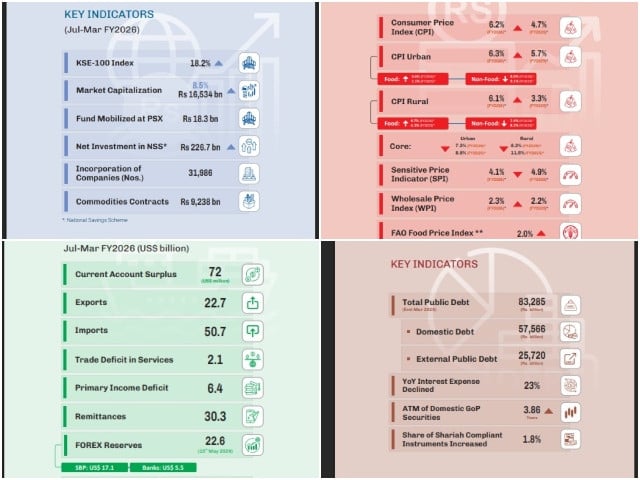
“The ”fiscal deficit stood at 0.7% of GDP, while the primary balance remained in surplus. Federal Board of Revenue (FBR) revenues increased by 10.1%, and the current account posted a surplus of $72 million.
“Remittances have played a very important role,” Aurangzeb said. He noted that freelance exports are exceeding $900 million, and IT exports reached $4.5 billion. Foreign exchange reserves stand above $17 billion, with the State Bank governor expecting them to exceed $18 billion by June.
The finance minister also highlighted that Pakistan-made footballs will be used in the upcoming FIFA World Cup. He said 175,000 new investors have entered the equity sector, and for the first time in 20 years, 11 initial public offerings (IPOs) have been completed this year.
It is often mentioned that some companies have left the country, but at the same time, many global firms including Aramco, Alibaba, Turkish Petroleum, Veon and Google, have also increased their investments, he said. “We remain in contact with all friendly countries, including Saudi Arabia and China,” he added.
He said 40 to 45% of the debt is concessional, long-term and bilateral, and the debt-to-GDP ratio is continuously declining.
Planning Minister Ahsan Iqbal said Pakistan has failed to build an export-led economy. “Nine million overseas Pakistanis send $40 billion annually while 250 resident Pakistanis make only around $40 billion in exports,” he said. “Exports must meet our external sector requirement, which is a structural flaw as the country couldn’t achieve that.”
He stressed that political consistency is essential for growth, evident in all neighbouring countries. “Either we will crawl or leapfrog – we cannot afford to crawl now,” Iqbal said, adding that Pakistan receives only $1.5 billion to $2 billion in foreign direct investment due to a lack of policy continuity.
While giving a brief overview, the finance minister said Pakistan entered the current financial year in July amid trade uncertainty, mainly due to global tariff discussions.
“How would the world’s tariffs be dealt with? And by the end of July, we had reached a point where we could get into a competitive position with respect to our exports, especially to the US. After that, we saw a flood in August and September. And in October, there was a rescue and relief effort,” he added.
Aurangzeb said the country also faced a regional conflict in March, describing these as “three exogenous factors” that were not anticipated at the time of last year’s budget.
“These are the challenges we faced during the year. They tested the resilience of Pakistan. We faced them properly and remained on the trajectory from stabilisation towards growth, and we remained steadfast on that journey,” he said.
Discover more from PressNewsAgency
Subscribe to get the latest posts sent to your email.