

The French Senate has approved the proposal of President Emmanuel Macron unpopular pension reform plan while hundreds of thousands of protesters rallied in cities across the country to oppose the changes.
Senators voted late on Saturday to adopt the reforms by 195 to 112, bringing the package, whose key measure is to raise the retirement age by two years to 64, closer to becoming law.
“After hundreds of hours of discussions, the Senate approved the pension reform plan. It is a key step to make a reform that will guarantee the future of our pension system a reality,” Prime Minister Elisabeth Borne wrote on Twitter.
She added that she was “totally committed to the final adoption of the text in the coming days.”
Now that the Senate has adopted the bill, it will be reviewed by a joint committee of lawmakers from the upper and lower houses, probably on Wednesday.
If the committee agrees to a text, a final vote in both chambers is likely to take place on Thursday. But the outcome of that still looks uncertain in the lower house, the National Assembly, where Macron’s party needs the votes of allies to win a majority.
If the government fears it will not have enough votes in the lower house, it may still pass the text without a parliamentary vote through a little-used and highly controversial constitutional tool known as Article 49:3.
‘Now or never’
Unions, which have fiercely opposed the measures, were still hoping on Saturday to force Macron to back down, though the day’s protests against the reform were much smaller than some before.
According to figures from the Ministry of the Interior, 368,000 protesters marched on Saturday through various cities. Officials expected up to a million people to participate afterward. a record 1.28 million people demonstrated on the streets earlier in the week.
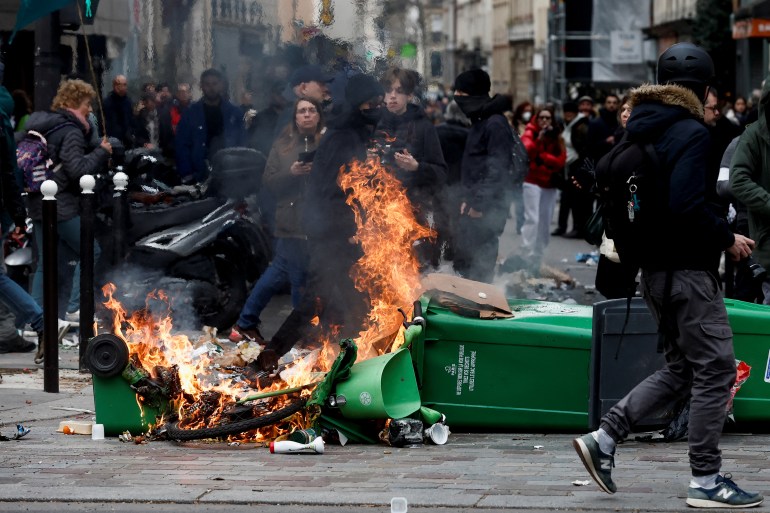
Tensions flared on Saturday night when Paris police said they had made 32 arrests after some protesters threw objects at security forces, including trash bins burned and windows broken.
In a joint statement, the French unions, maintaining a rare show of unity since the protest movement was launched at the end of Januaryurged the government to organize a “citizen consultation” as soon as possible.
The unions said they plan to keep up the pressure with an additional day of nationwide strikes and protests scheduled for Wednesday.
“This is the final stretch,” Marylise Leon, deputy leader of the CFDT union, told broadcaster Franceinfo. “A lot of things can still happen next week,” she said. “Will the text be voted on in the National Assembly? We have to get together. It’s now or never.”
Opinion polls show a majority of voters oppose Macron’s plan, while a slim majority support strike action. Most people, however, said they believed the president would end up getting the bill passed.
The government insists the reform plan is essential to ensure France’s pension system doesn’t run out of money, but many see the changes, such as raising the retirement age, as unfair to people who started working young. .
“I am here to fight for my colleagues and for our young people,” said Claude Jeanvoine, 63, a retired train driver demonstrating in Strasbourg in eastern France.
“People should not let the government get away with it, it is about the future of their children and grandchildren,” he told the AFP news agency.
The reforms would also increase the number of years people have to make contributions to receive a full pension. The protesters say that women, especially mothers, are also disadvantaged by the new reforms.
“If I had known this was coming, I wouldn’t have stopped working to take care of my children when they were little,” said Sophie Merle, a 50-year-old childcare provider in the southern city of Marseille.
rolling strikes
Ongoing protests and strikes have affected various sectors of the French economy, including rail and air transport, power plants, natural gas terminals and garbage collection.
A TotalEnergies spokesman said strikes were continuing at the oil producer’s French refineries and warehouses, while public rail operator SNCF said national and regional services would remain heavily disrupted over the weekend.
In Paris, garbage continues to accumulate on the streets and residents see a growing presence of rats, according to local media.
National power production in France fell by 7.1 gigawatts, or 14 percent, at nuclear, thermal and hydroelectric plants on Saturday due to strikes, a CGT union spokesman told Reuters news agency.
Maintenance at six French nuclear reactors, including Penly 1, was also blocked, the spokesman said.
Despite protests and strikes, Macron twice this week rejected urgent calls from unions to meet him in a last-ditch attempt to change his mind.
The slight made the unions very angry, said Philippe Martinez, head of the left-wing CGT union.
“When there are millions of people in the streets, when there are strikes and the only thing we get from the other side is silence, people ask: What else do we have to do to be heard?” he told her, calling for a referendum on pension reform.
Discover more from PressNewsAgency
Subscribe to get the latest posts sent to your email.