

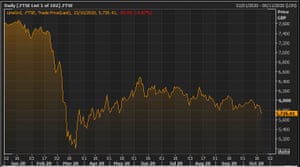
There’s a rather gloomy mood in the City today, as investors watch the FTSE 100 fall to levels not seen since the UK economy was emerging from lockdown.
Fiona Cincotta of City Index points out that the economic pain of the pandemic is rising, as new restrictions are imposed.
Covid cases in the UK and across Europe continue to surge. More areas of the UK are moving into the strictest Tier 3 lockdown, in a move to stem the spread of the virus but will also derail the fragile economic recovery of those areas and potentially the UK as a whole.
The tighter restrictions come as the FCA warns that around 12 million Britain’s are likely to struggle with bills and in repayments as the covid pandemic continues.
Stephen Innes of AXI says the US election race is also hitting equities:
With the pandemic firmly in everybody’s life again and the major macro event of the year just weeks away from its final decision, markets will probably trend more volatile and tack in a defensive manner.
Joshua Mahony
(@JMahony_IG)FTSE down in a new 5-month low. Watch descending channel for potential support down below pic.twitter.com/7Wpgl9TOWg
David Buik
(@truemagic68)At 8.05am – FTSE 100 – 5,742.72 −33.78 (-0.58%) – IAG down 4.95% at 95.48p – Unilever +0.64% – The mood is turgid – Covid19, global debt, US stimulus package delayed, earnings mixed and market has “a monkey on its back!”
Updated
European markets hit one-month low
The latest rise in Covid-19 cases, and the lack of a US stimulus breakthrough, are both weighing on markets across Europe.
The Stoxx 600 index, which tracks the largest European companies, has fallen by 1% to its lowest level since late September.
Germany’s DAX has slumped by 1.6%, with France’s CAC 1.4% lower.
Every sector is down, led by technology, consumer cyclicals, healthcare and industrial stocks.

FTSE 100 hits five-month low
Newsflash: Britain’s FTSE 100 index has slumped to its lowest level since early May, hit by worries over the economic cost of Covid-19.
The blue-chip index has fallen by 50 points, or nearly 1%, to 5723 points – a five-month low.
Stocks most badly hit by the pandemic are among the top fallers. IAG has lost 4%, with office developers British Land and Land Securities both losing 3.1%.
Jet engine maker (and servicer) Rolls-Royce has shed 2.5%, following BA’s decision to cut capacity in the next few months.
The Footsie is also suffering from the pound’s strength this week. Sterling jumped two cents yesterday to $1.313, on reports that negotiations on a trade deal would restart. That pulls down the value of multinationals with large overseas earnings.
Updated
IAG to cut capacity after posting £1.2bn loss
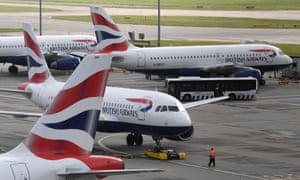
The Covid-19 crisis has dragged airline group IAG, the owner of British Airways, deep into the red – and forced the group to cut capacity over the next few months.
IAG told the City this morning that it made a £1.2bn loss in the last quarter – worse than expected – as the pandemic continues to hammer the air travel industry.
IAG’s third-quarter revenues were 83% lower than a year ago, with passenger numbers down 88%.
And in a sign that conditions remain very weak, IAG now plans to run just 30% as many planes as a year ago for the rest of 2020 [the previous goal was 60% capacity].
It told shareholders:
Recent overall bookings have not developed as previously expected due to additional measures implemented by many European governments in response to a second wave of COVID-19 infections, including an increase in local lockdowns and extension of quarantine requirements to travellers from an increasing number of countries.
At the same time, initiatives designed to replace quarantine periods and increase customer confidence to book and travel, such as pre-departure testing and air corridor arrangements, have not been adopted by governments as quickly as anticipated.
LBC News
(@LBCNews)British Airways’ parent company IAG has announced its flight capacity between October and December will be “no more than 30%” of what it was during the same period in 2019.
Scott Beasley
(@SkyScottBeasley)✈️ NEW: BA owner IAG reports loss of €1.3 billion in July to September
📉 Revenue ⬇️ 83% to €1.2bn from €7.3bn last year
💶 Loss was swing from €1.4bn profit last year
📉 Passengers ⬇️ 88% on last year
🛫 Capacity for October to December will now be just 30% of last year
Discover more from PressNewsAgency
Subscribe to get the latest posts sent to your email.