

Reid said he understands protesters. He said he also understands the hurt of an officer in a situation where circumstances actually call for the use of deadly force. He killed a man in October who, after crashing his car, refused Reid’s command to show his hands and approached him aggressively with an object Reid thought was a gun. It turned out to be a hammer.
Reid returned to work after an internal investigation found he acted in a “legal, justified and reasonable manner.”

“When you ask me to stand between society and those who would do harm, it’s not always safe. … A part of me died that day. It is hard every day, but the reason I continue is, I’ve got a wife and kids and other family and friends, and I’m going to be the one to make sure they are safe by continuing to do this job.â€
Reid said he had some positive exchanges with peaceful protesters on Saturday. He encouraged those who are angered over Floyd’s death or societal injustice to take additional steps.
“I want us to petition the government and for grievances to be heard, but we can’t just talk about the grievances. We have to take that next step. I challenge people in the community who want to organize and do those things to come together so we can come up with solutions … We can build a better community together, but a partnership goes two ways.â€
ITHACA, New York
Matthew Steecker, Ithaca Journal

Hundreds of members of the Cornell University community marched from campus to the Ithaca Commons and the police department, a continuation of protests in Ithaca.
Others promised protest would be a weekly occurrence in Tompkins County.
“George Floyd became the catalyst because of the egregiousness of his death, the blatant disregard of life and the confidence of the police who murdered him, and the system they are a part of that supports that act,†said Onyinyechukwu Nnodum, a member of Black Students United.
STOCKTON, California
— Scott Linesburgh, The Stockton Record

Alayssia Townsell, a 19-year-old Stockton native and UCLA freshman, says lasting change will require more than a large gathering and chants for justice. The real battle is about ideas and actual reforms that can prevent tragedies like Floyd’s death and so many others before. “There’s always room for change if you have enough people advocating for it,†Townsell said after protests that drew 1,000 people. “It’s difficult. But I think it’s possible and you have to try.â€
Protest organizers are advocating for widespread measures, including the addition of ethnic studies in the curriculums of schools, removal of cops from campuses and reopening cases against police brutality. What’s vital, she said, is not waiting for others to speak up.
WILMINGTON, North Carolina
Gareth McGrath, Wilmington StarNews
Peacemaker.
Lily Nicole didn’t envision playing that role when she joined the George Floyd protest in downtown Wilmington Sunday night. She went worried about what might happen, knowing it wasn’t an organized event like Saturday’s peaceful protest that was sponsored by several black community groups. Talking to friends and watching social media, Nicole also knew a lot of young people were planning to attend.
“I wanted to be there for the kids if something happened,†said the self-declared community activist, who is black.

As tensions began to rise between police and protesters, Nicole stepped up to defuse the situation — at one point speaking with Interim Wilmington Police Chief Donny Williams on the police line.
Tear gas was eventually fired, much to her frustration, but Nicole likely helped with a situation that could have gone much worse. She intervened, she said, “because nobody else was. I just wanted to see if I could try.â€
Nicole, who works at Wilmington’s historic Thalian Hall theater, attended the University of North Carolina Wilmington and has remained in the Port City since graduating. Now in her early 30s, Nicole said she has seen lots of change in the fast-growing city — mostly for the good.
But like many of the country’s urban areas, there are pockets of inequality. And being a Southern city, physical and social vestiges of segregation remain.
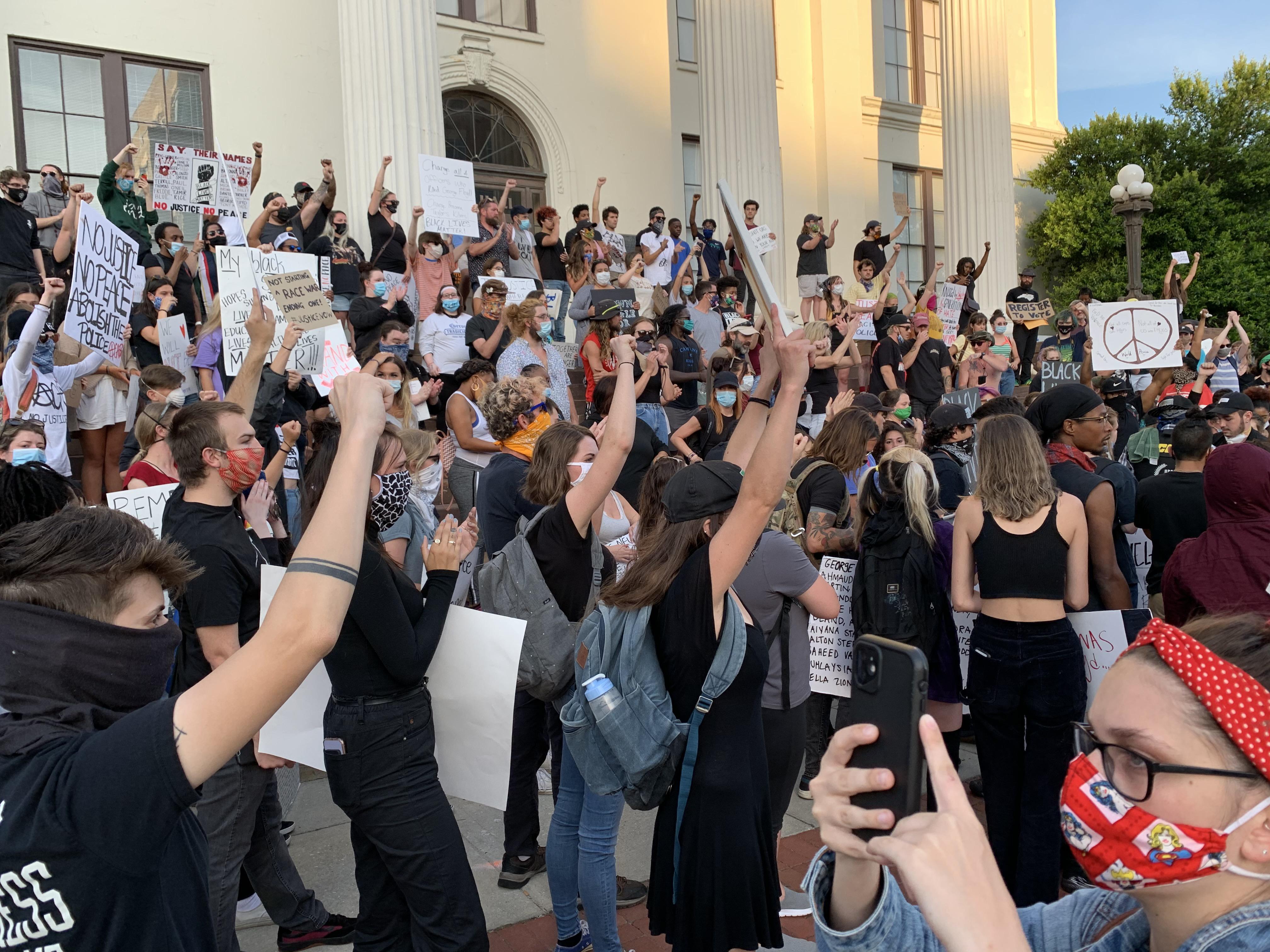
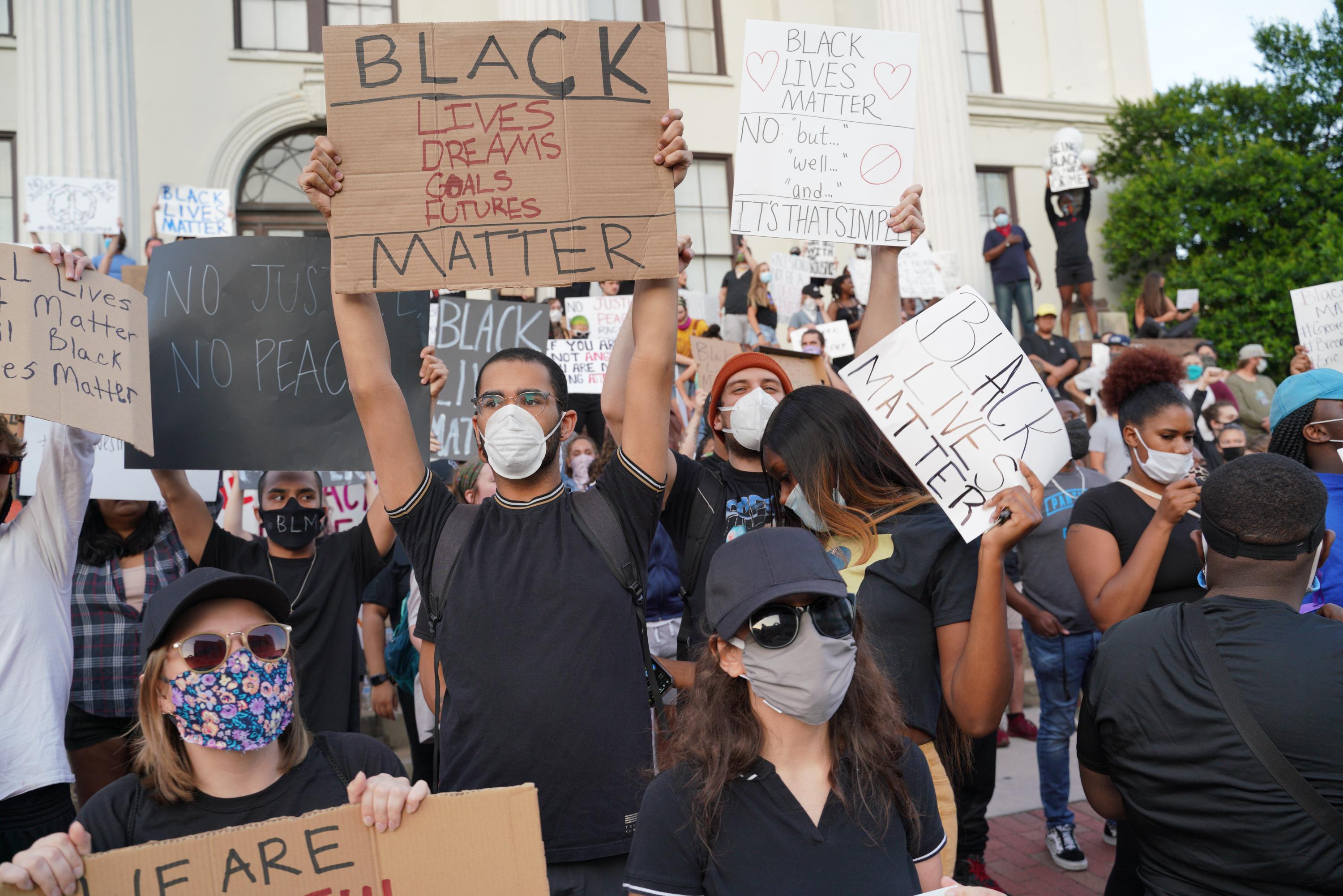
Protesters unite at City Hall in Wilmington for another day of demonstrations June 2 in the wake of the death of George Floyd.
Protesters unite at City Hall in Wilmington for another day of demonstrations June 2 in the wake of the death of George Floyd.
KEN OOTS/Wilmington STAR-NEWS
Nicole said she has been pleasantly surprised at the cross-section of Wilmington that has come out to join the protests, seeking not just equality in the eyes of law enforcement but social and political justice, too. She just hopes city leaders are paying attention.
“Come find out, come talk to us,†Nicole said, lamenting that Wilmington’s political elite has been noticeably absent from the protests. “Everyone has different reasons, but overall it’s for change.
“The community is begging for you to listen.â€
Nicole said she doesn’t know when or how the protests will end. But she knows she and the other protesters won’t let things go back to the way they were.
“We need open communication, and we need accountability,†she said. “There’s an obvious vacuum there.â€
SAVANNAH, Georgia
Mary Landers, Savannah Morning News
Savannah’s mayor was racially profiled this year while escorting a youth group to New York. “I didn’t do anything,†said Van Johnson, the 67th mayor of Savannah. This “officer came, jumped out of his car and came in my face and was threatening me.â€
But as bigger cities around the country erupted in protest and some in violence over the police killing of George Floyd in Minneapolis, the mayor of Savannah relied on his experiences and his empathy to guide his majority-black city.

“Before I became mayor of the city, I was a black man and I will remain a black man,†said Johnson, speaking in the quiet council chambers of Savannah’s City Hall days after the rally in front of the gold-domed building. “Secondly, I have training and experience in the area of law enforcement. So I understood it from a law enforcement perspective. And then finally, as a mayor of a community that is predominately African American, I also recognize then that this was also a matter that was very concerning to our community.â€
Johnson, 51, grew up in Brooklyn, came to Savannah at 16 for college and never left. He was a county police officer for about a year then served as a reserve sheriff’s deputy for almost 20 years while pursuing a career in human resources.
“I understand that the officer, at the end of the day, wants to go home, too,†he said. A four-term alderman, he’s five months into his new role as mayor.
Savannah was primed to react to Floyd’s killing in part because the high-profile killing of another black man, jogger Ahmaud Arbery, took place in Brunswick, an hour down the coast.
When Johnson heard rumors of a protest taking shape, he stepped in to guide it, calling a press conference the night before to clarify what would happen. He invited clergy to join him, and more than 100 showed up. They walked together from the historic First African Baptist Church to the May 31 rally, many in their clerical collars or robes.
Thousands of Savannah-area residents streamed into the historic downtown area. Johnson addressed them from the steps of City Hall, speaking “from the heart,†without notes.
“Protests are usually based on emotion,†he said afterward. “And we know from the various ones that have happened across the country. The protests come — they’re there. They happen. The emotion goes away. People go back to their business is always what happens next. And I remember saying that today is the moment, tomorrow is the movement.â€
At the rally he announced a blue-ribbon panel to study disparities in Savannah.
“Because I think you have to have facts, data to quantify the perceptions,†he said afterward.
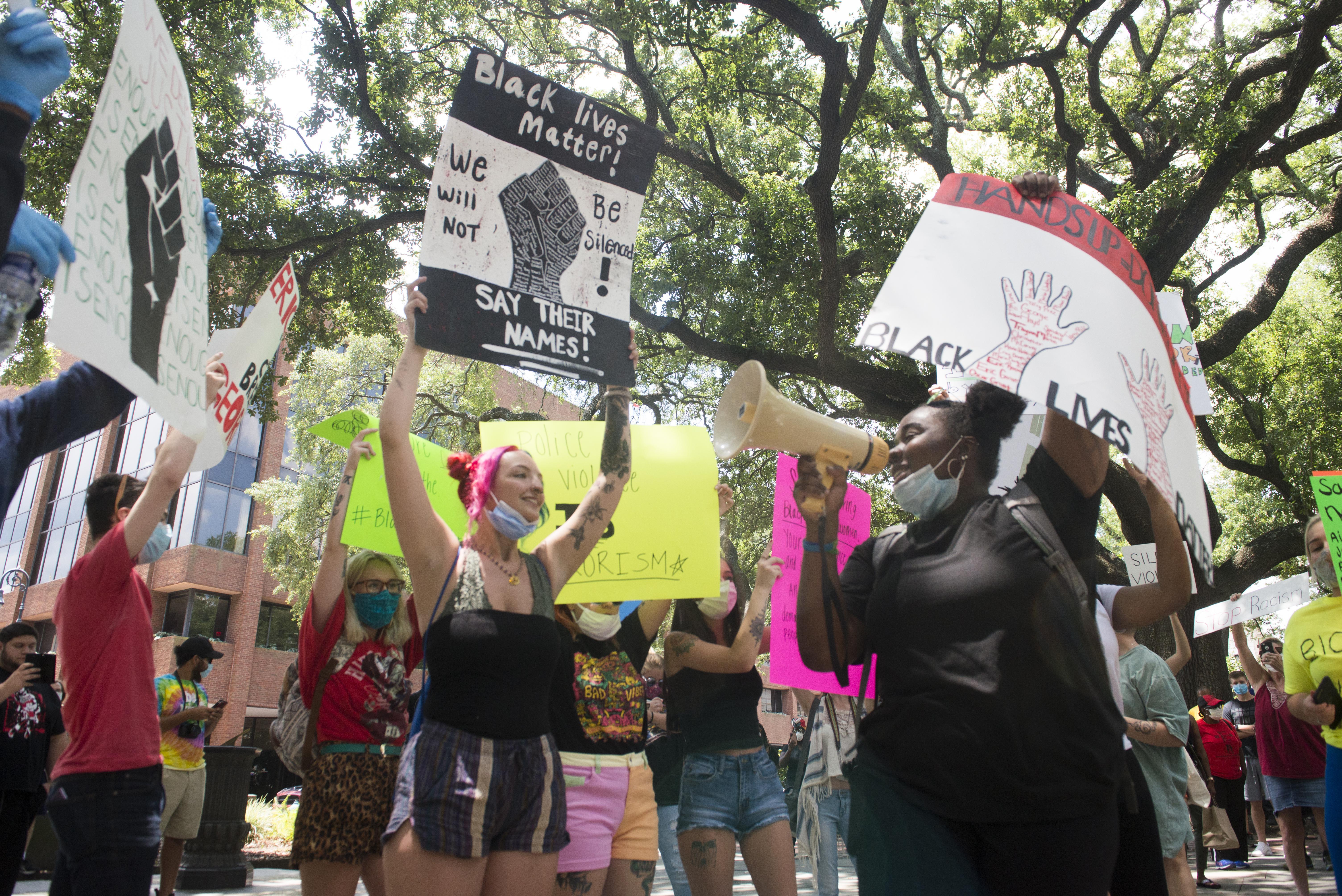
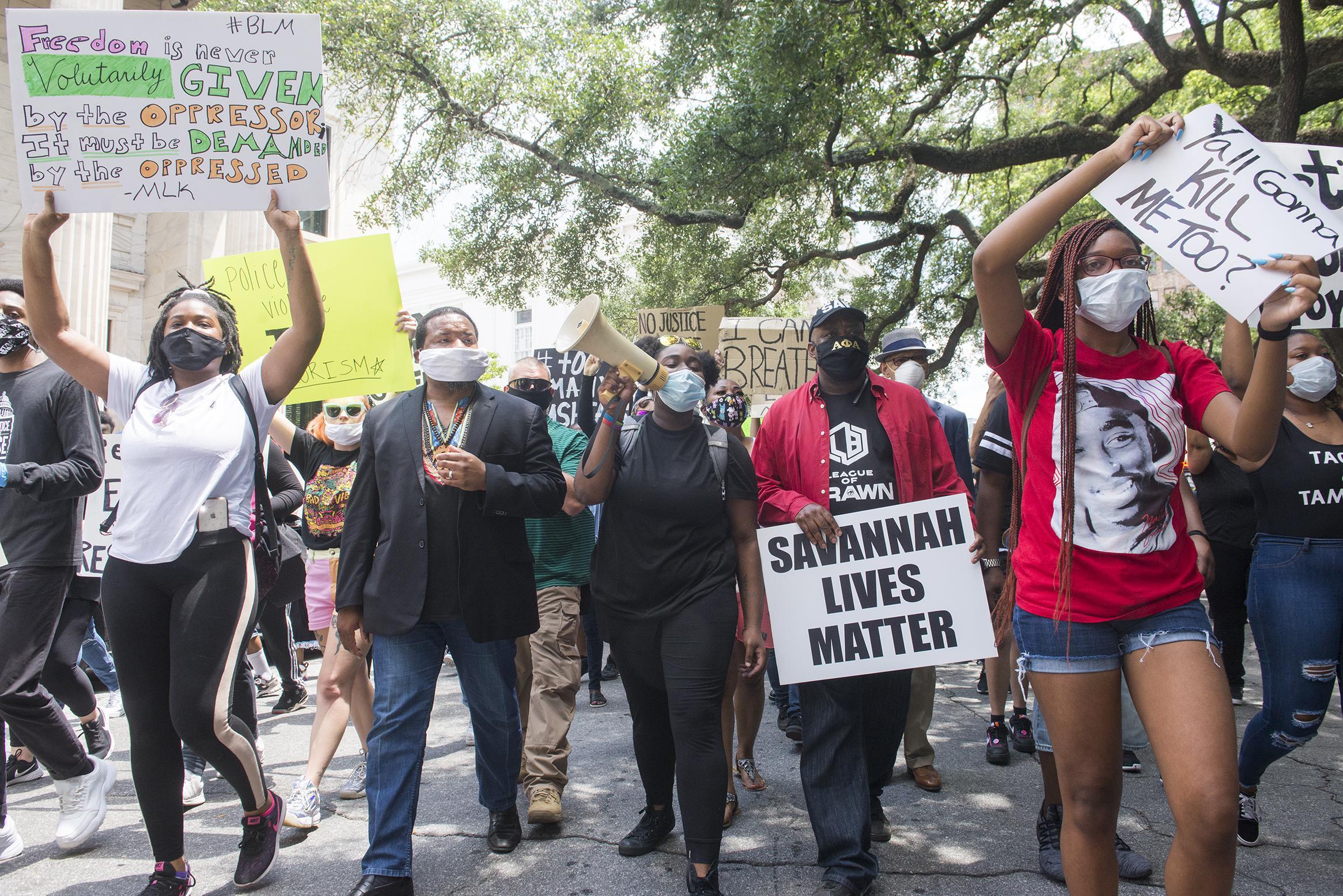
Protesters gather in Johnson Square in Savannah, Ga., on May 31, and march to City Hall.
Protesters gather in Johnson Square in Savannah, Ga., on May 31, and march to City Hall.
WILL PEEBLES/SAVANNAH MORNING NEWS
The crowd at the rally grumbled when Johnson suggested they could become police officers to make change from inside the organization. Many also chafed, he said, at his suggestion post-rally that “black men killing black men†is a bigger problem than police brutality in Savannah.
“If you look at our statistics, you don’t see officers killing black men,†he said. “You see black men killing black men. If we’re going to be upset, we’re going to have righteous indignation at what happened to George Floyd, which we cannot control. We can control the young men in our cities that are killing other men.â€
Among others, activist Moncello Stewart is organizing an “Enough is Enough“ rally to allow grass-roots organizations, including the men’s group League of Brawn and anti-gun violence group Moms Demand Action, to introduce themselves and recruit new members.
Peaceful, well-attended demonstrations are great, Stewart said, but they’re not the goal.
“I think until we kind of hold our elected officials accountable and talk about some of the issues and commit to changes, we’re always gonna have these issues,†Stewart said.
LUBBOCK, Texas
Jayme Lozano, Lubbock Avalanche-Journal
The shockwaves have reached even mostly conservative West Texas, where Lubbock residents began protesting last week.Â
High school students from Lubbock High, Lubbock-Cooper and Monterey High have all taken part in the protests, including one Wednesday where some graduating students wore caps and gowns the day before their own graduation.Â
Their jump into the action comes at an unexpected time for the young adults. Senior year activities came to an abrupt stop because of the coronavirus, and graduation plans had been canceled then rescheduled with limited seating.Â

The virus has been in the background since Floyd’s murder, only coming back into focus as organizers offer face masks to any protesters without one. Some people have arrived with the words “I can’t breathe†written on the front of their masks.
“It’s not only about this one case — police brutality has gone on for way too long,” said Hairuo Yi, a 16-year-old senior at Lubbock High. “This has gone on a decade, if we’re only counting the most recent viral incidents. We don’t want any more of this.”Â
Yi, who is Chinese American, came to the U.S. with her family when she was 6. She was inspired by seeing how Americans peacefully protest compared with the few experiences she had as a child, and she’s determined to keep advocating for social justice in college.Â
She said that part of the change she hopes comes from the protests is better training for police and somewhat limiting police immunity to leave less room for potential racial profiling.Â
Kori Egure, another Lubbock student, said even though their generation has seen some of the most violent acts after the attacks of Sept. 11, 2001, adults don’t take their concerns seriously because they are young.Â
“Listen to us. We’ve been silenced for too long,” Egure urged. “We’ve been told we don’t know what’s going on, we can’t understand it, but the reality is we’ve been exposed to it for too long. We’re too young to have to live through this kind of stuff.” Â
ASHEVILLE, North Carolina
Brian Gordon, Asheville Citizen-Times
Michael Hayes and Ajax Ravenel speak of two Ashevilles.
The first Asheville, they described, beckons millions of visitors a year with restaurants, breweries, eccentric vibes and access to Western North Carolina’s vast mountains and trails.
Though a generation separates Hayes, 53, from Ravenel, 18, both said living within another Asheville — black Asheville — taught them to challenge their city’s charming reputation. “It’s well for privileged white people,†said Hayes, who serves as executive director of the Asheville-based Umoja Health, Wellness, and Justice Collective. “It works for them. It doesn’t work for us.â€
As Asheville sees daily mass gatherings against police brutality and the killing of George Floyd, leaders in the local black community demand policymakers reform the city’s law enforcement and reverse widespread opportunity gaps in housing, health, recreation and education.
“It started because of George Floyd, because of the lack of justice we saw there, but it’s about so much more than that,†said Ravenel, who is home from Clark Atlanta University for the summer.

Ravenel and other advocates say protests must be for the black community, free from destruction and outside agendas that some, mostly non-black participants brought to rallies.
Like the city itself, black organizers want the protests to work for them.
To Hayes, George Floyd’s death doesn’t feel removed. Sitting on a sofa at the Umoja center with colleagues dotting the room, Hayes held court. He spoke freely and easily about Asheville’s past, present and future, displaying a cadence and vocal stamina he employs as a local radio host.
He mentioned Johnnie Rush, an Asheville man, who in 2017 was subjected to a severe beating at the hands of an officer. Body camera video captured Rush saying he couldn’t breathe multiple times while being restrained on the ground.
This is Asheville, North Carolina. The same thing that’s happened to George Floyd has happened here, a lot of times. So seeing it sparked something in us.
“This is Asheville, North Carolina. The same thing that’s happened to George Floyd has happened here, a lot of times,†Hayes said. “So seeing it sparked something in us.â€
Asheville’s first mass protest took place on May 31. Hayes marched alongside hundreds, and he worked to de-escalate tensions after authorities fired tear gas and rubber bullets.
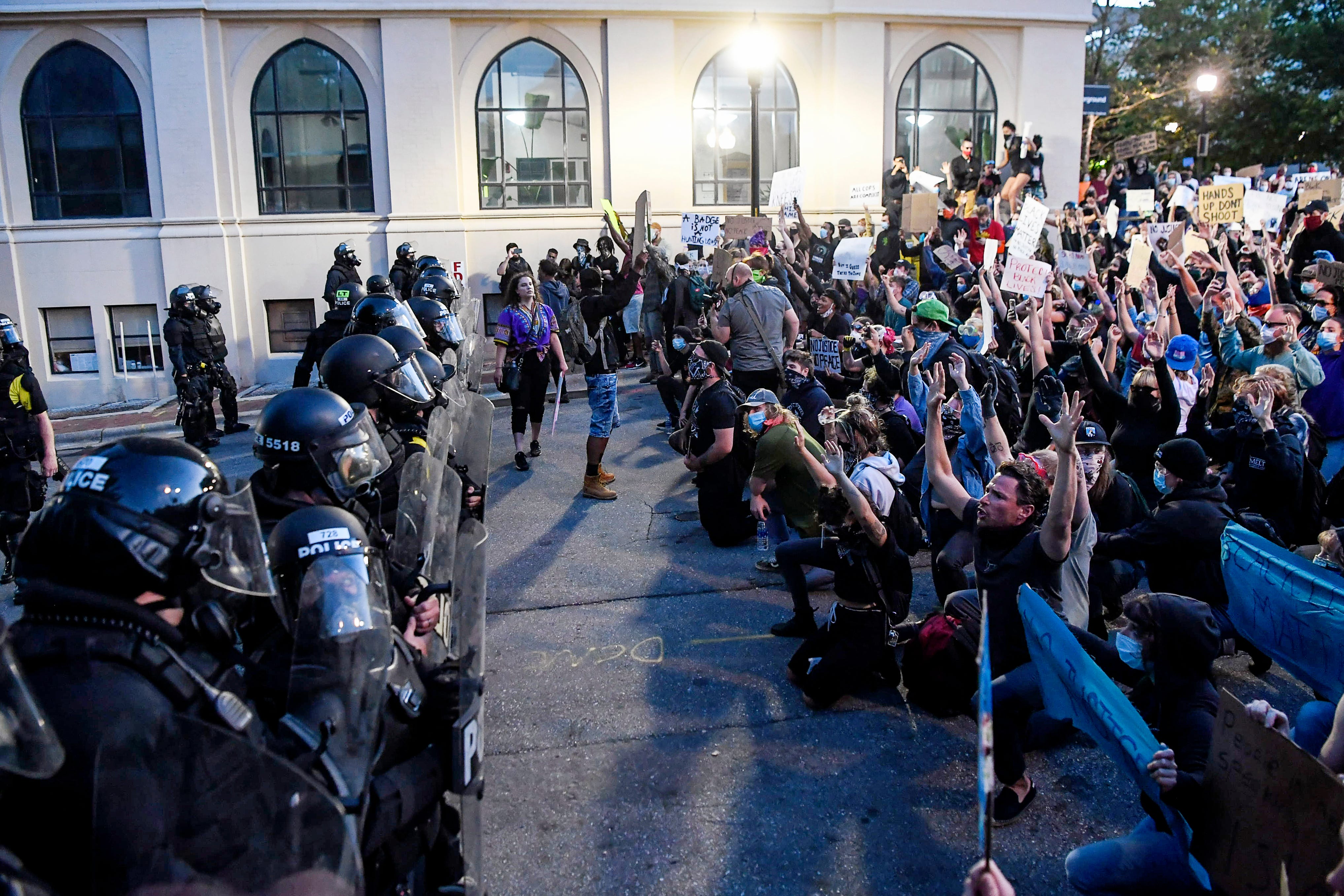
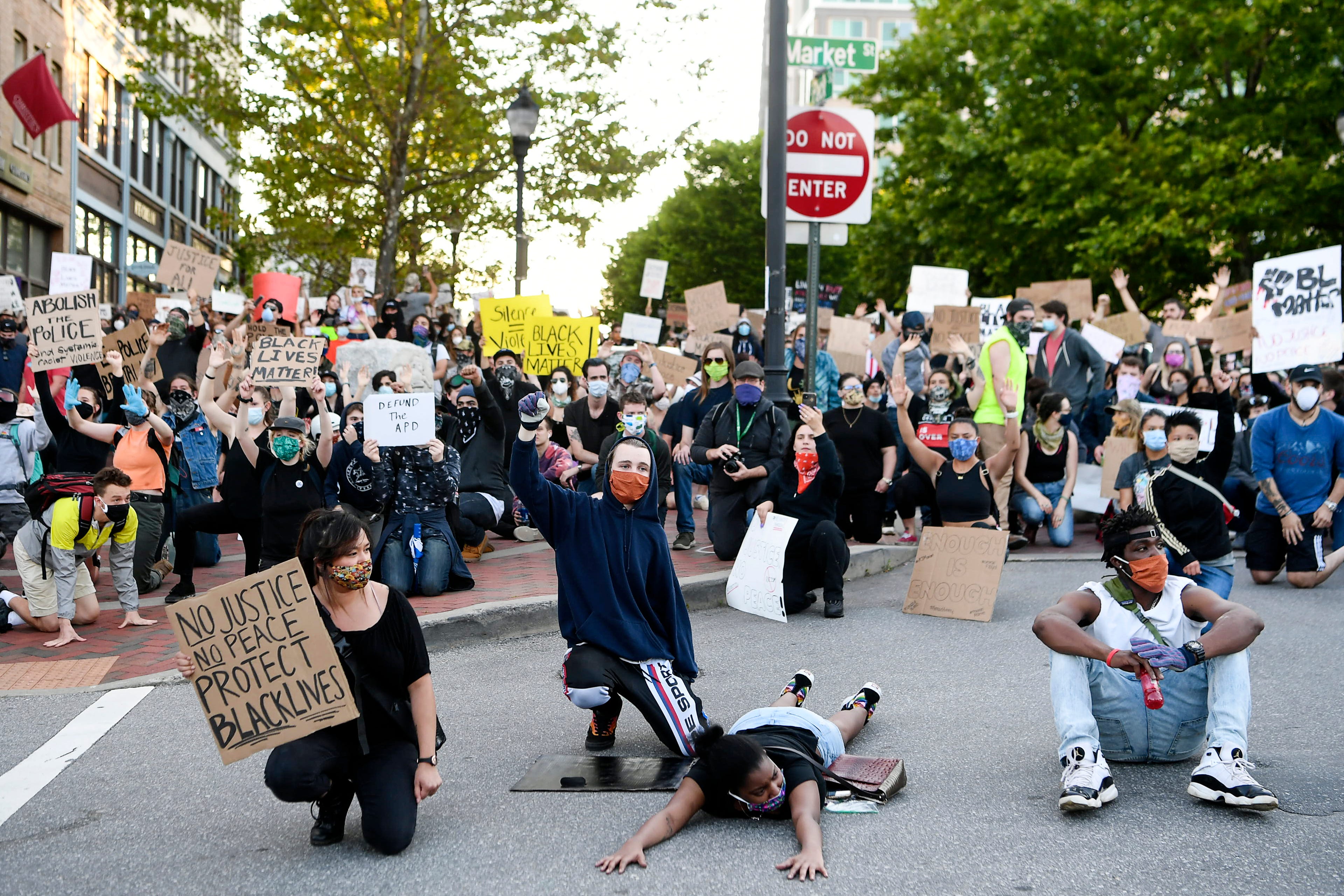
Hundreds gathered at Vance Monument in downtown Asheville on June 1 to protest police brutality before continuing on to the Asheville Police Department.
Hundreds gathered at Vance Monument in downtown Asheville on June 1 to protest police brutality before continuing on to the Asheville Police Department.
ANGELA WILHELM/Asheville Citizen-Times
Later that night, while protesting downtown, Ravenel watched white demonstrators set off fireworks and intentionally topple a newspaper stand and other random objects.
“It seemed like our voices were being drowned out,†she said. “The ones who are leading it, the black youth who are leading this stuff, they’re actually doing it correctly. It’s the antagonizers that are coming in and ruining everything.â€
When the first fireworks went off, Ravenel left. She skipped the next couple downtown rallies too, which ended with multiple broken storefront windows, copious graffiti and authorities releasing tear gas. On June 2, the city government declared a state of emergency, imposed an 8 p.m. curfew and called in the National Guard.
We’re protesting for George Floyd, but we’re also protesting for ourselves. Right here, right now, every single day. And we’re protesting for the generations that come after us.
Hayes did not protest in subsequent days either, but both he and Ravenel were coordinating plans to get back out on the streets. From Umoja, the two attended Zoom calls with hundreds of area residents to plan a weekend demonstration that would be peaceful yet forceful, presenting a unified message about the changes they demand.
“We’re protesting for George Floyd, but we’re also protesting for ourselves,†Ravenel said. “Right here, right now, every single day. And we’re protesting for the generations that come after us.â€
AMARILLO, Texas
Douglas Clark, Amarillo Globe-News

Tremaine Brown, owner of Shi Lee’s Barbecue and Soul Food Café, has led the serving of 1,000 meals a day to those in need during the COVID-19 pandemic. But on a recent sun-splashed morning, Brown woke with an even greater purpose in mind, sharing thoughts with a social justice group at city hall about a plan of action after the first Floyd protests. They got to work. “What you can do after this is be very courageous, steadfast and passionate about what happens to others,” he said. “We have to stay strong.â€
FAYETTEVILLE, North Carolina
Michael Futch, Fayetteville Observer

Protesters followed a police directive to back up to a tree on Murchison Road one evening this week, facing a line of officers wearing riot gear. A rally leader called for many of the protesters — still close to 300 strong after some had departed earlier — to take a knee. “I can’t breathe. I can’t breathe,†they chanted. And then, the police officers followed suit, taking a knee in solidarity. Cheers and applause erupted among the activists.
Discover more from PressNewsAgency
Subscribe to get the latest posts sent to your email.