
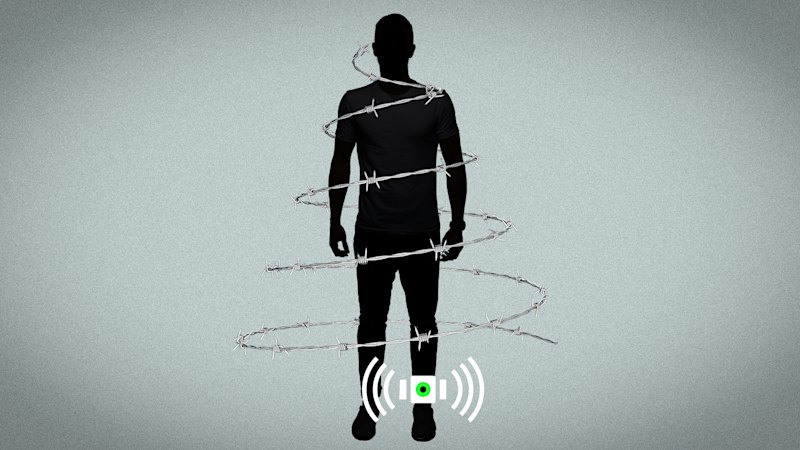
The High Court has for the second time struck down Labor’s ankle bracelet and curfew regime for former criminals released from immigration detention, continuing a years-long legal fallout over how the government deals with people it can’t deport.
Home Affairs Minister Tony Burke moved to restore the monitoring regime by upping its legal threshold after it was first struck down in November 2024. But the High Court on Wednesday ruled the updated measures remained punitive and the Commonwealth was acting beyond its powers.
It is the latest blow to the Albanese government in a legal saga that stemmed from the NZYQ case in 2023, when the High Court first ruled that non-citizens who had committed crimes but finished jail time could not be held in immigration detention indefinitely.
Given they cannot return to their country of origin – because they are stateless, fear prosecution if they return, or their countries refuse to accept them back – more than 340 people became stuck in Australia in a legal limbo that has plagued the government, since many committed serious crimes.
But Burke will be spared the same political damage from this ruling, given the government last year struck a $2.5 billion deal with Nauru to send former immigration detainees to live on the Pacific island with 30-year visas. While the deal has been slammed by the Greens and human rights advocates, it has alleviated pressure that was being piled on the government by the Coalition.
Government sources said six people had since arrived in Nauru. A further 27 people have had their Nauruan visas approved – a condition that allows them to be redetained under Burke’s laws – while 27 more have had their visa applications sent to Nauru for consideration.
According to latest government data, 78 people in the cohort are subject to ankle bracelets and 41 under curfew. Wednesday’s ruling will unshackle them from those conditions, although many of them are already in jail for committing further crimes once being released into the community.
Government sources said the 43 people with ankle bracelets still living in the community will instead be put on mandatory reporting conditions – akin to bail, requiring they check in at a set time and place.
Burke pointed to the Nauru deal as the government’s first priority when it comes to dealing with the NZYQ cohort. “Fortunately we now have the agreement with Nauru, because the best thing for people who have had their visa cancelled is to not be in this country,” he said in comments after Wednesday’s High Court ruling.
“While obviously the government would have preferred a different outcome, the government’s ambition was never about ankle bracelets. If someone has their visa cancelled they should leave. And that’s what we’re determined to achieve.”
Refugee support groups and human rights lawyers have damned the Nauru deal, ACT senator David Pocock has described it as “totally bonkers”, and the arrangement is still subject to several court challenges. Once people are sent to Nauru, however, the government cedes responsibility for them.
Wednesday’s case, EGH19 v Commonwealth of Australia, was brought by a Papua New Guinea man who first arrived in Australia as a child on his father’s temporary visa in 2000. He was convicted of murder while still a minor in 2006.
The man was released in parole and taken into immigration detention in 2018, where he then made four rejected applications for asylum. His protection visa was approved in 2022, and he was released into the community, but sent back to prison in 2023 after committing offences against his partner and his partner’s father.
His visa was cancelled in 2024 and he was sent back to immigration detention upon being released on parole. He was then released into the community on a bridging visa pending removal in 2025, which subjected him to the monitoring and curfew conditions.
He challenged the conditions, and the High Court on Wednesday agreed that the Commonwealth’s power to impose them was punitive and therefore invalid.
Cut through the noise of federal politics with news, views and expert analysis. Subscribers can sign up to our weekly Inside Politics newsletter.
 Natassia Chrysanthos is Federal Political Correspondent. She has previously reported on immigration, health, social issues and the NDIS from Parliament House in Canberra.Connect via X or email.
From our partners
Discover more from PressNewsAgency
Subscribe to get the latest posts sent to your email.