
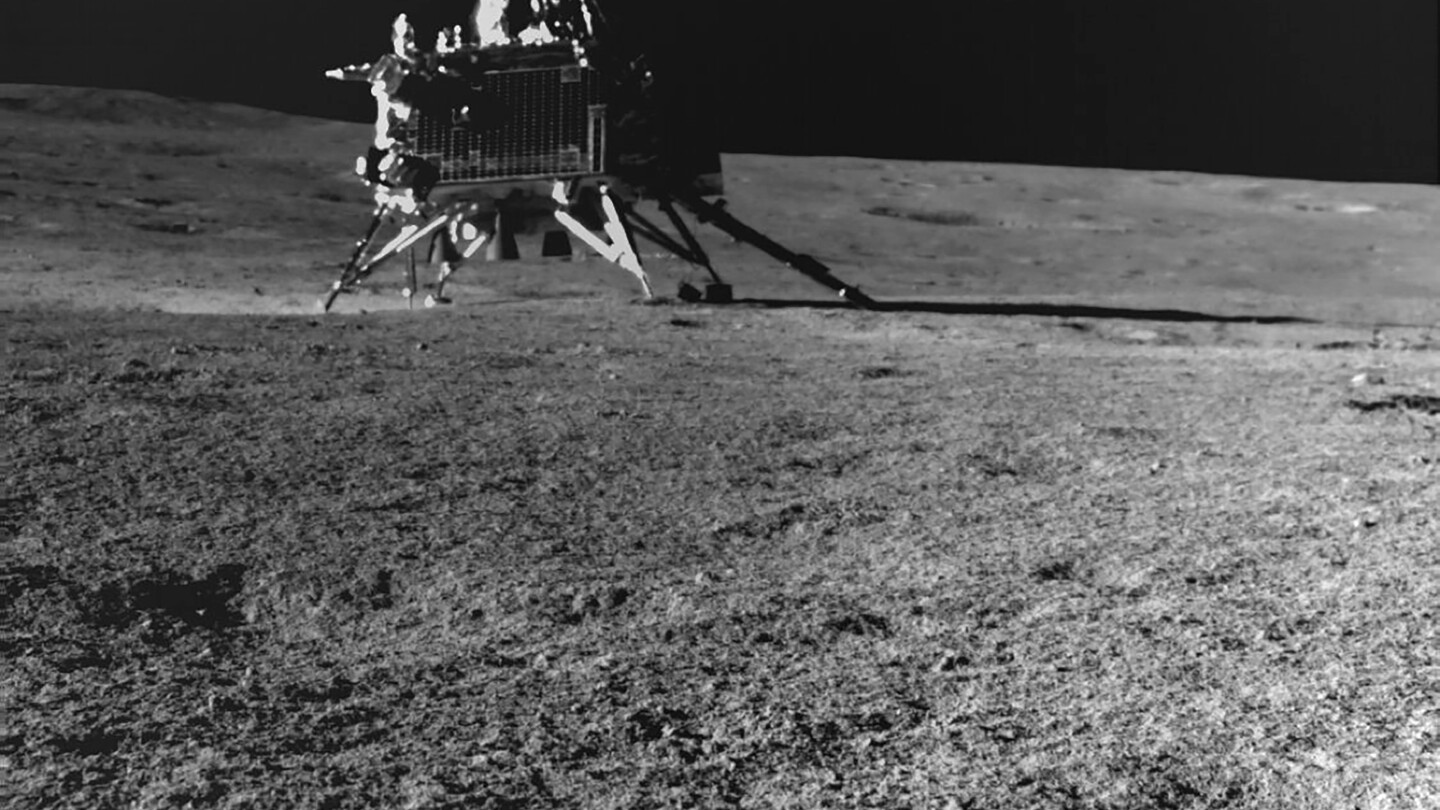
NEW DELHI (AP) — India’s lunar rover has completed its walk on the lunar surface and has been put into sleep mode less than two weeks after its historic landing near the lunar south pole, India’s space mission said.
“The rover completes its tasks. It is now safely parked and put into sleep mode,” and daylight on that part of the moon is coming to an end, the Indian Space Research Organization said in a statement late Saturday.
The rover’s payloads are off and the data it collected has been transmitted to Earth via the lander, the statement said.
The Chandrayaan-3 lander and rover were expected to operate for only one lunar day, which is equivalent to 14 days on Earth.
“Currently, the battery is fully charged. The solar panel is oriented to receive the light of the next sunrise predicted for September 22, 2023. The receiver is kept on. Waiting for a successful awakening for another series of tasks! the statement said.
There was no word on the outcome of the rover’s search for signs of frozen water on the lunar surface that could aid future astronaut missions, as a potential source of drinking water or to produce rocket fuel.
Earlier this week, the space agency said the lunar rover confirmed the presence of sulfur and detected several other elements. The rover’s laser-induced spectroscopic instrument also detected aluminum, iron, calcium, chromium, titanium, manganese, oxygen and silicon on the surface, it said.
The Indian Express newspaper said that the electronic components on board the Indian lunar mission are not designed to withstand very low temperatures, less than -120 degrees Celsius (-184 degrees Fahrenheit) overnight on the moon. The lunar night also lasts up to 14 days on Earth.
Pallava Bagla, a science writer and co-author of books on Indian space exploration, said the rover has limited battery life.
The data is back on Earth and will be analyzed at first by Indian scientists and then by the global community, he said.
At sunrise on the moon, the rover may or may not wake up because electronics die in such cold temperatures, Bagla said.
“Making circuits and electronic components that can survive the cold temperature of the moon, that technology doesn’t exist in India,” he said.
After a failed attempt to land on the moon in 2019, India last week joined the United States, the Soviet Union and China as the fourth country to achieve this milestone.
The successful mission showcases India’s growing position as a technological and space power and fits with Prime Minister Narendra Modi’s desire to project an image of a rising country asserting its place among the global elite.
The mission began more than a month ago with an estimated cost of $75 million.
India’s success came just days after Russia’s Luna-25, which was aimed at the same lunar region, entered an uncontrolled orbit and crashed. It was intended to be the first successful Russian moon landing after a lapse of 47 years.
The Russian director of the state space corporation Roscosmos attributed the failure to a lack of experience due to the long hiatus in lunar research that followed the last Soviet mission to the Moon in 1976.
Active since the 1960s, India has launched satellites for itself and other countries, successfully putting one into orbit around Mars in 2014. India is planning its first mission to the International Space Station next year, in collaboration with the United States.
Discover more from PressNewsAgency
Subscribe to get the latest posts sent to your email.