

from ISRO LVM3 heaviest rocket that carries 36 satellites belonging to the UK-based OneWeb Group, lifted off from this spaceport on Sunday. The second dedicated mission for NewSpace India Ltd, the commercial arm of the Indian Space Research Organization, is part of the agreement signed with Network Access Associates Ltd, UK (OneWeb Group Company) for the launch of 72 satellites into low Earth orbits. (LEO). READ MORE
The first set of 36 satellites from OneWeb Group company was launched on October 23, 2022 by ISRO.
Mid-release, we’re going to unravel some of the scientific terms used here:
First, what are low earth orbit satellites?
According toward European Space Agency, a Low Earth Orbit (LEO) is an orbit that is close to the Earth’s surface. It is usually less than 1000 km above Earth, although it can be as low as 160 km above Earth, which is low compared to other orbits, but still quite far above Earth’s surface.
By comparison, most commercial aircraft do not travel at altitudes much higher than 14 km, so even the lowest LEO is more than ten times higher.
Unlike geostationary orbit (GEO) satellites, which must always orbit close to the equator, LEO spacecraft do not always have to follow the same path around Earth: their plane may be tilted. This means that the satellites in LEO have more potential paths, which is one of the reasons why LEO is such a popular orbit.
Due to its proximity to Earth, LEO is useful for a variety of reasons. It is the most widely used orbit for satellite photography since being close to the surface allows for higher resolution photographs, the report explains. It is also the orbit used by the International Space Station (ISS), as it allows astronauts to travel a shorter distance to and from it.
Satellites in this orbit travel at about 7.8 km per second; At this speed, it takes about 90 minutes for a satellite to go around the Earth, which means that the International Space Station travels around the Earth about 16 times a day. Individual LEO satellites, on the other hand, are less effective for services like telecommunications, as they move very fast across the sky and take a lot of effort to track from ground stations.
In contrast, Low Earth Orbit (LEO) communications satellites sometimes operate as part of a large combination or constellation of many satellites to provide continuous coverage.
Now, you will be able to better understand the purpose of these satellites
Bharti Enterprises is a major investor in the OneWeb group, which is engaged in the implementation of the Low Earth Satellite Constellation. It is a global communication network powered from space, which enables connectivity for governments and businesses.
The launch was the 18 for the company OneWeb Group, while for ISRO, it would be the second mission in 2023 after the successful launch of the SSLV/D2-EOS07 mission carried out in February..
With today’s mission, OneWeb would have 616 satellites in its fleet, which would be more than enough to launch global services later this year.
A spatial collaboration
The mission marks OneWeb’s second satellite deployment from India, highlighting collaboration between the UK and Indian space industries, OneWeb said.
Across India, OneWeb would provide secure solutions not only to businesses, but also to towns, villages, municipalities and schools, including the hardest-to-reach areas across the country, the company said.
The first satellite separation set (comprising four of the 36 satellites) is scheduled to take place around 20 minutes after liftoff. The remaining satellites are expected to be placed in 450 km circular orbits at some point.
The satellites, after being placed in low earth orbits, would be divided into 12 planes at an altitude of about 1,200 km from the earth’s surface.. Each plane would be separated by an altitude of 4 km to avoid collisions between planes, ISRO said.
This is the sixth flight of LVM3, which was previously known as the Geosynchronous Satellite Launch Vehicle MkIII (GSLVMkIII) with a cryogenic upper stage.. She had five consecutive missions, including Chandrayaan-2.
About LVM3
The Mark-3 Launch Vehicle (LVM3), also known as the Mark III Geosynchronous Satellite Launch Vehicle (GSLV Mk3), is a three-stage medium-lift launch vehicle designed by ISRO. Its main goal is to launch communication satellites into geostationary orbit, but it will also carry out manned flights as part of India’s Human Space Flight Project, as reported. He payload capacity of the GSLV Mk III is larger than that of its predecessor, the GSLV Mk II.
Following multiple delays and a suborbital test flight on December 18, 2014, ISRO successfully completed the maiden orbital test launch of the GSLV Mk III from the Satish Dhawan Space Center on June 5, 2017.
It is a three-stage launch vehicle with two S200 solid boosters on each side and a center stage with an L110 liquid stage and a C25 cryogenic stage.
Among the satellites’ achievements are the ability to handle multiple satellite separation events, longer nominal mission duration, longer safe separation distance, ensuring data availability for the duration of the mission,
development of a new payload adapter and interface ring for satellite dispensers.
Let’s unravel some of this jargon more:
What is a launch vehicle?
A launch vehicle is usually a rocket-powered vehicle and is designed to carry a payload (spacecraft or satellites) from the Earth’s surface to outer space. Most launch vehicles are operated from a launch pad, which is supported by a launch control center and systems such as vehicle assembly and fueling.
And the payload capacity?
Payload capacity is the amount of weight a vehicle can carry.
What is Rocket Staging?
According POT, to overcome the weight of the rocket, all rockets use the thrust provided by a propulsion system. The payload weight is only a few percent of the takeoff weight of full-scale satellite launchers. The propellants account for most of the rocket’s weight.
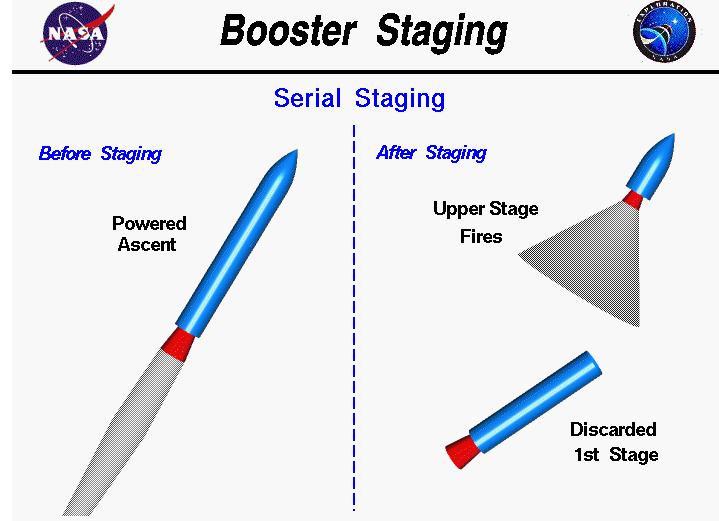
As propellants are consumed during powered ascent, a greater proportion of the vehicle’s weight is converted to the near-empty tank and structure than was required when the spacecraft was fully loaded.. Most launchers scrap a portion of the vehicle during the preparation procedure to reduce vehicle weight and achieve orbital speed. Rocket staging is classified in two types: series and parallel.
Serial staging
A small second stage rocket is mounted on top of a larger first stage rocket in serial staging. The first stage ignites during launch and continues to burn during powered ascent until its propellants are depleted. The first stage engine is then shut down, the second stage is separated from the first stage, and the second stage engine is started. The payload is sent into orbit on the second stage.
Parallel staging
The other type of staging is known as parallel staging.

Many small initial stages are attached to a central booster rocket in parallel stages. All engines fire at launch. When the tethered rocket propellants run out, the rockets are scrapped. The sustainer motor continues to run and the payload is put into orbit on the sustainer rocket. In the space shuttle, parallel scenarios are used. Spent solid rocket propellants are recovered from the ocean, recharged, and reused on the shuttle.
With PTI inputs
read all last explainers here
Discover more from PressNewsAgency
Subscribe to get the latest posts sent to your email.