Japan and the Philippines signed a key defence pact on Monday allowing the deployment of Japanese forces for joint military exercises, including live-fire drills, to the Southeast Asian nation that came under brutal Japanese occupation in World War II but is now building an alliance with Tokyo as they face an increasingly assertive China.
The Reciprocal Access Agreement, similarly allows Filipino forces to enter Japan for joint combat training, was signed by Philippine Defence Secretary Gilberto Teodoro and Japanese Foreign Minister Yoko Kamikawa in a Manila ceremony witnessed by President Ferdinand Marcos Jnr It would take effect after ratification by the countries’ legislatures, Philippine and Japanese officials said.
Kamikawa called the signing of the defence agreement “a groundbreaking achievement” that should further boost defence cooperation between Japan and the Philippines. “A free and open international order based on the rule of law is the foundation of regional peace and prosperity,” she said. “We would like to work closely with your country to maintain and strengthen this.”
Kamikawa and Japanese Defence Minister Minoru Kihara are in Manila to hold talks with their Philippine counterparts on ways to further deepen relations, the Philippine government said in a statement.
The defence pact with the Philippines is the first to be forged by Japan in Asia. Japan signed similar accords with Australia in 2022 and with Britain last year.
Under Prime Minister Fumio Kishida, the Japanese government has taken steps to boost its security and defensive firepower, including a counterstrike capability that breaks from Japan’s post-war principle of focusing only on self-defence, amid threats from North Korea and China’s growing assertiveness. It’s doubling defence spending in a five-year period to 2027 in a move to bolster its military power and make Japan the world’s third-biggest military spender after the United States and China.
Japanese troops ride amphibious assault vehicles during a joint landing exercise with Philippine and US troops. Photo: AFP
Many of Japan’s Asian neighbours, including the Philippines, came under Japanese aggression until its defeat in World War II and Japan’s efforts to bolster its military role and spending could be a sensitive issue. Japan and the Philippines, however, have steadily deepened defence and security ties.
Kishida’s moves dovetail with Marcos’ effort to forge security alliances to bolster the Philippine military’s limited ability to defend Manila’s territorial interests in the South China Sea. The busy sea passage is a key global trade route which has been claimed virtually in its entirety by China but is also contested in part by the Philippines, Vietnam, Malaysia and Brunei.
The US has also been strengthening an arc of military alliances in the region to better counter China and reassure its Asian allies. Japan and the Philippines are treaty allies of the US and their leaders held three-way talks in April at the White House, where Biden renewed Washington’s “ironclad” commitment to defend Japan and the Philippines.
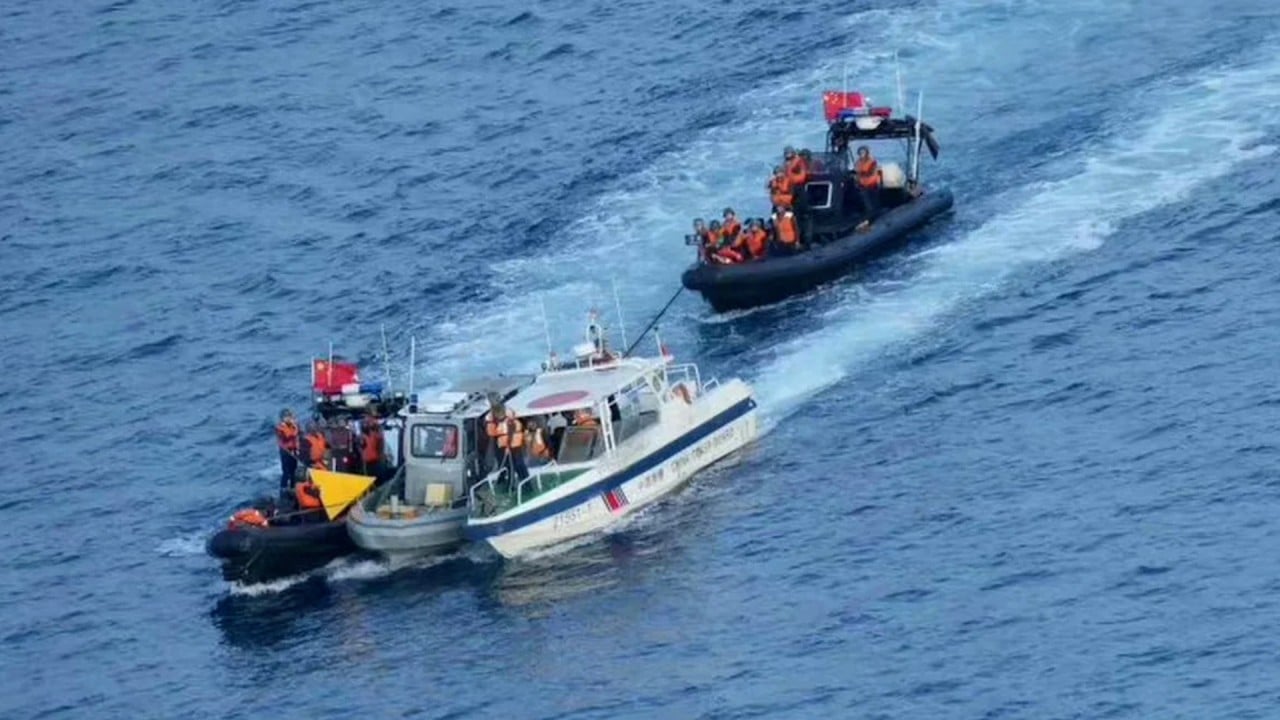
In the worst confrontation so far, Chinese coastguard personnel armed with knives, spears and an axe aboard motorboats repeatedly rammed and destroyed two Philippine navy supply vessels on June 17 in a chaotic face off in the disputed Second Thomas Shoal that injured several Filipino sailors. Chinese coastguard personnel seized several navy rifles.
02:34
Chinese and Philippine ships clash in first incident under Beijing’s new coast guard law
Chinese and Philippine ships clash in first incident under Beijing’s new coast guard law
China accused the Philippines of instigating the violence, saying the Filipino sailors strayed into what it called Chinese territorial waters despite warnings.
Japan and the US were among the first to express alarm over the Chinese actions and call on Beijing to abide by international laws. Washington renewed its warning that it is obliged to defend the Philippines, its oldest treaty ally in Asia, if Filipino forces, ships and aircraft come under an armed attack, including in the South China Sea.
We use cookies on our website to give you the most relevant experience by remembering your preferences and repeat visits. By clicking “Accept”, you consent to the use of ALL the cookies.
This website uses cookies to improve your experience while you navigate through the website. Out of these, the cookies that are categorized as necessary are stored on your browser as they are essential for the working of basic functionalities of the website. We also use third-party cookies that help us analyze and understand how you use this website. These cookies will be stored in your browser only with your consent. You also have the option to opt-out of these cookies. But opting out of some of these cookies may affect your browsing experience.
Necessary cookies are absolutely essential for the website to function properly. These cookies ensure basic functionalities and security features of the website, anonymously.
Cookie
Duration
Description
cookielawinfo-checbox-analytics
11 months
This cookie is set by GDPR Cookie Consent plugin. The cookie is used to store the user consent for the cookies in the category "Analytics".
cookielawinfo-checbox-functional
11 months
The cookie is set by GDPR cookie consent to record the user consent for the cookies in the category "Functional".
cookielawinfo-checbox-others
11 months
This cookie is set by GDPR Cookie Consent plugin. The cookie is used to store the user consent for the cookies in the category "Other.
cookielawinfo-checkbox-necessary
11 months
This cookie is set by GDPR Cookie Consent plugin. The cookies is used to store the user consent for the cookies in the category "Necessary".
cookielawinfo-checkbox-performance
11 months
This cookie is set by GDPR Cookie Consent plugin. The cookie is used to store the user consent for the cookies in the category "Performance".
viewed_cookie_policy
11 months
The cookie is set by the GDPR Cookie Consent plugin and is used to store whether or not user has consented to the use of cookies. It does not store any personal data.
Functional cookies help to perform certain functionalities like sharing the content of the website on social media platforms, collect feedbacks, and other third-party features.
Performance cookies are used to understand and analyze the key performance indexes of the website which helps in delivering a better user experience for the visitors.
Analytical cookies are used to understand how visitors interact with the website. These cookies help provide information on metrics the number of visitors, bounce rate, traffic source, etc.
Advertisement cookies are used to provide visitors with relevant ads and marketing campaigns. These cookies track visitors across websites and collect information to provide customized ads.