


The famous “three arrows†of Abenomics were monetary easing, fiscal spending and structural reforms to try to add some dynamism to the Japanese economy – which become something of a byword for stagnation (although visitors to Japan might argue that stagnation doesn’t appear to be such a bad thing).
Two of those arrows could directly weaken the yen – and indeed that was a boost to Japanese exporters.
ING strategists wrote in a note to clients that “Abenomics†was one of the key factors in yen weakness in previous years. But, they said, what matters most for the yen is the Bank of Japan’s stance and that it is too early to say whether Abe’s resignation would materially impact the central bank.
Shinzo Abe’s reported plan to resign has given currency markets a jolt on a usually quiet late-August Friday.
The US dollar index is down by 0.5%, after the Japanese yen (one of the biggest weights in the basket) jumped. The yen is up by 0.5% today, and has just strengthened to the 106 yen per US dollar mark.
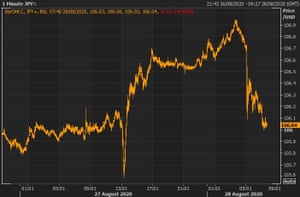
Note that this chart’s y-axis is quoted in yen per US dollar, so what appears as a drop is actually an increase in the yen’s value. And it’s also worth noting that the increase today only takes the yen back to levels seen yesterday.


Gatwick airport has reported a £343m loss after passenger numbers plummeted by two-thirds in the first half of the year as the coronavirus takes a heavy toll on the aviation industry.
Britain’s second-busiest air hub, which earlier this week announced plans to cut 600 jobs, said revenues plunged by 61% in the first half from £372m to £144m.
Gatwick is operating flights from only one of its two terminals and said passenger numbers fell by two-thirds year on year in the first six months from 22m to only 7.5m. The airport is forecasting it will take four to five years for air traffic levels to return to pre-pandemic levels.
You can read the full report here:
German consumer confidence falls back, surprising economists
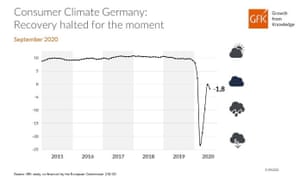
German consumer confidence fell back in August, denting economists’ hopes that the rebound from the depths of the coronavirus lockdowns would continue.
The latest indicator (labelled, confusingly, as September) by GfK fell to -1.8, down from -0.2 in the previous reading and lower than the 1.2 expected by economists.
GfK in its report said:
Expectations for a rapid recovery in the consumer climate in Germany were dealt a significant blow in August. After gaining for three consecutive periods, the indicator suffered a considerable decline.
Rolf Bürkl, an analyst at GfK, said:
An increase in the number of infections and the fear that coronavirus-related restrictions will be further tightened are creating uncertainty and consequently dampening the mood. The reduction in value added tax (VAT) which came into effect in Germany on July 1st may be boosting propensity to consume but has not yet been able to provide a stronger stimulus.
Whether or not this is just a temporary slowdown will depend primarily on what infection rates look like in future and the necessary measures to be put in place by policy makers.
Introduction: Nikkei slumps and yen rises after Abe resignation report
Good morning, and welcomed to our live coverage of business, economics and financial markets.
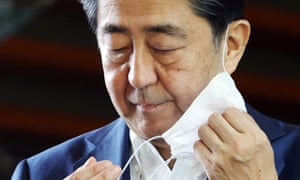
There had been rumblings for a few days about Japanese Prime Minister Shinzo Abe’s health problems after repeated hospital visits, but this morning rumours appear to have bubbled over into news: multiple media reports say he will indeed resign.
The news prompted an immediate slump on Japan’s stock market, with the blue-chip Nikkei 225 index losing as much as 2%, while the safe-haven Japanese yen, which had been falling, jumped by about 0.5% to a session-high of 106.10 per dollar on the news before easing to about 106.22.
Holger Zschaepitz
(@Schuldensuehner)#Japan stocks sink on report Shinzo Abe plans to resign. The Nikkei 225 fell as much as 2.7% while the Topix index dropped as much as 1.6%. (BBG) pic.twitter.com/VpJ57euFCX
Reuters reported:
A person familiar with the matter said Abe, the nation’s longest serving premier, had decided to step down.
Public broadcaster NHK earlier said Abe, who has battled the disease ulcerative colitis for years, wanted to avoid causing problems for the government due to the worsening of his condition
Also coming up today, we have eurozone economic sentiment and consumer confidence figures at 10am BST, which could come in lower than expected after GfK’s measure of German consumer confidence came in with a negative 1.8 reading, compared to a positive 1.2 consensus expectation. More on this to follow.
And at 2:05pm BST Bank of England watchers’ attention will be fixed on a speech by Andrew Bailey, the governor.
He has a tough act to follow after Federal Reserve chair Jerome Powell signalled a permanent change in the US central bank’s inflation targeting regime, although the Bank of England has its own issues to face. Bailey could talk about work the Bank has done on the diminishing returns from quantitative easing.
The agenda
- 9am BST: Japan Shinzo Abe press conference (subject to change)
- 10am BST: Eurozone economic sentiment, August (previous: 82.3; consensus: 88.9)
- 1:30pm BST: Canada GDP, second quarter (previous: -8.2% annualised; consensus: -39.6% annualised)
- 2:05pm BST: Bank of England Andrew Bailey Jackson Hole speech
Discover more from PressNewsAgency
Subscribe to get the latest posts sent to your email.