


A brand new examine finds that extra info can impair decision-making. This has implications for public well being, suggesting that simplified, targeted info improves decisions. AI chatbots may doubtlessly personalize recommendation to boost decision-making effectivity.
Even minimal extra info can hinder efficient decision-making in line with new analysis at Stevens Institute of Know-how.
When confronted with difficult decisions, people usually instinctively hunt down in depth info. Nonetheless, latest analysis printed within the journal Cognitive Analysis: Rules and Implications means that this might truly be an issue: this inflow of details and particulars tends to impair, somewhat than improve, the standard of their decision-making.
“It’s counterintuitive, as a result of all of us prefer to assume we use info properly to make good selections,” mentioned Farber Chair Affiliate Professor Samantha Kleinberg, the paper’s lead creator and a pc scientist at Stevens Institute of Know-how. “However the actuality is that relating to info, extra isn’t essentially higher.”
Easy Fashions vs. Actual-World Eventualities
To check how folks make selections, researchers usually create easy diagrams — or causal fashions — that present how various factors logically work together with one another to yield particular outcomes.
In terms of describing summary hypothetical eventualities, like how aliens sq. off at a dance get together, most individuals can motive successfully about such fashions as a result of they don’t have any biases or preconceptions about alien dance-offs. Individuals make good selections as a result of they deal with the knowledge that they’re given.
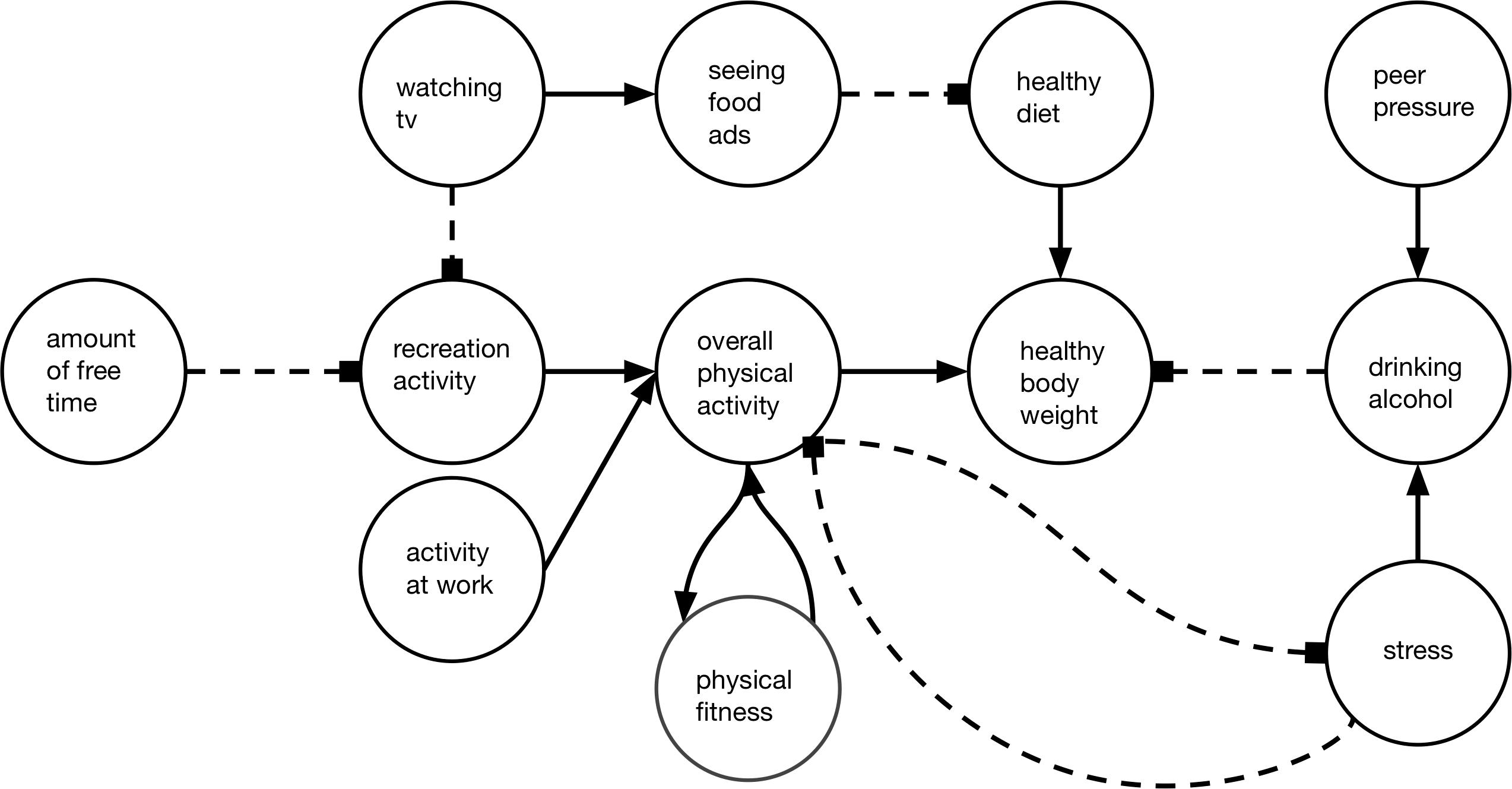
An instance of a posh causal mannequin for managing weight reduction, containing each related and irrelevant info. When related info will not be highlighted within the mannequin, members made poor selections when introduced with a sequence of questions. Credit score: Stevens Institute of Know-how
However Kleinberg’s work reveals that relating to on a regular basis eventualities, like determining make wholesome selections round diet, for instance, folks’s skill to motive successfully all however evaporates.
“We expect folks’s prior information and beliefs distract them from the causal mannequin in entrance of them,” defined Kleinberg. “If I’m reasoning about what to eat, as an example, I might need every kind of preconceptions about the perfect issues to eat — and that makes it more durable to successfully use the knowledge that I’m introduced.”
The Problem of On a regular basis Choices
To confirm that speculation and constructing upon their 2020 examine, Kleinberg and co-author Jessecae Marsh, a cognitive psychologist at Lehigh College, carried out a sequence of experiments exploring how folks’s decision-making varies once they’re introduced with totally different sorts of causal fashions throughout a variety of real-life matters, from shopping for a home and managing physique weight to choosing a university and rising voter turnout. It shortly turned obvious that individuals know use causal fashions however even a quite simple mannequin shortly turned all however ineffective when just a bit further element, past the knowledge that’s strictly essential to make choice, is added to the combo.
“What’s actually exceptional is that even a tiny quantity of surplus info has an enormous detrimental impact on our decision-making,” mentioned Kleinberg. “For those who get an excessive amount of info, your decision-making shortly turns into as unhealthy as in the event you’d gotten no info in any respect.”
If a causal mannequin reveals that consuming salty meals raises your blood strain, but additionally reveals extraneous info equivalent to ingesting water makes you much less thirsty, as an example, it turns into a lot more durable for folks to make efficient decisions about one of the simplest ways to take care of their well being. When Kleinberg’s workforce highlighted the salient causal info, nevertheless, folks’s skill to make good selections shortly returns.
“That’s important as a result of it reveals that the issue isn’t simply that persons are overwhelmed by the sheer amount of data — it’s extra that they’re struggling to determine which components of the mannequin they need to be listening to,” mentioned Kleinberg.
Implications in Public Well being and Past
This work has important implications in fields like public well being as a result of it implies that instructional messages must be simmered all the way down to their most important components and thoroughly introduced so as to have a optimistic influence. “For those who’re giving folks a laundry record of issues to contemplate once they’re deciding whether or not to put on a facemask or get a COVID take a look at or what to eat or drink, then you definitely’re truly making it more durable for them to make good selections,” mentioned Kleinberg.
Even when Kleinberg and Marsh gave members the choice of receiving kind of info, those that requested for extra info made poorer selections than those that requested for much less. “For those who give folks the chance to overthink, even once they ask for extra info,” mentioned Kleinberg, “issues go poorly. Individuals want easy and thoroughly focused causal fashions so as to make good selections.”
One strategy to help decision-making is likely to be to make use of AI chatbots to tailor well being info or dietary recommendation to people on a case-by-case foundation — basically feeding a posh causal mannequin into the AI mannequin, and letting it detect and spotlight solely the particular info that’s most related to a specific particular person.
Reference: “Much less is extra: info wants, info desires, and what makes causal fashions helpful” by Samantha Kleinberg and Jessecae Okay. Marsh, 30 August 2023, Cognitive Analysis: Rules and Implications.
DOI: 10.1186/s41235-023-00509-7
The examine was funded by the James S. McDonnell Basis and the Nationwide Science Basis.
Discover more from PressNewsAgency
Subscribe to get the latest posts sent to your email.