

3. The Scenarios
The combinations of two ends of a spectrum for each of three drivers play out in eight distinct ways, as depicted at the corners of the cube in the figure below. We “named†four of those combinations and developed the scenarios they suggest to illuminate some of the particularly important conflict dynamics possibilities.
Here we provide a synopsis of each of the four selected “Year 2025†scenarios. They are intentionally brief, only scratching the surface on how the drivers interact with each other. In each, we also examine the conflict dynamics in that scenario. Our ongoing work is continuing to develop the scenarios and to further explore the driver interactions and the conflict dynamics.
Â
Scenario: “Together — For Nowâ€
Health Response (Complementary), Economic Response (Triage), Social Dynamics (Murmur)
Despite a slow start, the health care response to the virus in the region shifted into higher and better synchronized gear in the summer and fall of 2020. Data-sharing and collaboration among health care workers and scientists across borders was robust. National governments worked to coordinate their border controls, travel bans, and decision-making around stay-at-home orders and economic shutdowns. The strong health response was mirrored by most regional governments in mitigating the pandemic’s short-term impacts on their economies. Even those with relatively constrained means provided substantial liquidity support measures, support to private sector employers, spending and revenue measures, and (in the Gulf Cooperation Council) cash transfers to their huge guest worker populations. But now in 2025, the recovery has virtually no momentum due to the short-term focus of the economic measures in 2020-21. Restiveness in most populations in the region was low throughout the early days of the crisis, and remains so in 2025. Rather than put the public health and economic responses at risk by having unrest lead to some governments’ collapse, many saw the value in biding their time on issues that had been divisive prior to the pandemic. The legitimacy of political systems and the leaders of the systems has actually risen to a degree in the eyes of many.
Â
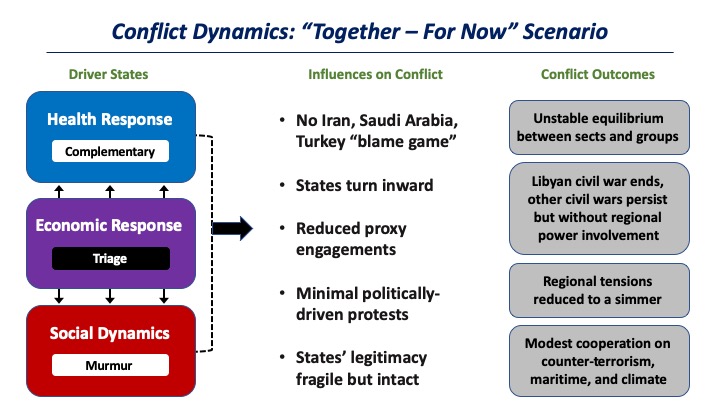
Conflict dynamics in the pre-pandemic Middle East reflected zero-sum thinking among the regional powers, other national actors, and international actors. While there were common interests served by regional stability, this abstract objective was crowded out by the security dilemmas of endemic conflicts that encouraged escalation, not cooperation. In the “Together — For Now†scenario, COVID-19 changed this. On the whole, while the region likely would not be fully stabilized in terms of conflict mitigation, we could expect at least an unstable equilibrium. Many might fear that unrest would further destabilize already weakened governments and put effective public health and economic relief measures at risk. The resulting relative calm among most populations region-wide would help give governments much-needed breathing room.
Pressing short-term interests in cooperating on the health response, particularly among Iran, Turkey, and Saudi Arabia, could produce modest spillover effects onto other issues requiring cooperation. These could include some winding down of proxy roles in Yemen and stabilizing the tense situation in Iraq. Also, in this scenario we could finally see resolution to the blockade of Qatar by Saudi Arabia, the UAE, Bahrain, and Egypt. While rivalry certainly would persist between these regional actors on a range of issues, the tenor of the relationships could be expected to evolve into something less venomous. And if the worst infection and death outcomes were avoided, as the relatively collaborative health response would suggest, there would be less of a tendency for governments to play the blame game.
A diminution of conflict between the regional rivals also would be reinforced by a desire to finally begin turning a corner in their anemic economies. In this scenario, recovery is still stalled due to the short-term financial “triage†support to people and businesses in 2020 and 2021. In 2025, and likely even sooner, thegovernments would be more focused on jump-starting their economies than on stoking legacy animosities with their neighbors. Competitive positioning as they try to create economic momentum likely would not spiral out of control or create heightened tensions. The need for economic growth could even catalyze some long moribund trade relations between countries, such as Qatar and Saudi Arabia.
With the regional actors in a more constructive posture in ongoing public health efforts, and focused inward on their economies, we could see a lull in the proxy engagements in some of the civil war zones. By the timeframe of the scenario, while the situation in Yemen still would be nothing approximating peace, it likely would shift away from a Saudi-Houthi conflict to conflicts among the indigenous actors. The Libyan civil war would effectively be ended if turning inward led to the end of support for General Khalifa Hifter by Russia, Egypt, Saudi Arabia, and the UAE, and attenuated support for the Tripoli government by Turkey and Qatar. Syria likely also would move to a different phase of its war. Proxy involvement by Iran, Hezbollah, Turkey, and Russia might lessen, but ISIS could take advantage and launch an all-out assault on the central governments in Syria, Lebanon, and Iraq, further threatening the stability of already weakened and unstable countries. Overall, in the conditions envisioned in this scenario, civil wars would persist, but in a new phase with the regional powers’ retrenchment.
Scenario: “Patients Yes, Patience Noâ€
Health Response (Complementary), Economic Response (Traction), Social Dynamics (Clamor)
Most governments in the region were cautious in their immediate actions to address impacts of the pandemic on their economies. Cash transfers, temporary tax relief, and other measures were capped at modest levels. The focus of the economic response was much more on business than people. The biggest focus was investment in the health care system. Helped by the global economy rebounding pretty well, the approach in the region has shown success, but not without controversy. On the health front, there were fewer infections and deaths than many had feared. This got a monumental boost from the global philanthropic community. Other aspects of the health response also benefited from the surprising degree of collaboration by the countries of the region throughout 2021. At first, people were pleased by how their leaders and the international community rose to the occasion on both the health and economic fronts. But the honeymoon didn’t last long. With governments prioritizing a stronger and more confident eventual economic recovery, the poorest found themselves in dire straits. Grievances unrelated to the pandemic reemerged and began to intensify, fanned by what many characterized as a purposefully uneven distribution of economic aid and the effects of the post-pandemic economic recovery.
Â
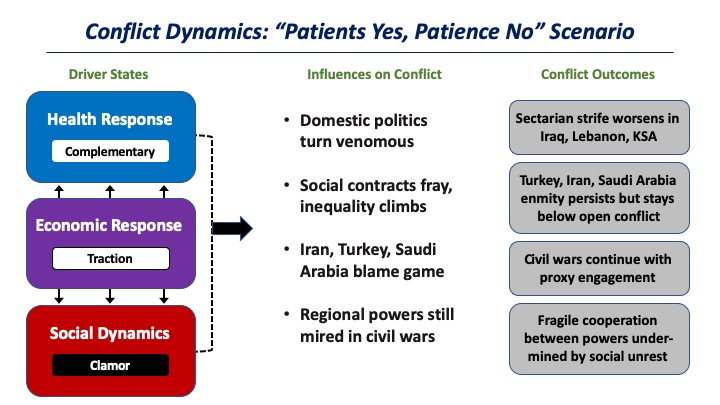
In this scenario, we would expect conflicts at the national level to have worsened in the five years since the advent of the COVID crisis. Rather than promoting solidarity or even wary tolerance among regional actors, the scenario envisions the public health response in Iran, Turkey, Israel, and Saudi Arabia falling victim to domestic politics. If it did, sectarian conflicts in Saudi Arabia, Bahrain, and Lebanon plausibly would flare. Iraq could descend again into Sunni-Shi’i conflict, contrary to its “Iraq-first†nationalist pathway in the pre-COVID-19 real world. Politicizing the health response would worsen rather than help with the legitimacy challenges that most governments in the region were already facing at home before the pandemic. Regardless, the conditions in a scenario like this one likely would push some of them to try to paper over these divides by creating the perception of a common outside enemy.
Governments in “Patients Yes, Patience No†would face other inconvenient truths as well that could affect conflict dynamics. While in 2020 and 2021 they act responsibly and invest in the long-term economic interests of their countries, in this scenario they get little credit for it from their populations. If the initial subsidies to stabilize the economy short term ran out, before long-term economic traction could be created, the unequal effects of recovery could fuel societal divisions. This would be a risk particularly where there is a history of sectarian conflict, violence, and disenfranchisement, such as in Lebanon, Iraq, and even Saudi Arabia. In these countries, in the 2025 of this scenario, violence could be expected to be worse than it was in 2020.
With an interplay of the drivers like “Patients Yes, Patience†envisions, Iran, Saudi Arabia, Turkey, Israel, and other regional powers could not afford to be in open conflict with one another. To do so would put the revival of tourism to the region, international trade, and other essentials of their economic recovery at risk. At the same time, they would have no incentive (and little pre-COVID “muscle memoryâ€) to devote energy to collaborating to dampen tensions in weaker countries such as Lebanon, Jordan, Iraq, Libya, Yemen, and Syria. If anything, they likely would still be calculating that blaming their regional rivals for stoking sectarian and other rifts in those countries would distract their own restive populations. Calls from outside the region for leveraging the COVID crisis aftermath to finally spur movement toward cooperative security would be lost in the clamor. With no effective conflict mitigation structures in place, temperatures would continue to rise in national-level conflicts across the Middle East. The muted tensions between the regional powers would be far from guaranteed.
Â
Discover more from PressNewsAgency
Subscribe to get the latest posts sent to your email.