
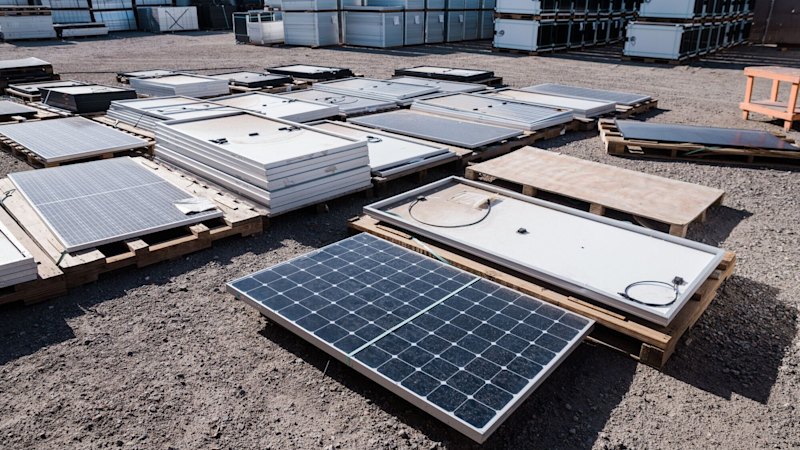
Plans to kick-start a solar panel recycling industry are in limbo, after a single complaint stalled the government’s $25 million pilot program to stop up to 4 million units being sent to landfill each year.
The Albanese government announced the pilot program in January, which it was hoped would develop a local industry to recover the valuable materials contained in discarded panels, like copper, silver and aluminium, and establish around 100 collection points around the country to pick up about 250,000 panels over three years.
However, the pilot program was paused by the Department of Climate Change, Energy, Environment and Water after a stakeholder lodged an undisclosed complaint about the tender process.
The solar industry estimates that at least 4 million solar panels come off rooftops and from large-scale solar farms each year, and most go into landfill.
Until recently, up to 2 million rooftop panels were shipped each year from Australia to mostly developing economies, where they were onsold. But rising transport costs and the ever-diminishing price of Chinese-made panels collapsed the reuse market.
The process to appoint an organisation to run the recycling pilot program was paused in May, as first reported by Reneweconomy, which confirmed the move this week.
Environment Minister Murray Watt told this masthead he was still seeking an administrator to run the pilot.
“The Albanese government remains committed to the pilot, and we want to see the pilot commence as soon as possible,” Watt said.
“The Department of Climate Change, Energy, the Environment and Water is working to appoint an administrator.”
The annual dump of millions of solar panels in landfill is a potential environmental hazard and a political risk for governments.
Panels can contain relatively small amounts of lead and cadmium that could leach from landfill into the water table.
The lack of recycling is a significant risk to the social licence of the massive solar industry.
Australia has long ranked as a world leader in per-person solar uptake, with more than 4 million homes – or one in three – fitted with rooftop solar panels. Rooftop solar has grown to 28 gigawatts of capacity in the energy grid, eclipsing that of the total of 22 gigawatts from all the nation’s coal plants.
The electricity grid is powered by roughly 50 per cent renewables and 50 per cent fossil fuels.
State and federal governments are committed to net zero emissions, and their plans to reach the goal depend on increasing uptake of solar farms and rooftop panels.
But the public support for the rewewables rollout could suffer if the increasing volume of solar panels that reach the end of their life must be dumped at the tip.
Australian Council of Recycling chief executive Suzanne Toumbourou said when the pilot was announced in January she thought it would get up and running quickly.
Now, she is worried the ongoing pause would result in more panels being unnecessarily discarded.
“It’s extremely disappointing that this indefinite delay continues,” Toumbourou said.
“We’re disappointed with the lack of clarity about the timeframe and the longer we delay the capability to collect and recycle solar panels, the longer we don’t know where they are going – it could be put into landfill, or it could be sent overseas, illegally.”
Rooftop panels can last for more than 25 years, but they eventually become inefficient as exposure to sunlight, rain and temperature change wears down the silicone cells and breaks down materials in the panels.
Those that are being scrapped to landfill are an average of eight years old, as home owners upgrade their systems to the more efficient and cheaper units that are now on the market.
Findings from the pilot program are to be used by state and federal governments to develop a solar industry stewardship program that would force manufacturers, importers and retailers of solar panels to take responsibility for the disposal of their products.
The Productivity Commission released a report in January, ahead of the pilot program being announced, that found reusing the various materials in solar panels could deliver economic benefits worth $7.3 billion.
Watt said the government remained committed to delivering the pilot and stewardship program.
“Getting the rollout of the pilot right is really important – it’s crucial we have a sustainable and effective national solution to recycling end-of-life solar panels.”
Get to the heart of what’s happening with climate change and the environment. Sign up for our fortnightly Environment newsletter.
 Mike Foley is the climate and energy correspondent for The Age and The Sydney Morning Herald.Connect via email.
From our partners
Discover more from PressNewsAgency
Subscribe to get the latest posts sent to your email.