

A large pool of science and engineering graduates, a large network of laboratories and research institutions and active involvement in some of the frontline areas of scientific research generally places India among the leading countries with deep scientific capabilities. However, in comparative terms, India lags behind a number of countries, some with much more limited resources, on a variety of research indicators.
Chief among them is the money India spends on research and development activities. For more than two decades, the stated objective of the Center has been to allocate at least two percent of the national GDP to R&D. Not only has this target not been met, but research spending as a share of GDP has fallen, from around 0.8 percent at the turn of this millennium to around 0.65 percent now. For the last decade or so, this share has remained stagnant.
This is not to say that research money has not increased. Research spending has more than tripled in the last 15 years, from Rs 39,437 crore in 2007-08 to over 1.27 lakh crore in 2020-21. But India’s GDP has grown faster, so the share of research has decreased.
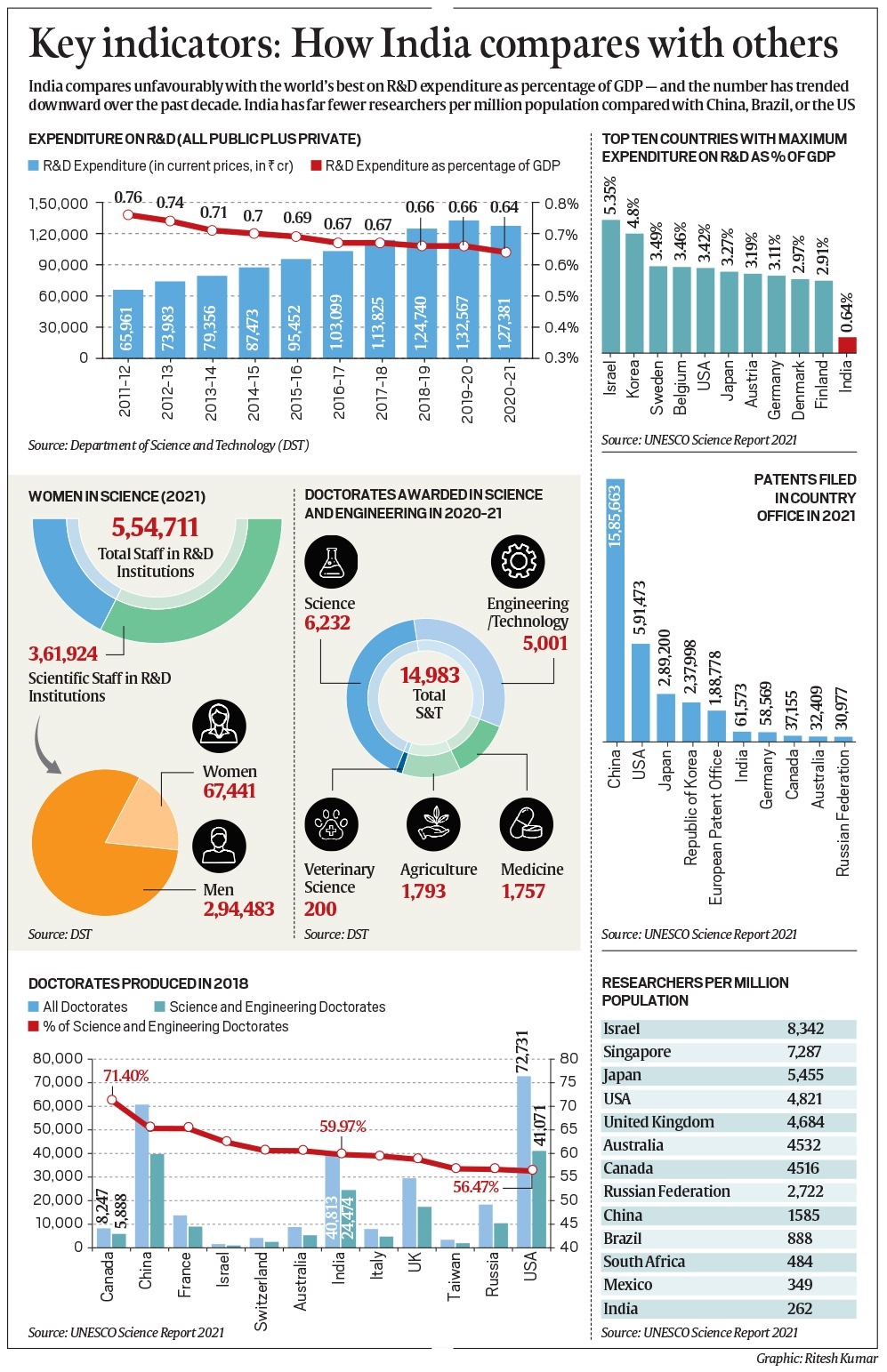
At least 37 countries spent more than 1 percent of their GDP on R&D in 2018, the latest year for which data is available for all countries, according to UNESCO’s 2021 Science Report. Fifteen of them spent two percent or more. Globally, about 1.79 percent of (global) GDP is spent on R&D activities. Unlike India, globally, growth in R&D spending has outpaced GDP growth.
In response to a question from Parliament in March, the government said India’s total spending on R&D in purchasing power parity (PPP) terms in 2018 (around US$68 billion) was the sixth highest of the world, after the US, China, Japan and Japan. Germany and South Korea. However, India fell far behind. The United States and China spent more than $500 billion that year.
India spent just US$42 (in PPP terms) per researcher in 2020, compared to almost US$2,150 for Israel, US$2,180 for South Korea and US$2,183.
Furthermore, women make up only 18 percent of the total research scientists in India, while globally this number was 33 percent.
research in universities
India has about 40,000 higher education institutions, mostly colleges. More than 1,200 of these are full universities. Only one percent of these are dedicated to active research, according to the project’s detailed report on NRF. No comparative number is available for other countries, but it is common knowledge that in most leading countries, universities are the centers of research and development activities.
“If you ask me to point to just one area where I would like to see NRF make a difference, it would be here, in the combination of education and research. This is the biggest anomaly that exists in the Indian system. And it is unsustainable. So the NRF concept puts a lot of emphasis on rectifying this,” said Professor Arindam Ghosh from the Indian Institute of Science, Bangalore.
According to the Department of Science and Technology (summer schedule), there were 7,888 R&D institutions in the country in 2021, including more than 5,200 units in the private sector and industries, which are mainly engaged in industry-specific research. The private sector unit count even includes 921 industries “with potential” to undertake research activities.
Research result
India produced 25,550 PhDs in 2020-21, of which 14,983 were in science and engineering disciplines. This 59 per cent share in general PhDs compares well with other countries, putting India in seventh place overall. Even in absolute terms, India’s annual output of science and engineering PhDs is at the top, with only the US, China and the UK producing more.
But due to India’s large population, this is not impressive in proportional terms. In fact, the number of researchers per million inhabitants in India, 262, is extremely low compared even to developing countries such as Brazil (888), South Africa (484) or Mexico (349).
Some 94 percent of Indians (34,241 out of 36,565) who earned a PhD from a US university between 2001 and 2020 did so in science and engineering disciplines, second only to China, according to DST data.
Publications and patents
The DST data showed that Indian researchers published 149,213 papers in science and engineering journals around the world in 2020, almost two and a half times more than a decade earlier. However, it still made up only 5 percent of all items. Chinese researchers contributed 23 percent, while American researchers accounted for 15.5 percent.
In 2021, a total of 61,573 patents were filed in India, making it the sixth largest in the world. But this was nowhere near the nearly 16 lakh patents filed in China and around 6 lakh in the US that year.
Discover more from PressNewsAgency
Subscribe to get the latest posts sent to your email.