

The Israeli government’s national security adviser said on Tuesday that a new nuclear facility being built by Iran would not be immune to attack, despite expert assessments, it would be beyond the reach of last resort. US bunker busting bombs.
Tzachi Hanegbi made the comments in response to a Associated Press report that said the new facility appears to be as deep as 100 meters (328 feet) underground.
Hanegbi, speaking at a security conference near Tel Aviv, said he was not surprised by the report, noting that Iran has other underground facilities.
While acknowledging that the location would complicate any potential military attack on the facility, he said there are still solutions to the challenge.
 International Atomic Energy Agency inspectors and Iranian technicians prepare to cut the connections between the twin cascades for 20% uranium enrichment at the Natanz nuclear site near Natanz. (AP/File)
“What can be said on this matter is that there is no place that cannot be reached,” he said.
He declined to say whether Israel had the ability to do this on its own.
“We hope we don’t get to a situation where the solution to the story of a nuclear weapon in Iran is a kinetic solution, a solution that involves an attack,” he said, adding that Israel prefers the international confrontation with Iran to be resolved. through diplomatic means.
Israel views Iran as its biggest enemy, and Prime Minister Benjamin Netanyahu has repeatedly said that he will not allow Iran to develop a nuclear weapon.
He said that international diplomacy should be accompanied by a serious military option and hinted that Israel would be prepared to attack Iran on its own if necessary.
Photos and videos of Planet Labs PBC’s new Iran facility show that Iran has been digging tunnels near the Natanz nuclear site, which has been the target of repeated sabotage attacks over the years.
Excavation mounds at the site suggest the facility could be between 260 feet (80 meters) and 328 feet (100 meters) underground, according to experts and AP analysis.
The Islamic Republic denies that it is seeking nuclear weapons, although officials in Tehran now openly discuss its ability to seek one.
With Iran now producing uranium near weapons grade levels after the collapse of its nuclear deal With world powers, the facility complicates the West’s efforts to prevent Iran from potentially developing an atomic bomb, as diplomacy over its nuclear program remains at a standstill.
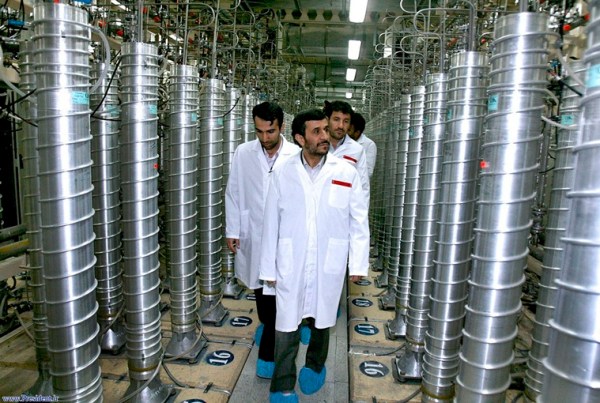 A new underground facility at the Natanz enrichment site could put centrifuges beyond the range of a massive so-called “bunker buster” bomb previously developed by the US military, according to experts and satellite photos analyzed by The Associated Press in May 2023. .(AP/ File)
The construction comes five years after then-President Donald Trump unilaterally withdrew the United States from the nuclear deal.
Since then, Iran has intensified its uranium enrichment well beyond the limits of the agreement.
Experts believe it is one step away from reaching the 90% enrichment threshold for weapons-grade uranium.
Uranium enrichment is a key element in the production of a nuclear bomb.
Israeli experts believe that Iran would need additional time, up to two years, to develop the means to launch and detonate a warhead.
Addressing the same conference, Israel’s military chief, Lt. Gen. Herzi Halevi, said Israel is closely monitoring Iran’s nuclear program and reiterated that the military is prepared to take action.
“There are possible negative developments on the horizon and that may trigger action,” he said.
“We have capabilities. Others have capabilities, and this is a very significant and important matter.”
Discover more from PressNewsAgency
Subscribe to get the latest posts sent to your email.