


Picture Credit: Husk Energy
Husk Energy Programs, a clear power firm on the forefront of fueling rural electrification since 2008 and that introduced plans to launch 500 photo voltaic mini-grids in Nigeria over the subsequent 5 years, has raised $103 million Sequence D in fairness and debt to fulfill its targets.
The capital injection contains $43 million in fairness, which Husk Energy describes because the largest-ever increase of its variety within the mini-grid business — and a $60 million debt financing. New traders STOA Infra & Vitality, the US Worldwide Growth Finance Company (DFC) and Proparco, and present traders Shell Ventures, Swedfund and FMO participated within the fairness deal. However, a number of finance establishments, together with the Worldwide Finance Company (IFC) and the European Funding Financial institution (EIB), offered the debt part.
What does this imply for Husk Energy? In an announcement, the 15-year-old cleantech stated the funding cements its place because the chief in electrifying communities in rural Sub-Saharan Africa and South Asia with an AI-enabled platform of renewable power companies.
Per the World Financial institution, mini-grids have the potential to offer half a billion folks with clear power by the tip of this decade (together with these utilizing overburdened grids) with the correct insurance policies in place. In addition they present cleaner and cheaper alternate options of power, which may rework the lives of tens of millions of individuals residing in darkness.
Sub-Saharan Africa accounts for 75% of the world’s inhabitants with out entry to renewable power options and electrical energy. Nations like South Sudan, Burundi, Chad, Malawi, Burkina Faso, Madagascar and Tanzania are amongst among the least electrified nations on the earth and may gain advantage from clear power from photo voltaic or wind.
Buoyed by this new capital, Husk Energy will look to judge growth into a few of these markets over the subsequent couple of years, together with the Democratic Republic of Congo (DRC), Zambia and Madagascar; it has to this point deployed over 200 mini-grids in Nigeria and India, in accordance with co-founder and CEO Manoj Sinha.
Since its launch in 2008, when it helped pioneer the neighborhood mini-grid business (a class of distributed renewable power infrastructure that gives first-time entry to dependable, inexpensive, clear and fashionable energy), Husk Energy has since developed its enterprise mannequin, increasing past power entry to incorporate the power transition from fossil fuels to renewables.
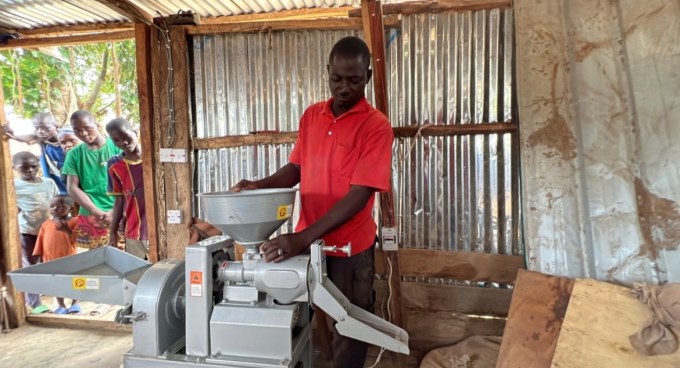
Consequently, Husk says it has matured from a pure-play mini-grid operator to an built-in platform that goes past simply electrical energy gross sales to gross sales and financing of energy-efficient home equipment, turnkey business and industrial (C&I) rooftop photo voltaic and a variety of low-carbon and climate-resilient power companies, together with e-mobility, agro-processing and chilly storage. The corporate stated this strategy is progressively changing into extra clever and automatic, powered by AI and IoT.
“We now have developed our know-how in a number of facets. Firstly, our mini-grids are actually powered by a synthetic intelligence platform. Meaning we will synthesize demand patterns and information from a historic perspective to foretell future demand as a result of our buyer patterns aren’t predictable,” Sinha informed TechCrunch.
“We even have a customer-facing app that folks use in rural India and Nigeria to make funds on-line. In order that’s a small part, however persons are utilizing digital fee, eliminating the necessity for money. Most significantly, folks can use that app to watch power utilization, optimize and even scale back power consumption if and when wanted. Final however not least, we even have our e-commerce platform, which sells energy-efficient units on the app,” added the CEO, who famous that these units are delivered to clients inside 72 hours.

Picture Credit: Husk Energy
In 2018, Husk Energy raised a $25 million Sequence C, cash it used to develop its fleet from about 12 to 200 photo voltaic mini-grids, Sinha talked about within the interview. He claimed that quantity makes the cleantech the most important neighborhood mini-grid proprietor and operator globally. India is its largest market, with 188 mini-grids to Nigeria’s 12.
To date, Husk Energy, by way of these mini-grids, has served over 10,000 micro, small and medium enterprises (MSMEs) and prevented 25,000 tonnes of carbon dioxide, it stated in an announcement. The assertion reveals its projections over the subsequent 5 years: rising its fleet to serve 300,000 new connections whereas avoiding 350,000 tonnes of carbon dioxide.
Having achieved a CAGR of 60% and maintained a retention fee of greater than 90% over time, Husk Energy may even use this new financing to extend its mini-grid footprint to 1,500. In keeping with Sinha, two-thirds of the financing can be devoted to rising its Sub-Saharan Africa footprint to deliver the variety of mini-grids within the area on par with what has been deployed to this point in India. Husk Energy expects the mini-grids in Nigeria to achieve 500 over the subsequent 5 years, a 40x development from its present determine.
The World Financial institution says distributed renewable power, sometimes mini-grids, is probably the most cost-effective, quickest path to common electrification for 380 million folks in Africa by 2030. To that finish, Husk Energy sees itself enjoying a extra vital function in deploying extra mini-grids throughout rural sub-Saharan Africa by way of “Africa Sunshot,” an initiative the cleantech introduced final month to put in 2,500 mini-grids (together with 1,000 in Nigeria, 500 within the DRC and 250 every in 4 further nations nonetheless to be recognized) inside 5 years. Husk expects to mobilize $500 million in fairness and debt to finance the Sunshot, cash it intends to boost privately or through an IPO by 2027.
“This Sequence D paves a path for us to boost the subsequent half a billion {dollars} within the coming years. After all, we may have our heads down for the subsequent 18 to 24 months and deploy a number of 100 mini-grids,” the CEO famous. “After which we can be out available in the market to search for both the subsequent spherical of financing from non-public capital markets, or we may even strongly contemplate a path to an IPO to checklist the corporate publicly and lift cash from public markets.”
In a market that wants greater than 100,000 mini-grids to realize common electrification in Africa, regardless of being bold, Husk Energy’s projected numbers are a drop within the ocean; accordingly, there’s a necessity for a number of cleantech gamers offering mini-grids in numerous markets throughout the area. Husk faces competitors from different cleantech platforms, together with Nuru and CrossBoundary. In keeping with Sinha, Husk differs from others in that it targets small villages whereas platforms like Nuru are keener on bigger cities; equally, he argues that Husk has the bottom levelized value of power (LCOE) globally and makes use of an AI-powered algorithm to run operations.
Whereas every cleantech platform has its aggressive edge, they could want to have interaction a number of governments as an alternative of venturing independently in the event that they wish to scale sooner, Sinha famous.
“I believe it’s potential for us to exceed even 2,500 mini-grids over the subsequent 5 years. However we have to change the scaling technique that we now have had to this point to get there. Our [Husk Power] technique is to get into 5 – 6 nations concurrently. However that can’t occur with out public-private partnership preparations with governments,” he stated.
“We are able to deploy a mini-grid asset for an space in a a lot much less capital-intensive method than what’s historically used with poles and wires. That’s why the World Financial institution is deploying its program throughout a number of nations, at the moment in DRC, Nigeria and shortly in different nations. So these corporations should come collectively to unravel the issue of electrifying half a billion folks over the subsequent seven years. Is it possible we’re going to attain there? I hope so as a result of many corporations like us should come to the platform to execute at greater than 10x scale-up fee to a minimum of transfer the needle in that path.”
Husk Energy turned EBITDA constructive within the final quarter of 2022, in accordance with Sinha. The cleantech, which has constructed a staff of 500+ staff, expects so as to add greater than 2,500 staff over the subsequent 5 years because it expands throughout Africa and Asia. The corporate’s development in numerous facets of its enterprise displays the rising alternative in Africa’s cleantech area, which has rekindled the pursuits of native and world traders over the previous 18 months.
Discover more from PressNewsAgency
Subscribe to get the latest posts sent to your email.