
NIAMEY, Niger (AP) — A week after a deadline for Niger’s mutinous soldiers to reinstate the country’s ousted president or face military intervention, the junta has not agreed. No military action has been taken and the coup leaders appear to have gained the upper hand on the regional group that issued the threat, analysts say.
The West African bloc ECOWAS had given the soldiers who ousted Niger’s democratically elected president, Mohamed Bazoum, until last Sunday to release and reinstate him or threatened military action. On Thursday, the bloc ordered the deployment of a “reserve” force to restore constitutional government in Niger, with Nigeria, Benin, Senegal and the Ivory Coast saying they would contribute troops.
But it is unclear when, how or if the troops will be deployed. The measure could take weeks or months to roll out, and while the bloc decides what to do, the junta is gaining power, some observers say.
“It looks like the coup plotters have won and will stay… The putschists hold all the cards and have cemented their dominance,” said Ulf Laessing, head of the Sahel program at the Konrad Adenauer Foundation, a think tank.
ECOWAS is unlikely to intervene militarily and risk dragging Niger into civil war, he said, adding that ECOWAS and Western countries would likely pressure the junta to agree to a short transition period.
Europe and the United States will have no choice but to recognize the junta to continue security cooperation in the region, Laessing said.
The July 26 coup is seen as a major blow to many Western nations, which saw Niger as one of their last partners in the conflict-plagued Sahel region south of the Sahara desert, with whom they could work to push back a growing jihadist insurgency linked to al-Qaeda and the Islamic State group. The United States and France have more than 2,500 military personnel in the region and, along with other European countries, have invested hundreds of millions of dollars in military assistance and training for Niger’s forces.
There was still little clarity about what would happen days after ECOWAS announced the deployment of the “standby” force.
A meeting of the region’s defense chiefs was postponed indefinitely. The African Union is expected to hold a meeting on Monday to discuss the Niger crisis. The group’s Peace and Security Council could annul the decision if it considered that an intervention threatens peace and security in general on the continent.
The delay of the meeting of defense chiefs to discuss the “reserve” force shows that ECOWAS sees the use of force as a last resort, said Nate Allen, an associate professor at the African Center for Strategic Studies.
“Given the likely challenges that an intervention would face, (the use of force) would require a high degree of consensus and coordination not only within ECOWAS, but also within the African Union and the wider international community,” he said.
But those with ties to the junta say they are preparing for a fight, especially since the soldiers are unwilling to negotiate unless ECOWAS recognizes its leader, Gen. Abdourahmane Tchiani, who ousted the president, as the new ruler.
“ECOWAS demands that (the junta) immediately release President Bazoum and reinstate him as head of state. Is this a joke?” said Insa Garba Saidou, a local activist who helps Niger’s new military rulers with their communications and says he is in direct contact with them. “Whether Bazoum resigns or not, he will never be President of Niger.
As time passes, concerns grow for the safety of Bazoum, who has been under house arrest with his wife and son since the coup. People close to him say that his situation is deteriorating without water, electricity and lack of food. The Niger junta told a senior US diplomat that they would kill the deposed president if neighboring countries attempted any military intervention to restore their rule, two Western officials told The Associated Press.
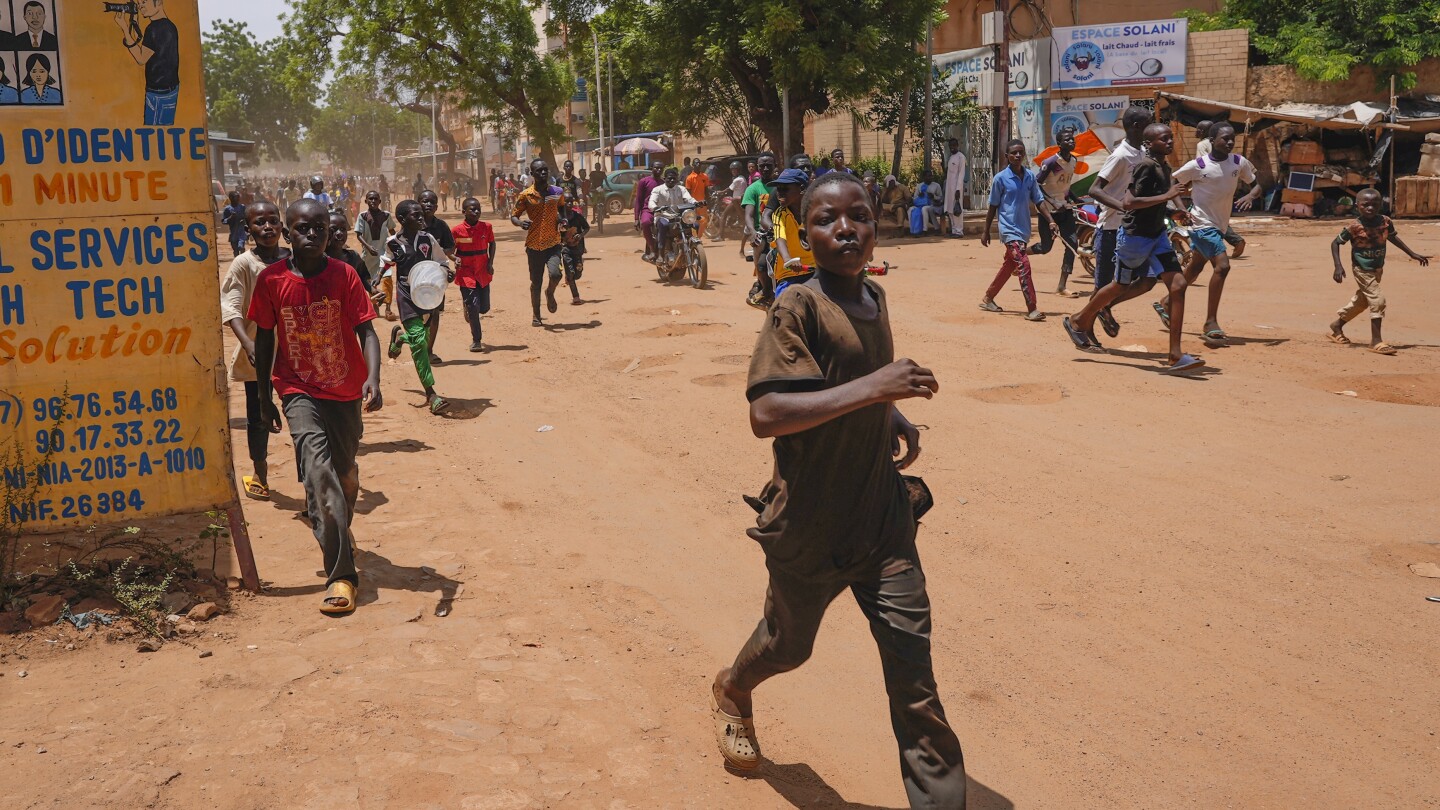
Most Nigerians are trying to get on with their lives as the clash between the coup leaders and countries in the region continues.
For the most part, the streets of the capital, Niamey, are quiet with sporadic pockets of pro-junta demonstrations. Security forces quickly silence any demonstrations in favor of Bazoum.
On Sunday, people marched, cycled and drove through the center of Niamey, chanting “down with France” and expressing their anger against ECOWAS.
“Niger is in a deplorable situation. We are very happy that there has been a coup. Now everyone can go out on the streets without problems… (but) if ECWOAS allows people to attack Niger, it will cross a red line,” said resident Saidou Issaka.
On Friday hundreds of people, many waving Russian flags, marched on France’s military base demanding the French leave. Mercenaries from the Russia-linked Wagner group already operate in a handful of other African countries and are accused of committing human rights abuses. Earlier this month, during a trip to neighboring Mali, which is also run by a military regime and cooperates with Wagner, the junta reportedly asked the mercenaries for help
Boubacar Adamou, a tailor in the capital, said he had made at least 50 Russian flags in the weeks after the coup.
But many Nigerians don’t have time for protests and are more focused on feeding their families.
The country of some 25 million people is one of the poorest in the world and the harsh economic and travel sanctions imposed by ECOWAS are taking their toll.
Moussa Ahmed, a food vendor in Niamey, said prices of foods like cooking oil and rice had risen 20% since the coup and there was not enough electricity to power the fridges in his shop. Niger gets up to 90% of its power from neighboring Nigeria, which has cut off some of its supply.
Aid groups that were already grappling with the challenges of helping more than 4 million people in need of humanitarian assistance say the crisis will exacerbate an already dire situation.
“We cannot overstate the impact on civilians, both in terms of humanitarian and protection needs, when military imperatives take precedence over civilian rule,” said Jan Egeland, secretary general of the Norwegian Refugee Council.
Sanctions and suspensions of development aid are expected to have a dramatic impact on living conditions in a country already under severe pressure, he said.
Discover more from PressNewsAgency
Subscribe to get the latest posts sent to your email.