North Korea has stepped up its verbal attacks on Japan, issuing more than a dozen denunciations through state media since early July and hardening its rhetoric in recent days by accusing Tokyo of whipping up a “neo-militarist frenzy” and preparing for a “war of aggression”.
Analysts said the latest broadsides from Kim Jong-un’s regime reflected both renewed confidence in Pyongyang as ties with Moscow deepen, and a desire to frame Asia-Pacific geopolitics as a contest between rival blocs – mirroring the Nato-Warsaw Pact stand-off at the height of the Cold War.
The attacks come amid rising tensions across the region: North Korea is forging deeper security and economic ties with Russia, Beijing is increasingly at odds with Tokyo, and Japan is moving to strengthen its defence posture in response to perceived threats from the other three.
North Korea’s leader Kim Jong-un (centre) watches performance tests of a weapons system on the destroyer Kang Kon at an undisclosed location last month. Photo: KCNA / KNS / AFP
“Both Russia and China have problems in their relationships with Japan at the moment and North Korea is keen to participate in the criticisms of Tokyo,” said Andrei Lankov, a Russian-born professor of history and international relations at Seoul’s Kookmin University.
“It is important for the regime to have an ‘evil enemy’ that they can complain about and Japan meets that need,” he said. “Pyongyang is very keen to side with Russia and China, as it helps to promote the narrative that they are part of a mighty military bloc.”
Such a bloc is unlikely to materialise any time soon, but analysts say that will not stop Pyongyang from launching further provocations to unsettle Tokyo.
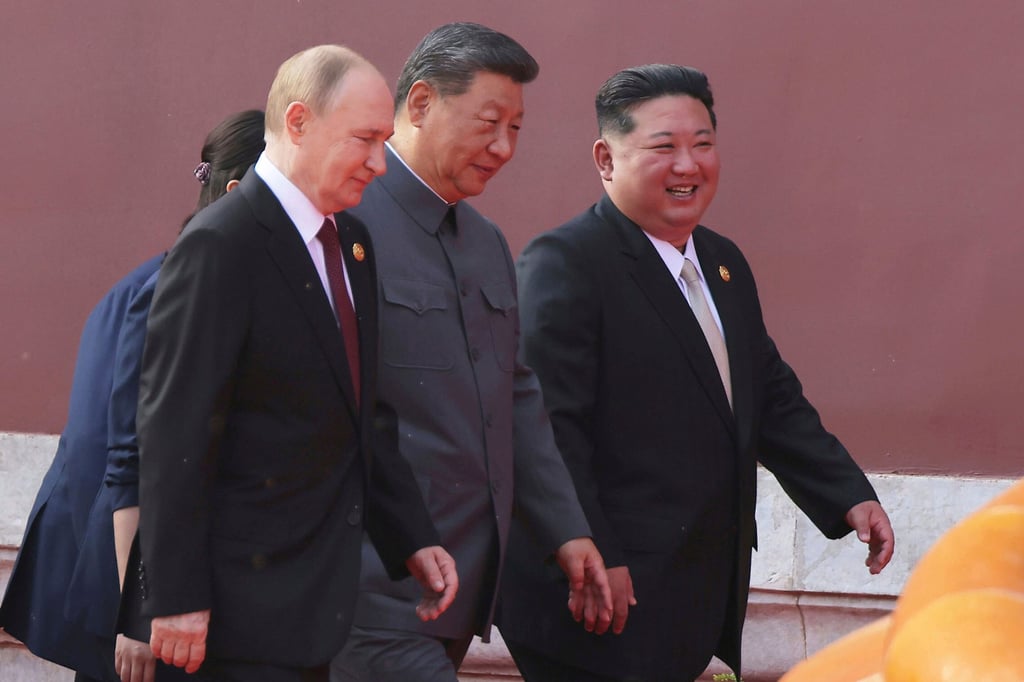
(From left) Russian President Vladimir Putin, Chinese President Xi Jinping and North Korean leader Kim Jong-un attend a military parade in Beijing last year. Photo: KCNA / Korea News Service / AP
On Monday, Pyongyang’s state-run Korea Central News Agency (KCNA) accused Japanese politicians of “harbouring militaristic ambitions” after they paid respects to the nation’s 2.5 million war dead at Tokyo’s Yasukuni Shrine, which also honours 1,066 men convicted of war crimes.
We use cookies on our website to give you the most relevant experience by remembering your preferences and repeat visits. By clicking “Accept”, you consent to the use of ALL the cookies.
This website uses cookies to improve your experience while you navigate through the website. Out of these, the cookies that are categorized as necessary are stored on your browser as they are essential for the working of basic functionalities of the website. We also use third-party cookies that help us analyze and understand how you use this website. These cookies will be stored in your browser only with your consent. You also have the option to opt-out of these cookies. But opting out of some of these cookies may affect your browsing experience.
Necessary cookies are absolutely essential for the website to function properly. These cookies ensure basic functionalities and security features of the website, anonymously.
Cookie
Duration
Description
cookielawinfo-checbox-analytics
11 months
This cookie is set by GDPR Cookie Consent plugin. The cookie is used to store the user consent for the cookies in the category "Analytics".
cookielawinfo-checbox-functional
11 months
The cookie is set by GDPR cookie consent to record the user consent for the cookies in the category "Functional".
cookielawinfo-checbox-others
11 months
This cookie is set by GDPR Cookie Consent plugin. The cookie is used to store the user consent for the cookies in the category "Other.
cookielawinfo-checkbox-necessary
11 months
This cookie is set by GDPR Cookie Consent plugin. The cookies is used to store the user consent for the cookies in the category "Necessary".
cookielawinfo-checkbox-performance
11 months
This cookie is set by GDPR Cookie Consent plugin. The cookie is used to store the user consent for the cookies in the category "Performance".
viewed_cookie_policy
11 months
The cookie is set by the GDPR Cookie Consent plugin and is used to store whether or not user has consented to the use of cookies. It does not store any personal data.
Functional cookies help to perform certain functionalities like sharing the content of the website on social media platforms, collect feedbacks, and other third-party features.
Performance cookies are used to understand and analyze the key performance indexes of the website which helps in delivering a better user experience for the visitors.
Analytical cookies are used to understand how visitors interact with the website. These cookies help provide information on metrics the number of visitors, bounce rate, traffic source, etc.
Advertisement cookies are used to provide visitors with relevant ads and marketing campaigns. These cookies track visitors across websites and collect information to provide customized ads.