
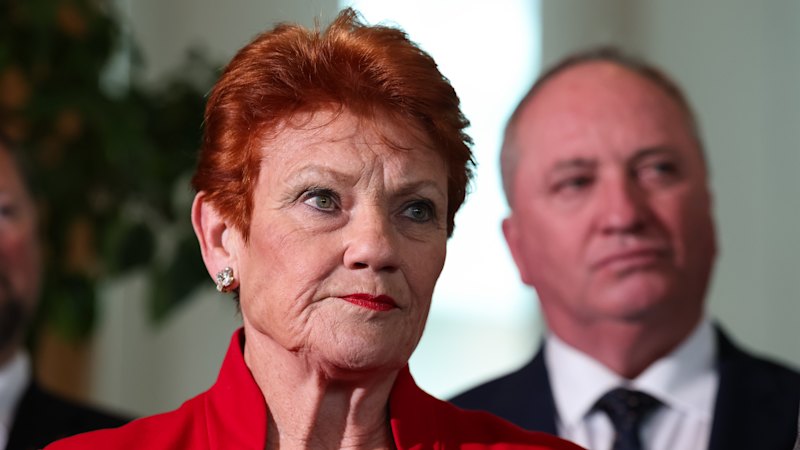
One Nation has been forced to clarify that its migration policy would allow tens of thousands more migrants than it first suggested, raising questions about the rigour of its policy manifesto.
For months, policy experts and political opponents have scratched their heads about One Nation’s vision for lowering migrant numbers, a hot-button issue that has helped drive Pauline Hanson’s popularity.
Its policy, as explained on its website, said the party would cut migration “by capping visas at 130,000 per year” to ease pressure on housing and infrastructure. But it had not specified which type of visas.
The migration system includes temporary visas, such as students, working holidaymakers and short-term skilled visas, some of which are demand-driven. The government also gives 185,000 permanent visas a year to skilled workers, family reunions and humanitarian cases. A combination of both visa types contributes to the net overseas migration figure – migrants who stay minus those who depart.
Either way, a policy of 130,000 visas would lead to either zero or negative overall migration since tens of thousands of people leave the country each year. One Nation’s explicit policy before the last election was “net zero” migration, although that term has since been dropped from its website.
But One Nation’s Barnaby Joyce on Monday said the 130,000 figure applied to the net intake of migrants. This would mean the number of visas issued would be much higher than 130,000.
Asked by reporters whether One Nation was referring to total visas issued, or the net overall migrant intake each year, Joyce said at a press conference on Monday: “It’s net.”
It came after Hanson muddied the waters on the weekend when she was grilled on the difference between net migration and the number of permanent visas during a Sunday morning interview on Sky’s Sunday Agenda.
At one point, Hanson said she wanted “net migration [of] about 130,000”. But in answer to a later question on permanent visas, she said, “I want to see 130,000 as the permanent number that are here”.
One Nation had not previously said that its 130,000 figure related to net migration. Party representatives have not responded to this masthead’s questions about the policy in the past, although a spokesperson also told SBS on the weekend that it was a net figure.
Hanson also said the country needed better leadership to “turn the country around” and stop people leaving Australia. However, more people staying in Australia for longer would actually increase net overseas migration because it would lead to fewer outflows.
One Nation is the political party most trusted to manage immigration, according to a survey of Australians in this masthead’s Resolve Political Monitor.
The party’s policy platform is yet to grapple with the ramifications that deep cuts to migration would have on key workforces, including in regional areas that are emerging as potential electoral strongholds.
Farrer MP David Farley, during this year’s byelection, broke with party policy during a candidate forum by suggesting it was “probably not” an issue if Australia’s net migration reached 306,000. “If we’re successful in One Nation’s water policies, we’re going to need more labour, and we’re going to need more labour quickly, skilled labour,” he said.
Last week, Liberal frontbencher Andrew Bragg sparked confusion about the Coalition’s net overseas migration target by suggesting it would be about 180,000. Opposition Leader Angus Taylor initially offered a figure below 200,000 but said he did not want to commit until he knew how many houses were built before the next election. Days later, Taylor told The Australian its figure would be about 173,000 based on the current rate at which homes were being built.
The Australian also reported that One Nation wanted to ban entrants from countries that were on the Department of Foreign Affairs and Trade’s “do not travel” list, such as Lebanon, Palestine, Afghanistan and Russia.
Joyce on Monday, however, suggested it was not an all-out ban. “People are saying we’re just completely ruling out certain areas. That’s not the case. We’re talking about greater stringencies,” he said.
In a rare intervention into domestic politics, the consulate for Haiti in Australia contested One Nation’s policy on behalf of the tiny diaspora. In an open letter to Hanson, honorary consul Julia Melamed said she had difficulty with “the idea that a travel advisory written about a country can serve as a judgment on the people who come from it”.
“We know of no conduct within this community that would justify calling Haitians in Australia a
security concern,” she wrote.
“People who leave a country in crisis are not usually carrying that crisis with them. They are trying to get away from it… We ask you, senator, and everyone taking part in this debate, to keep two ideas separate.”
Labor has also been agonising over a policy to cut net overseas migration from 300,000 to 225,000, though it has struggled to land the final package over concerns about offending migrant communities and creating economic harm.
Cut through the noise of federal politics with news, views and expert analysis. Subscribers can sign up to our weekly Inside Politics newsletter.
 Natassia Chrysanthos is Federal Political Correspondent. She has previously reported on immigration, health, social issues and the NDIS from Parliament House in Canberra.Connect via X or email.
 Paul Sakkal is Chief Political Correspondent. He previously covered Victorian politics and won a Walkley award and the 2025 Press Gallery Journalist of the Year. Contact him securely on Signal @paulsakkal.14.Connect via X or email.
From our partners
Discover more from PressNewsAgency
Subscribe to get the latest posts sent to your email.