Relations soured precipitously following the Galwan Valley clash in 2020, when troops were deployed to both sides of the poorly-delineated Himalayan border known as the Line of Actual Control, resulting in the deaths of troops from both countries.
During Wang’s unannounced visit to India in March 2022, the first by a high-level Chinese official following the Galwan clash, he said the border issue should be placed in its “proper position” in bilateral relations, and not be allowed to “define or even affect” the overall development of ties.
In a somewhat concessionary tone towards New Delhi, Wang also said that Beijing is not pursuing a “unipolar Asia”, is respectful of India’s traditional role in the region, and would like the two sides to explore “China-India Plus” cooperation in South Asia. He added that both sides should take part in multilateral institutions such as the Brics grouping and the Group of 20 with a “cooperative posture”.
More recently, at the Asean foreign ministers’ meeting in Vientiane, Laos, last month, Jaishankar said that maintaining stable bilateral relations “holds special significance to upholding regional peace and promoting multipolarity”. Wang said putting the China-India relationship back on the right track would meet the shared aspirations of the Global South.
In spite of the border dispute, Chinese President Xi Jinping and Indian Prime Minister Narendra Modi have, for the most part, overseen cordial and constructive relations. They have held 16 bilateral meetings since 2014 and have met multiple times on the sidelines of multilateral gatherings.
Xi has expressed to Modi that both countries’ development ambitions are opportunities rather than threats. Perhaps the most eye-catching series of diplomatic events between the two leaders has been their “hometown diplomacy” after they agreed to significantly boost bilateral convergence by holding informal summits at distinctive venues in their respective countries.
The first informal summit, in Wuhan, China, in 2018, enabled both sides to reach a consensus on long-term and strategic issues. These included agreements on reforming global governance mechanisms, upholding multilateral trade institutions, and securing safeguards against global financial and economic instability, as well as each leader’s respective vision for national development.
Indian Prime Minister Narendra Modi and Chinese President Xi Jinping pose with dancers at the Hubei provincial museum in Wuhan, Hubei province, on April 27, 2018. Photo: Reuters
At their informal summit in 2019, held in Chennai, India, Xi and Modi reaffirmed the Wuhan consensus and concluded accords in working towards a closer partnership in their joint development efforts. Both sides also expressed support for mutual learning and exchanges between the two “ancient civilisations”.
On an institutional level, China and India are members of various multilateral organisations including the Russia-India-China trilateral arrangement, Brics, the Shanghai Cooperation Organisation and the G20.
Both countries are also involved in a number of major regional multilateral lending institutions. For instance, India became one of the first co-founding members of the China-launched Asian Infrastructure Investment Bank (AIIB) in 2015.
India is also the AIIB’s second-largest shareholder, behind China, having a single member constituency on the board of directors. In 2018, India also hosted the bank’s third annual general meeting in Mumbai. As members of the Brics grouping, China and India were also among the co-founders of the New Development Bank.
As China and India emerge as the new superpowers of the 21st century, they are also aware of the need to share common goals in their respective development paths.
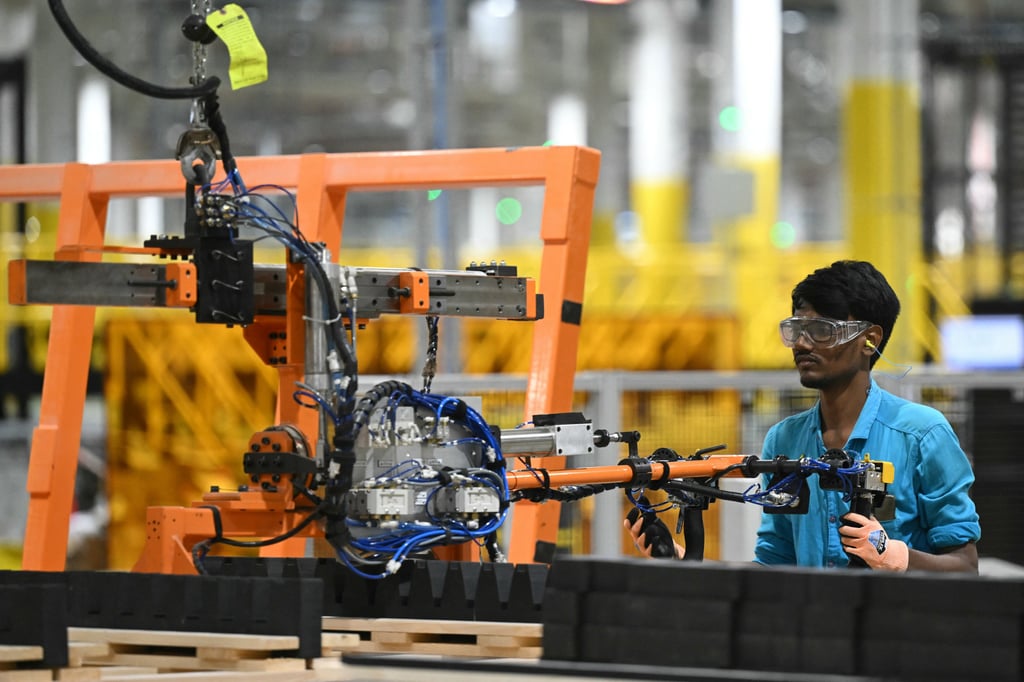
A worker operates a machine at a solar manufacturing facility in Sriperumbudur, India, on January 11. Photo: AFP
While their disputes may often dominate international headlines, multiple ongoing, albeit low-key, dialogues continue to push the two nations onto a more cooperative pathway.
Since the Galwan Valley clash, there have been 30 rounds of talks. Bilateral military and diplomatic meetings have resulted in disengagement at several friction points along the Line of Actual Control, although more must be done to achieve a fully comprehensive settlement.
Aside from their border dispute, which both sides admit is a source of great acrimony, China and India recognise that this will be their century as the world gravitates towards Asia, economically, politically and culturally. Ultimately, neither Beijing nor New Delhi want to jeopardise their respective destinies as great civilisations which are long overdue a re-emergence into global leadership.
Bob Savic is a senior research fellow at the Global Policy Institute in London, UK, and a visiting professor with the University of Nottingham’s Faculty of International Relations
We use cookies on our website to give you the most relevant experience by remembering your preferences and repeat visits. By clicking “Accept”, you consent to the use of ALL the cookies.
This website uses cookies to improve your experience while you navigate through the website. Out of these, the cookies that are categorized as necessary are stored on your browser as they are essential for the working of basic functionalities of the website. We also use third-party cookies that help us analyze and understand how you use this website. These cookies will be stored in your browser only with your consent. You also have the option to opt-out of these cookies. But opting out of some of these cookies may affect your browsing experience.
Necessary cookies are absolutely essential for the website to function properly. These cookies ensure basic functionalities and security features of the website, anonymously.
Cookie
Duration
Description
cookielawinfo-checbox-analytics
11 months
This cookie is set by GDPR Cookie Consent plugin. The cookie is used to store the user consent for the cookies in the category "Analytics".
cookielawinfo-checbox-functional
11 months
The cookie is set by GDPR cookie consent to record the user consent for the cookies in the category "Functional".
cookielawinfo-checbox-others
11 months
This cookie is set by GDPR Cookie Consent plugin. The cookie is used to store the user consent for the cookies in the category "Other.
cookielawinfo-checkbox-necessary
11 months
This cookie is set by GDPR Cookie Consent plugin. The cookies is used to store the user consent for the cookies in the category "Necessary".
cookielawinfo-checkbox-performance
11 months
This cookie is set by GDPR Cookie Consent plugin. The cookie is used to store the user consent for the cookies in the category "Performance".
viewed_cookie_policy
11 months
The cookie is set by the GDPR Cookie Consent plugin and is used to store whether or not user has consented to the use of cookies. It does not store any personal data.
Functional cookies help to perform certain functionalities like sharing the content of the website on social media platforms, collect feedbacks, and other third-party features.
Performance cookies are used to understand and analyze the key performance indexes of the website which helps in delivering a better user experience for the visitors.
Analytical cookies are used to understand how visitors interact with the website. These cookies help provide information on metrics the number of visitors, bounce rate, traffic source, etc.
Advertisement cookies are used to provide visitors with relevant ads and marketing campaigns. These cookies track visitors across websites and collect information to provide customized ads.