These are difficult times for anyone who wants to buy a home. Despite the government’s attempt to reinvigorate the market with a temporary stamp-duty holiday on properties costing up to £500,000 in England and Northern Ireland, unless you have a large deposit you could face a struggle.
During the crisis lenders have pulled mortgages, with those for borrowers with small deposits disappearing fastest. Some of the big banks and building societies have started to return to the market – last week saw 90% deals launched by Coventry building society and Metro Bank, and, from Monday, Nationwide building society will also be offering them.
But the choice is still limited, and lenders are asking a lot more questions than they were before lockdown.
What’s on offer
Since lockdown, the number of mortgages on the market has plummeted by almost half. Most deals that have gone are those where buyers need a deposit of 5% or 10%. According to financial data firm Moneyfacts, in March there were 779 products for borrowers with a 10% deposit, while the figure is now closer to 70.
For those with 5% deposits, the options are even narrower – in March there were 391, now just 14, and many of those are specialist products, says Eleanor Williams from Moneyfacts.
“This includes guarantor and family-assist mortgages, such as Barclays’ Springboard mortgage, and those open only to applications from selected professions, or from those in specific lending areas, such as those offered by Furness Building Society that reflect its principles as a mutual to continue to support those in their local area,†she says.
Matters are made worse by low interest rates, she says, which mean anyone saving is not seeing their money grow.
The stamp-duty holiday will give extra cash to movers and to first-time buyers spending more than £300,000. But for many, it won’t make up for the loss of 95% mortgages, says Simon Gammon, managing partner of mortgage broker Knight Frank Finance. “The stamp duty cut is not going to make that up, so, if anything, it is more frustrating for first-time buyers,†he says.
Blink and you miss it
With little choice at 90%, borrowers have needed to be on the ball to get their hands on the few mortgages that are available.
Coventry building society came back into the 90% mortgage market early last week, but not for long – it took applications for the deals between 8am on Tuesday and 8pm on Wednesday, saying the flash sale was to ensure good customer service.
Other lenders are taking a different approach to rationing mortgages. HSBC has been offering 90% home loans throughout the crisis but, since April, has limited the number of applications it accepts each day. “A small number of lenders cannot take all the business at higher loan-to-values and hence this action has been necessary,†says the bank. “We will, of course, continue to review the situation regularly and hope it isn’t too long before the market returns closer to normal.â€
Nationwide building society will return to the high loan-to-value mortgage market from 20 July, with a 90% mortgage for first-time buyers. It’s re-entry is expected to be a game-changer. It has promised not to limit the number of mortgages available each day, and, as the country’s largest building society, should have more capacity to cope than smaller lenders. Metro Bank, too, has put its 90% home loans on more general release, and is not restricting them to new borrowers.
More questions
Anyone who wants a mortgage at a high loan-to-value should expect a lot of questions. Most lenders have added new terms and conditions to their deals, increasing the number of hurdles would-be borrowers need to get over.
“You are going to have to be a good-quality borrower to access a 90% mortgage,†says David Hollingworth of mortgage brokers London & Country. So anyone looking to remortgage or move may be asked if they have taken a payment holiday. “If you say ‘yes’, you can expect a more forensic examination of why,†says Gammon. “The same would apply if you have been furloughed.†He says he has not seen lenders say upfront that they will not take on borrowers who have taken a payment break, but, after scrutiny, some have been unable to borrow as much as they hoped.
Coventry building society is clear about furloughing: it is only willing to offer loans of up to 65% of a property’s value to anyone currently paid through the scheme. Metro Bank has also ruled out furloughed applicants for these deals – and when you return from furlough you must have evidence of three months’ full pay to apply.
Borrowers may also face more questions about how they raised the money for their deposit. Although help from other people is still allowed, at Nationwide, buyers will only be able to take out a 90% mortgage if they have contributed to the down payment themselves.
Lenders are also asking for more from self-employed borrowers. “Back in February lenders would ask for three years’ business bank statements and base the lending on that,†says Gammon. “Now they want statements for the last three months to see how your business has been trading.†Hollingworth says lenders are keen to see “what income can be evidencedâ€. For the self-employed or anyone furloughed and on a reduced income this could mean being offered a mortgage based on this sum, rather than what you would expect to earn normally.
A frustrating future
It will be some time before mortgages which require only small deposits will return, said Gammon.
“I don’t envisage lenders rushing back to the 95% mortgage market – they will want to see what happens as the furlough scheme unwinds, and also what happens to prices,†he says.
“I don’t think 95% mortgages are going to be back before the end of the year.â€
Case study: ‘Every little bit counts’
Niamh Spence is looking for a house near Manchester. The 29-year-old PR manager is selling a property she bought with an ex-partner and hoping to move into a place of her own.
“I’m looking at around the £130,000 to £140,000 mark so I will benefit from the stamp duty cut. Every little bit counts, so I’m pleased about that. If you think before lockdown there were 95% mortgages, I’ve had to find extra for the deposit to meet the new requirements of lenders only supplying 85%. The problem is, there are barely no mortgages for 10% deposits and it’s so competitive – my broker says that if you don’t get in first thing in the morning you can’t get one from banks such as HSBC.â€
Spence is currently furloughed, which hasn’t helped. “My mortgage in principle is based on me being on a furlough wage. Until I get back to work I can’t borrow any more, so I’m looking for something based on what I can do currently.
“I know plenty of people who are in the same position and I’m lucky to be returning to work as I know there are many who are facing redundancy. I’m selling to a first-time buyer and I’m not in a chain, but it is hard. I wish the government had encouraged lenders to come back to offer mortgages to those with 5% as asking for 10% or 15% can mean the difference of £5,000 or £10,000.â€
Boris Johnson says he hopes normality will resume by November | Tolga Akmen/AFP via Getty Images
Prime Minister likens nationwide shutdown to a ‘nuclear deterrent.’
The U.K. won’t be in a position to need another national lockdown, according to Prime Minister Boris Johnson.
Johnson likened a nationwide shutdown to a “nuclear deterrent,†telling the Sunday Telegraph that he doesn’t want to use it. “And nor do I think we will be in that position again,†he added.
The move echoes France ruling out a second lockdown, with Prime Minister Jean Castex saying that this would lead to “disastrous†economic and human consequences.
Despite worldwide criticism of the U.K.’s response to the pandemic, Johnson defended the government, insisting that “lots of things … went very, very well.†He pointed to the quickly-built Nightingale hospitals across the country, the U.K. trial that led to dexamethasone becoming a possible treatment for coronavirus and the country’s extensive furlough scheme.
In the wide-ranging interview, Johnson also spoke of his plans to shake up the university education system. Specifically, he said that the pricing of university courses would be reviewed. “In reality, it would have been much more sensible if courses had been differently priced. We are certainly looking at all that.”
An increased focus on technical education would also support the U.K.’s production of new technology, argued Johnson, in a reference to the U.K. banning the Chinese firm Huawei’s 5G gear.
“Let’s start doing some of this stuff ourselves, working with … like-minded countries, and getting the stuff installed. The potential is enormous, whether it’s 5G or full fiber or gigabit or superfast broadband, the U.K. can really excel in all those,†he said.
Indian ship worker Tejasvi Duseja is desperate to go home after months stranded offshore by coronavirus border closures and lockdowns that have left more than 200,000 seafarers in limbo.
From engineers on cargo ships to waiters on luxury cruise liners, ocean-based workers around the world have been caught up in what the United Nations warns is a growing humanitarian crisis that has been blamed for several suicides.
Many have been trapped on vessels for months after their tours were supposed to end as travel restrictions disrupted normal crew rotations.
“Mentally, I am just done with it … but I’m still holding up because I have no other option,” Duseja, 27, told AFP news agency via WhatsApp and Facebook Messenger in late June as the Indian-owned cargo vessel he works on floated near Malaysia.
Duseja, one of roughly 30,000 Indian workers unable to leave their ships, had extended his seven-month contract a few months before the pandemic struck.
“The last time I stepped off from this 200-metre [650-foot] ship was in February,” he said.
Seafarers typically work for six to eight months at a stretch before disembarking and flying back to their home countries, with new crews taking their place.
But as the deadly virus whipped around the world and paralysed international travel, that was suddenly impossible.
Underscoring the growing urgency of the situation, more than a dozen countries at a United Kingdom-hosted International Maritime Summit this month pledged to recognise seafarers as “key workers” to help them get home.
‘You worry if you’ll ever come back home’
Philippine luxury cruise ship technician Cherokee Capajo spent nearly four months on ships without setting foot on land due to virus shutdowns.
The 31-year-old had barely heard of COVID-19 when he boarded the Carnival Ecstasy in Florida in late January.
Soon, a number of Carnival-owned cruise ships were stricken with severe outbreaks – including the Diamond Princess in Japan.
After the Ecstasy passengers disembarked in Jacksonville on March 14, Capajo and his colleagues were forced to stay on board for the next seven weeks.
Finally, on May 2, the ship sailed to the Bahamas where Capajo says he and 1,200 crew members were transferred to another boat that took them to Jakarta before arriving in Manila Bay on June 29.
He wanted to “kiss the ground” when he came ashore nearly two weeks later after finishing quarantine.
“This could probably be the hardest part of my experience as a seaman because you are not sure what will happen every day,” Capajo told AFP via Facebook Messenger last week, as he endured a second quarantine near his hometown in the central Philippines.
“You worry if you’ll ever come back home, how long will you be stuck on the ship. It’s difficult. It’s really sad.”
Filipinos account for about a quarter of the world’s seafarers. About 80,000 of them are stranded because of the pandemic, according to Philippine authorities.
Mental toll on workers
The ordeal has taken a toll on the mental health of many seafarers, with reports of some taking their own lives.
In one case, a Filipino worker died of “apparent self-harm” on the cruise ship Scarlet Lady as it anchored off Florida in May, according to the US Coast Guard.
Shipping industry groups have expressed their concerns about “suicide and self-harm” among workers in a joint letter to UN Secretary-General Antonio Guterres, who said last month some seafarers have been “marooned at sea for 15 months”.
An International Labour Organization (ILO) convention widely known as the Seafarers’ Bill of Rights limits a worker’s single tour of duty to less than 12 months.
The strain is also being felt by families waiting at home.
Australia opens criminal investigation into virus-hit cruise ship (2:00)
Priyamvada Basanth said she did not know when she would see her husband who has been at sea for eight months on a ship owned by a Hong Kong company.
“The government is not even doing anything,” said Basanth, from the southern Indian port city of Kochi. “I just want him to come home.”
Lala Tolentino, who runs the Philippine office for a UK-based seafarers support group, said they had been swamped by “hundreds” of pleas for help from stranded workers since March.
“They want to know what will happen to them, where they are going. Will they be able to get off their ships,” she told AFP.
Many of those stuck on board completed their tours more than four months ago and were exhausted, the ILO said last month.
For Duseja, who comes from the northern Indian city of Dehradun at the foothills of the Himalayas, the end of his ordeal is in sight.
“I’m still on the ship,” he told AFP in a WhatsApp message last week.
“But mentally, I am feeling slightly better because I’ve been told that I’m finally getting off the ship mid-August.”
Germany’s Chancellor Angela Merkel arrives for a meeting of an EU summit on a coronavirus recovery package and budget | Francisco Seco/AFP via Getty Images
Sunday will be ‘decisive,’ says German chancellor as leaders head into third day of talks.
German Chancellor Angela Merkel said on Sunday that it is possible EU leaders will fail to reach a deal on the budget and recovery package at the European Council summit in Brussels.
Speaking on arrival at the Europa building, she said Sunday would be the “decisive†day for talks. European leaders on Saturday decided to extend the summit in an effort to reach a deal on a proposed €1.82 trillion EU budget and recovery package.
“We are going into the third day of negotiations today and it is certainly the decisive one,†Merkel said. “At this point, we’ve properly worked through various issues including the size of the fund, how it is managed and also issues regarding the rule of law. I still can’t tell if there will be a solution.â€
“There’s lots of goodwill, but there are also many positions. That’s why I will be among those pushing for an agreement, but it is also possible that there will be no result today,†the German chancellor said.
Discussing the flood situation with Chief Minister Sarbananda Sonowal over phone, Modi also enquired about the COVID-19 scenario and the ongoing efforts to douse the raging blaze at the Oil India’s Baghjan gas well.
Prime Minister Narendra Modi on Sunday assured all support to Assam in dealing with the flood havoc, which has claimed 81 lives so far this year.
Discussing the flood situation with Chief Minister Sarbananda Sonowal over phone, Modi also enquired about the COVID-19 scenario and the ongoing efforts to douse the raging blaze at the Oil India’s Baghjan gas well.
“Hon’ble PM Shri @narendramodi ji took stock of the contemporary situation regarding #AssamFloods2020, #COVID19 and Baghjan Oil Well fire scenario over phone this morning,” Sonowal tweeted.
“Expressing his concern & solidarity with the people, the PM assured all support to the state,” he said.
An official at the Chief Minister’s Office said that Sonowal informed Modi about all the measures the state has taken so far in dealing with the problems faced by the people.
The total number of people killed in this year’s flood and landslide has gone up to 107 across the state, of whom 81 were killed in flood-related incidents and 26 died due to landslides, the Assam State Disaster Management Authority (ASDMA) said in its morning bulletin.
Floods have hit over 27 lakh people in 26 of the 33 districts of Assam and destroyed houses, crops, roads and bridges at several places
On the COVID-19 front, Assam has recorded 22,981 cases, of which 10,503 have been reported from the Guwahati city alone.
The total number of persons losing their lives due to COVID-19 in the state has gone up to 53.
However, five more COVID-19 patients have died, but the government’s Death Audit Board has not included them in the tally of deaths caused by the COVID-19 virus. They had other ailments.
Meanwhile, the damaged Baghjan gas well of the PSU major Oil India Ltd in Assam is spewing gas uncontrollably for the last 54 days since the blowout took place on May 27, followed by the inferno on June 9.
Alfredo Morelos was streaming a live video on Instagram when the comment was made by another user of the site
Police Scotland are investigating after Rangers striker Alfredo Morelos was racially abused on social media.
​​​​​​The 24-year-old was streaming a live video on Instagram, during which other users of the site could post comments, when the incident occurred.
A Police Scotland spokesperson said: “We have been made aware of offensive comments online and officers are investigating. We take all allegations of online abuse seriously and will thoroughly investigate such matters.”
It is not the first time that Morelos has been the target of racist abuse. In February, Police Scotland and Kilmarnock opened investigations after alleged racist comments were made towards the Colombian at Rugby Park.
Morelos has been part of the Rangers squad that spent the past week in France, where they played two friendlies as they prepare for the new Scottish Premiership season.
He started in their 2-0 win over Lyon, and was a substitute for the 2-0 victory against Nice.
Government Medical College and Hospital, Sector 32, Chandigarh. (Express Photo)
Bodies of the two Covid-19 victims were switched and sent to each other’s families by authorities of Government Medical College (GMC) Amritsar on Saturday.
One family cremated the body without seeing its face, however, other insisted on seeing face one last time and found that a wrong one had been sent.
Padama (37) of Damganj locality in Amritsar and Pritam Singh (92) from Hoshiarpur had died of Covid-19 on Saturday.
Family of Padma cremated the body sent to them on Saturday evening.
However, Pritam Singh’s family insisted on to see the face for once and found dead body of Padama.
Authorities were tight lipped over the development. However, sources blamed human error. “Dead bodies were first packed in PPE kits and then in wooden box. However, both dead bodies were labelled wrongly. Padma’s dead body was sent to Hoshiarpur and Pritam Singh’s dead body was cremated at Amritsar,†said source at GMC.
Upset over his wife leaving home, a 40-year-old man allegedly shot himself at his house in Uttar Pradesh’s Shamli district, police said on Sunday.
The incident took place in Sonta village under Babri police station on Saturday night, they said.
Balender Singh was upset as his wife had gone to her parents’ house with their children after the couple had a heated argument a few days ago. He shot himself using a country-made pistol, the police said.
The body has been sent for post-mortem, they said.
Disclaimer: This news piece may be triggering. If you or someone you know needs help, call any of these helplines: Aasra (Mumbai) 022-27546669, Sneha (Chennai) 044-24640050, Sumaitri (Delhi) 011-23389090, Cooj (Goa) 0832- 2252525, Jeevan (Jamshedpur) 065-76453841, Pratheeksha (Kochi) 048-42448830, Maithri (Kochi) 0484-2540530, Roshni (Hyderabad) 040-66202000, Lifeline 033-64643267 (Kolkata).
Ordinarily, the opening weekend of a food destination as ambitious as Escape to Freight Island would have been a circus. The pre-launch publicity would have drummed up such anticipation and queues that, even for those disappointed and turned away, the scrum at the door would have only added to Freight Island’s legend.
But that was pre-Covid-19. The seated, open-air food market – the first phase of a 2,500-capacity food, art and music complex – was due to open this weekend in Manchester’s abandoned Mayfield train station. It will now open on Friday 24 July and, for the first month, only to pre-booked parties of up to six who must all register their contact details online. On arrival, each group will receive a welcome briefing which, echoing the video and 16-point “Safe & Social Manifesto†sent out with booking confirmations, will remind them how to behave during their limited three-hour visit.
Staggered bookings and the on-street marshalling of exits and entries should ensure social distancing and no bottlenecks. Inside, except for toilet visits (to blocks of individual cubicles complete with disinfectant wipes to clean all surfaces; the urinal is over), you will be expected to stay at your table. No wandering. No browsing at the pizzas served by Dalston’s Voodoo Ray, Madre’s tacos or lingering at Baratxuri’s homage to Basque live-fire cooking. There will be music but, if it is to comply with government guidance, no live musicians, no dancing and only at a volume low enough that people do not have to shout over it. That is to decrease the risk of – and here is a thought to sharpen your appetite – “aerosol transmissionâ€. Yum.
The brainchild of a team that combines hospitality, festival and event management nous, and which includes the Unabombers – DJs turned restaurateurs and bar-owners – the hope for Freight Island is that, even with those restrictions, its dramatic outdoor location and sheer vastness will make it a place where, after months of pent-up stress and anxiety, 1,800 people a day can genuinely relax.
Under development before coronavirus, this first phase has been cleverly remodelled for the new normal. Using a QR code to pull up the menu, all food and drink will be ordered and paid for online using your phone, then delivered by masked staff to demarcated service zones on each table from where guests will hand dishes to each other. The tables are oversized creations spaced 2m apart. In this way, all guests and staff should be able to maintain a 2m distance for the vast majority of time; greater than the 1m now required indoors.
That will theoretically allow people to congregate at minimal risk without dividing tables with plexiglass screens, using individual dining pods, mannequins at spare seats, or any of the outlandish solutions floated on social media to space out and shield diners. Guests will be asked to use hand sanitiser, and free masks and gloves are available, but their use is not mandatory. Instead, as managing director Dan Morris puts it: “My responsibility is to keep people apart and safe.â€
In a world in which our ability to socialise freely will be curtailed for months if not years, Morris sees Freight Island as the perfect one-stop solution: “Now you can’t wander from bar to bar, you’ve got to plan it out. Travel’s an issue, everything’s a problem. We want you to know exactly what you’re getting, when and how.â€
Freight Island is a bold move in what, nationally, will be a perilous return for restaurants. The chancellor has cut VAT for the industry and offered a discount for customers in August, but surveys last month by industry body UKHospitality found that, while almost 70% of restaurants planned to reopen this month, the majority were predicting a “very slow recoveryâ€. In central London, empty of tourists, shoppers and office workers, figures as diverse as chef Claude Bosi at London’s two-Michelin-star Bibendum and Will Ellner, owner of Soho pasta restaurant Bancone, have already said they will not reopen until September. Last month, in an open letter, chefs including Fergus Henderson called for government support for this “ghost townâ€.
The team behind Manchester’s Escape to Freight Island, from left, Sonia Pabla-Thomas, Paul Swindles, Gemma Krysko, Heather Allen, Justin Crawford, Luke Cowdrey and Daniel Morris. Photograph: Richard Saker/The Observer
“We’re in no hurry to be first back,†says Justin Crawford, one half of the Unabombers, as he surveys the prospects for his smaller venues. Freight Island is an exception because – see also, Prawn On The Lawn relocating alfresco to Cornwall’s Trerethern Farm or London’s Brat operating at Climpson’s railway arch – it is open air, which will be one of the major features of the summer. Government and local authorities have pledged to make it far easier for pubs and restaurants to use rooftops, car parks and terraces. The risk of Covid-19 transmission is lessened outdoors. That is where diners will feel safest. Plus, says Crawford: “One big legacy of this period is it’s turbocharged the shift to cashless online ordering from phones. What might have taken 18 months has happened in three.â€
If Freight Island is a no-brainer, Crawford’s other venues are a post-coronavirus headache. For instance, 1m-distancing will reduce the tables at his Didsbury bar-diner, Volta, by 55%: “It’s frightening. You could lose more open than closed.†And Volta is not alone. Trade bodies have calculated that 1m-distancing will reduce the average restaurant’s capacity by 30% to 50%. A figure that will leave many just clinging on.
Currently offering take-out kebabs and Sunday roasts, the previously ultra-casual Volta reopened to eat-in diners on 9 July but, to make it financially viable, with fewer staff, a shorter menu and for limited hours. It is now bookings only, too. Similarly, at Crawford’s Hillary Step pub, reopening could waste big money if too many radical changes are made too quickly: “I don’t want to spend on plastic screens that Thursday through Sundayin three weeks aren’t necessary.†At the Refuge, a large Manchester hotel bar and restaurant where the Unabombers act as consultants, the menu also needs streamlining for the coronavirus era: “With small plates menus, waiters touch the table a lot. We have to look at that, perhaps packaging up dishes that are easy to drop, and also how many times dishes are touched in the kitchen, and reduce that.†All this will take time, and Crawford is envisaging a phased reopening between now and September.
Photograph: PÃ¥l Hansen/The Observer
In seaside resorts, reopening is a far more urgent issue. “I’ve missed Easter, half-terms, bank holidays, the start of summer. If I don’t get July, August and September, there will be no restaurants – simple as that,†says chef Paul Ainsworth, who runs several venues in and around Padstow, including the Mariners pub and the Michelin-starred No.6 restaurant. “I employ 140; 132 are on furlough. That’s a lot of people to be responsible for, a lot of mortgages. I live in Cornwall. My family are here. I don’t want to take unnecessary risks. But we can only go so far plunging into debt before it becomes financial suicide.â€
One-metre distancing means “no redundanciesâ€, but, says Ainsworth, at his casual restaurants this is a costly, difficult switch: buying hundreds of masks; refreshing hygiene procedures (waiting staff will wash their hands every 15 minutes rather than wearing gloves; most owners feel they could breed complacency); marking out physically distanced dining rooms; removing menus and digitising them so diners can access them on phones; timing bookings so groups do not mingle at the entrance; ensuring retention of walk-ins’ contact details; trialling collection points where guests might pick up food, rather than it being placed in front of them at the table – a procedure bizarrely not mentioned in official guidance.
Ainsworth worries about ripping the soul out of venues such as the Mariners. Bar service is not banned in the safety guidance for England, a document full of “where possible†loopholes which one operator predicts “will be policed more by customer pushback and social mediaâ€. But it strongly urges pubs to serve only seated guests. Being responsible, Ainsworth is creating a one-way system through the Mariners. “It will hugely affect a pub which on Friday night is usually jammed with people having a drink. It’ll become more a sit-down restaurant with staff greeting guests.â€
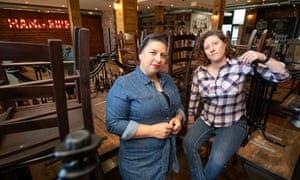
Shauna Guinn, co-owner of Hang Fire, the OFM Award-winningbarbecue restaurant in Barry, south Wales, shares that existential angst. Not only has she been dealing with “painfully slow†decision-making locally – in early July, a ruling by the Welsh government was still pending on whether or not to allow outdoor dining this month – but she’s also worrying about how the experience will feel: “I’m getting enquiries for birthday tables of 10 now and telling customers that won’t be viable until next year. I just can’t see it. The spirit of hospitality lies in close personal interaction around food. Being served by someone in a mask and blue gloves or parking a hostess trolley and guests collecting their food detracts from that. I’m not sure I’d sit in a restaurant under those circumstances. We need to make sure we don’t lose what makes this sector important and where, for customers, value lies.â€
As Mayur Patel, co-owner of Manchester’s Bundobust restaurant sees it: “Our industry’s job is to help relieve the fear. We want it light-touch but safe.â€
That tension between safety and hospitality is, arguably, most acute in fine dining, which takes its very reason from a frictionless, intimate pampering which coronavirus rules out. Notting Hill’s two-Michelin star restaurant, the Ledbury, has already closed, on the basis, chef-owner Brett Graham told Eater, that: “We can’t operate the restaurant with any form of social distancing.â€
Sam Evans (left) and Shauna Guinn, Hang Fire in Barry, south Wales: ‘We need to make sure we don’t lose what makes this sector important and where, for customers, value lies.’ Photograph: Adrian Sherratt/The Observer
Sam Ward, managing director of Simon Rogan’s restaurants, including Cumbria’s two-Michelin star L’Enclume, strikes a more positive note: “Hospitality’s principles haven’t changed. The palate is very fickle, and you’ve got to make people comfortable so they can enjoy quality flavours. What has changed is what makes them comfortable.â€
Rather than a terrifying “clinical†environment, the changes L’Enclume has made since reopening on 4 July (temperature checks for guests; coats stored in individual suit bags; masked staff; overt cleaning of surfaces such as door handles), are meant to reassure.
Instead of endless changes of cutlery over 12 to 18 courses, knives and forks now come in a tamper-proof box. This is to protect staff, too, says Ward: “Picking up a stranger’s cutlery is a danger zone.†Looking at hygiene protocols imposed on Rogan’s Hong Kong venues, Ward does not think environmental health officers will object to plates being placed in front of guests, but: “To minimise interactions, we won’t be doing lots of actions like saucing or cheese at the table. We’ll also give people the choice of waiters explaining each course or scanning a QR code that takes you through to the website.â€
“Short and sharp is the name of the game,†says Ward, which will be a relief to those who find fine dining’s fussy interruptions infuriating.
Not that customer comfort is the only consideration. Staff safety is in the spotlight like never before. “Chefs have one of the highest occupational death rates from Covid-19,†says Unite’s Dave Turnbull, referring to ONS figures published in May. There is, he reports, nervousness among union members: “They feel that 1m places them at greater risk as it will increase the venue capacity – that on busy shifts 2m becomes 1 and 1 becomes zero.â€
You can institute back-to-back working, screen off prep and cooking areas, issue visors, place chefs in shift bubbles or minimise their face to face contact with waiting staff using non-contact drop zones for food, but, realistically, in small, fast-paced kitchens chefs cross paths. Consequently, many restaurants will now have shorter menus that can be handled by fewer chefs, and not just for safety reasons. Many owners are also looking to cut costs, including staff wages, as Britain enters a period of profound economic turbulence.
In Manchester’s now much quieter Northern Quarter, bar-diner Common has switched from a full food menu to serving a short selection of terrific pizzas. They are easier to produce, minimise waste and can be served eat-in or for takeaway, to now mainly city-centre residents. “If we’re down 20% in numbers and revenue, Sunday brunch becomes a loss-making service,†explains owner Jonny Heyes. “We can’t risk that.â€
Some upbeat voices predict a busy summer. Ainsworth’s restaurants received around 7,000 booking enquiries in the week before reopening and most “name†restaurants opening this month report strong interest. “It’s like the 2008 recession,†says Crawford. “Not everyone’s taken a pay cut and people will want to eat, drink and see friends; no matter how weird it feels at first.†But there is almost universal agreement that winter 2021 could see a swathe of closures due to a mixture of restricted customer numbers, lockdown debt, rising unemployment and falling consumer spending.
“They’re being hung out to dry,†says Restaurant magazine editor Stefan Chomka. “If landlords demand rent, restaurants will have to try to make money. But in central London with no customers, potentially.†A move to turnover-linked rents is “the only sensible modelâ€.
Everyone is hunkering down and finding resilient new revenue generators which could continue during further lockdowns. The Michelin-starred Black Swan at Oldstead is selling mail-order meal kits, London’s Bao delicatessen sells foods and homewares via its Convni webstore. Takeaway, grocery retail or picnic hampers are, suddenly, essential parts of how restaurants operate, rather than bolt-ons. “To make it financially viable, that’ll be the new normal,†predicts Guinn.
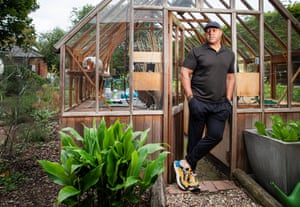
Chef Sat Bains in his restaurant’s kitchen garden Photograph: Fabio De Paola/The Observer
Sat Bains is mulling an at-home product line but will not reopen his two-Michelin star Nottingham restaurant until at least August. He is not judging those who have jumped in in July: “We’ve all got to earn. They’ve all got their issues. I’m losing 35, 40 grand a month. Most of us will end up in debt.†But while government support exists, he has no desire to reformulate a tasting menu restaurant where tables are visited 30 to 40 times: “It’s alright everyone going, ‘Why don’t you do a la carte?’, I’ve put my balls on the line with this. I’m not changing it overnight.â€
But this is about more than pride. Bains also takes Covid-19 incredibly seriously: “Friends of ours have really suffered, it’s real.†Ideally, he would only reopen when quick swab-tests are available for staff and customers: “I’ve got to look them in the eye and say, ‘Your health is our foremost priority.’ If we opened and caused someone to get ill, how would I live with myself?â€
“People have died,†Bains reiterates, a fact he wants his staff to be mindful of. When Restaurant Sat Bains does reopen, they will have to employ a tone of “respectful compassion†with guests still reeling from lockdown.
“We’ve shared a trauma together,†says Bains. “Every guest will have their story. Some might have lost loved ones and that’s going to be devastating. Hopefully it’ll connect us all better, but restaurants look after people and, now, people are going to really need looking after.â€
The heads of the three media bodies in charge of monitoring the performance of all audio, visual and written media outlets in Egypt took their constitutional oath before parliament July 5 to begin their work for the coming four years.
President Abdel Fattah al-Sisi had issued a decree reshuffling the media bodies June 22.
Under Articles 211, 212 and 213 of the 2014 Egyptian Constitution, television, radio, print media and online digital media are regulated by three commissions: the Supreme Council for Media Regulation (SCMR), the National Press Authority (NPA) and the National Media Authority.
As per the presidential decree, Sisi dismissed seasoned journalist Makram Mohammad Ahmad as head of the SCMR and replaced him with Karam Jaber, who was the chairman of the NPA.
Abdel-Sadek el-Shorbagy replaced Jaber as head of the NPA. Sisi kept Hussein Zein as head of the National Media Authority.
The reshuffle of the three media bodies should have been carried out in 2018, when the Law on the Organization of the Press took effect. Yet still, the bodies kept operating, with no amendments, until Sisi announced the reshuffle June 22.Â
The three media bodies were formed in April 2017 under a presidential decree. Since then, the bodies have been involved in a campaign undermining press and media freedom in the country.Â
Most recently, on June 16, the National Media Authority issued a decision banning the media from covering “sensitive†issues. The SCMR, then headed by Ahmad, issued a statement saying, “The Supreme Council for Media Regulation confirms the need for all media and social media sites, in all their forms, to abide by data issued by official sources when broadcasting information regarding Libya, the Renaissance Dam and the military operations in Sinai against terrorism.â€
Meanwhile for the past three years, the SCMR has blocked hundreds of news sites, imposed fines on press institutions and banned reporters from appearing on TV. The council has also blocked hundreds of blogs and accounts on social media, under a law that gives it the power to block and legally pursue any blog or account that has more than 5,000 followers and is accused of publishing false news.
Ahmad, who headed the SCMR for the past years, was thus considered a tool for the state to tighten its grip on the media.
However, the situation changed in December 2019 when Sisi ordered the formation of a Ministry of State for Information Affairs, as part of a Cabinet reshuffle. Osama Haikal was appointed Minister of State for Information Affairs, and was tasked with coordinating between the various media bodies and drafting the state’s media policies and following up on their implementation.
The Ministry of Information, which had been present in Egypt since 1952, was closed on June 16, 2014, following calls to ease the restrictions imposed on the media and allow a wider space for freedom of expression.
Haikal’s appointment sparked the anger of Ahmad, who accused Haikal of taking over his powers. In a TV interview on Sada al-Balad in February, Ahmad criticized what he considered undermining the freedom of expression in Egypt and called on the regime to give a platform to the opposition for the sake of diversity of opinions and to allow some space for openness without constraints.
Egypt has been witnessing a campaign of oppression and a crackdown on freedom of expression since Sisi took office in 2014. More voices have been silenced recently when journalists blamed the fragile health system that failed to counter the coronavirus crisis.
According to Amnesty International, at least 37 journalists are currently languishing in Egyptian prisons. Egypt recorded a drop in the global index for journalistic freedom that Reporters Without Borders issued in 2020, ranking 166 in a list of 180 countries.
It seems the Egyptian government is steering a plan to tighten its grip on TVÂ channels. It has also established WhatsApp groups to issue instructions regarding what the media can publish.
Perhaps the news coverage of the death of late President Mohammed Morsi, who died during a trial session on June 17, 2019, is the best example of the government’s intervention in media content; Morsi’s death was summarized with 42 words in Arabic on all media outlets — TV, radio and printed media — and it was not given much importance.
Justin Shilad, a senior researcher on Middle East and North Africa affairs at the Committee to Protect Journalists, said that ever since Sisi took office, the Egyptian authorities have been exercising total control on the media, at all cost. He added, “The government has gone to extremes in imposing its control over critical journalism.â€
Shilad told Al-Monitor via email his criticism of the Egyptian authorities’ clampdown on journalists and the media by imposing restrictions on the freedom of speech and expression.
Security forces arrested journalist Mohamed Monir on June 15, and Nora Younis, who is also editor-in-chief of the Al-Manassa news website, was arrested on June 24. She was later released. Monir, 65, died in prison on July 13 after he was infected with the coronavirus while in detention.Â
Earlier, on May 17, Lina Attalah, editor-in-chief of the independent Mada Masr news website, was arrested by security forces while she was interviewing the mother of detainee Alaa Abdul Fattah, a prominent anti-government activist.
Shilad noted that any possible change in the government’s inclinations toward the media depends on the international community and the pressure it can exert on the Egyptian government regarding the freedom of press and the media.
However, the hopes of media employees in Egypt of the state’s possible change of heart in the media issue were rekindled when media reports revealed early July the return of prominent media and press figures to TV screens after being absent or excluded, perhaps intentionally.
The main returning faces to the screen include Ibrahim Issa, a critic of Sisi’s regime, in addition to Magdy al-Jallad and Khairi Ramadan, among others, who will appear in a talk show on the private Al Kahera wal Nas channel (Cairo and the People) owned by Tarek Nour, owner of prominent Tarek Nour Advertising company. The program is set to be launched in August, according to Shorouk newspaper.
Issa’s last political program on an Egyptian channel was stopped in January 2017 due to security pressure for constantly criticizing Sisi’s policies.
In the wake of the escalating clampdown on freedom of speech and expression with Sisi’s rise to power, prominent journalists and correspondents forsook political programs and opted for social or artistic shows to avoid finding themselves unemployed.
A former editor-in-chief of a talk show told Al-Monitor on condition of anonymity that changing the media map, which is currently unilateral and pro-government, might contribute to encouraging Egyptian viewers to watch local channels again, while they had taken to following foreign media because the content of all local channels was similar and identical to the state’s narrative.
However, the editor-in-chief who had worked for several satellite channels linked the return of viewers’ trust in local satellite channels to the varied media content and wider space for freedom of expression through these shows.
We use cookies on our website to give you the most relevant experience by remembering your preferences and repeat visits. By clicking “Accept”, you consent to the use of ALL the cookies.
This website uses cookies to improve your experience while you navigate through the website. Out of these, the cookies that are categorized as necessary are stored on your browser as they are essential for the working of basic functionalities of the website. We also use third-party cookies that help us analyze and understand how you use this website. These cookies will be stored in your browser only with your consent. You also have the option to opt-out of these cookies. But opting out of some of these cookies may affect your browsing experience.
Necessary cookies are absolutely essential for the website to function properly. These cookies ensure basic functionalities and security features of the website, anonymously.
Cookie
Duration
Description
cookielawinfo-checbox-analytics
11 months
This cookie is set by GDPR Cookie Consent plugin. The cookie is used to store the user consent for the cookies in the category "Analytics".
cookielawinfo-checbox-functional
11 months
The cookie is set by GDPR cookie consent to record the user consent for the cookies in the category "Functional".
cookielawinfo-checbox-others
11 months
This cookie is set by GDPR Cookie Consent plugin. The cookie is used to store the user consent for the cookies in the category "Other.
cookielawinfo-checkbox-necessary
11 months
This cookie is set by GDPR Cookie Consent plugin. The cookies is used to store the user consent for the cookies in the category "Necessary".
cookielawinfo-checkbox-performance
11 months
This cookie is set by GDPR Cookie Consent plugin. The cookie is used to store the user consent for the cookies in the category "Performance".
viewed_cookie_policy
11 months
The cookie is set by the GDPR Cookie Consent plugin and is used to store whether or not user has consented to the use of cookies. It does not store any personal data.
Functional cookies help to perform certain functionalities like sharing the content of the website on social media platforms, collect feedbacks, and other third-party features.
Performance cookies are used to understand and analyze the key performance indexes of the website which helps in delivering a better user experience for the visitors.
Analytical cookies are used to understand how visitors interact with the website. These cookies help provide information on metrics the number of visitors, bounce rate, traffic source, etc.
Advertisement cookies are used to provide visitors with relevant ads and marketing campaigns. These cookies track visitors across websites and collect information to provide customized ads.



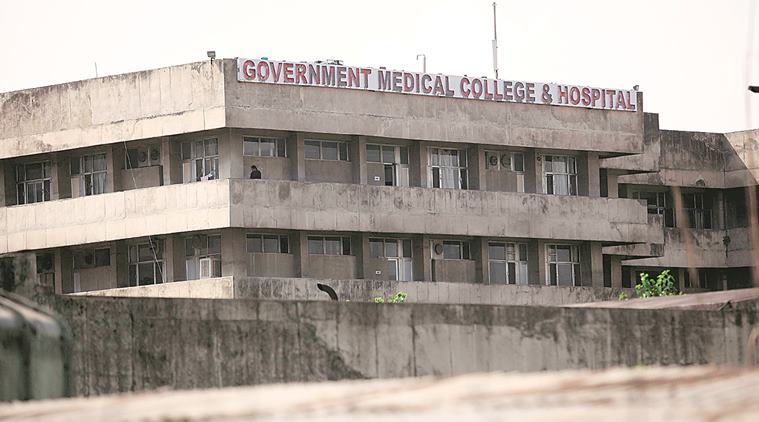 Government Medical College and Hospital, Sector 32, Chandigarh. (Express Photo)