Tuesday, April 28, 2026

NSW police officer appears to make white power salute near Sydney Black Lives Matter protest

0

Attendees of Friday night’s Black Lives Matter protests in Sydney say they were left terrified after an officer appeared to flash a hand symbol associated with the white power movement.

Black Lives Matter protesters gathered in the Sydney CBD to draw attention to Australia’s record on Indigenous deaths in custody.

Protester Jen Atherton filmed the video after the group was moved out of Hyde park by dozens of police officers and both parties made their way to Town Hall.

“It was just really shocking,” Atherton said.

The symbol is extremely similar to the “OK” hand gesture but has been used by white power movements in recent years.

“You can’t really ever confirm but … I don’t see why he would be saying everything was OK in that moment,,” Atherton said.

NSW police have denied the gesture was in any way related to the white power movement.

“The officer has been spoken to and did not intentionally make a gesture that could be deemed offensive,” a spokeswoman said in a statement.

“Further, the officer indicated he was responding to a group of women about the night being ‘OK’ and used a hand symbol as he was wearing a face mask. He did not know the gesture had any other meaning.

“The NSW police force works closely to foster a strong and cohesive partnership with Aboriginal communities and other groups and does not appreciate irresponsible inflammatory commentary in this space.”

Atherton did not accept the police’s account of events.

“I don’t believe it for a second. It was directly to the camera and I was clearly a protester.”

The video was taken at the corner of Pitt and Park St in the CBD.

More than 600 officers flooded the CBD on Friday night as about 300 people protested against Aboriginal deaths in custody.

One of the rally’s organisers,Lizzie Gareth, described the police presence as “

cousin of David Dungay who died in Long Bay prison in 2015 after being held down by prison guards

One person, a 24-year-old woman, was issued a fine for disobeying a move-on direction at the protest on Friday night.

Source link

Coalition urged to tackle far-right extremism after Asio revelations

The Morrison government is facing fresh calls to tackle the rising threat of right-wing extremism in Australia, after revelations such individuals now comprise a third of all domestic Asio investigations and that radicals are exploiting the Covid-19 pandemic to promote extreme messages.

Labor’s home affairs spokesperson, Kristina Keneally, told Guardian Australia people were being radicalised online at an increasing rate and “we do not want to be left asking if there was more we could have done during this pandemic to stop the spread of extremism fermenting in houses across Australia”.

“Asio has confirmed that right-wing extremists are exploiting the Covid-19 pandemic to further radicalise people and whilst we still don’t know the number of investigations taking place, we know they now make up a close to a third of all domestic Asio investigations,” she said.

Keneally called on the government to ensure it was adequately funding programs to counter violent extremism “across the extremist spectrum”.

“We can’t pretend extremism just ‘happens’ – people, often outcasts, are preyed on, they are enticed and they are radicalised and it’s happening in suburbs across Australia and online at an increasing rate,” she said.

The request came after the ABC reported right-wing extremists now represent about a third of all domestic investigations by the Australian Security Intelligence Organisation, second only to Sunni extremists. According to the report, Victoria and Queensland were the states with the highest number of investigations.

The reporting by the ABC’s Background Briefing program is partly based on an Asio threat assessment issued to security professionals in May.

The document warned that Covid-19-related restrictions were “being exploited by extreme right-wing narratives that paint the state as oppressive, and globalisation and democracy as flawed and failing”, the ABC reported.

“We assess the Covid-19 pandemic has reinforced an extreme right-wing belief in the inevitability of societal collapse and a ‘race war’,” it said.

An Asio spokesperson told Guardian Australia: “While the threat of violence inspired by Islamic extremism remains Asio’s greatest concern, extreme right-wing groups and individuals represent a serious, increasing and evolving threat to security.”

When asked about the details outlined in the threat assessment, the spokesperson said one of the ways Asio worked to protect Australia and Australians from threats to their security was “providing advice to Australian governments, agencies and industries”.

“Asio regularly engages with these sectors on national security issues; the details of this advice are sensitive and it would be inappropriate to comment further.”

The advice builds on Asio’s recent warnings about the extreme right-wing threat.

Mike Burgess, the director general of security, said in a speech in February that “violent Islamic extremism” remained the agency’s principal concern – but it was also focused on small extreme right-wing cells who met regularly in suburbs around Australia to salute Nazi flags, inspect weapons, train in combat and share their hateful ideology.

Guardian Australia understands that Asio has observed it has been a “busy” time for the spreading of extremist material. It is understood elements of the pandemic have fuelled some extreme views, including anti-Chinese and anti-migration narratives, and conspiracy theories.

Burgess alluded to this issue in general terms in an interview with the Institute of Public Administration Australia’s Work with Purpose podcast this week. He confirmed the agency had seen “increased chatter in the online world when it comes to the spread of extremist ideology attempting to radicalise people”.

.

Labor has previously questioned why no right-wing extremist groups have been listed as terrorist organisations in Australia. In March it called for a review of the criteria used to judge terrorist organisations to ensure the procedures were fit for purpose.

Currently, the 26 listed terrorist organisations in Australia include Al-Qa’ida and its offshoots, Islamic State and its offshoots, Jemaah Islamiyah, Boko Haram and Hizballah’s External Security Organisation.

In March, at a parliamentary committee hearing, Burgess said Australia constantly reviewed the situation, but listings depended on “the intelligence that we have, the legal threshold for which we can do so, and the purpose that that would allow us to achieve by listing such organisations”.

The government currently has a bill before parliament to expand the reach of Asio’s compulsory questioning powers. It is understood Asio argues the questioning power could be useful in addressing the growing threat posted by right-wing extremists.

In a submission to the joint parliamentary committee on intelligence and security late last month, Asio said the terrorist threat remained unacceptably high in Australia, with three counter-terrorism disruptions in the past year: two cases motivated by Islamist extremism and one by extreme right-wing ideology.

Asio said it remained “concerned about the possibility of individuals being radicalised to an extreme right-wing ideology and committing acts of terrorism”.

Guardian Australia reported last year on how the far-right was mobilising ahead of the federal election, with experts saying there were two camps of right-wing extremists: those who believed in violence and those who wanted to gain political legitimacy to pursue their agenda.

Source link

Skipped The Census? A Knock On Your Door May Be Coming As Early As July

The Census Bureau announced Friday that as early as mid-July, door knockers are set to visit some U.S. households that have been asked but haven’t filled out a 2020 census form yet.

Matt Rourke/AP


hide caption

toggle caption

Matt Rourke/AP

The Census Bureau announced Friday that as early as mid-July, door knockers are set to visit some U.S. households that have been asked but haven’t filled out a 2020 census form yet.

Matt Rourke/AP

Door knockers are preparing to start visiting homes that have yet to fill out forms for the 2020 census as early as mid-July, the Census Bureau announced Friday.

As part of other revamped plans for the national head count since the coronavirus outbreak, the bureau says the counting of people experiencing homelessness — both at shelters and outdoors — has been rescheduled for late September, and census workers will continue in-person counting in remote Alaska Native villages, which began in January, through August.

For past counts, in-person visits by the bureau’s workers have helped boost census participation among communities of color and other historically undercounted groups who are less likely to take part on their own in the constitutionally mandated count of every person living in the country.

But the COVID-19 pandemic had halted those kinds of interactions and upended the bureau’s earlier plans to start in-person visits to unresponsive homes in April and finish by the end of July. Faced with stay-at-home orders and public health concerns, the bureau had previously announced it was planning to wait until August to send out door knockers.

But in a press release on Friday, the bureau says it’s now planning a “soft launch” next month to “ensure systems, operations and field plans work as they should.” The bureau is expected to announce by the end of this month which six areas of the country may first see census workers at their doors, wearing personal protective equipment and trained in social distancing, for the nonresponse follow-up operation.

As early as Sunday, a smaller group of workers is set to return to parts of northern Maine and southeast Alaska to interview residents in remote areas that — unlike most of the U.S. — have not received any Census Bureau letters or postcards about the count because they do not have regular mail delivery.

By Aug. 11, door knockers will be fanning out across the country to follow up with unresponsive homes through the end of October, when the bureau says it plans to stop collecting responses.

Earlier this week, however, the U.S. Government Accountability Office issued a report warning that these door-to-door visits to complete the once-a-decade count “may be less effective” in a “post-COVID-19 environment,” given concerns that close interactions could increase the spread of the coronavirus.

“This may affect the quality of the data, especially for groups that are less likely to self-respond (often hard to count populations),” the GAO report said.

That, in turn, would affect the census results used to determine each state’s share of congressional seats, Electoral College votes and an estimated $1.5 trillion a year in federal tax dollars for public services over the next decade.

As of Thursday, more than 90 million households have participated in the count online, over the phone or through the mail, bringing the national self-response rate to 60.9%.

Under increased pressure because of the unpredictability of the pandemic, the bureau has asked Congress to extend by four months the legal deadlines for reporting census results, including new state population counts currently due by the end of December and the census data for the redrawing of voting districts due by the end of March 2021.

While House Democrats have moved forward with legislation granting those extensions, the Republican-controlled Senate has not put forth any bills so far.

In case Congress does not pass a new law, the GAO report notes, it will be “important” for the bureau to “monitor the risks” of potentially having to process and produce census data “under compressed time frames.”


Source link

Brazil coronavirus toll now world’s second highest: Live updates

  • Brazil became the country with the second-highest coronavirus death toll in the world with 41,828 fatalities, surpassing Britain’s and second only to the United States.

  • The British economy has dwindled 25 percent over March and April as a result of the coronavirus lockdown, dwarfing previous downturns.

  • The World Health Organization (WHO) said pandemic puts women at “heightened risk” of dying in childbirth.

  • More than 7.6 million people have now been confirmed to have the coronavirus and at least 424,000 have died, according to data from Johns Hopkins University.

Here are the latest updates:

Saturday, June 13

02:50 GMT – France to open borders to non-Schengen countries from July 1  

France will gradually reopen its borders to countries outside the Schengen zone from July 1, the interior and foreign ministers said in a statement.  

Foreign Minister Jean-Yves Le Drian and Interior Minister Christophe Castaner said France’s reopening would be in harmony with the rest of the European Union, which has recommended that the bloc reopen to some countries in the Balkans from July 1.

Travellers in cars and scooters cross the French-Italian border near Menton on June 3, 2020 after Italy reopened its frontiers with Europe [Valery Hache/ AFP]

“This opening will be gradual and will vary according to the health situation in each of the third countries, and in accordance with the arrangements that will have been agreed at European level by then,” the ministers said.    

Castaner and Le Drian confirmed that France would also lift all border restrictions with other Schengen countries from June 15.

02:42 GMT – South Africa sees biggest one-day rise in cases              

South Africa saw its largest single-day increase in coronavirus cases, recording 3,359 infections on Friday. 

A health ministry update said South Africa now has more than 61,9270 cases, or well over a quarter of the cases across the African continent, including 1,354 deaths.

Nearly two-thirds of South Africa’s cases are in the Western Cape province centered on the city of Cape Town, where the World Health Organization’s Africa chief has said the trend “seems to be similar to what was happening in Europe and in the US”.

02:29 GMT – Mexico prepares to reopen despite record cases

Claudia Sheinbaum, the mayor of Mexico City, said the Mexican capital will lift restrictions on car traffic and public transport next week, and allow 340,000 factory works to get back to work under strict sanitary conditions.

Sheinbaum said that street markets, malls, restaurants and churches could reopen a week later, but at reduced capacity.

The announcement came as the health ministry reported a record 5,222 new confirmed infections, along with 504 new deaths. Total confirmed cases now number 139,196 and total deaths are at almost 16,450. Both are considered substantial undercounts due to very limited testing.


Inside a Mexican intensive care unit battling COVID-19 (3:42)

Separately, the federal government announced that starting on Monday, half of Mexico’s 32 states can start limited re-openings of hotels and restaurants and broader re-openings of markets.

The states to re-open are those that have falling rates of coronavirus hospitalizations, lower rates of infection and acceptable ratios of available hospital beds.

President Andres Manuel Lopez Obrador has been eager to reactivate the economy, which has shed nearly 1 million formal jobs and is forecast to contract 8.8 percent this year.

“We don’t think there are going to be new outbreaks,” the president said on Friday. “We have to be careful that this doesn’t happen, and open little by little with health measures, health protocols, and if we see a new outbreak somewhere, return to confinement – everything voluntarily.”

01:59 GMT – Egypt registers highest daily rise in cases in nearly two weeks

Egypt confirmed 1,577 new coronavirus cases on Friday, the highest daily increase in almost two weeks.

In total, the Arab world’s most populous country has registered 41,303 cases including 1,422 deaths, the health ministry said in a statement.

The country is planning to open its seaside resorts to international flights and foreign tourists on July 1. 

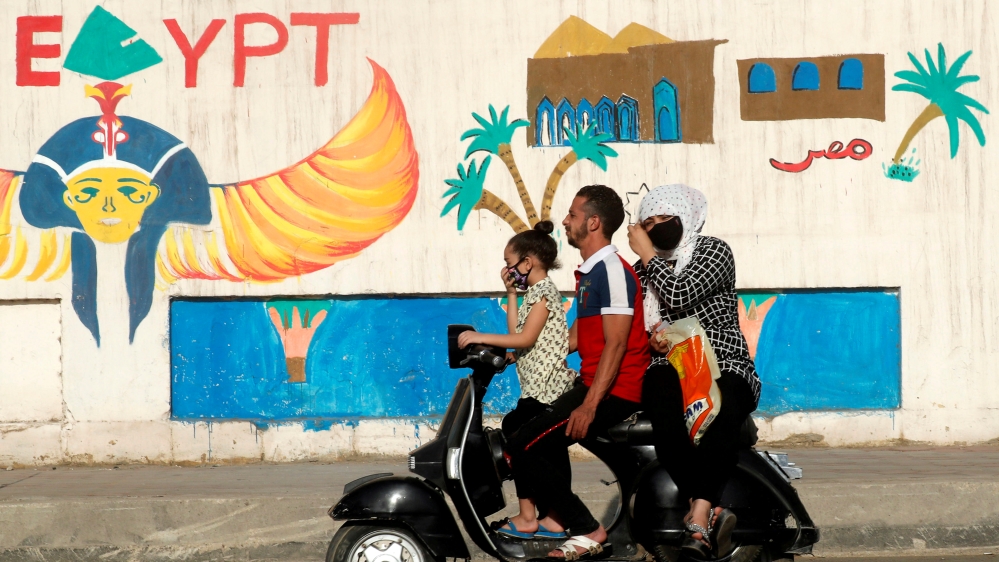
A man rides a motorcycle with his family in Cairo

A man rides a motorcycle with his family next to a wall with pharaonic images in Cairo, Egypt on June 4, 2020 [Amr Abdallah Dalsh/ Reuters]

01:39 GMT – Brazil court orders JBS meat plant closed for testing

A Brazilian labor court ordered the closure of a chicken plant owned by the world’s largest meatpacker, JBS SA, in the southern state of Rio Grande do Sul for 14 days while the company’s workforce is tested for COVID-19.

The court upheld an injunction sought by state health authorities ordering all workers to immediately leave the plant located in Trindade do Sul so that they can be in isolation for two weeks and be tested at the company’s expense.

JBS did not have any immediate comment on the court order.

01:31 GMT – Masks significantly reduce infection risk, says new study

Requiring the wearing of masks in areas at the epicenter of the global coronavirus pandemic may have prevented tens of thousands of infections, a new study suggests.

Mask-wearing is even more important for preventing the virus’ spread and the sometimes deadly COVID-19 illness it causes than social distancing and stay-at-home orders, researchers said, in the study published in PNAS: The Proceedings of the National Academy of Sciences of the USA.


Musicians perform a virtual gala in COVID-19 lockdown (2:50)

Infection trends shifted dramatically when mask-wearing rules were implemented on April 6 in northern Italy and April 17 in New York City – at the time among the hardest hit areas of the world by the health crisis – the study found.

“This protective measure alone significantly reduced the number of infections, that is, by over 78,000 in Italy from April 6 to May 9 and over 66,000 in New York City from April 17 to May 9,” researchers calculated.

01:12 GMT – Somalia’s al-Shabab sets up virus treatment centre

Somalia’s al-Shabab group said they had set up a COVID-19 treatment centre in the country, and said the disease posed a grave threat, citing international health authorities.

“Al-Shabab’s corona(virus) prevention and treatment committee has opened a COVID-19 centre,” the group said in a broadcast on their radio Andalus, adding the centre had been set up in Jilib, about 380 kilometres (236 miles) south of the capital, Mogadishu.

“International health organisations said COVID-19 is terribly spreading in countries of Africa continent.”

For more than a decade the group has been fighting to topple the Horn of Africa’s Western-backed central government and establish its own government based on its own interpretation of Islamic law.

00:18 GMT – Brazil’s COVID-19 death toll passes Britain’s

Brazil’s COVID-19 death toll has overtaken Britain’s to become the second highest in the world after the United States, according to numbers released by the Brazilian Health Ministry.

Brazil reported a total of 828,810 confirmed cases of coronavirus, with 25,982 new infections in the last 24 hours, and another 909 fatalities, raising the death toll to 41,828, the Health Ministry said.

Of the total cases of COVID-19, 365,063 have recovered, the ministry said.


COVID-19 spreading fast among Brazil’s Indigenous tribes (2:51)

00:10 GMT – Botswana reinstates strict lockdown in Gabrone

Botswana has brought back a strict coronavirus lockdown in its capital city and surrounding areas after recording 12 new cases of the virus – four imported cases at its borders and eight at a private hospital in Gabrone.

The southern African nation ended a 48-day national coronavirus lockdown late last month, allowing businesses and schools to reopen under controls, but its borders are still closed apart from for returning citizens and imports of essential goods.

Announcing the new lockdown measures, Malaki Tshipayagae, the country’s director of health services, said authorities were trying to determine if the Gabrone hospital cases were locally transmitted.

“From midnight today the greater Gaborone area will revert to extreme social distancing until further notice, where only essential services will be allowed to operate,” he said in a televised announcement.

The new cases bring Botswana’s cumulative cases to 60. Prior to Friday’s cases, Botswana only had one active case of the coronavirus. It has recorded only one coronavirus death.


Hello and welcome to Al Jazeera’s continuing coverage of the coronavirus pandemic. I’m Zaheena Rasheed in Male, Maldives.

You can find all the developments from yesterday, June 12, here.
Source link

Coronavirus live news: Fauci warns against Trump rallies; health fears in Australia over BLM protests


An evangelical church in Argentina reopened as a bar in protest against the lockdown on religious services that remains in place despite the gradual opening up of other activities in this country.

“We are standing here today dressed like this, carrying a tray, because it seems this is the only way we can serve the word of god,” pastor Daniel Cattaneo, dressed as a waiter, said opening the “worship bar” at the Comunidad Redentor (Redeemer Community) evangelical church in the city of San Lorenzo, in Argentina’s central province of Santa Fe Wednesday.

“So apart from the breaded veal headed for table four, here goes the word of god from the house of the lord to all nations.”

Bar tables were placed inside the church and pastors dressed up as waiters carried bibles on their trays in a mock service meant to draw attention to the evangelist’s demand that religious services be allowed despite Argentina’s coronavirus lockdown.

“We want to exercise our constitutional right to practice our faith,” pastor Cattaneo told local media. “Bars can open, shops can open, why are they discriminating against us?”

Although the coronavirus continues to spread rapidly in Argentina’s capital city of Buenos Aires and its surrounding Greater Buenos Area the rest of the country remains relatively Covid-free. The province of Santa Fe, where Cattaneo’s church is located, has been especially successful at containing the virus and has started reopening activities, including bars, but churches are still being allowed to receive a maximum 10 people per service.

Read the full story here:

Updated


Australia’s opposition leaders urges against protests


Mexico City to begin gradual exit from lockdown on Monday


As US president Donald Trump continues to fearmonger over Twitter about the hundreds of protesters who have occupied several city blocks in Seattle and dubbed them a police-free “Capitol Hill Autonomous Zone,” Seattle’s mayor has responded that “Seattle is fine.”

Mayor Jenny Durkan
(@MayorJenny)

Seattle is fine. Don’t be so afraid of democracy. https://t.co/o26PkJnYhA


June 12, 2020

The autonomous zone “has both a protest and street fair vibe, with a small garden, medic station, smoking area, and a “No Cop Co-op”, where people can get supplies and food at no cost,” Hallie Golden reported for The Guardian yesterday. One activist said the takeover was reminiscent of the Occupy movement.

Daily Beast reporter Kelly Weill also noted that claims that local businesses were being harmed by the takeover had been walked back, and that many local business owners were quite supportive of “CHAZ,” although one feared that it might distract attentionfrom the key demands of the Black Lives Matter movement.

Kelly Weill
(@KELLYWEILL)

Seattle PD made (then walked back) a claim about extortion in the Capitol Hill Autonomous Zone. Actual businesses around the CHAZ say they’re watching Ava DuVernay films, handing out granola bars, and having a nice time: https://t.co/7BRfOX61ZT


June 12, 2020


Thousands of sheep to be sent to Middle East

Updated


Updated


Welcome to our Covid-19 coverage

Good morning, and welcome to today’s live coverage of the Covid-19 pandemic.

As authorities in many countries are still struggling to contain the virus, protests are being held throughout the world following the brutal death of unarmed man George Floyd in the US on 25 May. A police officer knelt on his neck for nearly nine minutes, ignoring Floyd’s protests of “I can’t breathe”.

The event sparked organisers from the Black Lives Matter movement to organise protests, which have been occurring throughout the US, Australia and the UK.

  • US president Donald Trump has since announced he will be holding an election campaign rally on 19 June, known in the US as Juneteenth, one of the oldest official celebrations commemorating the end of slavery. Attendees are being encouraged to sign a liability waiver to acknowledge that by attending, they are at risk of acquiring or spreading Covid-19.

Hillary Clinton
(@HillaryClinton)

If your rallies come with a liability waiver, you shouldn’t be holding them. https://t.co/J1BgdUec9k


June 12, 2020

  • Meanwhile, in an interview with Fox news where Trump was asked to address the way chokeholds have been unfairly used by police against African Americans like George Floyd, Trump responded that: “I think the concept of chokeholds sounds so innocent and so perfect”. He added, however that “generally” speaking, chokeholds should not be used.
  • White house infectious disease expert and member of the White House coronavirus task force, Anthony Fauci, said that attending a protest is “risky”.
  • Black Lives Matter advocates and refugee activists will hold protests throughout Australia on Saturday, despite warnings from health authorities they could lead to Covid-19 outbreaks. Australia’s chief medical officer, Prof Brendan Murphy, said on Friday, “These sort of events really are dangerous”. However the prime minister, Scott Morrison, announced on the same day that major sports stadiums may allow 10,000 people by July.
  • Brazil’s death toll has overtaken the UK’s. There have been 41,828 deaths in Brazil, the country’s health ministry said, with only the US having more fatalities. The UK’s death toll is 41,566, according to figures compiled by Johns Hopkins University.
  • Breastfeeding mothers do not seem to be passing on Covid-19 to their infants, a World Health Organization expert has said. New mothers infected with the virus should generally continue breastfeeding if they wish to and should not be separated from their babies, the WHO said, stressing that the benefits outweighed the risks.


Protests to occur throughout Australia


Source link

Zaya Wade Celebrates 13th Birthday With Epic Medieval-Themed Party


Gabrielle Union and Dwyane Wade Celebrate Zaya’s 13th Birthday With an Epic Medieval-Themed Party | Entertainment Tonight


Source link

Sheriff to ‘de-deputize’ officers linked to threatening online posts after protest

Don Babwin, Associated Press
Published 9:46 p.m. ET June 12, 2020 | Updated 10:01 p.m. ET June 12, 2020

CLOSE

George Floyd’s brother gave an emotional opening during a House Judiciary Committee hearing on policing.

USA TODAY

CHICAGO — Cook County Sheriff Tom Dart was moving to temporarily strip as many as seven deputies of their police powers after the county’s public defender complained that deputies had apparently posted insulting and threatening comments online after a march in support of Black Lives Matter, his spokesman said Friday. 

Spokesman Matt Walberg said the investigation to identify the deputies and then move to “de-deputize” those linked to the posts comes a day after Dart’s office launched an internal probe in response to a letter from Cook County Public Defender Amy Campanelli. 

In her letter sent Thursday, Campanelli asked Dart and Inspector General Patrick Blanchard to discipline, or, if appropriate, fire the deputies behind the posts. 

Campanelli also informed Dart, whose office runs the jail, and Blanchard that the posts had appeared online after about 200 people, including many public defenders, participated in a demonstration Monday at the county jail in Chicago.

A Facebook comment purportedly posted by a deputy assigned to the Leighton Criminal Court Building reads: “Good luck to them all when the courts open up!” 

Watch: Chicago officials respond after cops seen lounging

June 5: Two Chicago officers relieved of police powers amid investigation into brutal encounter seen in video

Campanelli also cited a post that reads: “Bring in the fire hoses and horses this is not a protest.”

She questioned how she or anyone else could have confidence that people in custody are receiving housing, food and being treated “equitably and humanely” by “the custodians of the jail.”

Demonstrations and unrest spread to Chicago and other cities around the U.S. following the May 25 killing in Minneapolis police custody of George Floyd. A white officer pressed his knee into Floyd’s neck for several minutes, even after the handcuffed Black man stopped moving and pleading for air.

“The very purpose of our protest, as was the purpose of all protests around the country, was to oppose racism and discrimination exhibited by law enforcement,” Campanelli wrote in the letter. “Now, posted on social media as a banner for all to see, members of law enforcement are expressing their intolerance for justice and even suggesting there will be consequences to my staff and my clients.”

Autoplay

Show Thumbnails

Show Captions

Read or Share this story: https://www.usatoday.com/story/news/nation/2020/06/12/cook-county-sheriff-de-deputize-officers-linked-online-posts/3180499001/

Source link

CHAZ, a ‘no Cop Co-op’: Here’s what Seattle’s Capitol Hill Autonomous Zone looks like

CLOSE

After a Seattle Police precinct left a violent protesting area, protests became peaceful and they dubbed it the Capitol Hill Autonomous Zone, or CHAZ.

Storyful

In Seattle, a group of peaceful protesters have cornered off several city blocks and established the Capitol Hill Autonomous Zone – a sort of protest haven where artists paint murals, speakers discuss topics of racial equity, snacks are handed out for free and virtually no police are in sight.

President Donald Trump has branded the protest society as a group of “ugly Anarchists” and “Domestic Terrorists,” but the city’s mayor says Trump doesn’t get it. It’s a group of people gathering lawfully and exercising their First Amendment right of free speech, said Mayor Jenny Durkan.

“It is patriotism,” Durkan added.

The group gathered after Seattle police abandoned a precinct in the Capitol Hill neighborhood on Monday and effectively handed the area over to the protesters they had clashed with for days. 

According to media reports from around the area, the Capitol Hill Autonomous Zone, or CHAZ, has a festival-like energy where people are peacefully gathering and discussing how to better the world in an experiment of a society without police amid calls around the country to “defund” departments. 

People in the zone said George Floyd’s death was the last straw in a series of inequities across the country, highlighted at first by the widespread failure of government to competently and humanly respond to the coronavirus outbreak. Several added, however, that they would be at work if the outbreak hadn’t shut down their workplaces and could only afford to attend with the aid of the federal assistance payments.

Others expressed frustration that conservative media were painting them as armed anarchists. Friday, the smell of roasting hot dogs drifted over the area as volunteers offered hot oatmeal, energy drinks and bagels to anyone who wanted them. Although Washington is an open-carry state, no one appeared armed with a gun.

“We are not here to become a bunch of armed mercenaries. We just want equal rights,” said Matthew “Bootleg” Born, 40. 

‘Go back to your bunker’: Seattle mayor, Washington governor fire back at Trump threat to handle protests

Where is the Capitol Hill Autonomous Zone?

According to a Seattle Times map of the area, the zone spans several city blocks. It runs east to west along East Pine Street from 10th to 13th Avenues East. On 12th Avenue East, the zone extended down to East Pike Street. Some tents and a community garden have been set up in Cal Anderson Park, which runs along East Pine Street.

Capitol Hill is a neighborhood northeast of downtown Seattle and the famous Pike Place Market. The neighborhood is popular with many young residents in the city and home to many diverse artistic spaces, restaurants and Cal Anderson Park, named after Washington’s first openly gay legislator.

What does ‘defund the police’ mean? Why some say ‘reform’ is not enough

How did protesters first occupy the area?

Seattle, like most cities in the United States, saw major protests in the days that followed George Floyd’s killing in the custody of Minneapolis police.

For days, protesters and police in riot gear faced off nightly outside the Seattle Police Department’s East Precinct. 

Autoplay

Show Thumbnails

Show Captions

In response to outcries against the tactics used by police in Seattle to control the crowds, Durkan promised at a news conference last week there would be a 30-day ban on the use of CS gas, commonly known as tear gas. 

Despite that ban, police used tear gas to disperse demonstrators over the weekend, prompting a new wave of outrage from activists and City Council members. In response, the Seattle Police Department removed barricades from outside the East Precinct.

The Seattle Times reported that after the police barricades were removed, demonstrators quickly moved in with their own barricades and closed the area to vehicles.

Seattle Police Chief Carmen Best said Thursday it was her decision to use tear gas after the ban, as she said officers believed there could be violence, but it was not her decision to surrender the building, per the Times.

What’s the scene like inside the Capitol Hill Autonomous Zone?

News reports describe the occupied area as peaceful and safe. The words “Black Lives Matter” were painted on East Pine Street. Free food has been handed out at a “No Cop Co-op.” Speakers, poets and other performers share ideas and art.

A sign on the abandoned police precinct reads that the building is “property of the Seattle people.” The Seattle Times reported that some protesters hope to turn the building into a community center.

A community garden has also been planted in Cal Anderson Park. “We’re forced to build new plots because people are giving us so many plants,” Marcus Henderson, who was working in the gardens, told the Seattle Times.

Francis Vann, a 15-year-old high school freshman, told the newspaper that the movement happening inside the area is being driven by young people.

“A lot of times, the older people criticize the young people for how we choose to show our grief,” Vann said. “It kind of takes a lot to stir up emotions with the young people, but once we’re mad, we’re mad. And we’re mad. It’s the young people’s energy that’s out here and the old people’s wisdom that’s keeping us out here.”

Are businesses being threatened?

No.

Seattle police claimed earlier this week that some businesses housed inside the area are being extorted and forced to pay a fee to operate in the area. Best said Thursday that claim was false. “That has not happened affirmatively,” Best said, per the Seattle Times. “We haven’t had any formal reports of this occurring.”

Restaurant owners told the newspaper the protest has actually been good for business with more walk-ups. “This protest has not hurt us at all,” Bok a Bok Chicken co-owner Brian O’Connor told the Seattle Times.

Will police return to the area?

Police officials have said they plan to return to the abandoned precinct, but there is no timeline. 

“We don’t want to introduce additional flashpoints,” Durkan said at a news conference about police’s potential return, the Seattle Times reported.

The Seattle Times reported that a group of officers were spotted at the police precinct Thursday evening and that there was a brief confrontation with protesters. Some protesters claimed they were pepper sprayed during the incident, the newspaper reported.

Contributing: Trevor Hughes in Seattle; William Cummings; The Associated Press

Read or Share this story: https://www.usatoday.com/story/news/nation/2020/06/12/seattle-protest-chaz-capitol-hill-autonomous-zone-police-free/3173968001/


Source link

Celebrate Pride With Town Halls and Club Beats

0

If you’re feeling conflicted about how to celebrate Pride this year, you’re hardly alone. Three months after the coronavirus pandemic turned the world on its head, America has been rocked by coast-to-coast protests inspired by George Floyd, whose death has led millions to cry out for an end to police brutality — and an end to police departments generally.

But Pride organizers have adapted (shoe box parade floats, anyone?), and with no shortage of virtual events, many of which have been reoriented to amplify black voices and concerns, it’s possible to be not just safe but supportive while still showing your pride.

Within weeks, the George Floyd demonstrations upended a Pride month that was already poised to be unlike any other. Although many planned events were called off in deference, others were reconfigured to put the focus on black L.G.B.T.Q. people.

In New York, a virtual drag fest scheduled to feature more than 100 drag queens was replaced with a three-day Black Queer Town Hall (June 19-21). The event, to be hosted by Peppermint, a transgender actress who starred in the Broadway jukebox musical “Head Over Heels,” and Bob the Drag Queen, a past winner of “RuPaul’s Drag Race,” will feature round-table discussions on dismantling racism and white supremacy as well as performances by black New York City drag queens. (Keep in mind: Venmo tips are the new crinkly bills.) Marti Gould Cummings, a fixture of the city’s drag scene and a candidate for City Council, will help lead the festivities, which will also carve out time to pay tribute to black pioneers of the gay rights movement. All programming will be streamed on GLAAD’s and NYC Pride’s YouTube pages.

As its parent company, Condé Nast, faces a reckoning over its treatment of people of color, Them, the publisher’s fledgling publication dedicated to L.G.B.T.Q. style, culture, politics and issues, will host a virtual Pride event on June 22 called Out Now Live that is heavy on boldface names. Cynthia Nixon, Hayley Kiyoko, Zac Posen, Lee Daniels, Billy Eichner, Naomi Campbell, Elton John, Indya Moore, Judith Light and Tegan and Sara are all expected to appear in the event, which will include speeches, personal stories of L.G.B.T.Q. activism since the 1970s and performances by King Princess and Princess Nokia.

And with plenty of time to spend at home, there may be no better time to catch up on or revisit queer classics. This month New York Public Library branches will host online book discussions of titles including Oscar Wilde’s “The Picture of Dorian Gray” (June 17, 2 p.m.) and Leslie Feinberg’s “Stone Butch Blues” (June 24, 6 p.m.), which is available to read on the author’s website.

Last summer, 50 years after the Stonewall uprising, New York City was the center of the world’s Pride celebrations. But the city’s first gay pride march wasn’t held until 1970, a year after Stonewall, making 2020 another meaningful milestone for New York in the struggle for gay rights.

Instead of a physical march through Manhattan’s broad avenues and narrow side streets, NYC Pride will observe the 50th anniversary with a broadcast wending its way through the history of the L.G.B.T.Q. movement. The two-hour event (June 28, noon) will feature grand marshals including the transgender activist Victoria Cruz and Dan Levy, a creator and star of “Schitt’s Creek,” as well as performances by Janelle Monáe, Deborah Cox and Billy Porter. Carson Kressley — perhaps a more familiar sight flanking RuPaul as a judge on “Drag Race” — will co-host the special, which will be broadcast on WABC and stream on the station’s website.

But before settling into a more celebratory mood, the main weekend of New York Pride will begin with an online rally (June 26, 5 p.m.) seeking to capture the defiant spirit of the 1969 “Gay Power” demonstrations one month after the Stonewall uprising. Ashlee Marie Preston, a transgender writer and political activist, and Brian Michael Smith, a transgender actor, will host the event, which — in addition to sounding the call for L.G.B.T.Q. rights and human rights generally — will loudly condemn police brutality and discrimination.

When the pandemic began to pour cold water on plans for Pride celebrations around the world, L.G.B.T.Q. groups at every level — local, regional, even continental — pooled their organizational muscle to coordinate Global Pride, an ambitious 24-hour streaming event on YouTube (June 27). In addition to remarks from former Vice President Joseph R. Biden Jr., Speaker Nancy Pelosi, prime ministers and royalty, the event will showcase talent from across the globe: Pabllo Vittar, the Brazilian drag performer; Olivia Newton-John, the Australian pop icon; and American singers including Thelma Houston, Ava Max, Rita Ora, Steve Grand, Kesha and the Pussycat Dolls. Global Pride organizers have said they intend to use the event to amplify black voices, in part by working with founders of the Black Lives Matter movement.

Meanwhile, Dan Savage’s It Gets Better Project will do its best to build you up as you hunker down with a three-day livestream event (June 24-26) drawing on YouTube royalty like Rebecca Black and Louie Castro as well as the “RuPaul’s Drag Race” alumni Crystal Methyd and Jujubee. With musicians, actors and online beauty experts, the event hopes to be a dose of positivity amid the pandemic.

At the very first whiff of stay-at-home orders, D.J.s looking to keep the party going flocked to Zoom and Instagram Live. In a Pride month unlike any other, many of the same people who would ordinarily be responsible for supplying parades, marches, street festivals and dance clubs with thumping beats are now keeping us moving at home (or at least giving the less dance-inclined a taste of the music they miss).

Cincinnati Black Pride found the silver lining in the pandemic, noting on its website that the lockdown “offers some of our favorite D.J.s in Cincinnati a unique opportunity to virtually be in multiple places over the Pride weekend at the same time.” D.J. Kaotic, a Cincinnati native, leads off four nights of “grown and sexy” D.J.s with her set on June 25 — after the city’s Black Alphabet Film Festival. The rest of the weekend will include classics, Caribbean, jazz, spiritual house and a Sunday tea dance.

Amid Pride Toronto’s robust schedule of virtual programming, there are a few standouts. Before the city’s third and final Stay Home Saturday (June 20, 2 p.m.), be sure to tune in to the Link Up on June 18 (4 p.m.), when the Toronto D.J.s Soulsis and Razaq El Toro will bring soca, dancehall and Afro beats — so long as you supply the bass and an appropriately vibey Summer of Quarantine outfit. And the third of the city’s three Stay Home Saturdays (June 20, 2 p.m.) starts at a 10 and cranks up from there: Early afternoon programming from Toronto’s all trans, nonbinary, gender-nonconforming and Two Spirit cabaret gives way to a larger virtual event all before dinnertime.

Beloved New York City spots are also doing their best to deliver Pride straight to you. House of Yes, the free-spirited Brooklyn dance club, will host a digital dance party for Pride (June 27, 8 p.m.) in collaboration with Glitterbox, whose high-energy “virtual festivals” have given a jolt to quarantine nightlife for millions streaming worldwide. The Greenwich Village piano bar Marie’s Crisis is continuing to share show tunes from its pianists’ living rooms on Facebook Live. And Ty Sunderland, the promoter behind popular parties like Heaven on Earth, has been flirting with the idea of a digital version of his pop-music rave Devil’s Playground (June 26, 10 p.m.) for months now.


Source link

Amazon Said to Be Under Scrutiny in 2 States for Abuse of Power

0

SEATTLE — State investigators in California and Washington have been looking into whether Amazon abuses its power over sellers on the tech giant’s site, according to people involved with the inquiry.

In the last several months, California has asked about the company’s private label products and whether it uses data from sellers to inform which products it sells, according to two people, who spoke on condition of anonymity out of fear of retribution by the company.

The Washington attorney general’s office has also been interested in whether Amazon makes it harder for sellers to list their products on other websites, according to correspondence viewed by The New York Times.

The people said that the inquiries did not appear to be in advanced stages.

The interest in Amazon’s lucrative marketplace is a signal that scrutiny of the company is widening, including criticism of the working conditions in its warehouses and accusations that it boxes out small business and competitors. Liberal politicians have singled out the company and its founder, Jeff Bezos, the wealthiest person in the world, as examples of out-of-control corporate power.

Sarah Lovenheim, a spokeswoman for California’s attorney general, Xavier Becerra, said in an email that “it remains our policy not to comment on any pending or potential investigations — either to confirm or deny them — to protect the integrity of our work.”

Brionna Aho, a spokeswoman for the Washington attorney general, Bob Ferguson, said the office did not confirm or deny investigations.

Jack Evans, a spokesman for Amazon, declined to comment.

The California inquiry was earlier reported by The Wall Street Journal.

Amazon is among several tech giants facing antitrust investigations into its market power. The Department of Justice is likely to bring an antitrust suit against Google later this year, and the Federal Trade Commission has been examining Facebook’s acquisition of rival services.

In the last year, state attorneys general have increasingly joined federal law enforcement in scrutinizing the companies. Texas is leading a multistate inquiry of Google and its sprawling business, while New York has helmed an investigation into Facebook.

But so far, Amazon has avoided the same level of scrutiny. An F.T.C. investigation into its practices has attracted far less attention and state officials have not publicly revealed their inquiries.

Amazon argues that it has empowered small sellers on its platform and has delivered results to consumers. And the company has said organizers are misrepresenting the conditions in its warehouses, which have borne the brunt of a surge in purchases as Americans locked down at home.

Amazon — along with Facebook, Google and Apple — is also the subject of an investigation by the House Judiciary Committee. In recent months, Amazon has resisted the committee’s push to bring Mr. Bezos before the panel for public questioning. The committee has threatened to legally compel the chief executive to testify, but the matter remains unresolved.

Karen Weise reported from Seattle, and David McCabe from Washington.

Source link