this link is to an external site that may or may not meet accessibility guidelines.
this link is to an external site that may or may not meet accessibility guidelines.
When it comes to a group chat, it can be difficult to find something to keep the conversation going in this pandemic. This is even more so since you aren’t able to go out as much as you would like to and need to adjust to life in quarantine.
Social isolation can take its toll on your mental health that’s why it’s important to stay connected to family and friends.
Here are some topic ideas to use in your group chat to get the conversation going. This way you can stay connected with your family and friends during this challenging time.
When you hold in your feelings they may start to consume you. That’s why talking to your family and friends about feelings is important. You can learn from them the methods of how they are coping. They also may become a healthy support system which will help when you need to deal with feelings of anxiety and depression.
Engaging in a group activity with your group chat is a great way to liven things up. How about suggesting a movie night? Watching a movie together will get the conversation going on the characters, the plot and the film’s eye candy.
It can be difficult to stay positive when you are faced with a pandemic and the future appears to be bleak. However, this simple question can really trigger off a lot of good feelings in a group chat.
Ask each other what you are grateful for and you may re-discover the things you are lucky to have in your life. It also can deepen your emotional level of connection with your friends.
If you’ve been dreaming about what you will do once the lockdown ends, chances are your friends have been doing the same thing. Share your fantasies with them and ask them about theirs.
Talking about what you are looking forward to is a sure way to start a fun conversation. It’s a bit like the question: “What would you do if you won the Lotto?â€
This is the perfect time to explore new music and artists. Ask your friends to send you their music suggestions and do the same for them. Sharing your playlists will help you to understand their tastes in music and start an epic discussion in the process.
With so much tragedy in the news today it can be difficult to connect positively with friends and family. Use the above tips to inspire light-hearted conversations in a group chat and to evoke deeper connections with your loved ones.

The study found that while most of Brazil’s agricultural output is deforestation-free, 2% of properties studied in the Amazon and Cerrado are responsible for 62% of illegal deforestation. A significant portion of that deforestation is linked to agricultural exports, the study said.
“This small but very destructive portion of the sector poses a threat to the economic prospects of Brazil’s agribusiness, in addition to causing regional and global environmental consequences,” the authors of the report said.
Meanwhile, the far-right and pro-business president vowed to explore the rainforest’s economic potential. He found that in China, the country’s largest trade partner, which ramped up imports of beef and soy from Brazil in the wake of the US trade war.
To make the link between illegal deforestation and agricultural exports, the team — led by Raoni Rajao, professor in Social Studies of Science at the Federal University of Minas Gerais — compiled land-use and deforestation maps for Brazil and information on 815,000 rural properties in the Amazon and Cerrado, as well as cattle transport documents. They also developed software that calculated the level to which each property studied was complying with environmental and deforestation laws.
They found that about 1.9 million metric tons of soy grown on properties with illegal deforestation may have reached EU markets annually. That means 22% of all soy exported from the region to the EU is potentially contaminated.
The authors caution that the true percentage could be higher as their sample covered 80% of soy planted in the region.
Roughly 41% of EU’s soy imports come from Brazil, equating to 13.6 million metric tons per year.

Between 25% and 40% of EU beef imports come from Brazil. The study estimates that 12% of the 4.1 million cows traded to slaughterhouses in the states of Para and Mato Grosso in 2017, came directly from properties with potentially illegal deforestation.
But the number increases to about 50% when taking into account suppliers that had indirect contamination with illegal deforestation. This includes if a ranch does not deforest but buys cattle from one that does.
The study also cautions that in the state of Mato Grosso, contamination of beef exports by illegal deforestation could be as high as 44% in the Amazon and 61% in the Cerrado regions.
The report said that the Brazilian government insists “that national laws ensure high conservation standards, and hence trading bans should not include legally authorized deforestation.” But their results could have huge implications for how countries proceed with trade agreements when they know a portion of the imports could be linked to illegal deforestation of the Amazon.
“International buyers of Brazil’s agricultural commodities have raised concerns about products that are contaminated by deforestation,” the authors said in the report. “Among the concerns is that increasing greenhouse gas emissions from deforestation and forest fires in Brazil could cancel out EU climate change mitigation efforts.”
The first trimester of 2020 had already seen a more than 50% increase in deforestation compared to last year, according to INPE data.
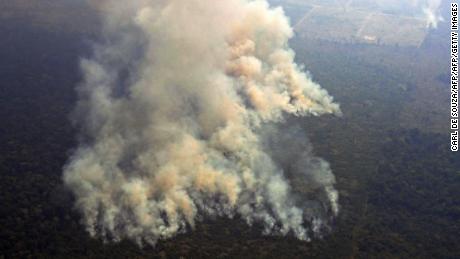
As the global demand for meat soars, and as China turns to Brazil for its supply of soybeans amid the trade war with the US, experts worry that Brazil’s agricultural boom will come at the cost of habitats like the Cerrado and Amazon.
In their report, the authors found that 120,000 properties in their study were deforested after 2008. About 36,000 of those properties in the Amazon — representing 84% — and 27,000 thousand in the Cerrado — 35% — carried out this deforestation that they said was in all likelihood done illegally.
The authors said that “all economic partners of Brazil should share the blame for indirectly promoting deforestation and GHG (greenhouse gas) emissions by not barring imports and consuming agricultural products contaminated with deforestation, illegal or not.”
The authors said the report raised awareness of the importance of pressing Brazil ” to conserve its environmental assets” and international efforts to cutting greenhouse gas emissions.
CNN’s Amy Woodyatt, Flora Charner and Eliza Mackintosh contributed.
The organization reported several killings which local authorities concluded had been retaliation for not following the measures created by these groups. HRW also detailed attacks on vehicles, threats, and coercion.
HRW said it interviewed 55 people in 13 states in Colombia including community leaders, prosecutors, staff at humanitarian organizations, police officers and local residents. The organization says it also reviewed 20 pamphlets signed by armed groups that appeared to be authentic and worked with other local sources.
One pamphlet from an armed group cited by HRW warned, “Those who fail to comply will be held to account under our law with his own life … Either you comply or you die.”
Groups involved in imposing their own restrictions on local populations at the start of the pandemic included the National Liberation Army (ELN), the Popular Liberation Army (EPL), the Gaitanist Self-Defenses of Colombia (AGC), and other “FARC dissident groups,” HRW said.
FARC, once the largest militant group in Colombia, signed a peace deal with the government in 2016. However, a number of offshoot factions continue to operate in the country.

The other groups, unlike ELN, do not have established communications arms.
Colombia has reported nearly 160,000 cases of Covid-19 — the 5th highest number in Latin America, following Mexico, Chile, Peru and Brazil, according to Johns Hopkins University.
Since Monday, officials have implemented new lockdown measures, based on geographic zones for the capital city, Bogota. Additionally, the national government announced the extension of the nationwide quarantine through August 1.
HRW noted that under international law, the government “is obligated to protect the rights to life and physical integrity by taking adequate preventive measures against reasonably foreseeable threats from private actors, including organized criminal groups and other armed groups.”
The Colombian government also has an obligation, it said, to take effective and adequate steps to prevent the spread of Covid-19 and to protect people’s right to health, as well as to ensure the rights to food and water.
“Draconian ‘punishments’ imposed by armed groups to prevent the spread of Covid-19 mean that people in remote and impoverished communities across Colombia risk being attacked and even killed if they leave their homes,” Vivanco said.
“The government should urgently ramp up its efforts to protect these communities, ensure they have adequate food and water, and protect their health from the effects of Covid-19.”
Colombian authorities have not commented on HRW’s allegations on Wednesday, but officials have made similar accusations in the past.
On April 30, Colombia’s Ombudsman Carlos Negret formally asked the Interior Ministry to take action against enforced lockdowns by groups like the ELN, urging the government to increase the presence of Colombia’s Army and National Police in certain areas, and to ensure aid to local civilian populations.
Between March 23 and April 27 alone, Negret’s office had registered up to 72 “violations of citizens’ rights” including murders, arson of vehicles, forced displacement and group kidnappings, he said in the statement.
More than half of these had been perpetrated “in the name of the health emergency,” according to Negret.
Hospital protocol is restrictive, says Amitabh Bachchan on not being able to respond to all wishes
 Amitabh Bachchan, who is currently admitted in the isolation unit of Mumbai’s Nanavati Super Speciality Hospital for COVID-19 treatment, shared a new tweet on Thursday thanking all his well-wishers for their blessings and love. “I receive all your blessings and love and prayers for our well being .. on sms, on whatsapp, on insta on Blog .. and all possible social media .. my gratitude has no bounds .. Hospital protocol is restrictive, i cannot say more .. Love.”, wrote the 77-year-old actor.
T 3596 –
I receive all your blessings and love and prayers for our well being .. on sms, on whatsapp, on insta on Blog .. and all possible social media ..
my gratitude has no bounds ..
Hospital protocol is restrictive, i cannot say more .. Love 🙏❤️— Amitabh Bachchan (@SrBachchan) July 16, 2020
Earlier in the day, Amitabh Bachchan shared a picture of two Hindu deities and wrote, “T 3596 – Ishwar ke charanon mein samarpit (I surrender myself to God).â€
A source from Nanavati hospital told PTI earlier this week that Amitabh and Abhishek were on the path to recovery. “Both are stable and are responding well to the treatment. They will have to be in the hospital for at least seven days,†the source said.
On Monday, Amitabh thanked fans for their prayers and wishes, and said that he was overwhelmed by the love. “Prarthanaon, sad bhavnaon ki musladhar baarish ne sneh roopi bandhan ka baandh tod diya hai; beh gaya, sthir reh na paaya, tar kar diya mujhe iss apaar pyaar ne, mere iss ekakipan ke andhere ko jo tumne prajwalit kar diya hai, vyakt na kar paunga vyaktigat aabhaar, bas nat mastak hoon main (The torrential rain of prayers and good wishes has gone beyond the bond of affection. I was swept away, I could not remain steady as this immense love filled me. It took away the darkness of my loneliness and filled my life with light. I will not be able to express my personal gratitude to each one but I bow down to you),†he wrote in an Instagram post.
Meanwhile, the Brihanmumbai Municipal Corporation (BMC) sealed all four bungalows owned by the Bachchans – Jalsa, Pratiksha, Janak, and Vatsa and declared them containment zones.

Lawmakers have been trying to pass reparation bills for descendants of slaves. Here’s why it’s taken so long – and how it might work.
USA TODAY
ASHEVILLE, N.C. – With a historic July 14 approval of reparations for Black residents the city joined a very small, but growing, group, according to several experts.
The number of cities with reparations programs is tiny, but racial disparities laid bare by the coronavirus pandemic and political momentum following the death of Minneapolis resident George Floyd, appear to be changing that, they said.
“Reparations programs are rare across all areas of government,” said Rashawn Ray, a David M. Rubenstein Fellow sociologist with The Brookings Institution who testified n March in support of Maryland’s Harriet Tubman Community Investment Act.
“Asheville should be applauded for being a trendsetter in this area that should be the norm.”
One scholar, though, criticized local government action was “piecemeal,” saying true reparations could only come from federal action.
Previously: In historic move, North Carolina city approves reparations for Black residents
Among the few cities to pass reparations are Chicago and Evanston, Illinois. State governments considering them include Maryland, New York, New Jersey, and Pennsylvania. In some of the biggest news for reparations, California’s state House passed legislation in June with the Senate now set to take up the bill.Â
The idea is more than a century old dating back at least to the post-Civil War promise of “40 acres and a mule” for freed slaves. The concept lost traction as harsh Jim Crow segregation set in.
In a 2020 paper “Why we need reparations for Black Americans,” Ray and fellow Brookings Rubenstein scholar Andre Perry argue reparations have already been given to some groups — such as $1.5 billion to Japanese Americans interned during World War II and billions of dollars and land to Native Americans — and that the country should fulfill the promise to Black citizens.
Perry said there has been momentum “slowly building” around reparations for decades. The uneven effects of the pandemic and the calls for reform after national attention around police violence is now spurring the idea forward.
In Asheville, the vote came after the Buncombe County Health Board declared racism a public health crisis and thousands of protesters packed the streets, calling for the Asheville Police Department to be defunded.
“The disproportionate amount of death related to COVID has exposed the structural inequity and lack of wealth in Black communities,” Perry said. “Paired with the death of George Floyd, it made it clear that if we are really going to overcome many of these structural barriers, we are going to need some form of reparations.”
What is systemic racism? Here’s what it means and how you can help dismantle it
In the cases of the cities of Evanston and Asheville reparations are not to be direct payments to individuals. Instead, city leaders say they will be investments in areas with large disparities between Black people and other residents, such as education, health care, the criminal justice system and home and business ownership.
Rob Thomas, community liaison for Asheville’s Racial Justice Coalition, said a central focus needs to be allowing African Americans to build generational wealth, something that was thwarted by centuries of individual and institutional discrimination. He points to loss of homes and land during urban renewal projects that sent many Black residents into public housing, where many of their descendants remain.
“Wealth is measured throughout the world by land and real property. That is what we need. The city and county has a lot of land, a whole lot. And we need finances to develop the land,” Thomas told council members the night of the historic vote.Â
Asheville’s resolution calls for the formation of a task force made up of local experts, community members and potentially appointees from other nearby local governments. The group would come back with recommendations for specific investments.
Evanston underwent a similar process starting the approval of reparations in June 2019. The city held community meetings hosted in part by actor and United Nations Goodwill Ambassador Danny Glover. A vote on a final reparations plan is expected this year with distribution from a fund supported in part by sales of recreation cannabis in 2021.
Government on all levels should take responsibility, Perry said, since slavery and discrimination wasn’t imposed solely from Washington and state capitals, but was enforced by local officials.
Another top reparations scholar disagrees. William Darity, a public policy professor and director of the Samuel DuBois Cook Center on Social Equity at Duke University said the national government should handle reparations with an encompassing program.
“I have strong reservations about local efforts at atonement being labeled as reparations,” said Darity, who in the book “From Here to Equality” coauthored with Kirsten Mullen, calls for substantial payments to each documented U.S. Black descendant of slavery.
Hopes of that could lie with House Resolution 40, a bill named after the once-promised acreage. But Darity, in 2019 while testifying before Congress, said the legislation lacked specifics, including criteria for eligibility for reparations, assistance for potential claimants establishing eligibility and details on how money would be dispersed.
HR 40 has not been brought forward for a vote, though it may soon, he said.
“Unfortunately, I think it is quite flawed in its current form and should be revised or replaced.”
Follow reporter Joel Burgess on Twitter:Â @JoelBurgess
24 hours in a COVID-19 hot spot leaves no walk of life unscathed: This is what it’s like
Reopening slowed down: More than half of all states, including California and Michigan, pause reopening or take steps to halt the spread of COVID-19
Read or Share this story: https://www.usatoday.com/story/news/nation/2020/07/16/asheville-north-carolina-reparations-not-all-experts-applaud/5452572002/
European Council President Charles Michel | Pool photo by Yves Herman/AFP via Getty Images
European Council president’s surprise figure is later updated.
European Council President Charles Michel caused confusion on the eve of an EU summit by publishing a number for the bloc’s combined budget and recovery package lower than his current proposal.
In the latest edition of his recently launched newsletter, Michel said the EU was working on “a plan to the sum of” €1.75 trillion to tackle the economic and social consequences of the coronavirus crisis.
That number would be news to EU leaders, who meet Friday and Saturday in Brussels for what are expected to be hard-fought talks to thrash out a deal on the budget and recovery fund. Just last week, Michel put forward a compromise plan for total spending of more than €1.82 trillion.
Asked about the number in the newsletter, an EU official told a pre-summit press briefing: “This I have to check before answering.” But the official noted that “the proposal, the negobox [negotiating box] on the table” is €1.074 trillion for the core EU budget and €750 billion for the recovery fund — which adds up to €1.824 trillion.
The Council posted an updated version of the newsletter Thursday evening, in which Michel used a figure of €1.8 trillion, followed by an asterisk. In a footnote, the text stated: “Precisely: 1.074,3 billion for the multiannual budget, and 750 billion for the recovery fund.”
Media playback is unsupported on your device
A stricter lockdown in Leicester will be eased after a drop in coronavirus cases, Matt Hancock has said.
The health secretary told the House of Commons some restrictions would be lifted from 24 July “but not all” following a prolonged lockdown.
The city remained under strict measures from 29 June after a spike in cases.
Restrictions on schools and nurseries will be lifted but bars remain closed as virus rates “still remain well above the national average”, Mr Hancock said.
The secretary of state said the latest data showed the seven-day infection rate in Leicester was now 119 cases per 100,000 people – down from 135 when the prolonged lockdown was announced.
Image copyright
PA Media
A new local power will be used to close shops selling non-essential items where necessary.
Bars and restaurants in the city will still not be allowed to open and the ban on non-essential travel and social gatherings of more six people will remain in force.
Despite announcing schools can reopen, those run by the city and county council have already closed for the summer.
Mr Hancock said: “Some say that the local lockdown is unnecessary.
“I wish this were true, but sadly it remains vital for the health of everyone in Leicester and the rest of the country that these restrictions stay in place.
“We will review them again in a fortnight. I hope that this careful easing of restrictions will provide some comfort to people in Leicester and Leicestershire.”
Image copyright
Michelle Teale/PA
Michelle Teale, who has incurable breast cancer, said she was upset the announcement made no mention of people still “shielding” in the city.
In his 29 June announcement, the health secretary said the nationwide relaxation of shielding measures on 6 July would not apply to Leicester.
“Each week that goes by is another week taken away from me,” she said.
“Yet again, he [Matt Hancock] never said anything about shielding people. We seem to be the forgotten people.
“We didn’t think it was going to be good news, and now we just have to wait.”
A number of suburbs included in the original lockdown boundary will now be removed, following discussions between the government and the county council.
However, restrictions will remain in the borough of Oadby and Wigston as case numbers are still above the national average.
County council leader Nick Rushton said the boundary changes would take effect from 24 July.
Image copyright
Leicestershire County Council
Leicester mayor Sir Peter Soulsby, who earlier suggested restrictions “should be lifted for 90% of the city”, expressed disappointment at the latest announcement.
He said he was “extremely frustrated that a sledgehammer approach is being taken to deal with an issue in a very small part of the city”.
Liz Kendall, Labour MP for Leicester West, tweeted that people in the city would be “very disappointed that whilst non-essential retail can now open our hospitality sector can’t and travel restrictions still apply”.
Blake Edwards, who runs a barber shop in the city, said news of a further delay to reopening was “heartbreaking”.
“I’m really angry and bitter,” he said.
“While this needs to be done and we want everyone to be safe, with another two weeks we need some financial support.
“It’s really serious for us now. Leicester will be in a dark place if we don’t sort this out.”
Follow BBC East Midlands on Facebook, Twitter, or Instagram. Send your story ideas to eastmidsnews@bbc.co.uk.

In for a penny, in for a pound. The UK yesterday revealed US surveillance company Palantir had secured a £1 million contract renewal to continue its work on the country’s COVID-19 data-aggregation project. That’s a hefty increase over the initial contract signed just four months ago for a single British pound.
NHS England aims to build a COVID-19 data store aggregating all of its patient data. Neural’s Thomas Macaulay wrote about the original deal here, where he explained:
Palantir will integrate an array of healthcare information into a single data store through the company’s Foundry software, a data integration tool used by US spy agencies to analyze intelligence.
Originally, the non-compete contract was framed in language that made it seem like Palantir would be figuring out simple logistics such as how many beds and ventilators the UK would need. But the scope of the project has apparently changed.
According to New Statesmen editor Oscar Williams, who first broke the news yesterday, Palantir will be doing a lot more analysis than initially indicated. Williams writes:
While the data store was initially used at a national level to provide NHS officials and ministers with data on bed capacity, ventilator usage and oxygen supply in different parts of the country, it is now also being used by local NHS managers to predict the potential impact of a surge in coronavirus cases on their organisation’s ability to provide routine care.
Microsoft and Amazon are supporting the UK government with cloud services for the data store, but the data-aggregation and modeling are being conducted by Palantir – a company whose bread and butter is providing surveillance capabilities which allow law enforcement agents to bypass the warrant process and circumvent the public’s right to privacy – and Faculty, an AI company that’s mostly known for its work on the Brexit “leave†campaign. Both companies have ties to Cambridge Analytica.
[Read: Trump’s paid Peter Thiel’s Palantir $1.5B so far to build ICE’s mass-surveillance network]
Quick take: Despite the fact that the UK and Palantir have promised the company would give back the data once it was done, this seems just as sketchy as the company’s dealings in the US. Data can be copied and “anonymized†can mean a lot of different things. This should bother anyone who doesn’t completely trust US president Donald Trump, Palantir and Faculty, and the Boris Johnson-led UK government.
Furthermore, Palantir just received a contract with the US Department of Health and Human Services worth $17.4 million to conduct similar work for the Trump administration. Coupled with the fact that President Trump just extricated the US from the WHO and subsequently took the US Center for Disease Control out of the nation’s COVID-19 data sourcing, it appears as though the UK is attempting to emulate the US’s success at dealing with the pandemic.
A record 156 people were reported dead in Florida from COVID-19 on Thursday, as nearly 14,000 new cases were tallied. https://t.co/j8rj9P6Huo
— Carol Rose (@CroseCarol) July 16, 2020
Good luck with that. Wear a mask.
Published July 16, 2020 — 18:29 UTC