Friday, April 10, 2026

China to propose hugely controversial national security law in Hong Kong

0

The law, which is expected to ban sedition, secession and subversion of the central government in Beijing, will be introduced through a rarely used constitutional method that could effectively bypass Hong Kong’s legislature.

The move could enable Beijing to crack down on anti-government protests in Hong Kong and will raise further fears that the city’s autonomy is being eroded just as demonstrations begin to resume following a lull due to the coronavirus pandemic.

Ahead of the annual National People’s Congress (NPC) meeting, which starts Friday, spokesman Zhang Yesui announced that this year’s session would review a proposal titled: “Establishment and Improvement of the Legal System and Implementation Mechanism for the Safeguarding of National Security in the Hong Kong Special Administrative Region.”

“National security is the bedrock underpinning a country’s stability. Safeguarding national security serves the fundamental interests of all Chinese people, including our HK compatriots,” Zhang told a news conference in Beijing on Thursday.

He emphasized that Hong Kong is an inseparable part of China and, “in light of new circumstances and need,” it is “highly necessary” for the NPC to exercise its constitutional power to deliberate such a proposal, adding that further details would be revealed Friday.

The announcement came after a meeting of top Chinese officials with Hong Kong delegates to the NPC.

Article 23 of the Basic Law — Hong Kong’s de facto constitution — calls on the local government to “enact laws on its own to prohibit any act of treason, secession, sedition, subversion against the Central People’s Government.”

But almost 23 years after the former British colony was handed back to China, the law has never been passed — the last attempt in 2003 was met with what were then the largest-ever protests in the city’s history, and the legislation was shelved.

Beijing has long been frustrated by this failure, and has called for the legislation to be introduced. However, while subsequent Hong Kong administrations have spoken of a need to pass Article 23, it has never been put on the agenda, apparently for fear of the type of widespread unrest seen last year over a proposed extradition law with mainland China.

Those mass protests, which lasted over six months and grew increasingly violent and disruptive before the coronavirus pandemic drew them to a partial halt, were a major challenge to Beijing’s control over the city. Following a closed-door meeting of China’s top decision-making body late last year, an official communique spoke of the need to “improve” Hong Kong’s legal system, which some saw as a reference to Article 23.

Dennis Kwok, a pro-democracy lawmaker from Hong Kong’s legislative body, told CNN after hearing of the proposal: “It is the end of ‘one country, two systems’. Completely destroying Hong Kong.”

“This law will provide critical supply of oxygen to ‘one country, two systems,'” an editorial by the state-run Global Times newspaper fired back Thursday. “It will ensure forceful clampdown on evil foreign forces’ interference in Hong Kong affairs and make extremist opposition forces in Hong Kong restrain their destructive behaviors.”

Hong Kong's economy just suffered its worst three months on record
According to local media, Hong Kong delegates to the NPC suggested to Beijing using Annex III of the Basic Law to effectively bypass the years-long gridlock over the anti-sedition legislation. Anything added to the annex must be introduced in Hong Kong “by way of promulgation or legislation.”
Per Article 18 of the Basic Law, “laws listed in Annex III … shall be confined to those relating to defense and foreign affairs as well as other matters outside the limits of the autonomy of the Region.” Previous laws introduced in Hong Kong by law of Annex III include regulations regarding China’s exclusive economic zone, which has an effect on territorial claims in the South China Sea, and legislation regarding foreign banks.
In recent years, the Chinese government has taken a broader view to Annex III, and in 2017 it added a national anthem law to the list. The Hong Kong government said this month that the legislature will resume debate on that bill next week. The proposed law will make it a crime punishable by up to three years in prison “to insult the national anthem.”

That it has taken three years for the national anthem bill to receive a second reading indicates the type of delaying tactics and fierce opposition any attempt to introduce Article 23 via the legislature would bring. However, the Basic Law also permits the Hong Kong government to simply promulgate the law, bypassing lawmakers altogether. While this would be hugely controversial, and may face legal challenges, constitutionally it remains an option.

After the pandemic-enforced pause, unrest has begun again in earnest in Hong Kong. The national anthem law, as well as suggestions that a traditional commemoration of the Tiananmen Square massacre on June 4 might be called off, have already fired up the opposition movement, which hardly needed any additional motivation to resume protesting.

Putting Article 23 — long seen as the law that would finally spell the “death of Hong Kong” — back on the agenda is guaranteed to create further anger and protests, dashing any chance of a return to normality or healing of the city’s yawning political divide.

Steven Jiang reported from Beijing and James Griffiths from Hong Kong. Additional reporting from journalist Isaac Yee in Hong Kong.

Source link

Coronavirus live updates:

Prime Minister Giuseppe Conte has praised his compatriots for their discipline in the fight against the pandemic.

“If the worst is behind us, we owe it to the citizens who have changed their lifestyles,” Conte said in a Thursday speech to the Chamber of Deputies in Rome.

However, the challenges of the next few months would be even more difficult, he said. To promote the tourism industry, Conte called on Italy’s 60 million citizens to holiday in their own country.

He warned young people in particular the time was not yet ripe for high spirits, following reports of gatherings and celebration.

In addition, he demanded more commitment from the banks.

“The banking system can and must do more to provide loans,” he said.

Conte announced that Italy would shortly begin testing the planned anti-coronavirus app Immuni. This is intended to make it easier for infected people to located anyone they have contacted.

Italy recorded 156 new deaths from the COVID-19 epidemic on Thursday, against 161 the day before, the Civil Protection Agency said.

Source by [author_name]

Prepare For A Potentially Extreme Atlantic Hurricane Season, Federal Forecasters Say

As the COVID-19 pandemic continues to wreak havoc across the nation, federal forecasters are predicting an “above-normal” hurricane season in the Atlantic and “near- or below-normal” cyclone activity in the central Pacific.

In a call with reporters Thursday to announce the Atlantic outlook, Neil Jacobs, the acting administrator of the National Oceanic and Atmospheric Administration, said “an above-normal season is most likely, with a possibility of that season being extremely active.”

The agency forecasts between 13 and 19 named storms, 6 to 10 hurricanes and 3 to 6 major hurricanes (Category 3 or higher). The season would mark a record five-year streak of severe storm seasons, beating the previous four-year record from 1998 to 2001.

“At this time, it is not possible to predict how many of these potential storms will land,” Jacobs said.

But Gerry Bell, a hurricane climate specialist and research meteorologist at the NOAA’s Climate Prediction Center in Camp Springs, Maryland, warned: “The 2020 Atlantic hurricane season is expected to be a busy one.”


A flooded street in North Carolina during 2019’s Hurricane Dorian, a devastating Category 5 storm. 

The federal forecast lines up with several organizations that have already released 2020 seasonal outlooks warning of above-average Atlantic hurricane activity.

The 2020 season officially begins on June 1. But over the weekend Tropical Storm Arthur, this year’s first named storm, formed in the Atlantic, battering Southeastern states with winds and rain before dissipating after three days. It marked the eighth preseason storm in the past decade, a sign, scientists say, of warming oceans.

The Federal Emergency Management Agency said officials were prepared to implement social distancing measures in evacuation centers, but warned “there’s always a challenge having enough” space and urged those displaced by storms to seek shelter with loved ones.

The 2020 Atlantic hurricane season is expected to be a busy one.
Gerry Bell, NOAA research meteorologist

“Evacuation centers are meant to keep you safe, but they’re not meant to keep you comfortable,” Carlos Castillo, FEMA’s acting deputy administrator for resilience, said on the call.

The forecasts come on the heels of a 2019 Atlantic hurricane season that tied 1969 as the fourth most active season on record. There were 18 named storms, six hurricanes and three major hurricanes. The worst of them was Dorian, which slammed into the northern Bahamas as a monster Category 5 hurricane ― the strongest to make landfall in the island nation’s recorded history ― devastating the islands of Abaco and Grand Bahama and causing at least $3.4 billion in damage. At least 70 people died and some 30,000 were left homeless. Climate scientists called it “a preview of the climate crisis to come.”

On Monday, researchers at the NOAA and the University of Wisconsin at Madison published a study that found that planetary warming over the last 40 years increased the likelihood of tropical storms becoming major hurricanes ― anything over a Category 3 ― by 8% per decade.

The Atlantic forecast comes a day after NOAA announced a 75% chance of a “near- or below-normal” season in the central Pacific. Two to six tropical cyclones are expected to develop there.


Source by [author_name]

Suspect Arrested After 3 Injured In Shooting At Arizona Shopping Complex

Police detained a suspect after three people were injured when a gunman opened fire at a popular Arizona shopping complex Wednesday night.

The suspect was taken into custody following the shooting at Westgate Entertainment District in Glendale, police said.

One of the victims is in critical condition, and two others suffered non-life-threatening injuries. Police have not released the name of the suspect.

“Our officers challenged that suspect and were able to safely take that person into custody,” Glendale police Officer Tiffany Ngalula said at a news briefing. 

Ngalula said the department was looking into evidence that the shooter livestreamed the attack and posted it to Snapchat.

Arizona State Sen. Martín Quezada posted on Twitter that he witnessed the shooting.

“I just witnessed an armed terrorist with an AR-15 shoot up Westgate,” Quezada said. 

Police so far have not called the shooting an act of terrorism nor have they specified the type of weapon used.

“I saw 2 victims with my own eyes,” Quezada said in another tweet. “I’m ok. Lots of shaken up people.”


Source by [author_name]

Metropolitan Museum Of Art Announces Tentative Reopening Plan

New York City’s Metropolitan Museum of Art is tentatively planning to reopen at the end of this summer with major restrictions, becoming the largest museum so far to announce such a plan, as cultural institutions around the world weigh when and how to welcome back visitors while grappling with the reality that COVID-19 social distancing measures will have to continue for the foreseeable future.

The largest art museum in the U.S., the Met said Wednesday it hopes to reopen some time between mid-August and early September. Once it does so, the Met will have reduced visiting hours and will cancel all tours, talks, concerts and events through the end of the year — including officially shelving this year’s Met Gala, after initially postponing it indefinitely.

It is also postponing its 150th anniversary celebration to next year. 


 A closed sign is seen outside of The Metropolitan Museum of Art on March 13 in New York City. Due to the ongoing threat of the coronavirus outbreak in the United States, many events have been canceled.

The timeline of the Met’s reopening is highly dependent on directives from New York state and city officials. While Gov. Andrew Cuomo (D) has authorized some regions of the state and certain businesses to begin a phased reopening process over the past week, New York City — the U.S. area by far the most severely affected by the pandemic — will almost certainly be the last to do so. And under the state’s guidelines, arts and cultural institutions are in the fourth and final category of places that will be allowed to resume operations, along with schools.

Globally, some museums have reopened in Asia and Europe, as countries there start to lift COVID-19 restrictions. For example, this week, museums in Italy and Belgium have cautiously begun to welcome back visitors, with safety measures such as requiring masks and limiting the volume of visitors.

It’ll likely look like this in the U.S. too. Some smaller museums have already outlined similar measures in their reopening plans, according to the American Alliance of Museums.

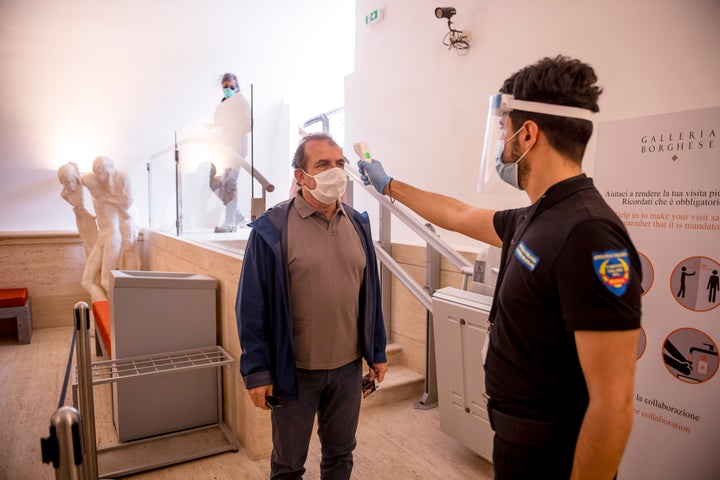
A staff member at Rome's Galleria Borghese checking a visitor's temperature on Tuesday.


A staff member at Rome’s Galleria Borghese checking a visitor’s temperature on Tuesday.

State and municipal lawmakers have communicated unclear messaging on what kinds of institutions can reopen and how they can do so safely, placing the onus on individual institutions. In California, Gov. Gavin Newsom (D) is allowing outdoor museums, gardens, galleries and exhibitions to resume operations. However, in Los Angeles, officials have recommended not doing so, and it is unclear what constitutes an “outdoor museum.”

Closed since March, the Met, one of the world’s most visited museums and home to a $3.6 billion endowment, laid off 81 employees last month and has projected a $150 million loss from the pandemic. The losses will likely be even more staggering for smaller museums without large endowments or major donations — if they survive at all.

Prior to the pandemic, the museum had briefly closed on just two other occasions: after the Sept. 11 attacks in 2001 and Hurricane Sandy in 2012.

“The Met has endured much in its 150 years, and today continues as a beacon of hope for the future,” the Met’s president and CEO Daniel Weiss said in a statement. “This museum is also a profound reminder of the strength of the human spirit and the power of art to offer comfort, inspiration, and community. As we endure these challenging and uncertain times, we are encouraged by looking forward to the day when we can once again welcome all to enjoy The Met’s collection and exhibitions.” 

A HuffPost Guide To Coronavirus


Source by [author_name]

Trump Announces U.S. To Exit Open Skies Treaty

WASHINGTON (AP) — The Trump administration notified international partners on Thursday that it is pulling out of a treaty that permits 30-plus nations to conduct unarmed, observation flights over each other’s territory — overflights set up decades ago to promote trust and avert conflict.

The administration says it wants out of the Open Skies Treaty because Russia is violating the pact, and imagery collected during the flights can be obtained quickly at less cost from U.S. or commercial satellites. Exiting the treaty, however, is expected to strain relations with Moscow and upset European allies and some members of Congress.

President Dwight Eisenhower first proposed that the United States and the former Soviet Union allow aerial reconnaissance flights over each other’s territory in July 1955. At first, Moscow rejected the idea, but President George H.W. Bush revived it in May 1989, and the treaty entered into force in January 2002. Currently, 34 nations have signed it; Kyrgyzstan has signed but not ratified it yet.

More than 1,500 flights have been conducted under the treaty, aimed at fostering transparency about military activity and helping monitor arms control and other agreements. Each nation in the treaty agrees to make all its territory available for surveillance flights, yet Russia has restricted flights over certain areas.

Last month, top Democrats on the Foreign Affairs and Armed Services committees in both the House and the Senate wrote to Trump accusing the president of “ramming” a withdrawal from the treaty as the entire world grapples with COVID-19. They said it would undermine U.S. alliances with European allies who rely on the treaty to keep Russia accountable for its military activities in the region.

“The administration’s effort to make a major change to our national security policy in the midst of a global health crisis is not only shortsighted, but also unconscionable,” wrote Rep. Adam Smith, D-Wash., Rep. Eliot Engel, D-N.Y., and Sens. Jack Reed, D-R.I., and Bob Menendez, D-N.J.

“This effort appears intended to limit appropriate congressional consultation on, and scrutiny of, the decision,” they wrote.

They said they weren’t moved by the defense secretary’s argument that $125 million to replace aging aircraft used for treaty verification, which was already appropriated by Congress, is too costly. “The total cost of replacing the aircraft is a tiny portion of the overall defense budget,” they said.

Earlier this month, 16 former senior European military and defense officials signed a statement supporting the treaty, saying that a U.S. withdrawal from the treaty would be a blow to global security and further undermine the international arms control agreements.

The officials asked the U.S. to reconsider its exit. But if the U.S. leaves, they called for European states to stay in the treaty, fulfill obligations under the treaty and refrain from restricting the length of observation flights or banning flights over certain territories.

Senior administration officials said Trump last fall ordered a comprehensive review of the costs and benefits of U.S. participation in the Open Skies Treaty. At the end of an eight-month review, which included extensive input from allies, it became clear that it was no longer in America’s interest to remain party to the treaty, the officials said. The U.S. notified other members of the treaty on Thursday, and the United States will formally pull out in six months.

The senior administration officials said Russian violations of the treaty were the main reason for exiting the treaty. They said Russia has restricted flights over Moscow and Chechnya and near Abkhazia and South Ossetia. Russian restrictions also make it difficult to conduct observation in the Kaliningrad, a Russian enclave sandwiched between Lithuania and Poland that is home to Russia’s Baltic fleet, they said.

Russia uses illegal overflight restrictions along the Georgian border in support of its propaganda narrative that the Russian-occupied enclaves of Georgia are independent countries. The senior administration officials said that amounted to an illegal restriction, under the treaty, coupled with a narrative that justifies Russia’s regional aggression.

The U.S. has been working on a proposal to backfill partners and allies with imagery that the U.S. would have shared from its open skies flights.

Associated Press Diplomatic Writer Matthew Lee contributed to this report.


Source by [author_name]

Tablet interactive: Coronavirus outbreak

The coronavirus pandemic is proving to be one of the toughest challenges of our generation. Visit our special coronavirus homepage to find important news updates, a link to our coronavirus newsletter, clear, useful information and tips for your wellbeing through this emergency. Visit our coronavirus data centre to see the latest data from your local area, across Australia and around the world.

Tap below to follow our daily live blog.

Source by [author_name]

China Proposes Law Cracking Down On Hong Kong Opposition Activity

0

BEIJING (AP) — China’s ceremonial parliament will consider a bill that could limit opposition activity in Hong Kong, a spokesperson said Thursday, appearing to confirm speculation that China will sidestep the territory’s own lawmaking body in enacting legislation to crack down on activity Beijing considers subversive.

Zhang Yesui said the National People’s Congress will deliberate a bill on “establishing and improving the legal system and enforcement mechanisms for the Hong Kong Special Administrative Region to safeguard national security.”

Such a move has long been under consideration but was hastened by months of anti-government protests last year in the former British colony that was handed over to Chinese rule in 1997. Such legislation was last proposed in 2003 under Article 23 of the Basic Law, Hong Kong’s mini-constitution, bringing hundreds of thousands of the territory’s citizens out in protest.


A riot police officer points pepper spray at a journalist as pro-democracy activists gather outside a shopping mall during the Labor Day in Hong Kong, Friday, May 1, 2020 amid an outbreak of the new coronavirus. (AP Photo/Kin Cheung)

The proposal was withdrawn by the government but Beijing has increasingly pushed for measures such as punishment for disrespecting the Chinese national flag and anthem and increased pro-China patriotic-themed education in schools. Opposition in Hong Kong’s Legislative Council, however, made it unlikely such a bill could pass at the local level.

The new measures are required by the “new situation and demands” and action at the national level is “entirely necessary,” Zhang said.

Hong Kong’s South China Morning Post newspaper said a draft resolution would be brought before the National People’s Congress on Friday afternoon and voted on at the end of its session on May 28. The congress’ standing committee that handles most actual legislation will then consider the details of the measure, the newspaper said.

A vote at the NPC will add to concerns in Hong Kong’s pro-democracy camp that Beijing is chipping away at the semi-autonomous territory’s rights to assembly and free speech that greatly exceed those permitted by the ruling Communist Party in mainland China.

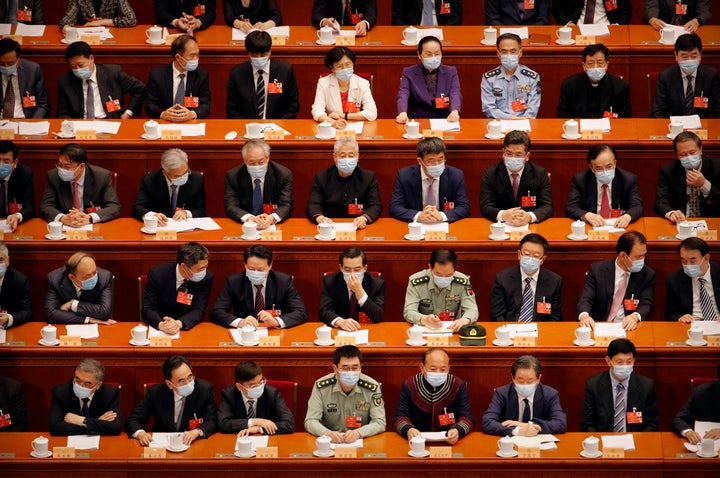
Delegates wearing face masks to protect against the spread of the new coronavirus wait for the start of the opening session o


Delegates wearing face masks to protect against the spread of the new coronavirus wait for the start of the opening session of the Chinese People’s Political Consultative Conference (CPPCC) at the Great Hall of the People in Beijing, Thursday, May 21, 2020. (AP Photo/Andy Wong, Pool)

Zhang’s comments at a news conference came on the eve of the opening of the congress’s annual session after a two-month delay because of the coronavirus pandemic.

Thursday saw the opening session of the Chinese People’s Political Consultative Conference, an advisory body. That will be followed Friday by the start of the 3,000-member NPC at which Premier Li Keqiang will deliver a keynote speech outlining economic and social goals for the year.

The holding of the “two sessions,” as the annual meetings are known, is a further sign of what the party says is its success in bringing the outbreak under control, although clusters of cases are still popping up in some parts of the country.

Members of the Consultative Conference will “tell the world about how China, as a responsible major country, has taken firm action and contributed to international cooperation in the fight against the COVID-19 epidemic,” Wang Yang, the chairman of the body, said in a report to the opening session.

Wang’s comments were in the prepared text distributed to journalists, although he skipped over them in his delivery, apparently to save time.

Rank-and-file members wore masks in the vast auditorium inside the Great Hall of the People in the heart of Beijing. Other top officials, including Wang, Li and President Xi Jinping, did not.

It remains unclear whether the premier will issue the usual economic growth target for the world’s second-largest economy. Given the economic devastation caused so far this year by the pandemic, any target would likely be considerably lower than last year’s 6.0% to 6.5%.

Tens of millions of Chinese have been thrown out of work and it’s unclear how many jobs will return. Not only have domestic production and demand been hammered, but key export markets such as the United States and Europe have collapsed as the outbreak spreads worldwide.

This year’s meeting of the two bodies is being shortened to one week from the usual two as part of virus-control measures. Media access has been largely reduced and only a limited number of reporters, diplomats and observers were permitted into the meeting hall.

Backed by massive state propaganda support, Xi has received plaudits at home for having contained the virus, even while the U.S. and others question China’s handling of the initial outbreak.

The Chinese public is also largely seen as backing Xi’s tough approach to foreign policy challenges, including criticism from the U.S., Australia and others.

Abroad, however, that policy has further bolstered concerns about China’s intentions. The Trump administration issued a 20-page report Wednesday attacking what it called Beijing’s predatory economic policies, military buildup, disinformation campaigns and human rights violations.

That may ultimately add to Xi’s difficulties in reviving economic growth and jobs at a time when global markets are partly shut and skepticism toward China runs high.


Source link

Most powerful cyclone in a decade kills at least 85 in India and Bangaldesh

Wide swathes of the coasts of India and Bangladesh have been flooded and millions of people remain without power, after the most powerful cyclone to hit the region in more than decade left dozens dead and a trail of destruction.

In the Indian city of Kolkata, home to more than 14 million people, large portions of the metropolis and its suburbs were underwater, including the city’s main airport. Roads were littered with uprooted trees and lamp posts and electricity and and communication lines were down.

Cyclone Amphan also badly damaged many centuries-old buildings when it tore through the city on Wednesday.

This Tuesday, May 19, 2020 satellite image released by NASA shows cyclone Amphan over the Bay of Bengal in India. (EOSDIS) via AP) (AP/AAP)
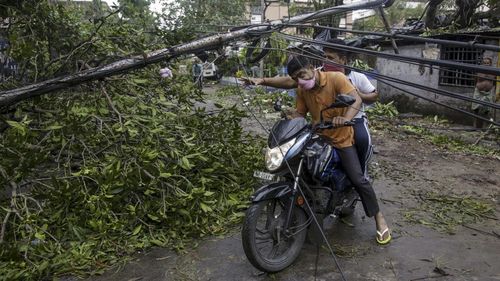
People make their way through damaged cables and a tree branch fallen in the middle of a road after Cyclone Amphan hit the region in Kolkata, India, Thursday, May 21, 2020. (AP Photo/Bikas Das) (AP/AAP)

“It feels like a dystopian Jurassic Park of sorts,” said Shuli Ghosh, who runs a cafe in Kolkata.

“The roofs of many homes have flown away and the streets are waterlogged.”

When the storm made landfall on Wednesday it lashed coastal areas in both India and Bangladesh with heavy rain, a battering storm surge and sustained winds of 170 kilometres per hour and gusts up to 190 km/h.

It devastated coastal villages in both countries, knocking down mud houses, ripping out electricity poles and uprooting trees.

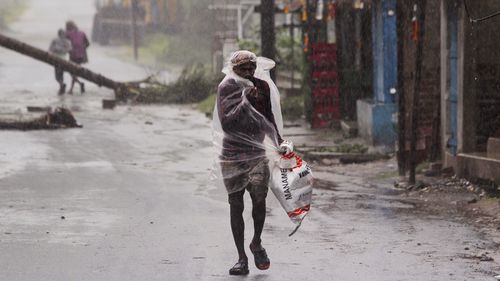
A man covers himself with a plastic sheet and walks in the rain ahead of Cyclone Amphan landfall, at Bhadrak district, in the eastern Indian state of Orissa, Wednesday, May 20, 2020. (AP Photo) (AP/AAP)

In Bangladesh, television stations reported 13 deaths, while 72 deaths were reported in India’s West Bengal state. Officials said two people were killed in India’s Odisha state.

Hundreds of villages in Bangladesh were flooded by tidal surges and more than a million people were without electricity.

Officials in both countries said the full extent of the damage remained to be seen as communication lines to many places remained down.

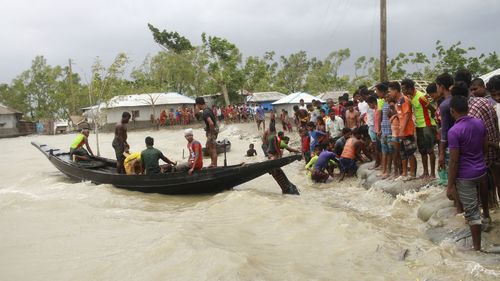
In this Wednesday, May 20, 2020 photo, people check an embankment before Cyclone Amphan made landfall, in Shyamnagar, Shatkhira, Bangladesh. (AP Photo/Abu Sufian Jewel) (AP/AAP)

India’s prime minister, Narendra Modi, said authorities were working on the ground to ensure all possible assistance to the those affected.

“No stone will be left unturned in helping the affected,” Modi tweeted on Thursday.

The ongoing coronavirus pandemic and social-distancing measures had made mass evacuations ahead of the storm difficult. Shelters were unable to run at full capacity in many places and some people were too scared of the risk of infection to mass there.

Likewise the pandemic will have and impact on relief efforts and the recovery. The damage caused by the storm is likely to have lasting repercussions for poor families already stretched to the limit by the economic impact of the pandemic.

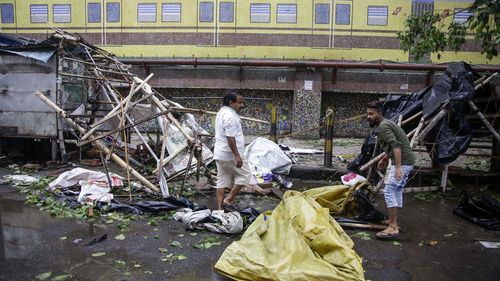
Roadside vendors along a metro station try to restore material from the debris of his stall due to a cyclonic storm Amphan in Kolkata, India. (AP Photo/Bikas Das) (AP/AAP)

In India’s Odisha state, the cyclone destroyed crops of Betel, a leaf used as a wrapper for chewing areca nut or tobacco. In Bangladesh’s southwestern district of Bagerhat, more than 500 fish farms were flooded.

Debashish Shyamal, who lives in a fishing village along the coast of West Bengal took shelter with his family in a government clinic. He said the wind blew open the windows and doors and for hours they sat huddled inside, drenched by the torrential rain.

On Thursday, he woke up to dangling electricity wires, waterlogged streets and an entirely uprooted forest next to his village.

“There is nothing left,” he said.

Source by [author_name]

Lori Loughlin To Plead Guilty In College Admissions Scandal, Agrees To Prison Time

“Full House” actor Lori Loughlin and her husband, the fashion designer Mossimo Giannulli, have agreed to plead guilty in connection with the college admissions bribery scandal.

Both will serve prison time and pay hundreds of thousands of dollars in fines under their plea deals for “securing the fraudulent admission” of their two daughters, Olivia Jade and Isabella Rose, to the University of Southern California crew team “as purported athletic recruits,” the U.S. Attorney’s Office in Massachusetts said in a statement Thursday.

Both daughters had never participated in the sport, according to court documents. The couple were accused of paying $500,000 to snag their places on the team so the girls would be admitted to the school.

Loughlin, 55, agreed to plead guilty to one count of conspiracy to commit wire and mail fraud, according to the deal she signed on Wednesday, and will be sentenced to two months in prison, a $150,000 fine and two years of supervised release with 100 hours of community service.

Giannulli, 56, will plead guilty to one count of conspiracy to commit wire and mail fraud and honest services wire and mail fraud, prosecutors said. He agreed to a sentence of five months in prison, a $250,000 fine and two years of supervised release with 250 hours of community service.

The couple will formally plead guilty and be sentenced at a hearing before U.S. District Judge Nathaniel M. Gorton that hasn’t yet been scheduled, the statement added.

Loughlin and Giannulli are among dozens of prominent public figures charged in the scandal that erupted in March 2019. The FBI called it a nationwide conspiracy that exposed how well-heeled parents bribed their children’s way into the nation’s most elite colleges.

Former “Desperate Housewives” star Felicity Huffman served 11 days in a low-security prison after she was found to have paid $15,000 to boost her daughter Sophia Macy’s SAT score so that she could secure a spot at Carnegie Mellon University in Pittsburgh.


Source by [author_name]