Friday, April 24, 2026

A Slice of Hope: As Bengal’s Brick Kiln Workers Await Their Turn to Go Home, Owners Come to Rescue

0

For an average three-member family, the owners supplied them each with 5kg of rice, potatoes and 4 litres of oil weekly along with the weekly wage of Rs 400-500 per worker. (Image: News18)

The brick kiln industry has often been pulled up for not standing by its contractual workforce and leaving them with bare minimum resources coupled with unhealthy living and work conditions. But, contrary to the abysmal standard, many kiln owners have reached out to their workers and provided then with ration and the basic needs till some normalcy returns.

Aarti Kumari sits crouched beside a burning coal oven that balances an aluminum bowl, frying half-a-dozen slice potato chunks in it. It’s past noon as she makes lunch outside her mud and brick hut at the kiln.

A resident of Jharkhand, Aarti is among some 90 odd migrant workers who are involved in making bricks at one of the many kilns based in West Bengal’s Hooghly district.

While the coronavirus lockdown hasn’t been kind to the country’s lakhs of migrant workers, who had no choice but to start trudging back to their native villages with families in tow, the perils of the unprecedented crisis seem to have dealt a lighter blow to some of these workers and their families in West Bengal.

The state has a little over 11,000 brick kilns out of which 7,000 are functional, scattered in many of its districts that employ over 8 lakh workers. Most of the migrant workers employed at these kilns stayed back when Prime Minister Narendra Modi announced the lockdown after the ‘Junta Curfew’ on May 22.

The brick kiln industry has often been pulled up for not standing by its contractual workforce and leaving them with bare minimum resources coupled with unhealthy living and work conditions. But, contrary to the abysmal standard, many kiln owners have reached out to their workers and provided then with ration and the basic needs till some normalcy returns.

Bacchi Devi, who works at the Bengal Brick Field in Hooghly’s Adhishaptgram and hails from Sapora village in Bihar, says she can’t believe how things have changed in a jiffy. “Itne saalo mein aisa kabhi nahi hua, lekin tumko idhar theek hi lag raha hai. Khaana paani bhi diya gaya, abhi ghar jaane ki umeed hai” (Never seen anything like this before, but we didn’t face too many problems. We got ration and water. Hoping to go back home now).

She has been working in brick kilns for the past 20-25 years and hopes to return to work if the owners call her back. Her brother, Brij Ram, who suffered a partial loss of speech after an accident a few years ago, is also employed at the kiln and distributes tokens for orders.

During the first couple of weeks of the lockdown, rations, face masks and sanitisers were provided to the workers. For an average three-member family, the owners supplied them each with 5kg of rice, potatoes and 4 litres of oil weekly along with the weekly wage of Rs 400-500 per worker. After the initial period, when shops started opening nearby, the workers started to take turns to buy essentials along with the ration provided by the government.

Tale of tragedies of migrants have reached these kiln workers who are grateful for the basic support they have been provided with. Khudiram Gundua, who hails from Jharkhand’s Chakradharpur, recounts how his brother-in-law Chhotu, who was working with a bridge construction crew in Hyderabad, had to peddle for six days to reach his home after work stopped due to the lockdown.

But Bengal Brick Field owner Tapas Dasgupta says he isn’t doing anything out of the ordinary for his workers. “But that’s the thumb rule of the brick-making business. We have always paid for their travelling from their home town to workplace and vice-versa. It’s just that now we are arranging for transportation instead of giving them money for it.”

Ashok Tiwari, President of West Bengal Brick Field Owners’ Association, says that the owners have tried to help as many workers as possible.

“With work halted during peak summer in April and no sale, the owners have been supporting the workers as much as they can. The state government has been involving us in policy-making, so I am hopeful that they will help us to revive the industry once the lockdown period is over.”

With the Centre now facilitating the travel of workers across the country, some of these owners have started sending their workers back to their homes.

Jayant Das, who owns DMB Enterprise in the area, says half of his workers in the production team are from Bihar who left a few days ago. “We arranged buses for them as it would have been troublesome for them with long queues before being able to board the trains.”

Others who hail from Gaya, Nawada in Bihar, or parts of Uttar Pradesh and Chhattisgarg will also be on their way as and when the buses are arranged.

Meanwhile, as they wait their turn to go home, most of the migrant workers have turned to their phones for amusement. “We watch Bhojpuri and Hindi songs. They are quite a rage,” quips an 18-year-old, perched atop a mountain of deformed bricks.


https://pubstack.nw18.com/pubsync/fallback/api/videos/recommended?source=n18english&channels=5d95e6c378c2f2492e2148a2&categories=5d95e6d7340a9e4981b2e10a&query=A,Slice,of,Hope:,As,Bengal’s,Brick,Kiln,Workers,Await,Turn,to,Go,Home,,Owners,Come,to,Rescue,brick,coronavirus,&publish_min=2020-06-05T12:53:23.000Z&publish_max=2020-06-07T12:53:23.000Z&sort_by=date-relevance&order_by=0&limit=2

Source link

What the coronavirus pandemic looks like when you don’t have the internet

0

They told her a deadly virus “like a whooping cough” was gripping the country and had even hit the nearby city of Maicao. But she was skeptical it was so close to home. “I don’t know if this is true,” said 38-year-old Montiel, who is part of the country’s largest indigenous group, the Wayuu.

When the Colombian government issued a nationwide lockdown in late April, she and her husband were advised to stay at home with their three children, keep their distance from other people, wash their hands and wear masks to avoid the virus, which has killed more than 365,000 people around the world.

But for the Montiels, the stay-at-home order is its own sort of death sentence.

Before the lockdown, Angela would occasionally top up a SIM card in order to use WhatsApp, but hasn’t been able to recharge it since the lockdown. With no internet connection, there is no way to “work remotely.” Angela knits traditional Wayuu mochila bags but she can’t sell them in the street under the current restrictions.

For now, her family has been surviving off emergency cash payments from the non-government organization Mercy Corps. It’s impossible for her children to continue their education from home without access to school materials online. As for updates, they wait for phone calls from friends or family, who might bring news. Otherwise, they’re in the dark.

“Seeing as we don’t have TV, internet or anything, we don’t know if it’s still going on or if it will keep going, so obviously we can’t go out or move around,” Montiel said. “We’re in despair.”

According to UN estimates, nearly half the global population — 46% — still aren’t connected to the internet. For those people, lockdown means missing out on immediate access to vital public health information, remote work opportunities, online learning, telemedicine appointments, digital grocery deliveries, live-streamed religious services — weddings, and even funerals — as well as the countless other ways we are increasingly living our lives online.

Governments around the world have committed to providing universal access by 2020, but the digital divide still runs deep and is widening inequalities offline as well.

People in poorer regions are less likely to be connected, as are women, elderly people and those living in remote or rural areas. And in many cases, connectivity can be tenuous — closures of offices, schools or public spaces, like libraries and cafes, have cut access off for many.

“We’ve always said that there are about 3.5 billion people who are not connected, but we know it’s more now, because quite a number of the people who used to be connected at their workplaces and other public spaces no longer have that access,” said Eleanor Sarpong, the deputy director at the Alliance for Affordable Internet (A4AI).

“Covid-19 has shown that there’s such a huge divide, and it’s actually come as a shock to some governments. When they asked their employees to go work from home … a lot of them couldn’t.”

Sarpong is hopeful the crisis will break through long-existing barriers to internet access — from a lack of political will to regulatory hurdles and data affordability — to get more of the world connected.

A4AI, an initiative of the World Wide Web Foundation, founded by Tim Berners-Lee, recently shared a set of policy recommendations, urging governments, companies and civil society to take urgent actions to bring as many people online as possible during the pandemic. Among their immediate recommendations are: removing consumer taxes on internet services; cutting out data charges for public websites; providing affordable data packages; expanding broadband allowances; and rolling out free public wifi infrastructure. Some are already taking these steps.

“Governments need to look at internet access, not as a luxury, but to see it as an enabler that can transform their economies … I think it’s a wake-up call for them,” Sarpong said.

A digital gender gap

Digital technologies have rapidly revolutionized life as we know it. But not everyone is benefiting equally, and many are getting left behind because of a lack of infrastructure, literacy and training.

Across the world’s least-developed countries, just 19% of people are online. Men are 21% more likely than women to be connected — and that gender gap is only widening.

In India, an aggressive approach towards digitization has moved most government benefits online — from rations to pensions. Even before the pandemic, the country’s poorest were dependent on digital, despite half of the population being offline.

The pandemic has only magnified the irony of that situation.

When the crisis hit and India’s 1.3 billion people were placed under lockdown, the nation’s informal economy ground to a screeching halt. So when the government announced it would send direct cash transfers to vulnerable women, widows, senior citizens and disabled people for three months starting April 1, it was welcome news. But, stuck at home without smartphones, many were unable to access the 500 to 1,000 rupees ($6 to $13) in aid.
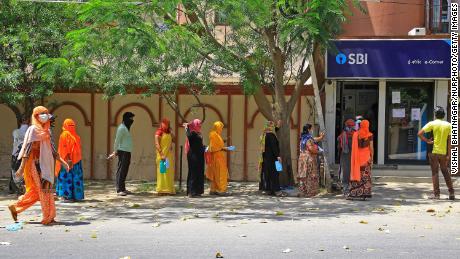
People wait outside a bank during lockdown in Jaipur, Rajasthan, India, on April 9.

Lal Bai, a 65-year-old widow living in a remote village in Rajasthan, couldn’t trek the five miles into the nearest town to withdraw the government cash, and had no means of accessing the government funds online, so she quickly found herself without any food left at home.

Distraught, Bai ended up on the doorstep of Ombati Prajapati, who runs a digital services shop in her village. “She was the only one who would help me.”

Prajapati is among 10,000 “soochnapreneurs,” or digital entrepreneurs, who have been trained and supported by Digital Empowerment Foundation (DEF), a New Delhi-based NGO, in rural parts of the country. Amid the lockdown, they’re helping provide essential digital services, including remote banking that allows people like Bai to withdraw cash using a mobile, biometric ATM. And they’re even helping to fight misinformation.

“It is only because of the internet that I am able to see what is happening and tell others that they should regularly wash their hands with soap, use sanitizer, wear masks,” said Prajapati, 27. “I would not have been able to help any of these people [if I had not learned how to use the internet]. I would not have been able to even help myself.”

Osama Manzar, a social entrepreneur and DEF’s founder, says that their work training women like Prajapati has shown how important it is to have digital infrastructure available to the last mile — especially during a disaster.

“Connectivity and access to the internet must be part of basic human rights. It must be considered, at the time of pandemic and disaster, just as you provide access to food or water, there must be a way to provide access to data,” Manzar said.

A problem for rich countries, too

The digital divide has long been thought of as a development issue. But the pandemic has highlighted that wealthy countries are also afflicted by digital deprivation.

More than four in 10 low-income households in America don’t have access to broadband services, according to research by Pew. And in the United Kingdom, 1.9 million households have no access to the internet, while tens of millions more are reliant on pay-as-you-go services to get online.

“Sometimes people talk about Covid-19 as being a great leveler. But actually, the way that people are experiencing the lockdown is not at all equal,” said Helen Milner, the chief executive of the Good Things Foundation, a UK charity working with the government to get more people online.
America's surprising breeding ground for inequality: The internet

“Digital exclusion is, for a lot of people, just an extension of social exclusion that they’re facing, and poverty is definitely part of that.”

The British government recently launched a number of initiatives to help try and tackle digital exclusion. Among the schemes is a new campaign, DevicesDotNow, which asks businesses to donate devices, sims and mobile hotspots. Good Things Foundation is helping deliver the devices to those in need, and assisting with training. So far, they’ve given out nearly 2,000 tablets
Among the recipients was Annette Addison, who lives alone in a flat in Birmingham, central England and uses a wheelchair to get around. Before the lockdown, she would go to her local community center to access the internet and get assistance with her disability payments. But without a smartphone, she says she has felt isolated and in the dark about the status of her benefits.

“I wasn’t coping at all. I was very lonely and depressed when lockdown first started, but since I’ve had the tablet … when I’m feeling lonely, I can talk to my grandchildren or my daughter. I’ve got contact with them constantly, because they’re always online.”

Why rural Americans are having a hard time working from home

On May 1, Addison turned 60. She celebrated with her grandchildren over a video chat on her new iPad — the same iPad she now uses to check her benefits portal. And she’s recently signed up for a dating site too. “I feel like a teenager,” she said.

But, as governments try to roll out digital services to the neediest, the question remains: Who gets a device and who doesn’t?

Hafsha Shaikh, founder of SmartLyte, the digital skills center that distributed the device to Addison, said that is a question that haunts her.

“That device isn’t just about immediate support during Covid, but it’s about opening up the gateway, for parents and for families, to aspirations and opportunities,” Shaikh said. There are currently 1,500 others on the waiting list.

“The biggest challenge is, who do I choose?”

CNN’s Swati Gupta and Jack Guy contributed to this report.

Source link

Outrage in Puducherry as Health Workers Caught on Camera Throwing Covid-19 Victim’s Body into Grave

0

Representative Image

As per the video, the workers flouted Covid-19 protocol while handling the body of a virus-infected patient as the body was seen merely wrapped with a white cloth and not in a bag as mandated by the government.

  • News18.com Puducherry
  • Last Updated: June 7, 2020, 12:37 PM IST

Massive outrage has erupted in Puducherry over a viral video on social media which purportedly shows some government workers throwing the body of a Covid-19 patient into a pit hurriedly and flouting Covid-19 protocols.

In less than a 30-second video as reported by several media outlets, four men in personal protective equipment (PPEs) can be seen moving the body from an ambulance and dumping it into the pit. Moreover, one of the workers can also be heard informing a government official that they have “thrown the body” for which the official responds by showing thumbs up in approval.

After the video went viral, the local administration ordered a probe into the incident.

As per the video, the workers flouted Covid-19 protocol while handling the body of a virus-infected patient as the body was seen merely wrapped with a white cloth and not in a bag as mandated by the government. It is yet to be known if the body was duly embalmed or not.

Sources said that the body was of a Chennai-based resident who had visited Puducherry and later tested positive of Covid-19.

Reacting to the incident, India Against Corruption said in statement, “Dignified disposal of dead body is a matter of right. Such an insult to a dead person is an offence under section 500 of Indian Penal Code. The health workers along with those supervisory staff are punishable with penalty for defamation of deceased person.”

According to the sources in the health department, the body was handed over to Revenue officials for burial.

Speaking to NDTV, Puducherry Collector Arun said, “I have issued a memo to the concerned department. It’s very unfortunate. I am enquiring into the issue. Have properly briefed them.”

Meanwhile, Lieutenant Governor Kiran Bedi said that show cause notices are being served to those involved in the incident.


https://pubstack.nw18.com/pubsync/fallback/api/videos/recommended?source=n18english&channels=5d95e6c378c2f2492e2148a2&categories=5d95e6d7340a9e4981b2e10a&query=Outrage,in,Puducherry,as,Health,Workers,Caught,on,Camera,Throwing,Covid-19,Victim’s,Body,into,Grave,Chennai,coronavirus,&publish_min=2020-06-05T18:06:58.000Z&publish_max=2020-06-07T18:06:58.000Z&sort_by=date-relevance&order_by=0&limit=2
Next Story

Source link

How can the Church of England speak about race when its leaders are so white? | Arun Arora

The reaction of many of those in leadership positions in the Church of England to the killing of George Floyd has been to ask BAME people about their experience, not only in the United States but also in Britain.

Social media posts with the hashtag #blacklivesmatter have been copious, as have been the searches for people “who can speak about race and the UK church” with sensitive rejoinders about “white people putting pressure on black people to tell us how to solve racism for us”.

All of this comes as Dr John Sentamu prepares to step down from his post as archbishop of York. His retirement comes at a time when the Church of England has been talking about making great strides in the appointments of senior BAME leaders. Yet from tomorrow, for the first time in over a quarter of a century, there will be no black or minority ethnic diocesan bishop serving in the Church of England. When diocesan bishops next meet and discuss their response to the events in America, the disproportionate impact of Covid-19 on BAME communities and on poor people in urban communities, there will be no one of colour with an equal voice among them. 

The questions about race and racism in the church extend far beyond its leadership. Yet when the Conservative party, hitherto unknown for racially progressive leadership, appoints a BAME man and a BAME woman to two of the four highest offices of state and appoints others to the cabinet, the one-colour nature of the senior leadership of the Church of England begins to look perilously archaic.

A glance at the most senior level of leadership in the Church of England reveals an alarmingly retrograde trend. Michael Nazir-Ali, who served as the bishop of Rochester, was the church’s first BAME diocesan bishop when he was appointed in 1994. Following Sentamu’s appointment as bishop of Birmingham in 2002, the church enjoyed the zenith of its ethnic diversity in leadership with two senior bishops until Nazir-Ali’s retirement in 2009. For the last decade, Sentamu has alone represented that diversity. 

But leadership in the church is about more than bishops. Leadership comes in many forms – lay and ordained, in parachurch organisations, mission agencies, theological colleges and diocesan administrators, to name but a few. 

These groups present an equally monochrome image of leadership. Take for instance Holy Trinity Brompton (HTB) and New Wine, two of the strongest evangelical networks operating in the Church of England today and with a considerable influence on new and growing churches across the country. There are no BAME members of HTB’s senior clergy or senior leadership team. None of their churches across London and the UK is led by BAME clergy. According to New Wine’s website, there are no BAME clergy or lay leaders in its 30-strong team of national directors, regional directors and heads of ministry.

But this failure is not confined to the church’s evangelical wing. In leading Catholic organisations the picture is the same. The newest organisation, the Sodality of Mary Mother of Priests, promotes itself on social media with a picture of a group with an image of 25 priests gathered around an altar – all of whom are white. More established national Catholic networks paint a similar picture. The leadership of the Society of Saint Wilfrid and Hilda is exclusively white, as is the leadership of Forward in Faith in its executive committee. If the old dictum that “you need to see it to be it” is applied to the church’s leadership, that offers little hope to young BAME church members for their inclusion or participation.

Try looking for BAME appointments in other senior roles within the church. Diocesan secretaries? None. Chairs of diocesan boards of finance? None. Principals of theological colleges? None. 

Last week, Robin Ward, the principal of one of the church’s training institutions, took to Twitter to call out the archbishop of York for supporting the Black Lives Matter rally in Hyde Park. Pitching his desire to see churches open their doors again against the tragedy of the death of George Floyd highlighted the lack of understanding or empathy at work in parts of the higher echelons of the church. 

But the picture is not entirely bleak. In recent years, there has been much rejoicing at the appointment of women and men as assistant or suffragan bishops in the Church of England. Rose Hudson-Wilkin as bishop of Dover, John Perumbalath as the bishop of Bradwell, Guli Francis-Dehqani as bishop of Loughborough and Karowei Dorgu as bishop of Woolwich joined bishop David Hamid from the diocese of Europe.

Yet if we were add up all of the Church of England’s serving BAME bishops, out of more than 100 we would still be counting on one hand. 

For some, the appointment of Sentamu as archbishop of York was going to mean that the issue of race and racism in the Church of England could now be dismissed. That kind of aspiration is simplistic. After all, after eight years of the Obama presidency in the United States, when one hoped that historical progress was being made, we are confronted with the opposite.

In a church that rightly proclaims that the gifts of the holy spirit are for all people, from every race and nation, why does the Church of England present such a contradictory picture?

• Arun Arora is vicar of St Nics Durham

• This article was co-written by Eileen Harrop, Remi Ole and Shemil Matthew

Source link

Seven productivity methods to help boost your work output

Working from home seemed like it would be less stressful and probably more fun, but you may be struggling to focus now that your office is a lot closer to your bedroom.

If you need tips on effectively managing your time to get more done each day, try one of these productivity methods:

Rubber duck debugging

Rubber Duck Debugging is telling an inanimate object, or even your pet, about the problem you’re having and why.

This verbalises the problem and puts it in perspective.

Eat the live frog: do the worst thing first

Mark Twain once said: “Eat a live frog first thing in the morning and nothing worse will happen to you the rest of the day.”

This productivity method reportedly works well for those who procrastinate, miss deadlines or rush last-minute work.

Do the task you’re dreading first and the rest of your list will seem like a breeze.

Personal Kanban

If you’re a more visual person; this simple system is great.

Divide all your tasks into three categories: “to do”, “doing”, and “done”. Use sticky notes on the wall above your desk, create an excel spreadsheet or the sticky notes app on your computer.

Check the list regularly and move things to their relevant sections.

The SMART method

Have big ideas? Need them turned into actionable plans? Try this.

SMART stands for: Specific, Measurable, Assignable, Realistic, Timely.

What would like to accomplish? What measurable tasks need to be done? Are there roles that need to be assigned? What are the real challenges? When is the deadline?

This method can work for individuals and businesses.

The Action Method

Are you great at brainstorming, but not always great at putting plans into action?

Being creative calls for thinking outside the box, but putting plans into action calls for structure. How do you do that exactly?

Break down ideas into three categories: action items, backburner items, and reference items.

Action: the steps you’ll take to get it all done.
Backburner: interesting, but maybe not for this project.
Reference: the resources and information you’ll need.

The Time Blocking Method

If small tasks and interruptions take too much of your time, this method will hold you accountable by allotting set times for specific work.

Split up your day into blocks of time assigned with specific tasks; from 11am to 12pm, you’ll answer emails, from 2pm to 4pm you’ll work on that design project and so on.

The Pomodoro Method

If you need structure and control to not be distracted, try this.

Work for 25 minutes, take a five-minute break, and repeat for four sprints, after which you take a longer break. It works out to two hours with a 20-minute break and then half an hour to sit in the sun, eat lunch, or even do a quick workout.

You can also adjust it to your personal preference.

No Zero Days

Use this productivity method to break habits or create them.

Set yourself an achievable task each day and mark it off on a calendar. The aim is to never have a day where you have achieved nothing.

Use it as a small step towards a much bigger goal.

This content has been created as part of our freelancer relief programme. We are supporting journalists and freelance writers impacted by the economic slowdown caused by #lockdownlife.

If you are a freelancer looking to contribute to The South African, read more here.


Source link

India Need to be Ruthless While Picking Spinner for Australia Tour: Ian Chappell

0


India

Former Australian cricketer Ian Chappell has urged India’s thinktank to consider including all-rounder Hardik Pandya in the Test side during their tour of Australia later this year. Chappell believes that Pandya has the key to unlock the strong Australian batting line-up.

Pandya hasn’t played Test cricket since 2018 and is returning from what was a career-threatening back injury.

The big-hitting medium pacer is a vital cog in India’s limited-overs set-up, a fact he says he is very well aware off. Pandya had recently spoken about the challenge that Test cricket is for him now given his injury-prone back, which needed surgery last year.

India and Australia are set to clash in a full series, including four Tests, beginning October and lasting till January 2021.

“It will help if Hardik Pandya is available. He gives India an extra bowling option to maintain the pressure when the leading fast bowlers need a rest,” Chappell wrote his column for ‘ESPNCricinfo’.

Also read: Aware of My Importance in Limited-overs Cricket, Energy is Plus Point: Hardik Pandya

“This is Pandya’s chance to gradually build up overs in the three Tests before the SCG match, where he could act as the third seamer so that a second spinner can be included,” Chappell said.

“Having Pandya at seven would necessitate Rishabh Pant keeping and batting at six.”

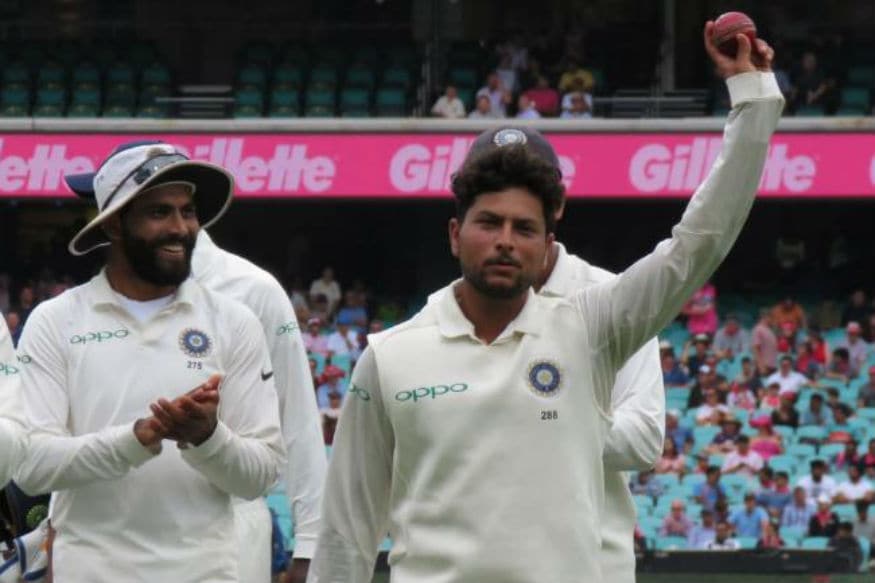
Chappell also urged the Indian selectors to be ruthless while zeroing in on spinners with the likes of Ravichandran Ashwin, Ravindra Jadeja and Kuldeep Yadav to choose from.

“Choosing a spinner will prove a major headache for the Indian selectors. R Ashwin has a great overall record, but not so much in Australia.

Ravindra Jadeja‘s all-round talents and improved bowling form make him a legitimate challenger, while Kuldeep Yadav‘s wrist-spin is the biggest wicket-taking threat on Australian pitches. The decision will call for brave selections,” he reckoned.

Chappell said India’s biggest challenge in the Test series will be navigating through a strong Australian batting line-up, which now doesn’t rely too heavily on David Warner and Steven Smith.

Under Virat Kohli, India scripted history when they earned their maiden Test series triumph Down Under in 2018-19, after trying for seven decades.

However, Australia are a different team now with Smith and Warner back in the side having served one-year ball-tampering bans in addition to the rise of young Marnus Labuschagne.

“India’s biggest challenge will be navigating a strong Australian batting line-up. In addition to Smith and Warner, the meteoric rise of Marnus Labuschagne at No 3 has helped solidify the batting,” Chappell wrote.

“Australia are now far less reliant for success on big contributions from Smith and Warner,” he added.

For the home side, Chappell feels the choice of bowlers is straightforward. However, the former captain is not too confident about the abilities of opener Joe Burns.

“The pace bowling is in great shape, with Pat Cummins, Mitchell Starc, Josh Hazlewood and James Pattinson forming a potent quartet. The spinner is a simple decision – Nathan Lyon and then daylight.”

“The batting line-up is not as clear cut. The recently announced contract list suggests Joe Burns will be Warner’s opening partner. Burns is vulnerable early and this is India’s big opportunity to first get at Labuschagne and then Smith while the ball is new.

“Australia’s middle order is an uncertain quantity, with Travis Head, Matthew Wade and Mitchell Marsh vying for two spots. That middle-order fragility highlights the rewards on offer for keeping Smith, Warner and Labuschagne in check.”

Chappell said that Warner’s opening partner is a weakness India should exploit.

“Warner’s opening partner is an area of weakness that India need to fully exploit, but keeping the ‘big three’ quiet should be the attack’s main focus,” he said.

Chappell feels Australia’s potent bowling attack will keep a check on the dangerous Kohli and Cheteshwar Pujara, who was the star of India’s breakthrough 2-1 series win over last time.

“Australia’s strong attack should restrict India’s scoring to reasonable levels despite the daunting presence of Virat Kohli and Cheteshwar Pujara.

“This heavyweight bout will be decided by who punches above their weight – Australia’s ‘big three’ or India’s ‘big bats’.”

(With Agency Inputs)


Source link

Delhi Riots: Police File Chargesheet Against 410 People in ‘Deep-rooted Conspiracy’ Case

0

Security personnel stand guard near a neighbourhood vandalised by rioters in Northeast Delhi on Tuesday. (PTI)

Communal violence had broken out in northeast Delhi on February 24 after citizenship law supporters and protesters clashed with each other in the area, leaving 53 people dead.

  • PTI New Delhi
  • Last Updated: June 7, 2020, 12:00 AM IST

Delhi police have chargesheeted 410 people in 78 cases in connection with the communal violence in northeast Delhi in February, officials said Saturday.

Communal violence had broken out in northeast Delhi on February 24 after citizenship law supporters and protesters clashed with each other in the area, leaving 53 people dead.

Following the violence, the body of Intelligence Bureau staffer Ankit Sharma (26) was found in a drain in Chand Bagh, where he lived.

Police arrested Aam Aadmi Party leader Tahir Hussain in the case.

In the chargesheet, police has said there was a deep-rooted conspiracy behind the riots and Sharma was targeted by a mob led by Hussain.

Delhi police head constable Ratan Lal was also killed during the clashes.

He was attached to the office of the Assistant Commissioner of Police, Gokulpuri.


https://pubstack.nw18.com/pubsync/fallback/api/videos/recommended?source=n18english&channels=5d95e6c378c2f2492e2148a2&categories=5d95e6d7340a9e4981b2e10a&query=Delhi,Riots:,Police,File,Chargesheet,Against,410,People,in,’Deep-rooted,Conspiracy’,Case,Ankit,Sharma,communal,violence,&publish_min=2020-06-05T02:51:07.000Z&publish_max=2020-06-07T02:51:07.000Z&sort_by=date-relevance&order_by=0&limit=2
Next Story

Source link

Empty stadiums could affect Ben Stokes’ performance: Darren Gough

0

By: PTI | London |

Published: June 7, 2020 11:58:57 am


Ben Stokes has been the big game player for England in the previous year (Source: Reuters)

Former England fast bowler Darren Gough believes that World Cup-winning all-rounder Ben Stokes’ performance might be affected if international cricket is played in front of empty stands due to the COVID-19 pandemic.

International cricket is set to resume after the coronavirus hiatus with England scheduled to host the West Indies team in a bio-secure environment for a proposed three-match series in July.

“We have seen Ben Stokes whenever there is a big game on, when there is something really at stake in a match, he steps up and always delivers,” the 49-year-old was quoted as saying by Sky Sports.

“So it will be interesting to see how someone like him, the greatest cricketer arguably in the world at the moment, how he performs with no crowd. I think it might affect his performance just a little bit,” he said.

Gough, who played 58 Tests and 159 ODIs for England, said it will be interesting to see how different players react to the new normal of playing in spectator-less grounds.

“I don’t think it makes any difference to the players. Of course some players react to crowd more than other. Graeme Gooch is to say that about me. He used to say the bigger the crowd they better I play,” he said.

“But for some players it doesn’t matter, they will still deliver. We are talking about small percentages in performance.”

📣 The Indian Express is now on Telegram. Click here to join our channel (@indianexpress) and stay updated with the latest headlines

For all the latest Sports News, download Indian Express App.

Source link

$320k Porsche gone in 60 seconds, caught in 500 metres

An opportunistic thief was arrested just 500 metres from a West Melbourne car wash where he allegedly stole a $320,000 Porsche 911 GTS, which has a top speed of 310km/h but barely got out of second gear during a bungled getaway.

The owner of the Porsche, who asked not to be identified, was drinking coffee as his high-performance vehicle was cleaned at the Magic Hand car wash on Spencer Street on May 14.

The Porsche GTS 911 that was taken from a West Melbourne car wash.

A confused attendant handed the keys to the alleged thief after complimenting him on the luxury sports car.

Not lacking in self-confidence, the man allegedly told the attendant: “If you work hard, you could have a car like this,” before turning left into Dudley Street.

Source by [author_name]

Sonam Kapoor is missing travelling amid lockdown and her latest Instagram photo is proof

Image Source : INSTAGRAM/SONAMKAPOOR

Sonam Kapoor is missing traveling amid lockdown and her latest Instagram photo is proof

Just like many others, Bollywood actress Sonam Kapoor too has been sharing her quarantine routine on social media which includes working out, cooking for husband Anand Ahuja, throwback photos, pretty selfies, and whatnot. She has been in Delhi ever since the lockdown began and could not fly down to Mumbai to be near her family–Sunita Kapoor, father Anil Kapoor, sister Rhea, and brother HarshVarrdhan. And now her recent post describes her desire to travel just like many other travelers. In the throwback photo which has been taken at the airport, The Zoya Factor actress can be seen wearing a white V-neck dress with a black shrug accessorized with glasses and boots. Her caption, however, caught the attention of many who thought that she’s hinting about traveling to Mumbai, now that the domestic flight operations have resumed.

Taking to Instagram, Sonam wrote alongside, “All my bags are packed and I’m ready to go….. somewhere.. anywhere I miss travelling.” Have a look at the post here:

She recently shared a photo in which she was seen all decked up seated in her bed. In the picture, Sonam can be seen wearing blue-coloured block-printed midi dress paired with trendy black coloured loafers. Alongside she wrote, “Lounging in bed is my favourite thing to do.”

Also, recently Sonam shared a series of photos that she posted and wrote about how she is getting bored at home. Take a look:

On the professional front, her last appearance was in The Zoya Factor opposite South star Dulquer Salmaan. The film did not work well at the box office. It is being said that she has been signed for the sequel of Veere Di Wedding co-starring Kareena Kapoor Khan.

For all latest news and updates, stay tuned to our Facebook page

More Bollywood stories and picture galleries


Fight against Coronavirus: Full coverage


Source link