Euro hits four-month high on Covid-19 recovery fund hopes – business live


French President Emmanuel Macron leaving the European Council building in the early morning Photograph: Olivier Matthys/AFP/Getty Images

Good morning, and welcome to our rolling coverage of the world economy, the financial markets, the eurozone and business.

After months of lockdown, a weekend in Brussels sounds like luxury. But I fear European leaders haven’t enjoyed their sojourn in the Belgian capital, after days of sometimes bitter arguing over their €750bn Covid-19 rescue package.

The European Summit, which began on Friday morning, temporarily broke up up around dawn today without having reached a deal. Leaders are due back at 3pm BST, for yet another push.

As suspected, the so-called ‘frugal four’ of Austria, Denmark, the Netherlands and Sweden fought the plan, unhappy about extending €500bn of grants to Southern EU members who are suffering the worst economic pain from the coronavirus.

They pushed for grants (funded by borrowing on the capital markets) to be cut to €350bn, plus €350bn of loans. They also want rebates to their EU budget contributions to sweeten the pill.

Painstaking diplomatic wrangling failed to bring the two sides together — yet. But a compromise is on the table — to cut the grants for struggling countries such as Spain and Italy to €390bn.

Even it that was agreed, leaders need to agree how to police the policy — what should a country pledge in return for a grant, and how is that enforced? Dutch PM Mark Rutte caused infuriation by demanding a national veto on how the cash would be spent. There’s also the small matter of agreeing a new seven-year EU budget.

Rutte struck an optimistic tone as he exited the summit this morning, telling reporters that negotiations were ‘back on track’.

Our Brussels bureau chief Daniel Boffey reports that leaders were challenged to show some much-needed unity:


At a late evening dinner, the European council president, Charles Michel, who is chairing the summit, asked the leaders whether they were “capable of building European unity and trust. Or, through a tear, will we present the face of a weak Europe, undermined by mistrust?”

Dutch prime Minister Mark Rutte said on Monday EU leaders were making progress but warned discussions could still fall apart. “At times it didn’t look good last night, but I feel that on the whole we are making progress,” Rutte told reporters in Brussels.

mehreenkhn
(@MehreenKhn)

Summit resumed and ended after just 7 minutes at 5.52am. Leaders were told by Charles Michel that new basis for an agreement is €390bn in grants. Meeting due to resume at 1400 on Monday afternoon with expectation of new negotiating draft after everyone gets some sleep


July 20, 2020

mehreenkhn
(@MehreenKhn)

Rutte also leaving to get some sleep says negotiations are “back on track” after the 5am breakthrough tonight #euco


July 20, 2020

This has lifted the euro — with traders anticipating that (in the best European traditions), a seemingly intractable crisis will be resolved in the end.

The single currency has jumped by a third of a cent this morning to $1.146, its highest level since March, and not far from an 18-month peak.
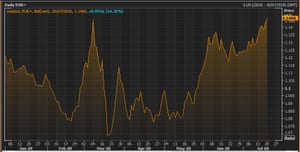
The euro vs the US dollar this year

The euro vs the US dollar this year Photograph: Refinitiv

Stephen Innes of AxiCorp reckons the euro has further to climb, if leader can back a compromise.


As for the EU summit, the market seems to prefer that a deal is not rushed through for the sake of appearances An agreement delay – perhaps until later in the summer – is preferable to markets than a weak agreement.

Stephen Innes
(@steveinnes123)

I think there is a high probability of a deal and would push EURUSD to around the 1.16 level, fuel further equity re-allocation towards Europe and provide another boost to peripheral bond markets. #forex #EURUSD long EURO could be a keeper https://t.co/2egVXIYtm3 pic.twitter.com/iFghhVdUSg


July 20, 2020

Otherwise, it could be a quietish day in the markets, as the summer lull looms. Investors will have Covid-19 vaccines on their mind, with Oxford publishing details of their trials today.

IGSquawk
(@IGSquawk)

European Opening Calls:#FTSE 6283 -0.11%#DAX 12929 +0.07%#CAC 5067 -0.04%#AEX 573 -0.13%#MIB 20339 -0.39%#IBEX 7436 -0.06%#OMX 1768 -0.11%#STOXX 3364 -0.06%#IGOpeningCall


July 20, 2020

The agenda

  • 9am BST: European Central Bank vice-president Luis de Guindos speaks about Covid-19’s economic impact
  • 3.30pm BST: Treasury Committee session with Bank of England policymakers Andy Haldane, Silvana Tenreyro and Jonathan Hall



Source link

Here are all the battlefronts TikTok is currently fighting on

0

The video-sharing social media platform is the No. 1 app on the Google Play Store and number two on Apple App Store, and has been downloaded more than 165 million times by US consumers. The app is now a source for everything from viral dance routines to pranks on the President, and has propped up the plush lifestyles of teen influencers living in Los Angeles “collab houses.”

But TikTok’s success — and its status as the first Chinese-owned social media platform to garner widespread adoption outside its home market — is looking increasingly tenuous.

US officials say they’re considering banning the app over security concerns related to TikTok and its parent company, Beijing-based internet company ByteDance, following a similar decision by India. In the meantime, at least one US corporation is already taking action to restrict use of the app on company phones. The situation has TikTok scrambling to try to prove its reliability.
At the same time, the company pulled out of Hong Kong after China imposed a controversial national security law, becoming one of several tech companies to express concerns about the legislation. And TikTok’s competitors have proven eager to pounce on its challenges and try to win over its audience with similar offerings.

“One of the things that troubles me about it is, it’s something that is counter to the spirit of the internet,” said Mark Lemley, a law professor at Stanford who teaches internet law.

“I think something significant is lost there if the only apps we get are US apps or apps from approved countries. We lose out as consumers on technology that people like … but in the long run the US also loses out economically, because we have been the great driver of the Internet.”

Possible trouble ahead

TikTok has already lost access to one of the world’s largest digital markets.

India banned TikTok and 58 other Chinese apps last month following a border clash between India and China, citing a “threat to sovereignty and integrity.” The app had been downloaded in India more than 660 million times since 2017, and some of its top stars live in the country.

Now, Trump administration officials are considering a similar measure.

Secretary of State Mike Pompeo told Fox News’ Laura Ingraham earlier this month that the White House is “looking at” banning Chinese apps, including TikTok, and said US officials are “taking this very seriously.” Pompeo added that people should only download TikTok “if you want your private information in the hands of the Chinese Communist Party.”

On Wednesday, Pompeo said, “we hope to have a set of decisions shortly” with regards to the app.

“We’re working through a process where all the relevant agencies and the private sector are getting to say their piece,” Pompeo said in a live interview with The Hill. “Whether it’s TikTok or any of the other Chinese communications platforms, apps, infrastructure, this administration has taken seriously the requirement to protect the American people from having their information end up in the hands of the Chinese Communist Party.”

US politicians have repeatedly criticized TikTok, accusing it of being a threat to national security because its parent company is based in China and could be compelled to share data with the Chinese government. TikTok has called the concerns “unfounded” and security experts say it’s not clear that the app presents a true national security concern.
Talk of the potential ban also comes amid larger tensions between the United States and China over technology.
It’s not just the Trump administration — lawmakers, including Missouri Republican Sen. Josh Hawley, have also introduced legislation that would ban TikTok from US government devices. Both Democratic and Republican national committees have warned their staffs about using the app.
Wells Fargo (WFC) on Monday banned its employees from using the app on company devices because of security concerns.

“Due to concerns about TikTok’s privacy and security controls and practices, and because corporate-owned devices should be used for company business only, we have directed those employees to remove the app from their devices,” a statement from a Wells Fargo spokesperson said.

The Wells Fargo decision came after Amazon (AMZN) told employees to delete TikTok from work phones — but Amazon quickly backtracked on the request, saying it had been sent “in error.”

Forced to address security concerns

For its part, TikTok says it operates separately from ByteDance.

TikTok’s head of US public policy Michael Beckerman said in a statement to CNN there is a lot of “misinformation about TikTok right now.”
The company says it stores US user data in Virginia, with backup in Singapore, and “we work to minimize access across regions,” Beckerman said. TikTok also hired an American CEO earlier this year, Disney (DIS) veteran Kevin Mayer, a move widely seen at least in part as an effort to win over US lawmakers.
But it appears even those steps may not be enough to alleviate the security concerns that threaten to undermine its growth, so the company is now considering a corporate restructuring aimed further distancing itself from China.
The changes could include establishing a headquarters for the video app outside of China or a new management board to distance the service from the country, according to The Wall Street Journal.

The company is also quickly expanding its presence in Washington DC. Beckerman said the company is creating so-called “Transparency Centers” in the nation’s capital and in Los Angeles “so that lawmakers and invited experts can see for themselves how we moderate content and keep our users’ data secure.”

“We remain fully committed to protecting our users’ privacy and security as we build a platform that inspires creativity and brings joy for hundreds of millions of people around the world,” a TikTok spokesperson said in a statement to CNN last week.

Stanford’s Lemley said the app’s dedicated teen fanbase could also end up proving helpful.

“Is there a revolt among the teenagers of the world?” Lemley said. “I say that jokingly, but only half jokingly. If a bunch of congressmen go to their teenagers and say they’ve banned their favorite app, there might be a lot of pushback and that could matter.”

TikTok is a national security threat, US politicians say. Here's what experts think

Competition ready to pounce

Facebook’s (FB) efforts to overtake TikTok with a copycat app have so far been unsuccessful, but new bans could change that.
Days after India banned TikTok, Facebook-owned Instagram began testing its own app, Reels, in the country. On Friday, Instagram said it’s preparing to launch reels in the United States and 50 other countries, just one week after it began testing the platform in India.

Indian companies are also looking to benefit. One homegrown video-sharing app, Roposo, said that before the TikTok ban was announced, it had recorded 50 million downloads since its 2014 launch. After the announcement, the company said it received another 22 million downloads in just two days.

And while TikTok is still fully functional in the United States, some creators on the app are already trying to transition their audiences to other platforms, including Instagram and YouTube, in anticipation of a ban.

YouTube plans to launch a competitor to TikTok, called Shorts, by the end of the year, according to The Information.

Source link

Pooja Banerjee to enter Kumkum Bhagya as the new on-screen Rhea : Bollywood News – Bollywood Hungama

With the lockdown gradually lifting and people across the country stepping out into the new normal, Zee TV has resumed shoots of its shows and is all set to reconnect its audiences with the journeys of their beloved characters who had become their favourite dinner-table companions. Kumkum Bhagya, which has been one of the most popular shows on the channel, has also kick-started its shoot and will offer a rather interesting twist to its viewers. Disclosing the little secrets of Ranbir (Krishna Kaul) and Prachi’s (Mugdha Chapekar) love life, the show is all set to unveil a new face to the grey character formerly essayed by Naina Singh. Television actress Pooja Banerjee is all geared up as she joins the cast of Kumkum Bhagya as Rhea and stirs up Ranbir and Prachi’s life.

Talking about stepping in as Rhea’s character, Pooja Banerjee shared, “Roles with grey shades have always intrigued me and unlike positive shades, there is a certain amount of meticulous planning that goes in depicting the best side of that character. I decided 2 years back that I wanted to do grey shade characters and I haven’t looked back ever since. I feel there is so much to play around with such characters and you also get to learn a lot as an actor. Although I am thoroughly excited to join this show and more so intrigued to essay the character of Rhea, the role comes with its share of challenges as well. Naina essayed the character with utmost brilliance and brought in so much poise and grace to this role, I hope to bring in the same style that viewers have loved seeing in Rhea. Also, I personally adore Shabir and Sriti. I have watched them on screen since I was in school and have always loved their screen presence, so for me, it will be a pleasure to portray their on-screen daughter.”

Essaying the character of Abhi-Pragya’s second daughter and Prachi’s manipulative sister, the episodes before the lockdown showcased an evil Rhea plotting a plan to have Prachi’s heartbroken by Ranbir. What she didn’t expect was a new romance to brew between Prachi and Ranbir. Meanwhile, Prachi has been maintaining her distance from Ranbir after his confession, entirely denying the fact that she had herself fallen for him too.

Also Read: Karan Patel, Shubhavi Choksey, Pooja Banerjee to start shooting for Kasautii Zindagii Kay today, sans Parth Samthaan


BOLLYWOOD NEWS

Catch us for latest Bollywood News, New Bollywood Movies update, Box office collection, New Movies Release , Bollywood News Hindi, Entertainment News, Bollywood News Today & upcoming movies 2020 and stay updated with latest hindi movies only on Bollywood Hungama.

Source link

Rajeev Sen to debut as Rohit Vardhan in Vivek Oberoi starrer Iti – Can You Solve Your Own Murder : Bollywood News – Bollywood Hungama

0

Rajeev Sen is all set to make his Bollywood debut with a recently announced film from Mandiraa Entertainment, Iti – Can You Solve Your Own Murder. This whodunnit thriller has been in news for its intriguing tagline, “Can You Solve Your Own Murder” which forms a never-heard-before premise in the film. This is a first collaboration between Mandiraa Entertainment and Vivek Anand Oberoi’s Oberoi Mega Entertainment. It is written and directed by Vishal Mishra. The makers recently launched their first character poster featuring Vivek Anand Oberoi as Prabhu Singh. They also roped in Rajesh Roshan to compose music for the film.

Now, Mandiraa Ent has launched a new character poster featuring Rajeev Sen who will be playing Rohit Vardhan in the film. Talking about the character, director Vishal Mishra said, “Rohit Vardhan is a suave and sophisticated person in the film and we wanted someone who can pull off the part. Rajeev looks the part and went through multiple tests before bagging the role.”

Here’s the character poster, teasing us with his character in the film.

Talking about the same, Rajeev Sen said, “I want the audience to not just see my performance, but also feel and experience my role through me. When I play the part, I just want to trust the director and give him my heart & soul, to sail me through. I’m lucky to have Vishal sir as my director, who’s been guiding me really well through the preparations. I’m very thankful to Prerna and my producers for giving me a wonderful debut. Talking of Rajeev, Reshabh D Saraf said, “Right from the word go, Rajeev Sen has been fantastic to collaborate with. I’m really looking forward to seeing him on screen, entertaining the audience with his talent. As a first time producer, I’m honoured to be on this incredible team with Prerna V Arora and Kussum Arora. Together, we’ve envisioned a big dream for Mandiraa Entertainment and am thrilled to start it off with ITI, a movie that promises to keep the audience at the edge of their seat.”

Joining the team, Prerna V Arora said, “One can begin so many things with a new talent who has supreme potential to go around. I don’t ever second guess my professional first opinion. Having Rajeev onboard for ‘Iti’ was that first impression, and it happened after having a simple interaction with him. He just fit in as if it was all predestined. I am extremely proud and happy about Rajeev joining the team.” ‘Iti’ revolves around a woman who is racing against time to solve her own murder. Intricately woven, it has an ensemble of characters intertwined in their own struggles. It is expected to go on floors this year and release in theatres early next year.

Iti is presented by Mandiraa Entertainment and Oberoi Mega Entertainment, and produced by Vivek Anand Oberoi, Girish Johar, Kussum Arora, Reshabh D Saraf, Keyur Pandya and Garauv Bhatia.

ALSO READ: Rajesh Roshan to compose music for Vivek Oberoi starrer Iti- Can You Solve Your Own Murder

BOLLYWOOD NEWS

Catch us for latest Bollywood News, New Bollywood Movies update, Box office collection, New Movies Release , Bollywood News Hindi, Entertainment News, Bollywood News Today & upcoming movies 2020 and stay updated with latest hindi movies only on Bollywood Hungama.


Source link

#Coronavirus – Commission strengthens preparedness for future outbreaks

0

The Communication focuses on all necessary actions needed to enhance preparedness, including testing and contact tracing, improved public health surveillance and widened access to medical countermeasures such as personal protective equipment, medicines and medical devices. Actions also include measures on healthcare surge capacity, non-pharmaceutical countermeasures, support to minorities and vulnerable persons, and activities to reduce the burden of seasonal influenza.

The communication lays out a number of priority actions for national authorities, the Commission and EU Agencies:

  • Increased testing coverage, contact tracing and surveillance by public health bodies to map clusters in order to contain the spread of outbreaks. In addition to the Communication, the Commission adopted today an Implementing Decision to support interoperability of mobile tracing and warning apps across national borders in the EU.
  • Ensuring the smooth supply of personal protective equipment, medicines and medical devices through mechanisms such as emergency joint procurements and strategic EU stockpiles.
  • Maintaining rapid access to public health surge capacities without neglecting other areas of health care, including through financial support for the transport of medical personnel and patients between member states and the coordination of the deployment of emergency medical teams and equipment to requesting countries through the EU Civil Protection Mechanism.
  • Provision of targeted and localised non-pharmaceutical measures, informed by research and evidence as well as timely information exchange on the effectiveness of re-introduced measures.
  • Supporting vulnerable groups such as the elderly, those with underlying medical conditions and those on the margins of society through sharing best practices of testing, care, and treatment, including in mental health and psychosocial support.
  • Reducing the burden of seasonal flu to avoid additional pressure on the already-stretched health care systems, through increased vaccination coverage and other means such as ensuring additional national procurements for influenza vaccines.

Promoting the European Way of Life Vice-President Margaritis Schinas said: “We now know more about the virus but our duty is to remain vigilant and preventive. The set of measures presented today aim to counter further possible outbreaks of COVID-19. Drawing on the lessons of the past months we are planning ahead to avoid improvisation, reinforcing our preparedness on all fronts, preserving the single market and its main freedoms, and facilitating the path towards economic and social recovery across the EU.”

Health and Food Safety Commissioner Stella Kyriakides said: “We have come a long way from the height of the COVID-19 pandemic but the virus is still circulating. Vigilance, preparedness and co-ordination are indispensable to prevent generalised outbreaks. We call for strong and joint action to protect our citizens and will support member states in doing so. It is our responsibility to ensure that we are fully prepared. Now is not the time to let our guard down.”

Background

The COVID-19 pandemic has put unparalleled pressure across the EU and indeed around the world. Many countries had to face widespread transmission of the virus in the community. The EU and its Member States have introduced measures to mitigate social and economic impacts, such as maintaining the functioning of the internal market, supporting the transport and tourism sectors, protecting employment and supporting medical care services for vulnerable groups. The Commission has also issued recommendations on travel and border measures necessary to protect the health of our citizens while also preserving the internal market.

Member States are increasingly coordinating their response, which is absolutely vital in ensuring that the epidemiological situation remains low across the EU. The public health measures taken by the countries helped to decrease the numbers of new infections to a level that was manageable by health systems. This in turn allowed the progressive lifting of the various restrictions imposed and the reopening of most activities, guided by the European road map to lifting of coronavirus measures.

The virus does not stop at EU borders. The Commission will continue to coordinate with other global actors, including the UN and WHO, to ensure the required international response to this global health threat, including equitable access to a COVID-19 vaccine.

More information

Communication on short-term EU health preparedness for future COVID-19 outbreaks

Factsheet: Preparing the EU for future COVID-19 outbreaks

Coronavirus: new steps towards setting-up of an interoperability solution for mobile tracing and warning apps 

Coronavirus website

Source by [author_name]

Coronavirus: Housing ‘mini boom’ gathers pace after stamp duty cut – Rightmove

0

A housing market “mini boom” has gathered pace since Rishi Sunak announced a stamp duty holiday earlier this month, according to figures from property website Rightmove.

It reported a 35% rise in the number of sales agreed in England – compared with the same period last year – in the five days after the chancellor’s announcement.

That marked an acceleration in a recovery that was already taking place which saw agreed sales rise by 15% in June.


The end of London’s skyscrapers as workplace

The uptick follows the reopening of England’s housing market following the coronavirus lockdown.

Rightmove director Miles Shipside said: “The unexpected mini-boom continues to gather momentum.”

Mr Sunak announced the stamp duty holiday with immediate effect on 8 July as part of a package of measures designed to boost the beleaguered economy.

It means that until 31 March next year the threshold for paying the property transaction tax has been lifted from £125,000 to £500,000.

The Rightmove data showed asking prices between June 7 and July 11 climbed by 3.7% to hit a record high average of £312,625. That was 2.4% higher than before the lockdown began in March.

Mr Shipside said: “The busy until interrupted spring market has now picked up where it left off and has been accelerated by both time-limited stamp duty holidays and by home owners reappraising their homes and lifestyles because of the lockdown.

:: Listen to The World Tomorrow on Apple podcasts, Spotify, Google podcasts and Spreaker

“These figures are the earliest indicator of house price trends

“They show on average prices gently rising not falling, and this will be reflected in the coming months in other house price reports.”

Lender Nationwide recently reported a year-on-year fall in house prices for the first time since 2012, while Bank of England figures showed mortgage approvals at the lowest number on record in May.

There are also signs that banks and building societies are tightening the availability of home loans.

But the Rightmove figures pointed to a sharp recovery in interest from potential buyers.

They showed that buyer enquiries across Britain as a whole since the start of July jumped by an annual 75%.

Last week, Bank of England Governor Andrew Bailey said there were signs of activity returning “quite strongly” in the housing market.

Source link

Balochs seek answers from Pakistan as more disappear in conflict

For more than 11 years, relatives of people who disappeared in the murk of a separatist movement in southwestern Pakistan have gathered outside the Press Club of Quetta wanting to know who took their fathers, husbands and sons.

The daily sit-in protest in the provincial capital of Balochistan began on June 28, 2009, after a doctor, Deen Muhammad, was abducted by “unknown men”.

Relatives suspect Muhammad, like many other missing ethnic Balochs, was snatched by Pakistani security forces hunting separatists, who for decades have waged a campaign for greater autonomy or independence.

Sometimes less than a dozen join the daily protest, other days many more, but Muhammad’s two daughters have been among the regulars since they were eight and 10 years old.

“Our little hands were holding pictures of our father back then; now we have grown up and we still have no clue if he is alive,” Sammi Baloch, now 21, told Reuters news agency by telephone from Quetta.

When the weather is too extreme in Quetta to hold protest, a sit-in is observed by Balochs in front of the press club in Karachi, Pakistan’s largest city and a melting pot for different ethnic groups.


Pakistan deadly attacks: Armed group says violence is necessary

‘Stop disappearing people’

The separatist movement in Balochistan, a sparsely populated, mountainous, desert region bordering Afghanistan and Iran, has both waned and intensified over the years.

Last month, the Balochistan National Party (BNP) quit Prime Minister Imran Khan’s parliamentary bloc, frustrated by unfulfilled promises to address Baloch grievances including the festering issue of the disappeared.

When he led the BNP into an alliance with Khan’s coalition two years ago, Akhtar Mengal gave the government a list of 5,128 missing people.

Since then, more than 450 of the people on the list have been found or returned to their families, but during the same period, Mengal says another 1,800 were reported to have disappeared.

“If you cannot recover people, at least stop disappearing more people,” said Mengal.

Another Baloch party – set up in the months prior to the 2018 elections with backing from the military establishment, according to political analysts – is in a coalition with Prime Minister Khan’s party at federal and provincial levels.

Balochistan Awami Party Senator Anwar-ul-Haq Kakar told Reuters the numbers of the missing are “exaggerated”.

But Mama Qadeer, who heads a group called Voice for Baloch Missing Persons, keeps his own count.

“In last six months, the number of Baloch missing persons has risen,” he told Reuters by telephone. His son disappeared 10 years ago.

In February last year, Qadeer’s group handed a list of 500 missing people to provincial officials. Since then, nearly 300 have been returned to their homes but 87 others disappeared in the first half of this year, according to the group.

Last week, three soldiers were killed and eight wounded in an area known for attacks by Baloch rebels [Din Muhammad Watanpaal/Getty Images]

But for all the durability of the Baloch struggle, the conflict has seldom drawn international attention.

It grabbed headlines however in late June when a group of young Baloch fighters launched an attack on the Pakistan Stock Exchange in Karachi.

Last week, three soldiers were killed and eight wounded in Balochistan’s Panjgoor district, an area known for attacks by Baloch rebels.

But beyond giving the grinding casualty toll, the veil of secrecy over the conflict is seldom lifted, and foreign journalists are often discouraged from visiting Balochistan.

Multiple calls, texts and emails to Pakistan’s human rights ministry, the military and Balochistan’s provincial government, seeking their comments for this story went unanswered.

The military issued a statement last year sympathising with families of missing Balochs, while saying that some may have joined rebel groups and “not every person missing is attributable to the state”.

Pakistan has repeatedly blamed India for fanning the rebellion in Balochistan, a charge New Delhi has consistently denied.

QUETTA, BALOCHISTAN, PAKISTAN - 2020/03/25: Security personnel patrolling in the city to implement partial lock down. Due to COVID-19 all markets are closed during lockdown implement by Pakistan gover

For all the durability of the Baloch struggle, the conflict has seldom drawn international attention [Din Muhammad Watanpaal/Getty Images]

China raises stakes

A federal commission set up nine years ago listed 6,506 cases of enforced disappearances nationwide by the end of 2019. Most came from the northwestern province of Khyber-Pakhtunkhwa.

Only 472 were registered from Balochistan. Advocacy groups say Balochistan’s number is far higher, pointing to difficulty in having cases accepted by the commission.

“There’s hardly a home in Balochistan that hasn’t had a relative or loved one picked up,” Mohammad Ali Talpur, an aged activist who once fought alongside Baloch rebels in the 1970s, told Reuters.

The conflict has a long, complex history, but since that time, the stakes rose as Balochistan’s wealth of copper, gold, gas and coal deposits caught China’s eye.

The prospects of Pakistan’s most reliable ally pouring in money excited successive governments, while heightening Baloch resentment over how little would come their way.

Separatist fighters have frequently targeted Chinese construction in Gwadar, a port on the Balochistan coast, near the entrance to the strategically-important Gulf of Oman.

In 2018, the Balochistan Liberation Army launched an assault on the Chinese consulate in the southern port city of Karachi, killing four Pakistani police and civilians.

It was the most prominent attack by the group until June 29 this year, when its fighters attacked the stock exchange, again killing four people.

The attack came a day after hundreds of relatives of missing Balochs gathered in Quetta to mark the 4,000th day of their protest since the disappearance of Deen Muhammad.

Source link

Playgrounds, outdoor gyms and funfairs reopen

0

Image copyright
Getty Images

Image caption

Councils in Wales are now able to reopen their playgrounds if they choose to do so

Playgrounds, outdoor gyms and funfairs are now able to reopen in Wales after being shut during the coronavirus lockdown.

It is the latest round of measures to ease restrictions.

Pubs, restaurants and cafes were able to resume trading outdoors from last Monday, and hairdressers were also able to reopen.

From 27 July, cinemas, museums and galleries, beauty salons and tattoo parlours can also reopen.

However things will not be immediately back to normal, with Oakwood Theme Park in Pembrokeshire confirming some attractions will stay closed, admission will be on an advanced ticketing basis and there will be limited opening hours.

And it is up to individual councils whether they reopen their facilities, with Neath Port Talbot council’s playgrounds not reopening for another week.

Councils can also set rules such as only one adult being allowed to accompany children at a time, and banning food and drink.

Community centres are also able to reopen from Monday, meaning some childcare schemes will be able to operate again – on the same day some councils are ending childcare provision for key workers for the summer.

It comes as Public Health Wales (PHW) reported 31 new cases on Sunday, meaning 16,928 people have tested positive for Covid-19 in Wales.

The rise of 31 cases is the largest since 6 July – the day the Welsh Government eased the stay local lockdown restrictions.

PHW have said 1,547 people have died with coronavirus, but Office for National Statistics figures shows that figure is at least 2,470 when all registered deaths where Covid-19 is suspected or proven are included.

On Thursday it was announced that those most at risk from coronavirus can stop shielding after 16 August.

About 130,000 people in Wales with underlying health conditions had been advised to stay indoors since the start of the pandemic to protect themselves.

Image copyright
Getty Images

Image caption

Lockdown measures have been in place in Wales since March

Addressing the final daily coronavirus briefing on Friday, First Minister Mark Drakeford said: “A tiny proportion of people tested in Wales are turning out to have coronavirus.

“We continue to look carefully at the latest medical and scientific evidence and the current state of the virus as we make decisions to unlock our society and economy.

“With rates of the virus in Wales continuing to fall, we are able to carry on with our gradual, step-by-step lifting of the restrictions.”

Source link

#Sassoli – The decisions we will take will reshape the Union for decades

0

David Sassoli at the summitDavid Sassoli (centre) at the summit 

David Sassoli told EU leaders recovery plans must meet ambitions and warned against taking Parliament’s consent on the new EU budget for granted.

The Parliament President was speaking at the start of an EU summit on 17 July dedicated to finding agreement among national governments on the EU’s next long-term budget, which would also include measures to help Europe recover from the coronavirus pandemic.

“The discussions and decisions we will be called upon to take will be crucial in rebuilding our Union for the decades to come,” said Sassoli. He said there was no going back following the COVID-19 crisis.

“The pandemic has given us new responsibilities and duties: the responsibility to make choices and the duty to do so in the interests of the many, not the few. If we take this as our brief, it becomes obvious where we should invest: in the green economy, health, education, and in digital, democratic and social rights.”

Sassoli said the recovery plan must help to transform the economy and address widening inequalities: “The recovery plan must be commensurate with our ambitions.”

He said Parliament backed the level of funding proposed by the European Commission and the proposed splits between grants and loans. The President also called for a basket of own resources to be introduced and an end to rebates for some member states, which he called “unfair and hard to justify”.

Sassoli reminded EU leaders that Parliament’s consent to the budget is crucial. “It is unthinkable that a Europe which has reached agreement on a joint response to the crisis should sideline Parliament.”

The president said Parliament was “disappointed” with the Council proposal on the budget being presented at the summit: “If we are to bring about a recovery, we need steady, long-term funding. This is a prerequisite for Parliament’s consent.”

Sassoli stressed the importance of solidarity in the current crisis: ”Europe has grown together based on common values. Let us not reduce the European Union to a continent-wide ATM.”

He added: “Parliament will give its consent to the [EU’s long-term budget] only if it meets the priorities I have mentioned today.”

Source by [author_name]

Businesses Are Supposed to Cut Debt in a Downturn. Why Not Now?

0

Since the 2008 global financial crisis, American corporations have taken advantage of historically low interest rates to gorge themselves on debt. Then came the pandemic and the sharpest economic downturn in history, which resulted in an odd solution for the companies that did all that borrowing: more debt.

Through late June, giant U.S. companies had borrowed roughly $850 billion in the bond markets this year, double the pace from last year. Analysts at JPMorgan Chase anticipate that investment-grade companies will borrow roughly $1.6 trillion from investors by the time 2020 is over.

It has turned conventional wisdom on its head.

“During a standard recession, and that would include the global financial crisis as well, you would expect to see corporate debt as a percentage of G.D.P. begin to come down,” said Paul Ashworth, chief U.S. economist at Capital Economics, a consulting firm.

The increased borrowing can be traced, in part, to the actions of the Federal Reserve. The central bank slashed interest rates back to rock-bottom levels, making it attractive for businesses to refinance and borrow more to build a cushion of cash. But an even bigger factor was the Fed’s announcement — in the heat of March’s market upheaval — that it would buy corporate bonds.

Investors have been so emboldened by the Fed’s actions that even companies viewed as especially risky are having no problem borrowing heavily despite a deeply uncertain economic recovery marked by spiking infections and rolled-back reopenings.

“Now they have, like, a second life,” said Steven Chylinski, head of fixed-income trading at Eagle Asset Management in St. Petersburg, Fla.

Heavily indebted companies — with below-investment-grade, or junk, credit ratings — issued a record $48 billion in new bonds in June alone. They included Abercrombie & Fitch and Sirius XM Radio.

Other companies that were shunned by investors a few months ago because of the threat of the virus are likewise finding no shortage of willing lenders. Hotel companies like Marriott and Hilton have borrowed hundreds of millions of dollars, the online travel company Expedia borrowed more than $2.5 billion, and the concert company Live Nation borrowed over $1 billion.

Long-term strategy has effectively gone out the window, on both sides: Some investors feel free to ignore the risks of lending to companies that are focused on surviving the crisis and figuring the rest out later.

“Do they have a viable business going forward? Maybe or maybe not,” Mr. Chylinski said. “But if they didn’t have this Fed facility and the confidence that the Fed gave the market, they wouldn’t have been able to come to the market and borrow.”

The borrowing has been a boon for Wall Street, providing a rare bright spot for banks that are setting aside billions of dollars in case consumers and corporations become unable to cover their debts. Banks collect hefty fees for squiring these bonds to market, and quarterly earnings reports last week showed remarkable increases in investment banking revenue over a year earlier, including 91 percent at JPMorgan Chase. Citigroup said its underwriting business for investment-grade bonds was up 131 percent from the same time last year. Goldman Sachs reported record numbers for debt underwriting, “reflecting a significant increase in industrywide volumes.”

Corporate debt has been growing steadily since the last financial crisis. Back then, the Fed slashed interest rates to near zero — and kept them there. For the next decade, there was little reason not to pile up debt: Stocks climbed ever higher, and corporate earnings more than made up for the borrowing, even as rates began to creep up. Since 2008, corporate debt held by nonfinancial companies has increased 92 percent, to nearly $6.8 trillion. (Financial firms aren’t considered because they typically borrow money to relend it, which could result in a kind of double counting.)

The pandemic’s blindside hit immediately changed the way investors looked at that pile of debt.

Bondholders sprinted to sell, fearing that even the most bulletproof companies wouldn’t be able to pay their debts. Benchmark corporate bond indexes plummeted about 5 percent in a matter of days in one of the sharpest drops in the market’s recent history.

It threatened to set off a full-blown crisis. Bond yields, which move in the opposite direction of prices, soared. Those yields are used to calculate the cost of new borrowing, such as the short-term loans that companies use to pay for basics like payroll and inventories. There was a danger that many companies — even those feeling no ill effects from the virus — wouldn’t be able to pay their bills.

The Fed took drastic measures to break the doom loop. On March 15, in a highly unusual Sunday announcement, the central bank cut interest rates to near zero. After another terrible week — the worst for stocks since the 2008 financial crisis — the Fed said it would buy corporate bonds for the first time in its history.

That seemed to do the trick. Within days, the government’s unlimited buying power virtually eliminated the panic.

“There’s the feeling there that, even if we were to have another big sell-off, the Fed would step in and do more if they have to,” Mr. Chylinski said.

Surging bond prices have pushed yields down sharply. By some measures, they’re hovering at some of lowest levels on record, meaning it has never been cheaper for companies to borrow.

At first, only the bluest of blue-chip corporations were able to open investors’ wallets. Nike borrowed $6 billion. The energy subsidiary of Warren E. Buffett’s Berkshire Hathaway borrowed $2 billion. McDonald’s, Deere and Pfizer loaded up on billions more.

But the trickle became a flood, as investment-grade companies borrowed record amounts in March, April and May, when they issued more than $230 billion in debt, according to Dealogic.

Soon even the riskiest borrowers were again welcome in the market, which some critics argue might be a problem with the Fed’s approach.

The low costs of borrowing will inevitably keep some companies alive that would otherwise have gone bankrupt this year, creating a class of so-called zombie companies that stagger along but are too weak to invest and grow while sucking up cash that could be put to better use elsewhere. After Japan’s economic crash in the early 1990s, such companies were long seen as a contributor to the country’s economic stagnation.

But most market analysts say visions of American corporate zombies are far less frightening than the economic cataclysm the country was facing back in March.

And for now, the Fed’s actions have transformed the fear that racked investors into opportunity — perhaps bordering on greed — as they race to buy riskier bonds with higher payoffs.

Daniel Krieter of BMO Capital Markets called this a “yield grab” trading environment. Investors are clamoring for big returns, and the pieces are in place to support it.

“There’s demand for all this kind of debt out there,” he said.

Source link