Locusts, COVID-19 and deadly flooding pose a “triple threat” to millions of people across East Africa, with the World Bank announcing a US$500 million (A$762.3 million) program for countries affected by the historic desert locust swarms.
A new and larger generation of the voracious insects, numbering in the billions, is on the move in East Africa, where some countries haven’t seen such an outbreak in 70 years. Climate change is in part to blame.
The added threat of COVID-19 imperils a region that already was home to about 20 per cent of the world’s population of food-insecure people, including millions in South Sudan and Somalia.
Yemen in the nearby Arabian Peninsula is also threatened, and United Nations officials warn that if locusts are not brought under control there, the conflict-hit country will remain a reservoir for further infestations in the region.
Lockdowns imposed for the COVID-19 pandemic have slowed efforts to combat the locusts, especially imports of the pesticides needed for aerial spraying that is called the only effective control.
“We’re not in a plague, but if there are good rains in the summer and unsuccessful control operations, we could be in a plague by the end of this year,” Keith Cressman, senior locust forecasting officer with the United Nations Food and Agriculture Organisation, said.
He later told a UN briefing in New York that “the locust invasion is most serious now in Kenya, Somalia and Ethiopia” and is also “very serious in southern Iran and in parts of Pakistan”.
Locusts, COVID-19 and deadly flooding pose a “triple threat” to millions of people across East Africa (AP)
Starting in June, Mr Cressman said, the locusts will move “from Kenya to throughout Ethiopia as well as to Sudan, perhaps West Africa” and the swarms in southern Iran and southwestern Pakistan “will move to India and Pakistan in the border areas.”
He said the latter “could be supplemented by other swarms coming from East Africa, or coming from northern Somalia”.
He said the FAO is appealing for tens of millions of dollars of additional funds for operations in Kenya, Somalia and Ethiopia that will now be extended to Yemen, Iran, to Pakistan and if need be to West Africa.
In West Africa, he said, there’s a risk that the locusts could make their way in the coming months into the sprawling and arid Sahel region just south of the Sahara Desert, he said.
Chad, Niger and Mauritania could be affected —another burden for a region under growing threat from extremist attacks.
The FAO is preparing to increase its appeal for aid to US$310 million (A$472.6 million) as the livelihoods of millions of people across Ethiopia, Kenya and elsewhere are at stake, including farmers and herders.
Already about 400,000 hectares of land have been protected from the locusts, or enough crops to feed about five million people, said Dominique Burgeon, FAO’s director of emergencies, “but it is only one part of the equation”.
The number of locusts continues to grow despite the control efforts, and if that work is not sustained, the combined threat with COVID-19 and flooding “could have a catastrophic effect,” FAO director-general Qu Dongyu said.
The FAO in its latest assessment says the situation in parts of East Africa remains “extremely alarming” because new swarms will form from mid-June onward, coinciding with the start of the harvest season for many farmers.
The World Bank’s new US$500 million (A$762.3 million) program will benefit affected countries in Africa and the Middle East, and Uganda, Kenya, Djibouti and Ethiopia benefit from an initial disbursement of US$160 million (A$243.9 million).
Some of the money will go directly to farmers as cash payments. Plans to help Yemen and Somalia are at an “advanced stage,” the bank said.
“This food supply emergency combined with the pandemic and economic shutdown in advanced economies places some of the world’s poorest and most vulnerable people at even greater risk,” World Bank Group president David Malpass said in a statement.
The recent floods in parts of East Africa have killed nearly 300 people and displaced 500,000, slowing locust control work and increasing the risk of the virus’ spread, according to the International Federation of Red Cross and Red Crescent Societies.
“We are facing an unusually complex humanitarian situation,” Simon Missiri, the group’s Africa director, said in a statement.
NSW will allow 50 patrons in pubs cafe and restaurants from June 1, Premier Gladys Berejiklian confirmed on Friday. Â
“This will be with very strict guidelines in place. It has to be in adherence to the four-square-metre rule,†she said.Â
“Some venues are small in space. They will only be able to have as many customers as is allowed in that space according to the four-square-metre rule.â€Â
Berejiklian said venues will only be able to take bookings of up to 10 people and every patron must be seated. Â
“You have to be seated at a table, even if it’s a pub. You have to be seated at the table, you have to be served at the table,†she added.  Â
“There is no mingling, no standing around.â€Â
Deputy premier John Barilaro said June is a time to help the hospitality industry “fill their registers.â€Â
“We’ve opened up the regions and now it’s our happy hour, time to wine and dine,†he said.Â
We want to see people visiting the regions visiting hotels, pubs, clubs, restaurants and cafes.â€
A woman died in a Sydney hospital Thursday night bringing the national death toll to 101.Â
Face-to-face teaching is set to resume around the country at the end if next week.Â
South Australia has brought forward the lifting of restrictions, with restaurants and cafes able to seat up to 20 people at a time. Â
“We are allowing those businesses that have been trading with 10 outdoors now to have 10 indoors also with alcohol. So a small step,†SA Premier Steven Marshall said.Â
“Our major step, of course, is occurring on 5 June when we will be allowing indoor dining with alcohol right across the state.â€
Charles Dunst is an associate at LSE IDEAS, the London School of Economics’ foreign policy think tank.
No matter how you look at it, China’s treatment of Australia during the coronavirus crisis is a cautionary tale.
After incompetently letting the coronavirus loose on the world, Beijing slapped tariffs on Australian barley this week in an unmistakable show of muscle after Australian Prime Minister Scott Morrison said last month that he wanted an independent inquiry into the COVID-19 outbreak.
For the Chinese Communist Party (CCP), the move is obviously intended as a warning for other leaders considering standing up to Beijing. For European countries like Germany, the Netherlands and Italy, which export billions of dollars worth of goods to China every year, it should serve as a wake-up call about what it means to be dependent on Chinese trade.
Beijing has said the tariffs are a response to what it considers “dumping†by Australian barley producers. But it comes just weeks after the Chinese ambassador to Australia threatened a Chinese boycott in response to Morrison’s comments: “Why should we drink Australian wine? Why eat Australian beef?â€
The fact that China, itself a trade surplus country, is willing to use punitive trade actions as a first-resort response should indeed alarm Beijing’s European partners.
The editor-in-chief of the state-run Global Times newspaper then described Australia as “chewing gum stuck on the sole of China’s shoes†(an attack that is particularly aggressive in Asia), adding: “sometimes you have to find a stone to rub it off.â€
When Canberra pressed forward with its calls for an inquiry, Beijing suspended imports from Australia’s top meat processing facilities and imposed the tariffs on barley — measures that could cost the country upward of $500 million annually.
European exporters dependent on China are similarly exposed to the CCP’s pressure. Given Beijing’s now-demonstrated willingness to retributively leverage trade relationships for political purposes, China’s European partners should seriously reconsider their own economic interdependence with the country and think about careful decoupling from the Asian giant’s economy.
Australia’s relationship with China soured in 2018 when the former banned the effectively Chinese state-owned company Huawei from its nascent 5G network. Despite American lobbying and cybersecurity fears, the European Union ruled out banning Huawei, leaving the decision to individual member countries.
German operators Deutsche Telekom, Vodafone and Telefonica are all Huawei clients. German Chancellor Angela Merkel favors a level playing field for all providers, although some within her party favor banning the company. But when Germany debated Huawei, China’s ambassador there threatened “consequences†if Germany excluded the telecoms giant from its market.
Germany’s hesitance to ban Huawei, likely due to fear of Chinese retribution, will surely be augmented by China’s aggressive approach to Australia. These fears are not misguided, given that Germany exports some $95 billion of goods, namely cars and vehicle parts, to China every year — and that a disturbing percentage of that could disappear at the snap of the CCP’s fingers.
Germany is not the only vulnerable European state. Italy exports around $16 billion of goods to China annually. Dutch exports to China are worth around $12 billion per year.
For these and Beijing’s other European trade partners, Chinese billions come at a moral cost: placation of the CCP, a repressive regime currently carrying out a cultural genocide of China’s Uighur Muslims.
Such placation was perhaps best evinced in late April when European Union officials bowed to CCP pressure and softened their criticism of China in a report on disinformation.
“China has continued to run a global disinformation campaign to deflect blame for the outbreak of the pandemic and improve its international image,†the initial report said. After China got wind and threatened the European Union, Brussels’ senior officials ordered revisions “to soften the language.â€
European appeasement of the CCP is no accident; it is the result of European leaders’ economic calculations. Many European governments are now in too deep and simply do not want to deal with the financial headache of falling out of Beijing’s good graces. China, in response to any perceived slight, could impose damaging tariffs on German car parts, Italian cars or Dutch malt extract.
China’s harsh treatment of Australia — at a moment when the latter faces its worst economic conditions since the Great Depression — further serves Beijing’s aims by demonstrating its global power and heightening European concerns, thus preemptively shutting many European mouths from criticizing the CCP.
Australian Prime Minister Scott Morrison antagonized Beijing | Rohan Thomson/Getty Images
The fact that China, itself a trade surplus country, is willing to use punitive trade actions as a first-resort response should indeed alarm Beijing’s European partners. It should also prompt them to prepare punitive economic policies, such as tariffs on Chinese goods that recipient states can easily find elsewhere. This could have a substantial impact, given that annual Chinese exports to Germany are worth around $110 billion, for instance.
Such a response, however, requires European leaders to wake up from their dream of liberal internationalism, recognize the reality of Chinese authoritarianism and reevaluate their countries’ relationships with a great power whose illiberal ruling regime demands complicity. Trade with China is deeply intertwined with the CCP’s construction of an illiberal Sino-centric world order. Europe can no longer pretend otherwise.
Europe’s leaders would be wise to pursue careful decoupling or at least preemptively prepare retaliatory steps — lest they find themselves coerced into the Beijing’s illiberal global order or reduced to gum on the sole of the CCP’s shoe.
Michael Bradley via Getty ImagesPrime Minister Jacinda Ardern. (Photo by Michael Bradley/Getty Images)
New Zealand is considering distributing free cash directly to individuals as a way of policy stimulus to help boost the economy reeling from a COVID-19 pandemic driven contraction, Finance Minister Grant Robertson said on Friday.
At a regular news conference Robertson was asked to share details about the government’s plans for launching ‘helicopter money’ – whether it would be the central bank printing money and distributing it or the government increasing its borrowing and then handing it out.
Robertson said the concept was being discussed but “it’s not something that has got to that level of discussion at all.â€
“I am pretty keen on making sure that fiscal policy remains the role of the government,†he added.
The idea of helicopter money, or dumping cash unexpectedly onto a struggling economy, is slowly gaining currency among economists and policymakers as the pandemic looks to inflict the worst blow to global growth since the Great Depression in the 1930s.
None of the wealthy countries have embarked on it, though, citing risks such as central bank independence and the risk of flaring long-term inflation.
In a helicopter money drop, a central bank would directly increase the money supply and, via the government, distribute the new cash to the population with the aim of boosting demand and inflation.
The extra cash will be a boon for New Zealand’s export-reliant economy which is expected to contract a massive 21.8% in the current quarter due to the shock from the outbreak and tough measures to contain it.
In a bid to cushion the blow, the Reserve Bank of New Zealand (RBNZ) has slashed its official cash rate to a record low 0.25% and doubled its bond buying programme last week to NZ$60 billion and flagged a potential shift to negative interest rates.
The government is also splashing out cash, having appeared to contained the coronavirus after one of the strictest lockdowns that lasted more than a month.
Â
(Reporting by Swati Pandey; Editing by Kim Coghill)
Anosmia is the medical name for a sudden loss of smell | Image via iStock
Declassified
Smell can play an important role in politics.
Welcome to Declassified, a weekly column looking at the lighter side of politics.
(Important note: I’m not a doctor but I have set my Zoom background to ‘operating theater’)
Somebody notify Ed Sheeran fans! Having no sense of taste has been added to the U.K.’s coronavirus symptoms list. The move came weeks after experts first raised concerns that many cases were being missed because a lack of taste wasn’t part of the British government’s definition of what patients may experience when suffering with COVID-19.
Now, anyone suffering a sudden loss of taste should self-isolate for seven days to reduce the risk of spreading the infection, according to England’s deputy chief medical officer, Jonathan Van-Tam. The same applies to anyone experiencing a sudden loss of smell or, to use its medical name, anosmia (and I always thought Anosmia was one of Jacob Rees-Mogg’s children). Mind you, not being able to smell could come in handy, as the U.K. is considering testing sewage for the presence of the coronavirus as part of its national epidemic-monitoring program.
Of course smell can play an important part in politics. According to a study published in the American Journal of Political Science, people are more attracted to those who share their political views. The researchers found that greater “disgust sensitivity … predicts more conservative positions, particularly around issues involving morality and sexual reproduction.”
Researchers at Magna Graecia University of Catanzaro, Italy, also found a link between a person’s sensitivity to certain smells and them being sympathetic to right-wing views.
So if you want to avoid rabid right-wingers, make sure you have a piece of blue cheese in your pocket at all times.
And of course, with crushing inevitability, you can buy a Donald Trump fragrance, which is presumably 90 percent hydroxychloroquine and, in the words of one Amazon reviewer, “kind of smells like urine.”
CAPTION COMPETITION
“Hand it over, little girl or I’ll close down your school!”
Thanks for all the entries. Here’s the best from our post bag (there’s no prize except for the gift of laughter, which I think we can all agree is far more valuable than cash or booze).
“Is a game of limbo out of the question?” by Aleksandra Chadaj
More than half of Australians believe social restrictions to combat the coronavirus pandemic are being eased at an appropriate pace, a new survey has revealed, but one in three people are still worried they are being relaxed too quickly.
As state governments prepare to lift internal travel bans and open up more businesses to the public, 52 per cent of participants in a new nationwide survey say the COVID-19 restrictions are being relaxed appropriately. A further 32 per cent believe the pace is too fast, with only 15 per cent believing it is too slow.
Overall concern about the global pandemic has dropped to the lowest point since the study was first conducted 10 weeks ago, with about three quarters (73 per cent) of Australians saying they are concerned about coronavirus.
Newgate Research’s weekly tracking study of more than 1000 Australians, taken between Monday and Wednesday, found opinion around the appropriateness of Australia’s reaction to coronavirus remains high and mostly stable, with 79 per cent believing Australia continues to respond at an appropriate level.
President Donald Trump faced backlash online on Thursday after he praised Henry Ford, the founder of Ford Motor Co., as having “good bloodlines.â€
“In our lifetimes, the company founded by a man named Henry Ford ― good bloodlines, good bloodlines ― if you believe in that stuff,†Trump said in a speech following his tour of a Ford plant in Ypsilanti, Michigan. “You got good blood,†he added, ostensibly addressing William Clay Ford, the company’s executive chairman and great-grandson of Henry Ford.
As many on social media pointed out, Henry Ford was among the most influential anti-Semitic figures in the U.S. in the early 20th century. He held deeply prejudiced personal views, and his anti-Semitic writings were admired and praised by Adolf Hitler. Through his Michigan hometown newspaper, The Dearborn Independent, Ford disseminated hundreds of articles that claimed the existence of an international Jewish conspiracy that served as a rationale for anti-Semitism.
His newspaper also wrote articles based on “The Protocols of the Elders of Zion†― a fraudulent anti-Semitic document first published in Russia in the early 1900s ― and presented it as a factual text detailing Jewish attempts to seize control of the world. Following a libel lawsuit, Ford officially apologized for spreading hate speech in 1927, the same year his newspaper was shut down.
In 1938, a year before Hitler’s invasion of Poland, the Nazi regime bestowed Ford with the Grand Cross of the German Eagle, the highest decoration Nazi Germany could award a foreigner.Â
It’s not the first time Trump has made comments touting superior genetics. In 2018, during a dinner with top world business leaders, he reportedly made comments praising the “good bloodlines†and “amazing DNA†in the room. He’s praised his own “good genes†on several occasions and has been known to agree with eugenics.
The President says the founder of Ford has good bloodlines.. If you’re not familiar with Henry Ford, I would encourage you to read more about him and specifically his actions during WW2 pic.twitter.com/vniaOSR2sX
Henry Ford was a Nazi sympathizer who wrote “The International Jew, the World’s Foremost Problem.â€
Hitler called Ford an “inspiration†& gave him the highest Nazi medal for foreigners.
Trump praising Ford’s “good bloodlines†= a dog-whistle to antisemites & white nationalists. https://t.co/478q3Oq67r
— Bend the Arc: Jewish Action (@jewishaction) May 21, 2020
You guys know what Henry Ford had to say about my people’s bloodlines, right? https://t.co/zNd5Df0WdC
— Rabbi Jonah Geffen (@JonahGeffen) May 21, 2020
Henry Ford helped fund the Nazis during WW II. He was given the highest civilian honor from Germany, the Grand Cross of the German Eagle. Like Ford, Trump is an American fascist. https://t.co/cD9V4698zD
— Jeffrey Guterman (@JeffreyGuterman) May 21, 2020
Henry Ford was also a raging anti semite. This is such a weird thing to say. https://t.co/SopgThjzk1
— Wajahat “Social Distance Yourself” Ali (@WajahatAli) May 21, 2020
Henry Ford popularized the Elders of the Protocols of the Elders of Zion anti-semetic conspiracy theory that empowered Adolf Hitler, who told reporters he wanted to install Henry Ford as a fascist president. https://t.co/vWhOaR1GeF
Cool so I guess we’re just gonna breeze by how basically the only time Trump has invoked the word “good bloodlines” during his presidency has been while talking about the Fords, who were known for antisemitism and were *literally* mentioned by name in Hitler’s “Mein Kampf.” https://t.co/my2NzffA2r
— Brian Tyler Cohen (@briantylercohen) May 21, 2020
It’s generally unwise to praise the “bloodlines” of Henry Ford, a man who distributed thousands of anti-Semitic pamphlets and was a hero of Hitler, who kept a framed picture of him in his office. But our president is a moron who doesn’t know basic history, so we get this instead: https://t.co/679mmRgIUe
— (((Yair Rosenberg))) (@Yair_Rosenberg) May 21, 2020
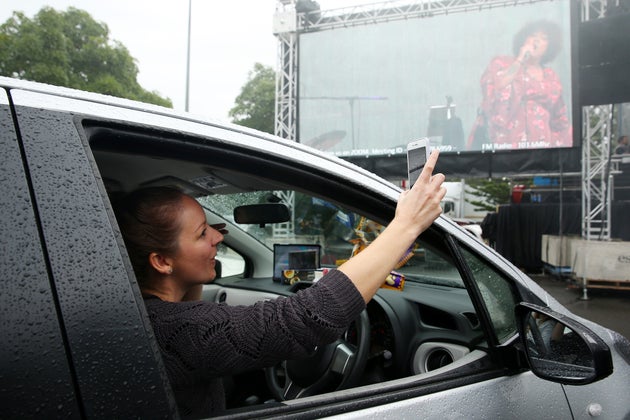
Don Arnold via Getty ImagesSYDNEY, AUSTRALIA – MAY 21: A man in a car takes a selfie as Casey Donovan performs on stage during a media call to showcase how a drive-in live entertainment venue will operate ahead of its opening in July in the suburb of Tempe on May 21, 2020 in Sydney, Australia. From July visitors will be able to drive to the venue and enjoy music and performances from the safety of their vehicles as restrictions on group sizes continues due to the COVID-19 pandemic. (Photo by Don Arnold/WireImage)
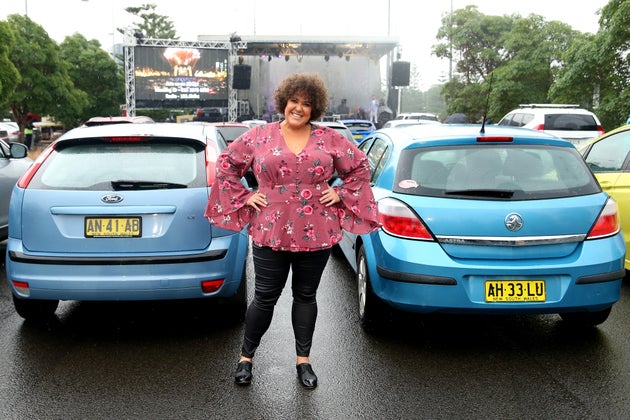
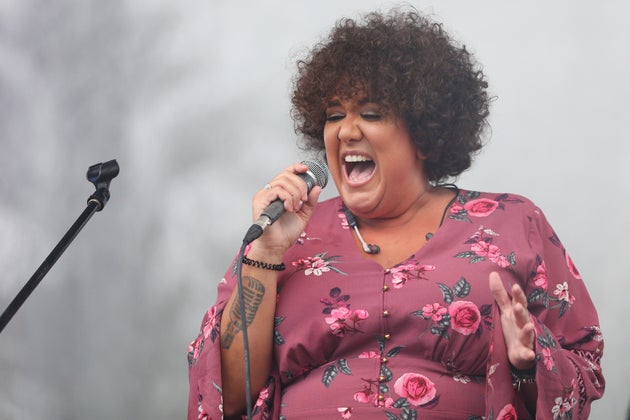
Casey Donovan performed on stage in Sydney on Thursday in a free concert that treated fans to some of the first live music many had heard in months. But they had to stay in their cars to enjoy it.
Drive-in concerts are emerging as a trend that allows performers to connect with fans in real life while maintaining safe social distancing during the coronavirus pandemic.
Donovan, who shot to fame after winning Australian Idol more than a decade ago, headlined the performance in a car park to about 40 vehicles.
“I’ve been missing live music so much that I’ll go and see it in a car park, in my car just so I can see live music in front of me. It’s good,†said audience member Mick Radojkovic.
To ensure physical distancing, audience members were not allowed to leave their cars but could tune into an FM band on their radios to get full high-definition sound, or simply wind down their windows despite the rain.
Instead of clapping or cheering, fans blared their car horns.
Drive-in Entertainment Australia plans to have several more car park concerts in coming months with many more people being able to attend as COVID-19 restrictions are eased further.
Musicians around the world have had to adapt how they engage with their audiences due to mass closures of concert venues, with many performing online from their homes in virtual concerts.
Concert venues are expected to be among the last to reopen because of the challenges of social distancing.
Country music star Keith Urban performed a surprise live show at a drive-in movie theatre in Nashville, in a test drive for how concerts might look in the era of social distancing.
It was thought to be the first major live music show of its kind in the United States, following the cancellation of hundreds of concerts and tours and the closure of large venues in March because of the coronavirus epidemic.
Don Arnold via Getty ImagesSYDNEY, AUSTRALIA – MAY 21: Casey Donovan poses during a media call to showcase how a drive-in live entertainment venue will operate ahead of its opening in July in the suburb of Tempe on May 21, 2020 in Sydney, Australia. From July visitors will be able to drive to the venue and enjoy music and performances from the safety of their vehicles as restrictions on group sizes continues due to the COVID-19 pandemic. (Photo by Don Arnold/WireImage)
Don Arnold via Getty ImagesSYDNEY, AUSTRALIA – MAY 21: Casey Donovan performs on stage during a media call to showcase how a drive-in live entertainment venue will operate ahead of its opening in July in the suburb of Tempe on May 21, 2020 in Sydney, Australia. From July visitors will be able to drive to the venue and enjoy music and performances from the safety of their vehicles as restrictions on group sizes continues due to the COVID-19 pandemic. (Photo by Don Arnold/WireImage)
Don Arnold via Getty ImagesSYDNEY, AUSTRALIA – MAY 21: Casey Donovan performs on stage during a media call to showcase how a drive-in live entertainment venue will operate ahead of its opening in July in the suburb of Tempe on May 21, 2020 in Sydney, Australia. From July visitors will be able to drive to the venue and enjoy music and performances from the safety of their vehicles as restrictions on group sizes continues due to the COVID-19 pandemic. (Photo by Don Arnold/WireImage)
Don Arnold via Getty ImagesSYDNEY, AUSTRALIA – MAY 21: A girl in a car takes a selfie as Casey Donovan performs on stage during a media call to showcase how a drive-in live entertainment venue will operate ahead of its opening in July in the suburb of Tempe on May 21, 2020 in Sydney, Australia. From July visitors will be able to drive to the venue and enjoy music and performances from the safety of their vehicles as restrictions on group sizes continues due to the COVID-19 pandemic. (Photo by Don Arnold/WireImage)
Don Arnold via Getty ImagesSYDNEY, AUSTRALIA – MAY 21: Casey Donovan performs on stage during a media call to showcase how a drive-in live entertainment venue will operate ahead of its opening in July in the suburb of Tempe on May 21, 2020 in Sydney, Australia. From July visitors will be able to drive to the venue and enjoy music and performances from the safety of their vehicles as restrictions on group sizes continues due to the COVID-19 pandemic. (Photo by Don Arnold/WireImage)
Cameron Spencer via Getty ImagesSYDNEY, AUSTRALIA – MAY 21: People are guided into position in their vehicles to watch Casey Donovan perform during a media call to showcase how a drive-in live entertainment venue will operate ahead of its opening in July in the suburb of Tempe on May 21, 2020 in Sydney, Australia. From July visitors will be able to drive to the venue and enjoy music and performances from the safety of their vehicles as restrictions on group sizes continues due to the COVID-19 pandemic. (Photo by Cameron Spencer/Getty Images)
Reporting by Jill Gralow and Cordelia Hsu; Editing by Giles Elgood.
In February, when I spoke with registered dietitian Christy Harrison about her recently released “Anti-Diet†book, I didn’t realize that the world was about to change so drastically.
We talked about the pervasiveness of diet culture ― the belief system that champions the thin (usually white, cisgender) ideal, that says certain ways of eating are good and others are bad, and that encourages weight loss at all costs. It’s in marketing, health care, our own views of ourselves. Although things look very different these days, all of that is still true.
Diet culture is even more prevalent in the midst of the coronavirus pandemic. Wellness brands are preying on our fears and uncertainty by offering supplements. More time to scroll through social media and all of the perfectly chosen images leaves us feeling more insecure about our own bodies.
In “Anti-Diet,†Harrison chronicles the history of diet culture, uses evidence to point out the flaws in our strongly held beliefs about weight, and gives some insight into how to finally stop judging ourselves and others for the shape of our bodies and the food we eat.
And there’s no better time to heed those lessons than right now, when the pressure to “watch what we eat†is through the roof (despite the fact that we’re battling a global health crisis totally unrelated to food).
Below, Harrison breaks down some ugly truths about dieting and advice on how you can ditch the horrible cycle for good. Because, yes, it’s possible to ditch diet culture and feel good in your own body.
If you couldn’t lose weight on a diet, it isn’t your fault ― there’s tons of evidence that long-term weight loss just doesn’t happen for most people.
The idea that diets don’t work is nothing new. In “Anti-Diet,†Harrison traces the belief that 95% of diets fail back to a 1959 literature review that looked at past weight loss studies. The review found that, basically, no diet or intervention proved consistently effective for weight loss.
And this still holds true: A 2013 review of several weight-loss studies found that diets do typically lead to short-term weight loss, but that most people regain the weight within five years. A similar 2011 review found that many dieters actually regain more weight than they initially lost.
“In any other case, we would be so quick to say, ‘This thing didn’t work for me, this product is the problem.’ But with diets, we think, ‘I’m the problem.’â€
– Christy Harrison, author of “Anti-Dietâ€
Harrison described this initial weight loss that diets bring as the honeymoon phase.
“I think often when it’s a person’s first diet ever, there’s a honeymoon phase of dieting where you do see weight loss ― although not everyone does ― and you feel like you’ll be able to stick to it because there are no complications,†she told HuffPost. “There’s the feeling of, ‘It’s working! It’s happening!’â€
But none of that lasts. “The body gets wise and starts to feel the effects of starvation,†Harrison said. “On average, people will lose weight for about six months to a year, and then at the year mark they start regaining the weight, and the rate of weight regain speeds up over time.â€
A lot of people aren’t even able to make it to this six-month mark, she said, “because the starvation response really kicks in and pushes people to start eating more than they were before the diet, which oftentimes leads to binging.â€
In other words: The obsession and out-of-control feeling around food that often happens several months into a diet isn’t a personal failing, it’s a biological response.
Because we live in diet culture, people think the solution to one failed diet is to find another, “better†diet.
Habitually jumping from one restrictive eating plan to another is so commonplace that we have a name for it: yo-yo dieting.
But, as any past or current yo-yo dieters know, even very different diets tend to lead to the same result: initial weight loss, eventual weight regain.
“It’s ridiculous,†Harrison said. “In any other case, we would be so quick to say, ‘This thing didn’t work for me, this product is the problem.’ But with diets, we think, ‘I’m the problem. Maybe this one isn’t for me, maybe I’m not meant to be an intermittent faster, maybe I’ll be a keto or Whole30 person instead.’ So we see people jumping from diet to diet to diet.â€
AndreyPopov via Getty Images
“Oftentimes people who have lived in diet culture their whole lives have this accumulation of rules,†said Christy Harrison. Question why you still hold up these rules from diets that didn’t serve you, then work on ignoring them.Â
Weight cycling and weight stigma are bad for our physical and mental health.
Although plenty of people diet for aesthetic reasons, health is also a motivator. Those who live in larger bodies are often told by their doctors (and, sometimes, their friends and family) to diet and lose weight to improve their health outcomes. But that advice often leads to more harm than good.
“No matter what weight a person is at, even controlling for BMI, weight cycling is an independent risk factor for all these things that get blamed on weight itself: heart disease, diabetes, some forms of cancer, and mortality,†Harrison said. “When we diet, we’re almost inevitably going to end up weight cycling. That’s going to put our bodies at greater risk than just saying the same weight, even if that’s a higher weight.â€
The anti-diet movement isn’t just about not dieting, it’s about understanding that bodies can be healthy at any size.
The idea that more weight is an inherently bad thing is flawed. Many people at higher weights are metabolically healthy, Harrison said. (And, of course, it’s possible to be metabolically unhealthy at a lower weight.) A 2015 study of over 100,000 people in Denmark found that those in the “overweight†category lived the longest, on average ― a conclusion that’s consistent with past findings.
In response to this evidence, the Health at Every Size movement encourages people to “accept and respect the inherent diversity of body shapes and sizes and reject the idealizing or pathologizing of specific weights.†It also aims to end weight stigma and discrimination and to make the world more accessible to all people, no matter their weight.
It’s important to understand all of this if you want to truly reject diet culture, give up dieting and become a more intuitive eater, Harrison said. Intuitive or mindful eating encourages you to focus on your hunger and fullness cues, pushes you to slow down and enjoy meals, and doesn’t vilify any foods. It’s not a diet program; it’s a lifestyle habit.
It can be much harder for someone in a larger body to reject diets and diet culture because of the discrimination they face.
Throughout the book, Harrison acknowledges her privilege as a thin, white, cisgender woman. When you live in a body that society deems “acceptable,†quitting dieting is easier than it might be for someone who lives in a more marginalized body.
“People in much larger bodies do face discrimination every single day, and it’s natural to want to lose weight as a way to escape that,†said Kimmie Singh, an anti-diet dietitian and fat body liberation activist.
“If you’re someone in a smaller body who’s working toward body acceptance and becoming a more intuitive eater, make sure you also work on accepting all bodies and body sizes to help all people feel safe stepping away from dieting.â€
Singh gives her clients background and evidence about why diets don’t work and encourages them not to pursue weight loss, but ultimately leaves the choice up to them. If you’re someone in a smaller body who’s working toward body acceptance and becoming a more intuitive eater, make sure you also work on accepting all bodies and body sizes to help all people feel safe stepping away from dieting.
A life without dieting might be hard to imagine, but it’s possible. Here’s how to do it.
The first obstacle in quitting diets for good is that these days, so many of them claim not to be diets at all.
“Diets have morphed and shape-shifted into this wellness thing that’s now so much harder to detect,†Harrison said. “The ‘wellness diet’ is about demonizing some foods while elevating others; eating the supposedly ‘right’ things and removing the supposedly ‘wrong’ things. It promises health and moral superiority, but it almost always promises thinness, as well.â€
Harrison recommends rejecting any diet or “wellness†lifestyle that comes with rules ― eat this not that, eat X amount, only eat between the hours of Y and Z. Even once you do this, you might find that you have a lot of old food rules swimming around in your head.
As an early step in the journey to rejecting diet culture and becoming a more intuitive eater, Harrison encourages clients to write down any food rules or thoughts that pop into their heads during the day.
“It’s fascinating to see. Usually there are dozens of these thoughts throughout the day,†she said. “You realize, ‘Anytime I start to think about food, these rules or these judgments pop up.’ Just becoming aware is the first step.â€
Then, you can start to question any rules you might have.
“Oftentimes people who have lived in diet culture their whole lives have this accumulation of rules,†Harrison said. “They can even be from completely contradictory diets ― like demonizing fat and demonizing carbs.â€
Question why you still hold up these rules from diets that didn’t serve you, then work on ignoring them.
Don’t be surprised if eating without food rules or judgment feels a little out of control at first.
“Your brain and body have been so deprived that there’s going to be this pendulum swing back from the side of restriction to the side of eating all the food,†Harrison said. “I call it the restriction pendulum.â€
But this doesn’t last forever. “Eventually you really will be able to settle in the middle, and get to a place of peace and balance with food,†she said.
The reward goes far beyond just a better relationship with food and body. “It’s amazing to see what happens for people when they’re eating intuitively,†Harrison added.
At first, learning to be an intuitive eater takes some effort. But once you click into it and aren’t constantly obsessing about what you can and can’t eat, you get so much brain space back.
“You’re not thinking about exercise, or your weight,†she said. “You’re thinking about all the other things you really care about. You’re free to do your work, engage in your relationships, and be really present in all the big and small moments of your life. There’s so much more available to people once they stop dieting.â€
It often feels like time has lost all meaning in this new at-home reality amid the COVID-19 pandemic. So instead of counting days and weeks, many are tracking their quarantine journeys in terms of stages.
Or at least they’re joking about doing so on Twitter. We’ve rounded up 40 funny tweets that sum up the various stages of quarantine ― from the experimental haircut phase to the watching Christmas movies phase.
We use cookies on our website to give you the most relevant experience by remembering your preferences and repeat visits. By clicking “Accept”, you consent to the use of ALL the cookies.
This website uses cookies to improve your experience while you navigate through the website. Out of these, the cookies that are categorized as necessary are stored on your browser as they are essential for the working of basic functionalities of the website. We also use third-party cookies that help us analyze and understand how you use this website. These cookies will be stored in your browser only with your consent. You also have the option to opt-out of these cookies. But opting out of some of these cookies may affect your browsing experience.
Necessary cookies are absolutely essential for the website to function properly. These cookies ensure basic functionalities and security features of the website, anonymously.
Cookie
Duration
Description
cookielawinfo-checbox-analytics
11 months
This cookie is set by GDPR Cookie Consent plugin. The cookie is used to store the user consent for the cookies in the category "Analytics".
cookielawinfo-checbox-functional
11 months
The cookie is set by GDPR cookie consent to record the user consent for the cookies in the category "Functional".
cookielawinfo-checbox-others
11 months
This cookie is set by GDPR Cookie Consent plugin. The cookie is used to store the user consent for the cookies in the category "Other.
cookielawinfo-checkbox-necessary
11 months
This cookie is set by GDPR Cookie Consent plugin. The cookies is used to store the user consent for the cookies in the category "Necessary".
cookielawinfo-checkbox-performance
11 months
This cookie is set by GDPR Cookie Consent plugin. The cookie is used to store the user consent for the cookies in the category "Performance".
viewed_cookie_policy
11 months
The cookie is set by the GDPR Cookie Consent plugin and is used to store whether or not user has consented to the use of cookies. It does not store any personal data.
Functional cookies help to perform certain functionalities like sharing the content of the website on social media platforms, collect feedbacks, and other third-party features.
Performance cookies are used to understand and analyze the key performance indexes of the website which helps in delivering a better user experience for the visitors.
Analytical cookies are used to understand how visitors interact with the website. These cookies help provide information on metrics the number of visitors, bounce rate, traffic source, etc.
Advertisement cookies are used to provide visitors with relevant ads and marketing campaigns. These cookies track visitors across websites and collect information to provide customized ads.