Sunday, April 26, 2026

A world without hugs is a world that makes no sense | Zoe Williams

I had had enough of remote socialising by the time lockdown was slightly eased. I was happy to just abjure other people, get all my extramarital fellowship needs from the memory of the kind of thing they said. Suddenly, in England we were allowed to see six people so long as it was outdoors. After all that time worrying about the bubble, who was in it, who was out of it, it turned out the bubble was infinite. It could be a different six people every night. The trouble is, I’ve forgotten how to do it. 

At a most basic level, I’ve forgotten how to say hello and goodbye. These things were always conveyed in hugs – excited hug, I’m glad to see you; relieved hug, I’m glad I’ve seen you. Random, in-evening hug, you mean more to me than all those other people I have to see. I can just about clear the confusion of no greeting-hug, but I don’t know how to say goodbye. The last hour of any given meeting, I just have the Communards’ Never Can Say Goodbye going round my head and my hands shoved prophylactically in my pockets. 

People have different levels of risk aversion, of compliance, and they are unguessable. They don’t map on to anything you already knew about each other – the most courageous, rebellious people I know, the people who would shoplift and bleach their pubes and go to tribunal to fight The Man, are checking the government website to see if they are allowed to use my spoon. The most diligent and rule-bound, the ones who check their step count and only drink on a Friday, are the ones asking what on earth we’re all doing outside when it’s plainly raining, and come on, it’s only a virus. But you can’t scope any of this out in advance; you just have to caper into the minefield of each other’s anxiety and wait for something to explode over an accidentally shared tea towel, wondering: is this a friendship-ending thing? Or will a year pass, and it all be forgotten? 

Finally, there is the now-familiar problem that nothing has happened – so sorry, you’re the first person I’ve seen, I’ve no one to bitch about. I’ll be using you for my next set of anecdotes, so this had better be good. 

That’s it. Like I say, I’ve forgotten how to say goodbye. 

Source link

Some GOP Heavyweights Won’t Vote To Reelect Trump: Report

Republican Voters Against Trump is lashing out against what’s filling the president’s time during the COVID-19 pandemic and nationwide anti-racist protests: “Hiding in a security bunker. Watching his shows. Afraid. Alone. Not a leader, not a president,” says the group’s new ad.

“It’s time for a competent president,” the spot concludes. “Let’s elect one.”

In a strange election year twist, it’s Republicans who oppose President Donald Trump who are regularly releasing new ads on social media. Republican Voters Against Trump and The Lincoln Project, co-founded by lawyer George Conway, husband of White House counselor Kellyanne Conway, are putting out anti-Trump videos, like the latest one above, that often go viral.

But it’s not just organized Republican groups that aren’t going to vote to keep their party in the White House. Some heavy hitters will likely also sit this one out. 

The New York Times reported Saturday that former President George W. Bush won’t endorse — or vote for — Trump, though it’s not clear whether he’ll vote for Democrat Joe Biden, sources say.

In response to the report, a senior Bush aide told NBC News that the former president hasn’t indicated how he will vote.

Bush’s brother Jeb Bush, the former governor of Florida, isn’t yet sure how he’ll vote, according to the Times.

Sen. Mitt Romney (R-Utah) won’t vote for Trump, and may write in his wife Ann’s name. Cindy McCain, widow of the late Sen. John McCain (R-Ariz.), will likely vote for Biden, the Times reported.

None of them voted for Trump last time, but since he is the incumbent, the calculations are different this time.

Rep. Francis Rooney (R-Fla.), who served as Bush’s ambassador to the Vatican, told the Times that he is considering voting for the likely Democratic nominee, Joe Biden, because Trump is “driving us all crazy.”


Source link

Jack Grealish: Manchester United interest will depend on Aston Villa’s survival, say Sunday Supplement panel

0

“If Villa do stay up, do Manchester United have the stomach to spend £80m on Grealish?” asks Matt Law on Sunday Supplement

Last Updated: 07/06/20 2:01pm


Jack Grealish has been Aston Villa’s stand-out on their Premier League return

Manchester United’s interest in Jack Grealish will hinge on whether Aston Villa are relegated this season, say the Sunday Supplement panel.

A report in the Sunday People claims United have made Grealish their top target this summer, replacing Jadon Sancho on their transfer wishlist.

Grealish has long been linked with a move to Old Trafford, but with a fee of £80m touted for the midfielder, Steve Bates – who wrote the Sunday People article – told the Supplement he didn’t expect United to be spending so much in the midst of the coronavirus crisis, and that they would not need to if Villa are relegated.

“Grealish has been a player on their radar for quite some time, I’m not sure United would be spending anything like £80m on Jack Grealish, but particularly if Villa end up going down, in this current market, I don’t think United would be valuing him at anything like £80m for a player who hasn’t played for England or had sustained exposure in the Premier League,” said Bates.

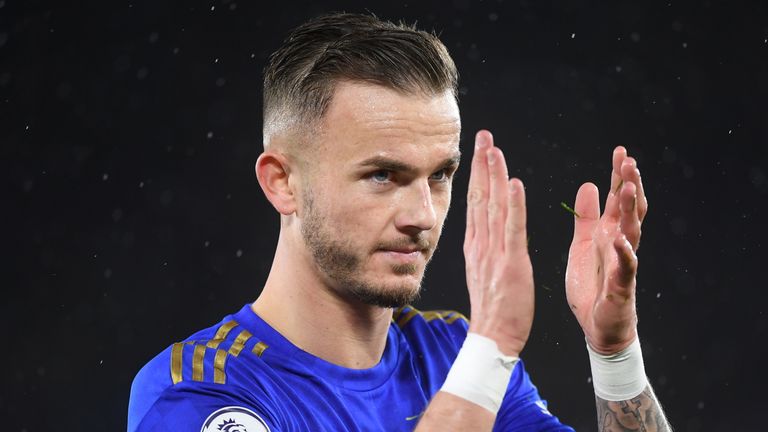
“He’s certainly a player they’re looking at. They were looking at James Maddison, but now it looks like he’s signing a new contract. If (Paul) Pogba commits himself to United, there’s less need to rush into the transfer market for a player like Grealish, they’ve just bought Bruno Fernandes who is, again, an attacking midfield player, but I think a lot comes down to the Jadon Sancho situation.

“United still like him, we saw what a top star he is on Saturday in the Bundesliga and he’s probably ahead of Grealish in his development into a player to fit United’s DNA.”

Manchester United had an interest in signing James Maddison  in January

Manchester United had an interest in signing James Maddison in January

That was a viewpoint shared by Matt Law, football correspondent at the Daily Telegraph, who said Villa would be under no obligation to sell their most prized asset, and captain, should they survive.

“Villa’s Premier League safety will be key to the Grealish situation,” said Law. “If they go down, I think everybody expects them to have to sell him, and not at the money they’d want to.

“But if they stay up, they have incredibly wealthy owners and if they go down, they’d only have to sell Grealish from an FFP standpoint. Their owners are the fourth or fifth wealthiest in the Premier League. There’s no financial pressure on them to sell him, and if they do stay up, do Manchester United have the stomach to spend £80m on Grealish?”

Super 6: Bayern to sail past Gladbach?

Do not miss your chance to land the £50,000 jackpot on Saturday. Play for free, entries by 2:30pm.


Source link

NDA will get two-third majority in Bihar under Nitish’s leadership: Shah

0


Setting the tone for Bihar assembly polls, Union Home Minister on Sunday said the state moved from “jungle raj to janta raj” during the rule and expressed confidence that the alliance will get a two-third majority in the state assembly polls under the leadership of


Addressing the party workers and people of Bihar through a virtual rally, he attacked the opposition saying the growth rate of the state was just 3.9 per cent when the party was in power, but it rose to 11.3 per cent under the


The state moved from ‘lalten raj’ to ‘LED raj’, he said referring to the RJD’s poll symbol of lamp.


At the same time, the former BJP president asserted that this rally had nothing to do with Bihar poll campaign and was aimed at connecting with people during the fight against (Covid-19).


“This rally is aimed at connecting people with ‘Aatmanirbhar Bharat’ campaign. The BJP will have 75 such meetings,” he said.


Shah applauded both Bihar Chief Minister and Deputy Chief Minister Sushil Modi, saying they were working for the people though they might lack in publicising it.


He said during the rule of JD(U)-BJP alliance Bihar came out of ‘Jungle Raj’ to ‘Janta ka Raj’ Taking a dig at the which protested against his virtual rally by beating utensils, Shah asked if anyone had stopped them from holding a rally, and added they were relaxing in Delhi.


He said though the opposition leaders dismissed Prime Minister Narendra Modi’s efforts to unite the country in the fight against Covid-19 as political propaganda, but the nation stood with him and followed his appeals.


The central government safely ferried 1.25 crore migrants to their respective destinations after the required health infrastructure was ramped up to meet their needs, he said.


Talking about achievements of Modi government, he said issues which none dared to touch in 70 years were resolved in the first year of the Modi government’s in 2nd term and referred to the scrapping of Article 370 provisions and the law against triple talaq.


Citing various steps for the welfare of the poor and the needy taken by Modi government amidst the fight against the pandemic, Shan asked what the opposition did for them besides doing


Source link

Big surge in demand for Isolated Cars from ride-hailing company

Ride-hailing app Bolt is adding 4 000 more ‘Isolated Cars’ to its South African fleet due to heavy demand from workers who don’t want to use traditional public transport during the pandemic.

The company, formerly known as Taxify, is a European-based ride-hailing app similar to Uber.

The Bolt Isolated Car was launched in Johannesburg during March 2020, with an initial 500 vehicles. The 4 000 new cars have been added to the local fleet from June in response to a surge in demand.

Public transport a poor option for health workers

This increase is due to healthcare and essential services workers, and their employers, choosing to use specialist ride-hailing vehicles rather than public transport.

“Vehicles have a protective barrier installed between the front and back seats, providing a physical shield between the driver and their passenger,” said Gareth Taylor, country manager for Bolt in South Africa. “This limits the airflow between the drivers and riders inside the cars.”

The company said in a statement that it provides free sanitisation liquid refills at all its driver centres each day in an effort to ensure that drivers comply with sanitisation protocols. It is also mandatory for drivers and passengers to wear face masks.

Passengers must sanitise their hands on entering the vehicle and drivers are required to ventilate and sanitise the car between every trip.

Service expands to Cape Town and now Durban

After launching the Isolated Car concept in Johannesburg, Bolt then expanded it to Cape Town. Durban has now also been added to the list and Taylor says it the city with the highest demand for Isolated Cars.

“We anticipate that Bolt Isolated Cars are likely to be even more popular under Level 3 as COVID-19 lockdown conditions relax and more South Africans are able to return to work – many of them concerned about using public transport due to social distancing fears,” he observed.


Source link

How dangerous will that first Belgian beer be?

0

Belgium is entering phase three of its five-part exit strategy | Nicolas Maeterlinck/AFP via Getty Images

It’s been almost three months since Belgians could meet up with friends and go to a bar for a beer (or three). But from Monday they can do just that after the government moved to the next phase of easing coronavirus lockdown restrictions.

But just how dangerous is it to go out again?

Belgium is entering phase three of its five-part exit strategy, expanding the number of people you can meet up with from four per household to 10 “close” contacts per person, per week. Restaurants, bars and gyms can reopen under strict conditions (in restaurants, diners will have to maintain a distance of 1.5 meters between tables, while bars will have to close at 1 a.m.) and trips within the country can be taken ahead of the reopening of Belgium’s borders on June 15.

That’s thanks to an improvement in the country’s health situation that took even the government by surprise, according to Prime Minister Sophie Wilmès. On Friday, the virus’ reproduction rate had slowed to 0.81 (meaning that each infected person would pass on the virus to 0.81 others on average) and there are fewer than 700 people being treated for COVID-19 in Belgian hospitals, down from nearly 6,000 in mid-April.

A new study from the University of Antwerp found that only 6.9 percent of Belgians have produced antibodies against the virus.

But virologists warn that progress could be short-lived.

“We can say that we’ve put out the first major fire, but the wood is still smoldering,” Steven Van Gucht, who chairs the government’s scientific committee on coronavirus, warned during a daily update Friday. “One mistaken gust of wind, and the fire could flare up to its full strength.”

Given the number of new cases per day, now is the right time for further relaxation of the lockdown, Kevin Ariën, professor of virology at the Institute of Tropical Medicine Antwerp, told POLITICO. But with the government taking one of its biggest steps yet, he warned that daily monitoring will be needed to see whether there is an uptick in cases.

“We know from other countries that this can translate into new cases,” he said, pointing to China, Singapore and South Korea, where cases of the virus increased after lockdowns were lifted.

Test, trace, repeat

A new study from the University of Antwerp, out Friday, that tested blood samples from around the country to establish immunity levels found that only 6.9 percent of Belgians have produced antibodies against the virus. That means herd immunity is still “miles away,” but it also signals that lockdown restrictions successfully stunted the population’s exposure to the virus, the researchers concluded.

As Belgium inches toward freedom, keeping track of the virus’ circulation will become more important: The idea behind the 10-person meeting threshold is to allow more social interaction while still making it possible to trace who people have come into contact with.

The new freedoms also come with new responsibilities for citizens and businesses in terms of hygiene and social distancing restrictions, as well as carefully keeping track of contacts, the government has warned.

If Belgian’s new freedoms lead to an uptick in cases, Ariën said that the first reaction should be to reduce the number of close contacts. Similarly, if the reopening of bars and restaurants affects the figures, the government will need to close them down, he said.

But lawmakers are determined to prevent a second lockdown. “The lockdown as we knew it was exceptional. Therefore it had an exceptional impact on civil liberties,” said Green MP Gilles Vanden Burre. But he added that in the event of an upsurge in cases, the plan shouldn’t be to go back to lockdown; it should be to test, isolate and maybe revive some restrictions.

That strategy relies on authorities’ ability to detect and isolate new cases fast.

When the virus first surfaced in Belgium, the government didn’t have the testing and tracing capacity to offer an alternative to a full-blown lockdown, but it has since massively ramped up testing.

Tracing could prove trickier: Belgium’s regions last month rushed to cobble together coronavirus-tracing teams, charged with tracking down people who’ve been in touch with newly discovered coronavirus patients.

The teams have had a slow start thanks to the slowdown of the virus; so much so that the Flanders region is already moving to scale down its contact-tracing capacity. But the Brussels committee in charge of tracing warned Friday that most coronavirus patients are only reporting two contacts. That’s “insufficient to break the chain of transmission of the virus, and ward off the risk of a second wave,” it cautioned.

One of the complications with the tracing system is Belgians not wanting to share their contacts. “We’re just not used to being traced by the government,” said Ariën.

A tracing app is not yet on the market, as its legal framework still needs to be approved by Belgium’s many parliaments. And any app would be “merely complementary to the manual tracing system,” said Vanden Burre, as its use would remain voluntary and, as with other countries, those most at risk — the elderly — are least likely to embrace the technology necessary to report infections.

No turning back

For Ariën though, it’s not if there will be a second coronavirus wave, but when.

If that requires a return to lockdown, he predicts it would be a hard sell for citizens. “To impose this a second time later this year, or whenever the second wave hits us, that’s going to be much more difficult,” he said. “I think here will be less willingness and cooperation.”

Politicians, businesses and medical experts have spoken out against a new lockdown. “A second lockdown is something we can’t take anymore. It’s not only not desirable, it’s also no longer possible from an organizational point of view,” Interior Minister Pieter De Crem said in late May, noting that there would be no turning back once Belgium opens its borders — which is planned for June 15.

Erika Vlieghe, chairwoman of the government’s expert group on deconfinement, said she would rather have kept the borders closed “for another month” | Arthur Gekiere/AFP via Getty Images

Erika Vlieghe, who chairs the government’s expert group on the exit strategy, told the broadcaster VRT she would rather have kept the borders closed “for another month” than risk problems with opening up too soon.

The government’s weekly announcements lifting lockdown measures have also been a point of contention, with scientists arguing that it takes longer than a week to get accurate data about the effects.

“For now it’s turned out OK,” said Ariën. But he isn’t sure what the latest measures will mean for the virus in Belgium. “We’ll have to see in two to three weeks how that translates in the numbers.”

This article is part of POLITICO’s premium policy service: Pro Health Care. From drug pricing, EMA, vaccines, pharma and more, our specialized journalists keep you on top of the topics driving the health care policy agenda. Email pro@politico.eu for a complimentary trial.


Source by [author_name]

As China Touts Its Virus Triumphs, Its Mistakes Are Ignored

0

BEIJING — Under continued fire for its early mishandling of the coronavirus, the Chinese government vigorously defended its actions in a new, detailed account on Sunday that portrays the country’s approach to combating the outbreak as a model for the world.

Calling the epidemic a “test of fire,” Beijing builds a comprehensive picture of its “painstaking efforts” to identify the virus, stop its spread and warn other countries — a narrative that discounts and ignores missteps by the government at the outset of the outbreak.

In the report, local and provincial officials are described as acting decisively. The World Health Organization is said to have been kept informed in detail starting from Jan. 3, while Chinese scientists quickly released the genome sequence. China’s top leader, Xi Jinping, is described as playing a pivotal role throughout the crisis.

“Confronted by this virus, the Chinese people have joined together as one and united their efforts,” the report said. “They have succeeded in containing the spread of the virus. In this battle, China will always stand together with other countries.”

Like much of China’s state propaganda on the coronavirus, the report provides a sanitized version of events, leaving out political and bureaucratic problems that exacerbated the crisis when it first emerged in the central Chinese city of Wuhan.

There is no mention of the doctor who was reprimanded by the police for raising an early alarm about the virus or the young Chinese bloggers who were taking into custody after creating videos of the suffering in Wuhan. There is no discussion of local officials’ delays in reporting cases and underplaying the outbreak, or their subsequent firing.

The report offers no new information on the origins of the virus. In a news conference on Sunday, a top Chinese official dismissed accusations about Beijing’s conduct as “completely unwarranted and unreasonable,” an apparent reference to numerous accusations by the Trump administration that China is to blame for the pandemic.

China has much at stake in global perceptions of its actions. Whether China is pilloried or praised could have a big effect on Beijing’s world standing in the months and years ahead and its ability to continue playing an ever more assertive role in international organizations and in geopolitical affairs.

The Chinese government put its full propaganda muscle behind the report. Three ministers, two vice ministers and the president of the Chinese Academy of Medical Sciences held a joint news conference to release it on Sunday morning at the State Council Information Office, an elite propaganda agency.

Xu Lin, the minister who oversees the office, characterized China’s handling of the disease in heroic terms. “China’s fight against Covid-19 is extraordinary and should be remembered forever,” he said.

As the United States and other countries struggle to bring their outbreaks under control, China has largely returned to normal life. Its last remaining high-risk area, a district in the northeastern city of Jilin, lowered its epidemic response level on Sunday. The city of Beijing gave permission on Friday for people to stop wearing masks when outdoors and well separated.

The government reported six new cases across the country on Sunday. Five originated abroad, and one was said to have been transmitted locally in the southern island province of Hainan.

Since the outbreak began, the Chinese mainland has recorded more than 89,000 cases and more than 4,600 deaths. By contrast, the United States has confirmed almost two million cases and nearly 110,000 deaths.

Ma Zhaoxu, vice minister of foreign affairs, complained bitterly about foreign criticisms of China’s handling of the coronavirus. Critics “went all out to smear and slander China — this is spreading a political virus, and in responding to such politicized practices, China, of course, will push back resolutely,” he said.

As evidence of China’s transparency, Mr. Xu said that 480 journalists from state news media had risked infection by reporting from the epicenter of the outbreak in Wuhan and the rest of Hubei Province. In his only hint that China may have had any difficulties in handling the epidemic, he said, “They have also uncovered some issues and pressed for their solution.”

  • Updated June 5, 2020

    • How many people have lost their jobs due to coronavirus in the U.S.?

      The unemployment rate fell to 13.3 percent in May, the Labor Department said on June 5, an unexpected improvement in the nation’s job market as hiring rebounded faster than economists expected. Economists had forecast the unemployment rate to increase to as much as 20 percent, after it hit 14.7 percent in April, which was the highest since the government began keeping official statistics after World War II. But the unemployment rate dipped instead, with employers adding 2.5 million jobs, after more than 20 million jobs were lost in April.

    • Will protests set off a second viral wave of coronavirus?

      Mass protests against police brutality that have brought thousands of people onto the streets in cities across America are raising the specter of new coronavirus outbreaks, prompting political leaders, physicians and public health experts to warn that the crowds could cause a surge in cases. While many political leaders affirmed the right of protesters to express themselves, they urged the demonstrators to wear face masks and maintain social distancing, both to protect themselves and to prevent further community spread of the virus. Some infectious disease experts were reassured by the fact that the protests were held outdoors, saying the open air settings could mitigate the risk of transmission.

    • How do we start exercising again without hurting ourselves after months of lockdown?

      Exercise researchers and physicians have some blunt advice for those of us aiming to return to regular exercise now: Start slowly and then rev up your workouts, also slowly. American adults tended to be about 12 percent less active after the stay-at-home mandates began in March than they were in January. But there are steps you can take to ease your way back into regular exercise safely. First, “start at no more than 50 percent of the exercise you were doing before Covid,” says Dr. Monica Rho, the chief of musculoskeletal medicine at the Shirley Ryan AbilityLab in Chicago. Thread in some preparatory squats, too, she advises. “When you haven’t been exercising, you lose muscle mass.” Expect some muscle twinges after these preliminary, post-lockdown sessions, especially a day or two later. But sudden or increasing pain during exercise is a clarion call to stop and return home.

    • My state is reopening. Is it safe to go out?

      States are reopening bit by bit. This means that more public spaces are available for use and more and more businesses are being allowed to open again. The federal government is largely leaving the decision up to states, and some state leaders are leaving the decision up to local authorities. Even if you aren’t being told to stay at home, it’s still a good idea to limit trips outside and your interaction with other people.

    • What’s the risk of catching coronavirus from a surface?

      Touching contaminated objects and then infecting ourselves with the germs is not typically how the virus spreads. But it can happen. A number of studies of flu, rhinovirus, coronavirus and other microbes have shown that respiratory illnesses, including the new coronavirus, can spread by touching contaminated surfaces, particularly in places like day care centers, offices and hospitals. But a long chain of events has to happen for the disease to spread that way. The best way to protect yourself from coronavirus — whether it’s surface transmission or close human contact — is still social distancing, washing your hands, not touching your face and wearing masks.

    • What are the symptoms of coronavirus?

      Common symptoms include fever, a dry cough, fatigue and difficulty breathing or shortness of breath. Some of these symptoms overlap with those of the flu, making detection difficult, but runny noses and stuffy sinuses are less common. The C.D.C. has also added chills, muscle pain, sore throat, headache and a new loss of the sense of taste or smell as symptoms to look out for. Most people fall ill five to seven days after exposure, but symptoms may appear in as few as two days or as many as 14 days.

    • How can I protect myself while flying?

      If air travel is unavoidable, there are some steps you can take to protect yourself. Most important: Wash your hands often, and stop touching your face. If possible, choose a window seat. A study from Emory University found that during flu season, the safest place to sit on a plane is by a window, as people sitting in window seats had less contact with potentially sick people. Disinfect hard surfaces. When you get to your seat and your hands are clean, use disinfecting wipes to clean the hard surfaces at your seat like the head and arm rest, the seatbelt buckle, the remote, screen, seat back pocket and the tray table. If the seat is hard and nonporous or leather or pleather, you can wipe that down, too. (Using wipes on upholstered seats could lead to a wet seat and spreading of germs rather than killing them.)

    • Should I wear a mask?

      The C.D.C. has recommended that all Americans wear cloth masks if they go out in public. This is a shift in federal guidance reflecting new concerns that the coronavirus is being spread by infected people who have no symptoms. Until now, the C.D.C., like the W.H.O., has advised that ordinary people don’t need to wear masks unless they are sick and coughing. Part of the reason was to preserve medical-grade masks for health care workers who desperately need them at a time when they are in continuously short supply. Masks don’t replace hand washing and social distancing.

    • What should I do if I feel sick?

      If you’ve been exposed to the coronavirus or think you have, and have a fever or symptoms like a cough or difficulty breathing, call a doctor. They should give you advice on whether you should be tested, how to get tested, and how to seek medical treatment without potentially infecting or exposing others.


Ma Xiaowei, the minister who oversees the National Health Commission, said on Sunday that China had not covered up the epidemic. “We have not delayed in any way” the release of information, he said.

But he indicated that China was stepping up preparations to make sure that it would catch any future outbreak of disease quickly. “We shall also develop a smart early-warning system with multiple triggers,” he said. He did not explain how the existing early-warning system, put in place after the SARS crisis in late 2002 and early 2003, mostly failed during the coronavirus outbreak.

The news conference on Sunday underlined how completely Mr. Xi has consolidated his power.

China’s top leader said little publicly in the early days of the outbreak and made a state visit to neighboring Myanmar in mid-January as the virus spread swiftly through Wuhan. He sent Premier Li Keqiang, the country’s second-highest official, to Wuhan soon after that city’s lockdown began, on Jan. 23, and put him in charge of handling the government’s response.

But the new report barely mentions the premier, while Mr. Xi was praised at length. He “made key decisions at critical moments and led the Chinese people in an all-out fight,” Mr. Xu said.

Source link

Global coronavirus death toll tops 400,000 as protesters continue to defy lockdowns

The coronavirus pandemic has now claimed more than 400,000 lives, according to the latest data from Johns Hopkins University. More than a quarter of these were in the U.S., according to the NBC News’ tally.

The grisly toll was reached after tens of thousands of people around the world to defied COVID-19 lockdown restrictions to protest against the death of the death of George Floyd, a black man who died under the knee of a former Minnesota police officer last month. More protests are planned for Sunday.

Dr. Anthony Fauci, the head of the National Institutes of Allergy and Infectious Diseases warned about the dangers of such protests on Friday. He told told Washington D.C. radio station WTOP that he was “very concerned” about large crowds congregating in geographic areas where there is active infection transmission.

He added that it was the “perfect setup” for further spread of the virus.

“It’s a delicate balance, because the reasons for demonstrating are valid, and yet, the demonstration itself puts one at an additional risk,” Fauci said.

The only thing public health officials could do was to keep warning people to be careful, while urging them to wear a face mask and keep it on at all times.

Full coverage of the coronavirus outbreak

His comments were echoed by Britain’s Health Minister, Matt Hancock, on Sunday. He said the protests against Floyd’s death in the U.K. were “undoubtedly a risk” for coronavirus spread. With more than 40,000 deaths, the U.K. has suffered more deaths than any other country apart the U.S.

Hancock was speaking after anti-racism protesters briefly clashed with mounted police in central London on Saturday after thousands had gathered to protests. There were also demonstrations in France, Australia, South Korea and Japan, as well as a number of other countries around the world.

Elsewhere, fears continued to mount over the growing number of cases in Latin America, particularly Brazil, where almost 673,000 cases have been recorded and over 36,000 people have died, according to Johns Hopkins University data.

Brazil has removed months of data on its COVID-19 epidemic from public view, as President Jair Bolsonaro defended delays and changes to official record-keeping of the world’s second-largest coronavirus outbreak, Reuters reported Sunday.

Bolsonaro has repeatedly played down the dangers of the pandemic, replaced medical experts in the Health Ministry with military officials and argued against state lockdowns to fight the virus.

Download the NBC News app for full coverage of the coronavirus outbreak

Meanwhile, China released a white paper on the county’s response to COVID-19 pandemic, reiterating the official party line that Chinese officials released information about the novel virus in a timely and transparent manner.

President Donald Trump’s administration has accused China of cover-ups and lack of transparency regarding the pandemic, which originated in the city of Wuhan.

However, the 84-page white paper called accusation that China concealed epidemic information and death figures “baseless,” reiterating Beijing’s official position.

Eric Baculinao, Leou Chen and Reuters contributed.


Source link

Should images of coronavirus victims be sanitised?

The New York Times chose a startling way to mark the catastrophe COVID-19 has wreaked in the US. With the country approaching the grim milestone of 100,000 deaths, on May 24, the newspaper chose to banish articles, photographs and graphics from its front page and instead there was “just a list: a long, solemn list” of nearly 1,000 obituaries of people killed by the pandemic.

The page clearly stood out, striking and memorable in its spartan sombreness, a throwback to the days before images came to dominate how news stories were told. In another sense, it perhaps signposts a relative change in US media coverage of the crisis.

Observers have noted that during this pandemic Western media has increasingly opted to publish images of ill and dead people. Though doubtlessly distressing, the unfamiliar images pale in comparison with how tragedies such as the 2014 Ebola outbreak in West Africa were portrayed on the same pages, both in volume and in gut-wrenching detail.

Where Ebola victims were routinely pictured in starkly undignified states, uncovered, dead or dying alone on bare floors inside isolation wards, the published pictures of COVID-19 patients are for the most part more restrained, perhaps more respectful, almost always showing them covered.

And it is not that similarly graphic images of COVID-19 victims are not available. They are, but they are not being published.

Still, much like the Times front page, the new visibility of death is also emblematic of a past era. Between the Spanish Civil War, the first war to be extensively photographed for a mass audience, and the Vietnam War, perhaps the most photographed conflict, Western newspapers would routinely show bodies. However, even then, the foreign dead were treated differently.

For example, Folker Hanusch notes in his book Representing Death in the News, that in the latter conflict, when displayed, American casualties were carefully framed and filmed while Vietnamese bodies were regularly shown bleeding, wounded and dead. It is worth emphasising that this aversion to employing potentially disturbing imagery is not unique to Western journalism.

Further, as Rhonda Breit, who specialises in media law and ethics, notes in her book Professional Communication, journalists engage in “boundary work and community construction”. They help societies reinforce identity by defining who is in and who is out, and typically apply different rules depending on who is being covered.

In terms of using gory images, the unspoken rule seems to be the closer to home the incident, the less likely editors are to use them. The further the cultural, geographical and racial distance of victims, the more likely disturbing images of them are to appear.

This does raise an intriguing question. If coverage of COVID-19 were to include more gruesome imagery, how would this influence contemporary societies’ perception of the threat? Would it perhaps lead to a greater willingness to abide by the advice of epidemiologists?

These are questions worth reflecting on as countries and communities debate reopening economies and resuming a semblance of a pre-COVID existence. In an environment where many, including public officials like US President Donald Trump and his Brazilian counterpart, Jair Bolsonaro, openly defy scientific advice and risk even greater catastrophe, would covering the crisis differently make a difference?

News coverage does more than simply portray situations and events; the way stories are told can dramatically shape how both citizens and policymakers react to them. This is perhaps even more the case when it comes to graphic images.

For example, as Dr Hanusch writes, “The unprecedented media coverage, particularly through television, is still widely held responsible for turning the American public against the war.” And though some scholars do think this is, at best, an exaggeration, it is undoubtedly true that governments since have sought to restrict the imagery of war and terrorism out of fear of the effect this may have on public opinion.

A 2017 study found that showing disturbing imagery from conflicts heightened the public’s perception of risk and concluded that current journalistic codes “fail to acknowledge any potential benefits” of showing graphic violence which may include cultivating the public appetite and will for early intervention to stop atrocities. While the study focused on showing graphic images of violence, there is reason to believe that the same effect can occur with graphic images of illness.

Studies of the effect of graphic warning images on cigarette packs, for example, consistently show them to be more of a deterrent than text-based alternatives. And in 2000, an analysis of scientific literature on the effect of appeals to fear in public health campaigns concluded that “vivid language and pictures that describe the terrible consequences of a health threat increase perceptions of severity of threat”.

However, while it is arguable that publishing graphic news images showing the bodies of coronavirus victims closer to home might be effective at getting the public to listen to health authorities, that is not the sole consideration. Images are not perceived in a vacuum. And, as Thomas Wheeler notes in his book Phototruth or Photofiction, when it comes to images, seeing is not always believing. Rather, “viewers will believe in [the truth of photographs] as long as they believe it corresponds in a meaningful way to reality”.

This not only means that people are more likely to believe images that correspond to their own version of reality (think uncovered African corpses in decrepit surroundings versus American ones in more sanitary contexts) but also that images may be used to reinforce rather than challenge pre-existing stereotypes.

This is a concern highlighted by the Executive Director of the National Press Photographers Association, Akili Ramsess. She notes that, as a person of colour, she is acutely aware of the fact that the press “has always been much more open to showing death of black and brown bodies than [those of] whites”. Given that COVID-19 has disproportionately affected minority communities in the US, showing more images inevitably risks perpetuating stereotypes of it as “a black-brown” disease.

In a 2016 interview, Dr Safiya Umoja Noble also raised important ethical issues, particularly about who benefits and who suffers from the online distribution of images and videos of Black men being killed by police. She pointed out that 30 years of graphic videos going back to the brutal beating of Rodney King in 1991 had not resulted in more convictions of people who kill Black people.

However, she says, the images had translated to “a tremendous amount of media value. The 24/7 news cycle thrives on these types of videos. It pulls a lot of viewers in”. She argues that such imagery may have more of a trauma-inducing impact on Black populations rather than actually helping to shift attitudes.

There is no simple, straightforward answer to whether media should show more graphic imagery. The options are fraught with risk of causing harm, either by commission or omission. For editors having to daily make this decision, the ultimate question may very well be whether the potential downsides of showing the images outweighs the risk to society of not displaying the full horror of the epidemic. The choices they make will have implications for us all.

The views expressed in this article are the author’s own and do not necessarily reflect Al Jazeera’s editorial stance.

Source link

Hundreds Of Positive COVID-19 Cases At D.C.’s Children’s National Hospital

0

A visit to the Children’s National Hospital in the Washington, D.C. shows how doctors are trying to keep up with testing demands for children affected by COVID-19.


Source link