Friday, May 15, 2026

Hunger, violence, cramped housing: lockdown life for the poorest children

“Before Covid, my three children and I had structure. We would wake up in the morning, they would go to school and do their thing, and I would do mine. We had joy,” says Vicky (not her real name), a single parent living in one of the most disadvantaged boroughs in the country, in south London.

The capital has the highest rate of child poverty in any English region – more than 700,000 children, and 43% of children in inner London. Over the past five years, child poverty has risen in every London borough, in part because of the capital’s uniquely high housing, childcare and living costs, as well as low pay (72% of children in poverty are in working households) and the impact of £39bn cut nationally from the benefit system since 2010. Then, in March, came Covid-19 and lockdown, deepening and accelerating deprivation across the UK, increasing rates of child abuse, mental ill-health and domestic violence.

“It’s been really hard,” Vicky says. “My son is seven and autistic. His routine has been cut away and he has become so aggressive. The younger ones copy. I’m normally calm but it’s been chaos. It’s the financial impact, trying to keep everyone fed and occupied in a tiny flat. Kids crying. I’m told I’m a wonderful mum, but I was snapping and shouting. I started to buy rum every day to flood out my emotions and I’m not a drinker. I felt I’d become horrible. Without these guys, I would have had a breakdown.”

“These guys” are the small dynamic team that run the Max Roach Loughborough Community Centre (MRLCC) in Brixton, south London, led by manager Candice James. It’s relying on the Childhood Trust to help deal with the extra cost and demands of a post-Covid social-distancing world. “Without it, we won’t survive,” James says bluntly.


Candice James, manager of the Max Roach Loughborough community centre. Photograph: Antonio Olmos/The Observer

The Childhood Trust supports London charities and grassroots projects, many now at risk, by match funding. These include lunch clubs, youth centres, refuges, legal services, sports, arts, music and holiday schemes and therapy and counselling services. On Sunday, it launches Champions for Children, a week-long campaign to raise £3.5m to partner 96 London organisations to address the potentially devastating consequences of lockdown for 100,000 of the capital’s most vulnerable children.

“This is a once-in-a-lifetime crisis,” says Galiema Amien-Cloete, executive headteacher of a primary school in which more than 80% of its pupils are classed as deprived. “Some of our parents are living 24/7 with four or five children in one- and two-bedroom flats during lockdown. They don’t have easy access to laptops and iPads so home schooling is challenging. If we can raise £3.5m it will help us to cater for the mental health provision and services we will desperately need when we return to semi-normal society.”

On Sunday, the Childhood Trust also publishes Children in Lockdown, a report that charts the impact on London children (echoed in every city in the UK), in areas such as abuse, education and play, hunger, housing, homelessness (88,000 children in London are in temporary accommodation) and mental health. As part of the campaign, London primary-school children were interviewed on film. Their distress is palpable.

London schoolchildren explain how lockdown has affected their lives.

One little boy says poignantly, “I feel humanity is going to die very soon.” “My mum can’t cope,” says another. “She’s chucked dad out and now it’s me and my five younger brothers and sisters on the 23rd floor.”

“This crisis … is exceptionally challenging for those who are not included in the national discussion and who rarely get to vocalise their needs,” the report points out.

“Many children are terrified,” says Laurence Guinness, the Childhood Trust’s chief executive. “The government’s message is not designed with children in mind. If home is not a safe place, many feel abandoned and invisible. The consequences may be grave for their mental health.”

The government has pledged £63m for the most vulnerable families. Other emergency measures include a £20 increase in universal credit. Last week, money for extra tuition in the summer holidays was announced; however, a vacuum still exists where a more robust welfare state once operated. Youth and children’s services have almost been erased. A shortfall of £4bn due to lockdown and rising demand has been predicted for crucial London charities. A chasm of provision still exists.

Pre-pandemic, James at MRLCC ran community and parents’ groups, holiday play projects and Rosebuds, a nursery for two- to five-year-olds, free at the point of entry. The centre also rents space to local groups that normally generates an income of up to £50,000 a year. That has gone.

“At lockdown, we closed. We thought statutory services and local authorities would step in and help,” James says. “Nothing happened. We had to do something – even though we were broke.”

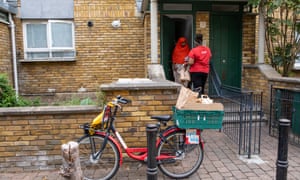
The centre has 500 children on its database, the team has been phoning mothers such as Vicky regularly. It became clear some children were being left alone for long periods. So, in addition, three times a week, the team take to their bikes to distribute 120 “Happy Lunches” and playpacks to 136 children in 68 families. It hopes to raise £5,000 this week.

“Covid has highlighted that for many in our community, a balcony is a privilege,” James says. “Some children haven’t been out at all.” She adds: “Imagine if you have a parent with poor mental health, substance abuse, alcoholism, trauma – there’s a darkness for the child. When we really unlock, the stories are going to come and we have to be ready.”

James is giving her team training to deal with mental health issues. “We have to give the children a chance to heal and recover. Play is vital and therapeutic, but our costs have doubled and without funding, we won’t survive. This is crisis time.”


Kenosha Smith from the MRLCC


Kenosha Smith from the MRLCC delivering food and playpacks to children in Brixton. Photograph: Antonio Olmos/The Observer

The Akshaya Patra Foundation (TAPF) – Akshaya Patra is Sanskrit for the pot of food that never runs out – has provided free vegetarian meals for children in India for 20 years guided by the mantra, “Feeding children gives wings to their dreams”. In 2017, TAPF came to the UK to feed those in need. Three million children go hungry during the summer holidays.

Last year, the Childhood Trust gave match funding for a pilot scheme that provided 10,000 free meals for four weeks in the summer holiday. “A child can eat a piece of fried chicken that kills hunger,” says TAPF’s Neha Agarwal. “But that’s not tackling malnutrition. I’ve talked to many children who have only a piece of toast at the end of the day.”

This summer, helped by the Childhood Trust, TAPF hopes to serve 100,000 meals to children, raising £100,000 during Champions for Children week. Agarwal says. “If we don’t do this, we know there will be a huge attainment gap by September. Dealing with hunger shouldn’t be driven by charity. I hope in 10 years’ time, we won’t be needed.”

“We haven’t seen the full economic shock of the pandemic yet,” Guinness says. “Debts are mounting, rent arrears rising, unemployment will shoot up.

“We are happy to spend billions on huge infrastructure like HS2 but that’s a false economy when children are going hungry. Investment in human infrastructure must matter too.

“To participate, to have fun, to feel safe and be inspired – they are every child’s right.”

To donate, go to Champions for Children

Source link

The Room Where It Happened review: John Bolton fires broadside that could sink Trump

0

John Bolton’s near-600-page tome is the most damning written account by a Trump administration alumnus, the one that stands to haunt the president come November. In the author’s judgment, “I don’t think he’s fit for office. I don’t think he has the competence to carry out the job.” Joe Biden couldn’t say it better himself.

Finally, Donald Trump’s third national security adviser is spilling his guts. Trump begging for China’s assistance in 2019 makes his waltz in 2016 with WikiLeaks almost comical. “Make sure I win … Buy a lot of soybeans and wheat and make sure we win,” said the MAGA King, abasing himself before Xi Jinping, successor to the Dragon Throne, in the uncut version of Bolton’s narrative.

The president’s loyalists know they are staring at a problem that isn’t disappearing. Insult is the only available weapon. Mike Pompeo, the secretary of state, called Bolton a traitor. Peter Navarro, the White House trade hawk, labeled The Room Where It Happened “deep swamp revenge porn”.

On Saturday, a federal judge declined to block the book’s publication. Make that three big losses in one week for Bill Barr’s justice department. First, LGBTQ workforce rights, then Daca and the Dreamers, now this. And that’s not including the standoff with the US attorney for the Southern District of New York that didn’t got quite as planned for Trump and Roy Cohn 2.0.

Trump trails Biden by double digits. His consigliere, Rudy Giuliani, is begging for more than three debates in the fall. Tulsa was a bust. The president’s tailspin is pronounced, showing no sign of let-up.

The Room Where It Happened is laden with proximity and credibility, which makes it a book to be believed. Putting things into perspective, Trump’s justice department never went after A Warning, an insider-wannabe’s account of Trumpian bedlam penned by “Anonymous”. Likewise, no one will confuse Bolton with Omarosa or Sean Spicer. There is no reality TV in Bolton’s past or future. Just the public’s verdict.

Not surprisingly, Trump bashes Bolton as a liar and threatens him with criminal prosecution. But Bolton retains his famed notepads. Trump beware.

The president’s public persona is little different from the man behind the Resolute Desk. The Room Where It Happened chronicles, for example, Trump’s animus toward the late Senator John McCain. Bolton describes the president’s “vindictiveness, as evidenced by the constant eruptions against John McCain, even after McCain died and could do Trump no more harm”.

Back in the day, Bolton was recruited by James A Baker III, like McCain a Republican lion, Ronald Reagan’s chief of staff and George HW Bush’s secretary of state. To quote Baker, “John’s an extraordinarily bright guy.”

Baker didn’t say wise.

In 2018, when the president was looking to offload HR McMaster, his second national security adviser, Bolton was on Fox News auditioning. Trump liked what he saw and heard. The rest is spectacle.

Bolton is neither hero nor martyr. It’s not in his DNA. A staunch proponent of the Iraq war and an implacable Iran foe, he sees death as something for others. In his Yale University 25th reunion yearbook, he wrote: “I confess I had no desire to die in a south-east Asian rice paddy. I considered the war in Vietnam already lost.” Think of Dick Cheney saying the quiet part loud – in Dolby sound.

Late last year, during impeachment proceedings against Trump, the nation focused on the congressional testimony of Fiona Hill and Lt Col Alexander Vindman, members of Bolton’s own National Security Council. Bolton himself sat mum, despite the fact he had already left the White House. Like Nero, he fiddled when things got hot.

During the impeachment trial, Bolton said he would respect a Senate subpoena demanding his testimony – knowing that writ would never arrive. Even as The Room Where It Happened is published, Senate Republicans persist in claiming Bolton’s revelations would not have changed a thing.

Bolton witnessed the president trading national security for dirt on Biden, bartering the US justice system for Turkey’s benefit, turning into Xi’s lapdog. But when it counted, Bolton elected to hold his peace. Belatedly posing as virtuous brings limited rewards.

For the price of a publisher’s advance, Bolton now opines that the House Democrats committed “impeachment malpractice” by not broadening their investigation. He may have come to loathe the president, but “owning the libs” took precedence.

In case anyone forgot, once upon a time Bolton was a client of Cambridge Analytica, the now defunct Breitbart affiliate and Robert Mercer-owned company that hoovered up personal data and illicitly interfered in the Brexit vote.

In 2014, Bolton’s Super Pac contacted with the company for “behavioral microtargeting with psychographic messaging”. That meant plundering Facebook users’ data.

According to whistleblower Christopher Wylie: “Bolton Pac was obsessed with how America was becoming limp-wristed and spineless and it wanted research and messaging for national security issues.” In his book, Bolton’s description is more modest: “In late 2013, I formed a Pac and a Super Pac to aid House and Senate candidates who believed in a strong US national security policy.”


Jared Kushner, Steven Mnuchin, Trump and Bolton, in the cabinet room at the White House in September 2018. Photograph: Kevin Lamarque/Reuters

He also shares world leaders’ impressions of Trump Inc’s policy chops. The Room Where It Happened records the doubts of Benjamin Netanyahu, Israel’s prime minister, about Jared Kushner’s ability to deliver Middle East peace.

Says Bolton, Netanyahu was “enough of a politician not to oppose the idea publicly, but like much of the world, he wondered why Kushner thought he would succeed where the likes of Kissinger had failed.” Delusion? Hubris? Either will do.

On that score, the author observes the relationship between the Israeli prime minister and Kushner’s family had spanned decades. In a non-denial denial, Netanyahu has said he “has complete faith” in “Kushner’s abilities and rejects any description to the contrary”.

Bolton’s prose is lackluster. But that’s a relatively minor shortcoming. More egregious is the book’s title, which is lazy and self-aggrandizing. Bolton has ripped-off Lin-Manuel Miranda and compared himself to Alexander Hamilton, founding father and first treasury secretary. Talk about overreach.

In Miranda’s Broadway smash, Hamilton, Aaron Burr laments his lack of nexus to power, as opposed to the play’s protagonist, who is negotiating a grand compromise on the federal government’s assumption of the states’ debt. In song, Burr complains: “I wanna be in the room where it happens.”

When an American president is caught giving a thumbs-up to concentration camps for Muslims – an allegation the White House has not denied – and his son-in-law is the grandson of Holocaust survivors, that’s one heckuva story.

Just before the book oozed out, Steve Bannon, another Cambridge Analytica partner, predicted China would be the “centerpiece” of this year’s campaign. How right he is.

Except it will be Trump, not Biden, who will be catching grief for being the Middle Kingdom’s poodle. Vladimir Putin, move over. The Room Where It Happened is the best opposition research dump. Ever.


Source link

Classic Braised Lamb Shanks in a Red Wine Sauce

0

This recipe is a classic way to prepare lamb shanks, they are cooked in a red wine sauce until the meat falls off the bone. As it is a tough cut of meat, you need to cook the shanks long and slow until they are tender and succulent.

The red wine cooks away so its taste doesn’t overpower the dish. It just adds an extra depth and flavour and completely transforms the sauce.

This lamb shank recipe is so versatile, you can make it in the oven or on your stove. Just note that it will take longer to cook if you are preparing it on the stove.

This content has been created as part of our freelancer relief programme. We are supporting journalists and freelance writers impacted by the economic slowdown caused by #lockdownlife.

If you are a freelancer looking to contribute to The South African, read more here.


Source link

The Greatest ODI teams in history: MS Dhoni’s India make history at home in the 2011 World Cup – Sport360 News

0

It’s approaching 50 years since the maiden ODI was played between Australia and England at the iconic Melbourne Cricket Ground (MCG). While T20s are the current darlings of cricket, it was the 50-over format which initially helped raise the popularity and exposure of the sport.

The format gave birth to the ICC World Cup in 1975, a quadrennial competition, which has become the benchmark for greatness in the game. Over the years, there have been several teams to have dazzled with their brilliant performances over both bilateral series and ICC competitions.

In this series, we take a look at eight of the best ODI squads in history. India’s World Cup winning squad of 2011 is the subject of our focus below.

SQUAD

Openers: Sachin Tendulkar, Virender Sehwag

Middle-order: Gautam Gambhir, Virat Kohli, MS Dhoni (WK, C), Yuvraj Singh, Suresh Raina, Yusuf Pathan

Spinners: Harbhajan Singh, Ravichandran Ashwin, Piyush Chawla

Pacers: Zaheer Khan, Munaf Patel, Praveen Kumar, Ashish Nehra, S Sreesanth

Overview

After what turned out to be a disastrous 2007 World Cup campaign in the Caribbean, the Indian ODI side was in a state of flux for several months. Several veterans were shown the door as a new era was unleashed under the captaincy of MS Dhoni.

The seeds of revival were sown in the inaugural World T20 held in 2007, where an unfancied Indian side led by Dhoni turned out to be the unlikely victors.

The ODI fortunes, however, continued to fluctuate as the team suffered several hiccups along the way over the next few years. In the end, it all came together quite nicely just in time for the World Cup on home soil, as Dhoni’s men attained a second title for the country in 2011. There would be more success two years later, as the Men in Blue clinched the ICC Champions Trophy in England.

Captain – MS Dhoni

A man who would ultimately earn the nickname of ‘Captain Cool’, Dhoni proved to be exactly the kind of leader India needed to rebuild themselves. Having burst on to the scene as a swashbuckling wicketkeeper batsman, the player who hailed from Ranchi was a surprise choice for skipper.

However, he proved his doubters wrong instantly by leading India to triumph in the 2007 World T20 in South Africa. With a calm and collected demenour bereft of emotions, Dhoni orchestrated the team from behind the stumps.

He brought the steel they had lacked in high-profile ICC tournaments and challenged them to ruffle the feathers of the all-conquering Australians.

As a batsman, Dhoni always led from the front and his exploits with the bat saw him rise to the top of the ODI rankings in 2009. Gradually, he transitioned from an aggressive batsman to one of the best finishers in history. His finishing qualities would prove to be instrumental in India’s 2011 World Cup triumph, with his winning six sending a billion plus fanatics into delirium.

STRENGTHS

Formidable top-three

Sachin Tendulkar

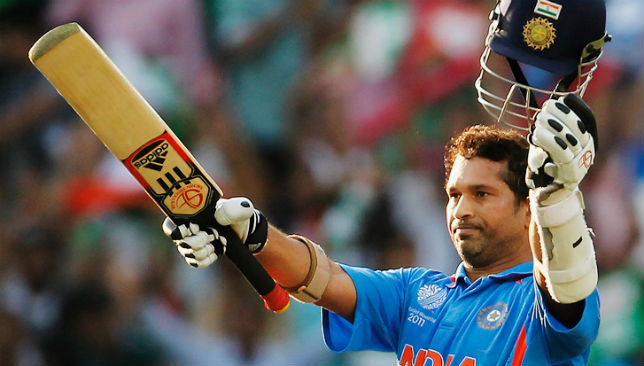
In Sachin Tendulkar and Virender Sehwag, India had an opening pair that could be trusted to hand them a solid start. Despite being on the last legs of his ODI career, Tendulkar was batting like a man possessed in the 2011 World Cup. His 482 runs in the tournament were only bettered by Sri Lanka’s Tillakaratne Dilshan, with the ‘Master Blaster’ smashing two tons and as many half-centuries in the process.

The Delhi pair of Sehwag and Gautam Gambhir aggregated nearly 800 runs between them in the campaign, with the duo completing a formidable top-three for India.

All-round prowess of Yuvraj Singh

yUVRAJ1

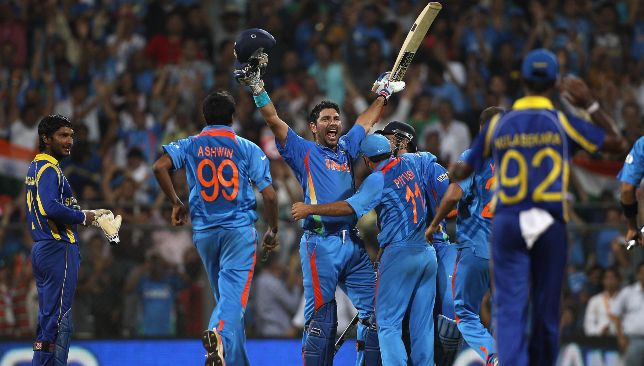
While there were several notable contributions towards India’s World Cup conquest, none of them were greater than Yuvraj Singh’s. The flamboyant star’s all-round prowess proved to be a game-changer for the hosts and gave them the requisite balance to go all the way.

Some 362 runs at an average of over 90 were phenomenal numbers from Yuvraj, but it was the effectiveness of his left-arm spin which propelled him towards the man-of-the-tournament award. His 15 wickets at an average of 25.13 meant that India could pack their side with seven specialist batsmen.

In terms of all-round displays, no one else comes close to Yuvraj’s 2011 campaign in the World Cup.

Wily Zaheer makes amends

Zaheer-Khan

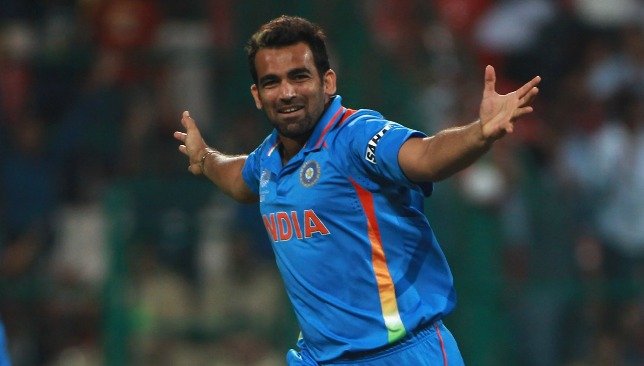
His wayward bowling in the first over of the 2003 World Cup final had set the tone for a crushing defeat for India, but a more experienced and seasoned Zaheer Khan made amends spectacularly eight years later.

With 21 scalps in the tournament, the left-armed seamer finished as the joint highest wicket-taker in the World Cup. He was always on hand to give India some early breakthroughs with the new ball, while his clever off-cutters and accurate yorkers made him a tough nut to crack in the death overs.

Greatest feat – Back-to-back ICC trophies

Home advantage played its part in the 2011 World Cup for India, with the hosts ending up as deserved holders of the crown. A narrow loss to South Africa was the only blip as Dhoni’s men clinched the title at the Wankhede stadium in Mumbai.

Their path to the trophy wasn’t easy and they had to contend with several tricky obstacles. In the quarter-final, they beat an Australian side which had won three World Cups in a row. A tough test against arch-rivals Pakistan awaited them in the last-four, with the Indians managing to hold their nerve in a tense clash.

In the final, they looked dead and buried after the early dismissals of Sehwag and Tendulkar in a chase of 275 against the Sri Lankans. Despite the immense pressure at the stage, timely innings from Gambhir and Dhoni helped India seal a magical night in Mumbai.

That they followed up the World Cup title with a Champions Trophy conquest in England two years later only enhanced the reputation of Dhoni and India. There, they won all five of their games, including a tight low-scoring final against hosts England in the final.

Know more about Sport360 Application


Source link

Russia reopens ahead of Victory Day and Putin referendum — but coronavirus threat remains

0

Here are the areas that are starting to reopen

Here are the areas that are starting to reopen

People exercise in workout pods at Inspire South Bay Fitness, a gym in Redondo Beach, California, on Monday, June 15.

Here are the areas that are starting to reopen

Sue Stamp fits a young girl with a new pair of shoes after W.J. French and Son reopened in Southampton, England, on June 15.

Here are the areas that are starting to reopen

Here are the areas that are starting to reopen

Floor supervisor Dumitru Carabasu sanitizes dice at Las Vegas’ Excalibur Hotel & Casino on Thursday, June 11. It was reopening for the first time since mid-March.

Here are the areas that are starting to reopen

Nail technicians perform manicures and pedicures at a nail bar in Moscow on June 9. The Russian capital ended a tight lockdown that had been in place since late March.

Here are the areas that are starting to reopen

Commuters wear protective masks as they ride a subway train in New York on June 8.

Here are the areas that are starting to reopen

Parishioners are welcomed back to a Greek Orthodox church in Keilor East, Australia, on June 7. Religious services and gatherings for up to 20 people are now permitted in the state of Victoria.

Here are the areas that are starting to reopen

Visitors ride a roller coaster at the Universal Studios theme park in Orlando after it reopened on June 5.

Here are the areas that are starting to reopen

Customers stand on an escalator inside Le Printemps Haussmann, a department store in Paris, on May 28.

Here are the areas that are starting to reopen

A restorer cleans Michelangelo’s David statue on May 27 while preparing for the reopening of the Galleria dell’Accademia in Florence, Italy.

Here are the areas that are starting to reopen

Traders work on the floor of the New York Stock Exchange after it reopened for in-person trading on May 26.

Here are the areas that are starting to reopen

A man dives into an outdoor swimming pool in Rome on May 25.

Here are the areas that are starting to reopen

Visitors take photos from the South Rim of the Grand Canyon shortly after sunrise on May 25. Grand Canyon National Park has partially reopened on weekends.

Here are the areas that are starting to reopen

Students in Abidjan, Ivory Coast, study at the Merlan school of Paillet on May 25.

Here are the areas that are starting to reopen

Tourists enjoy the hot weather at a beach in Bournemouth, England, on May 25.

Here are the areas that are starting to reopen

Visitors look at the work of artist Berlinde De Bruyckere at Fondazione Sandretto Re Rebaudengo, a contemporary art foundation in Turin, Italy, on May 23.

Here are the areas that are starting to reopen

Jasmine Donaldson cleans a movie theater in Auckland, New Zealand, on May 22. Matakana Cinemas reopened May 28 with a reduced capacity to allow for social distancing between seats and in the foyer.

Here are the areas that are starting to reopen

Chinese Communist Party delegates stand for the national anthem at the opening of the National People’s Congress on May 22. The annual parliamentary gathering had been postponed.

Here are the areas that are starting to reopen

People visit the ARoS Museum of Art in Aarhus, Denmark, on May 22. The museum opened its doors to the public after being closed for two months.

Here are the areas that are starting to reopen

Surfers take to the water in Lido Beach, New York, on May 21.

Here are the areas that are starting to reopen

People visit the reopened Blaavand Zoo in Denmark on May 21.

Here are the areas that are starting to reopen

People swim at a public pool in Cologne, Germany, on May 21.

Here are the areas that are starting to reopen

Christian Orthodox faithfuls attend a liturgy in Athens, Greece, on May 20.

Here are the areas that are starting to reopen

People visit Florida’s Clearwater Beach on May 20. Florida opened its beaches as part of Phase 1 of its reopening.

Here are the areas that are starting to reopen

People walk in Naples, Italy, on May 19.

Here are the areas that are starting to reopen

People enjoy the water as Florida’s Palm Beach County reopened some beaches on May 18. Social-distancing rules were still in effect.

Here are the areas that are starting to reopen

Nuns await a Mass in Rome on May 18. It was the first Mass celebrated by parish priest Marco Gnavi in more than two months.

Here are the areas that are starting to reopen

A worker wears protective gear while cutting a customer’s hair at a salon in Nadiad, India, on May 17. India’s lockdown was set to remain in place until May 31, but many salons and shops were able to reopen.

Here are the areas that are starting to reopen

Police walk through New York’s Hudson River Park with a reminder about social distancing on May 16.

Here are the areas that are starting to reopen

Here are the areas that are starting to reopen

Swimmers pay for sunbeds at the Alimos beach near Athens, Greece, on May 16.

Here are the areas that are starting to reopen

Here are the areas that are starting to reopen

Here are the areas that are starting to reopen

A customer buys eggs at a market in Kunming, China, on May 12.

Here are the areas that are starting to reopen

A woman takes a photo at Disneyland Shanghai after the amusement park reopened in China on May 11. The park had been closed for three and a half months. Visitors are now required to wear masks, have their temperatures taken and practice social distancing.

Here are the areas that are starting to reopen

People eat fries on the boardwalk in Ocean City, Maryland, on May 10.

Here are the areas that are starting to reopen

People exercise on a reopened promenade next to a beach in Barcelona, Spain, on May 9.

Here are the areas that are starting to reopen

Patrons eat at a restaurant in Bangkok, Thailand, on May 9.

Here are the areas that are starting to reopen

Fans cheer during a professional baseball game between the Fubon Guardians and the Uni-President Lions in New Taipei City, Taiwan, on May 8.

Here are the areas that are starting to reopen

Traci Hancock has her hair cut by stylist Jill Cespedes at Shampoo Salon in Fort Worth, Texas, on May 8. Texas Gov. Greg Abbott announced that hair salons, barber shops and tanning salons were allowed to open on Friday.

Here are the areas that are starting to reopen

A long line of cars forms as a KFC drive-thru reopens in Plymouth, England, on May 8.

Here are the areas that are starting to reopen

Sue Conklin, owner of Books Rio V, stocks her shelves in Rio Vista, California, on May 8. It was her first day back at the used bookstore since March 28.

Here are the areas that are starting to reopen

A man receives a haircut at Doug’s Barber Shop in Houston on May 8.

Here are the areas that are starting to reopen

Two men wearing face masks play chess in Montevideo, Uruguay, on May 7.

Here are the areas that are starting to reopen

People enjoy a beach that had just reopened in Isle of Palms, South Carolina, on May 6.

Here are the areas that are starting to reopen

People stand on social-distancing markers at a Mercedes-Benz car dealership in Brussels, Belgium, on May 6.

Here are the areas that are starting to reopen

Kelly Watson puts glass in a recycling bin in Springfield, Missouri, on May 6, The Lone Pine Recycling Center had just reopened.

Here are the areas that are starting to reopen

Customers wait to get their nails done at the Nail Tech salon in Yuba City, California, on May 6.

Here are the areas that are starting to reopen

A man wears a protective face mask while visiting the Old Masters Picture Gallery in Dresden, Germany, on May 6. The gallery had been closed for more than six weeks.

Here are the areas that are starting to reopen

Here are the areas that are starting to reopen

People in Athens, Greece, enjoy a sunset May 5 on the Areopagus hill near the Acropolis.

Here are the areas that are starting to reopen

Kayleigh Tansey and Justin Smith watch a movie in Kyle, Texas, on May 4. The EVO Entertainment movie theater reopened after Gov. Greg Abbott lifted a shelter-in-place order and allowed select businesses to open to the public at no more than 25% capacity.

Here are the areas that are starting to reopen

People line up at a reopened liquor shop on the outskirts of New Delhi on May 4. The six-week lockdown in India, which was supposed to end on May 4, was extended two weeks with a few relaxations.

Here are the areas that are starting to reopen

A man gets his hair cut in Sarajevo, Bosnia and Herzegovina, on May 4. Some retail shops and hairdressers have started to reopen as the Balkan states start to gradually lift coronavirus measures.

Here are the areas that are starting to reopen

Teacher Katharina Schneider welcomes back a group of 10th-graders who will soon face exams in Ettlingen, Germany.

Here are the areas that are starting to reopen

Pet groomers wear face masks as they tend to dogs in Bangkok, Thailand, on May 3. The business was reopened as the Thai government eased measures that aimed to combat the spread of Covid-19.

Here are the areas that are starting to reopen

Farmer Samantha Alvarez, left, hands a bag of onions to a customer at the West Seattle Farmers Market on May 3. Farmers markets in Seattle are reopening with guidelines that include fewer vendors allowed, a limited number of customers, and additional hand-washing and sanitizing stations.

Here are the areas that are starting to reopen

Tourists visit the Forbidden City in Beijing as it reopened to limited visitors on May 1.

Here are the areas that are starting to reopen

Leslie Wilson helps her son, JP, tape off booths at Falcone’s Pizzeria in Oklahoma City on April 30. Restaurants in Oklahoma City are being allowed to reopen, and Falcone’s Pizzeria is closing some booths to allow for social distancing.

Here are the areas that are starting to reopen

A waitress wears a face mask while serving customers at a restaurant in Vilnius, Lithuania, on April 30. The Lithuanian government extended the country’s nationwide lockdown until May 11, but it gave the green light for museums, libraries, outdoor cafes, hairdressers, beauty salons and shopping mall retail stores to reopen.

Here are the areas that are starting to reopen

Children play on a public playground in Berlin on April 30. Many playgrounds were reopening for the first time.

Here are the areas that are starting to reopen

Garment workers wear face masks as they return to work in Dhaka, Bangladesh, on April 30. More than 500 garment factories in Bangladesh reopened.

Here are the areas that are starting to reopen

A worker checks a person’s temperature as they get ready to reopen a commercial center in Santiago, Chile, on April 29.

Here are the areas that are starting to reopen

Surfers in Sydney wait for officials to open Bondi Beach on April 28 as restrictions were eased. The beach was open to swimmers and surfers, but only for exercise.

Here are the areas that are starting to reopen

Here are the areas that are starting to reopen

Here are the areas that are starting to reopen

Here are the areas that are starting to reopen

Here are the areas that are starting to reopen

A man covers his face with a mask while getting a haircut at The Barber Shop in Broken Arrow, Oklahoma, on April 24. Personal-care businesses in the state have reopened for appointments.

Here are the areas that are starting to reopen

Here are the areas that are starting to reopen

A person wearing a protective mask walks through the takeout-only food court at the reopened Anderson Mall in Anderson, South Carolina, on April 24.

Here are the areas that are starting to reopen

Technicians give pedicures to customers at a nail salon in Atlanta on April 24.

Here are the areas that are starting to reopen

Visitors maintain their distance outside the elephant enclosure at Bergzoo Halle in Saxony-Anhalt, Germany, on April 23. Under strict conditions, zoos in Saxony-Anhalt have been allowed to reopen after being closed for several weeks.

Here are the areas that are starting to reopen

A child and his father shop at a toy store in Berlin that reopened on April 22. It was the first time the store was open since March.

Here are the areas that are starting to reopen

A woman shops at a bookstore in Rome on April 20. In parts of Italy, shops like bookstores, laundries and children’s clothing stores have reopened.

Here are the areas that are starting to reopen

A groomer trims a dog’s fur on April 20 after pet-grooming salons reopened in Prague, Czech Republic.

Here are the areas that are starting to reopen

Here are the areas that are starting to reopen

Dentist Torben Schoenwaldt and clinical assistant student Rebecka Erichsen care for a patient at Harald Dentists Soenderaaparken in Vejle, Denmark. The office reopened on April 20 and is accepting patients again.

Here are the areas that are starting to reopen

Here are the areas that are starting to reopen

Here are the areas that are starting to reopen

Here are the areas that are starting to reopen

Here are the areas that are starting to reopen

Source link

Solar Eclipse 2020, International Yoga Day 2020 LIVE: Delhi, Gujarat, Maha Treated to Rare ‘Ring of Fire’ Eclipse; Virus Clouds Yoga Celebrations

0


The annular phase of solar eclipse 2020 will be visible in the morning from some places within a narrow corridor of northern India like parts of Rajasthan, Haryana and Uttarakhand. A few prominent places within this narrow annularity path are Dehradun, Kurukshetra, Chamoli, Joshimath, Sirsa, Suratgarh. From the rest of the country, it will be visible as partial solar eclipse.

A solar eclipse occurs on a new moon day when the Moon comes in between the Earth and the Sun and when all the three celestial objects are aligned. An annular solar eclipse occurs when the angular diameter of the Moon falls short of that of the Sun such that it cannot cover up the latter completely. As a result, a ring of the Sun’s disk remains visible around the Moon. This gives an image of a ring of fire.

The safe technique to observe the solar eclipse is either by using a proper filter like aluminised mylar, black polymer, welding glass of shade number 14 or by making a projection of the Sun’s image on a white board by telescope. Several organisations have organised lectures on the eclipse and also the virtual viewing of the phenomenon.

With the shadow of the Covid-19 pandemic looming large, International Day of Yoga on Sunday, June 21 is being celebrated on digital media platforms sans mass gatherings. In a special message, Prime Minister Narendra Modi hailed the occasion as a “day of oneness” and counted the benefits of yoga poses in helping build immunity.

Yoga Day will go digital for the first time since June 21, 2015, when it began to be celebrated annually across the world, coinciding with the Summer Solstice each year. This year’s theme is ‘Yoga at Home and Yoga with Family’ and people will be able to join the celebrations virtually at 7 am on June 21.

The Indian missions abroad are trying to reach out to the people through digital media as well as through the network of institutions which support yoga, officials said. The Ministry of AYUSH had planned to hold a grand event in Leh, but cancelled it due to the pandemic.

On December 11, 2014, the United Nations General Assembly declared June 21 as ‘International Day of Yoga’, months after Modi had proposed the idea. A message from Modi will be the highlight of the International Day of Yoga which will be observed on electronic and digital platforms on June 21, the AYUSH ministry said on Thursday.

“Due to the current global health emergency due to the COVID-19 outbreak, the focus this year is less on such celebrations and more on people performing Yoga at their respective homes with participation of the entire family,” the ministry said. The prime minister’s remarks will be televised at 6.30am, a statement by the Ministry of Ayurveda, Yoga & Naturopathy, Unani, Siddha and Homoeopathy (AYUSH) said. As has been the practice in International Day of Yoga (IDY) observation, the PM’s message will be followed by a live demonstration of a 45-minute Common Yoga Protocol (CYP) by a team from Morarji Desai National Institute of Yoga.

The CYP drill has been designed keeping in mind people of different age groups and of varied walks of life, the ministry had said in its statement. “Yoga is found to be especially relevant in the pandemic situation, since its practice leads to both physical and mental wellbeing, and increases the individual’s ability to fight diseases,” it said.

Modi on Thursday had urged people, in a video message, to observe the day from the confines of their homes due to the COVID-19 pandemic. “This year, the event will highlight the utility of yoga for individuals, to develop immunity to combat the global pandemic and strengthen the community in managing some of the significant aspects of this crisis,” Vinay Sahasrabuddhe, president, Indian Council for Cultural Relations (ICCR) had said earlier this month.

The ministry and ICCR, through the ‘My Life – My Yoga’ video blogging competition which was launched by the prime minister on May 31, has sought to raise awareness about yoga and inspire people to prepare for and become active participants in the observation of IDY 2020. The contest has two legs — the first one consisting of an international video blogging contest wherein the winners will be picked within a country. This will be followed by global prize winners who will be selected from different countries.

To enter the contest, participants were required to upload a three-minute video of three yogic practices (kriya’, asana’, pranayama’, bandha’ or mudra’), including a short video message/description on how the said yogic practices influenced their lives. The videos could be uploaded on Facebook, Twitter or Instagram with the contest hashtag #MyLifeMyYogaINDIA and appropriate category hashtag. Entries could be submitted by participants under three categories– youth (male and female aged under 18), adults (male and female above 18 years) and yoga professionals (male and female), Kotecha said.

This made it a total of six categories in all. For India contestants, prizes worth Rs 1 lakh, Rs 50,000 and Rs 25,000 will be given for first, second and third positions within each of the categories. The Indian missions abroad will give away prizes in each country. At the global level, cash prizes worth $2,500, $1,500 and $1,000 along with a trophy and certificate will be given to those ranking first, second and third, respectively.

The blogging contest which has started on various digital platforms such as MyGov.gov.in will end on Sunday. The jury will then later collectively decide and announce the names of the winners. The International Day of Yoga will be celebrated at AIIMS, New Delhi with an online live yoga session that shall be telecast on AIIMS Telemedicine YouTube channel at 07:00 AM on Sunday under the aegis of Centre for Integrative Medicine and Research (CIMR).

The mandate of the CIMR is to conduct transformational research to understand the feasibility and applicability of yoga and integrative medicine in prevention and management of diseases. Yoga programmes are organised across the globe by Indian missions every year, but this year will be different. Several missions are organizing digital events to mark the occasion.

Thousands of yoga enthusiasts in Texas and adjoining US states are all set to roll out their mats to bend and twist their bodies in complex postures from the safety of their homes with acclaimed yoga guru Baba Ramdev on livestream to mark the International Day of Yoga on Sunday.


Source link

‘No evidence to link Victoria’s 19 new cases to Black Lives Matter protests’

0

There is no medical evidence to suggest a spike in coronavirus cases in Victoria is linked to the Black Lives Matter protests held in Melbourne a fortnight ago, Australia’s Deputy Chief Medical Officer has said.

It comes as Victoria recorded 19 new COVID-19 cases and its State of Emergency was extended to July 19, giving authorities unprecedented powers to restrict Victorians’ movements in the interests of public health.

“It is a timely reminder that in a population that is non-immune to the virus, to COVID-19, that we will get, from time to time, outbreaks an clusters as we have seen in Victoria,” DCMO Dr Nick Coatsworth said today.

Authorities say they can’t confirm whether an uptick in coronavirus cases is related to recent rallies in Melbourne’s CBD, but urged people to avoid all large gatherings. (AAP Image/James Ross)

The Victorian government announced it was winding back some eased measures yesterday, reducing the number of people allowed to visit homes to five and restricting outdoor gatherings to 10.

Ten of the new cases have been deemed community transmission.

Among the cases is a Year Three student at St Mary’s Primary School in Hampton in Melbourne’s south east.

The student attended class last week while believed to be infectious with the virus, prompting the state’s rapid response team to close the school.

Students’ families have been notified and the school will remain closed until at least Wednesday for deep cleaning and contact tracing.

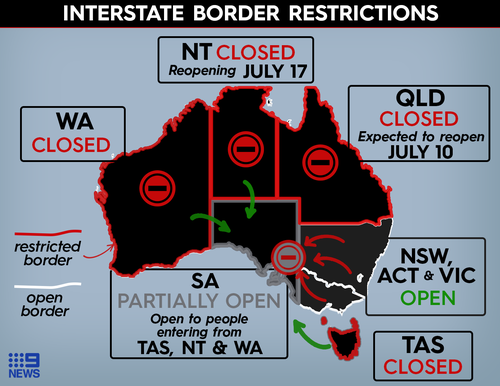
Latest update on border closures as of June 18, 2020. (Graphic: Tara Blancato)

There have also been four new cases linked to security contractors at the Stamford Plaza Hotel in Melbourne’s CBD, where returned travellers are in mandatory isolation.

It brings the total number connected to that outbreak to 14.

The new figures bring the total number of active cases in Victoria to 121 – a considerable uptick in the past week.

Seven people are currently being treated in hospitals in the state, including two in Intensive Care Units.

Victorian Health Minister Jenny Mikakos urged the community to remain home if experiencing even mild symptoms. (9News)

Victorian Health Minister Jenny Mikakos said extended family gatherings inside homes where people weren’t following social distancing were largely to blame for the “concerning” rise in cases.

“It is still a very serious situation,” Ms Mikakos said this morning.

“We have had particularly some concerns around extended family members across many households visiting each other even when they have been exhibiting mild symptoms and – very concerning – even going to work when they had mild symptoms.”

Victorian Health Minister Jenny Mikakos urged the community to remain home if experiencing even mild symptoms.

She noted that many recent cases involved extended family members infecting each other, including children infecting their grandparents, and a child who went to school while ill infecting a teacher.

Residents have been warned that police will be enforcing new restrictions.

‘Victoria a good example of combating future outbreaks’

Dr Coatsworth today acknowledged that while Victoria’s spike in COVID-19 cases is of concern to health authorities, the outbreak will be overcome if Australians stick to virus guidelines provided by the government.

Deputy Chief Medical Officer Nick Coatsworth has said there is no medical evidence to suggest a spike in Victorian COVID-19 cases can be linked to Black Lives Matter protests. Photo: Alex Ellinghausen (Sydney Morning Herald)

“(It is) a timely reminder that, as for all Australians, there are restrictions on how we live that we have really done well in pursuing but those will continue whilst we remain non immune to COVID-19, whilst there is not a vaccine and effective treatment and as cases continue to increase around the world,” he said.

“This is a good example of how things are going to work into the future and it’s an important example of how a state can get on top of outbreaks of this nature, in Victoria, and then move forward.”

The DCMO also said that he believes there is no medical suggestion the spike in cases can be linked to a Black Lives Matter protest held in Melbourne two weeks ago, despite authorities not knowing where two of the 19 cases came from.

To date, just three confirmed coronavirus cases have been linked to the protest – however they are not included among the 19 new cases diagnosed today.

People march in solidarity on June 06 in Melbourne in solidarity with protests in the United States following the killing of an unarmed black man George Floyd at the hands of a police officer in Minneapolis. (Photo by Quinn Rooney/Getty Images) (Getty)

“There’s a majority of cases that are community transmitted – about 60 per cent as opposed to hotel quarantine which is about 40 per cent,” he said.

“There’s still a large number of cases in Victoria that are being diagnosed through hotel quarantine.

“Those cases whilst we don’t know where they have come from, the contract tracing will include genomics … to assist us in determining where they came from.”

No new cases in Queensland as stadiums reopen

Deputy Premier Steven Miles said the rise in community transmission in Victoria had confirmed that Queensland had made the right decision in keeping its borders closed as restrictions within the state are eased.

Despite that, he also confirmed this morning the state will be reopening stadiums for sporting events.

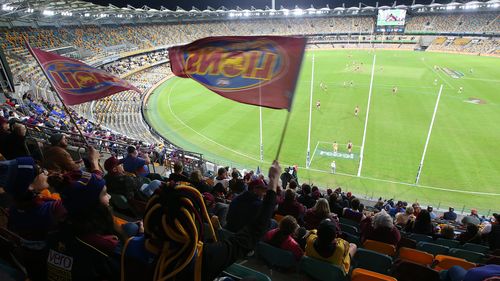
Lions fans cheer during the round 3 AFL match between the Brisbane Lions and the West Coast Eagles at Metricon Stadium in Gold Coast, Australia. (Photo by Jono Searle/AFL Photos/via Getty Images ) (via Getty Images)

Venues will be allowed to fill up to 25 per cent of their ticketed seats up to a cap of 10,000 spectators starting from Saturday, June 27.

“It’s time to get Queenslanders back to the football,” he said.

“Queenslanders have earned this reward. They have earned the chance to go to the footy, and I’m really pleased that they will be able to from next weekend.”

Queensland Chief Health Officer Jeannette Young says the hotspots now include all 31 Local Government Areas in Greater Melbourne, as well as bordering areas of Murrindindi, Mitchell, Moorabool, Macedon Ranges and Greater Geelong.

“We need to keep ourselves safe,” Mr Miles said.

“We cannot afford to be importing cases from these hotspots because if we do we will be forced to go backwards as Victoria has had to with their easing of restrictions.

“We want to keep going forward. We want to keep having people at the football, more people back at pubs and cafes and restaurants, more people back at work.”

NSW marks another day with no community transmission

New South Wales has gone another day with no community transmission of COVID-19.

The state recorded five new cases of coronavirus as of 8pm last night from more than 13,000 tests.

All of these positive results were in returned overseas travellers in mandatory hotel quarantine.

Western Australia reports one new case

Western Australia has reported one new active case of COVID-19, bringing the state’s total to 605 on Sunday.

The WA Health Department said the woman in her 20s is a returned overseas traveller and is now in hotel quarantine.

The state now has three active cases, all of whom are in hotel quarantine.

On Saturday 346 people were tested for the virus, resulting in just over 165,000 total tests across WA.

Source by [author_name]

Pair arrested over R300 000 illicit cigarette haul

0

Two people will appear before the Senwabarwana Magistrate’s Court, about 90km km northwest of the city Polokwane in Limpopo, on Monday 22 June in connection with possession of illegal cigarettes worth an estimated R307 000.

The pair, aged 29 and 35, was arrested on Friday 19 June while transporting the cigarettes in the Alldays policing area outside Makhado.

According to a media statement from SAPS, police officers were conducting routine patrol duties at around 10pm when they spotted a suspicious motor vehicle within the Alldays CBD area.

“They signalled the driver of the vehicle to pull over. Upon conducting a search, police recovered 23 boxes of illicit cigarettes with an estimated value of R307 441,” the statement said.

Investigations are still continuing.

Illicit trade is all about supply and demand

According to Johann van Loggerenberg, former SA Revenue Services executive and author of the book The Tobacco Wars, the trade in illicit cigarettes is a simple supply and demand issue.

“When six to eight million people want something (they’ll get it) even if the legitimate suppliers have been shut down,” he said in post on his Facebook page.

“Existing tobacco and cigarette syndicates are now in overdrive. They make up to R30-million a container and over R900 a carton. Technically speaking, all cigarettes being sold during the lockdown, regardless of the brand, are now ‘illegal’. This renders the illicit trade in cigarettes under lockdown as 100% of the market.”

Available at five times the normal price

In a recent expose on the ease with which illegal cigarettes are available in working-class areas, published in the Daily Maverick, journalist Ferial Haffajee observed that, with cigarettes now selling for around five times the normal retail price, it’s easy to see how the ban has pushed the tobacco industry into the hands of criminal syndicates and black marketeers.

“Sales are particularly prevalent in poorer areas where policing is more difficult. Prices are also higher in these areas than in the more upmarket suburbs,” she said.


Source link

Europe’s stranded assets: Mapped

0

data point

To reach carbon neutrality, the world will need to scrap trillions of euros of fossil fuel infrastructure.

This article is part of the special report The World in 2050.

There’s a cost to becoming climate neutral — it will mean having to abandon trillions of euros in energy assets that will no longer be needed in a greener world.

The technical term is a “stranded asset” and it encompasses all the infrastructure needed to dig out, process and ship fossil fuels, as well as the vast coal, oil and gas reserves left forever underground.

The assets that will have to be disused or repurposed if Europe is to meet its goal of becoming carbon neutral by 2050 include pipelines, pumping stations, oil rigs, coal mines, gas stations, power plants and even buildings that can’t be upgraded to meet modern energy standards.

If the world takes rapid action under the Paris Agreement to limit global warming to 2 degrees, the total stranded assets’ value would be about $10 trillion, according to the International Renewable Energy Agency. If it acts more slowly, under a more conservative business-as-usual approach, the cost will be far greater — roughly doubling as companies build new assets they will eventually have to abandon.

Those costs are becoming real very quickly. This week, BP announced it is writing off up to $17.5 billion in assets thanks both to the coronavirus slump and to the shift away from fossil fuels.

This infographic is from POLITICO Pro’s DataPoint library. DataPoint provides ready-to-use, customizable data presentation slides based on research by POLITICO journalists and data analysts. Use them in your newsletters, presentations or on your website. To access this DataPoint, and see what else we have in the library, email pro@politico.eu requesting a complimentary trial.


Source by [author_name]

Our addiction to predictions will be the end of us

0

Samanth Subramanian’s new book, “A Dominant Character: The Radical Science and Restless Politics of J. B. S. Haldane,” will be published by Atlantic Books UK in August.

CAMBRIDGE, England — Trawling through the news archives, I found predictions of “the new normal” — the post-pandemic world — from as early as the first week of March. At the time, the United Kingdom hadn’t yet gone into lockdown; neither had France, India or Spain. In the United States, President Donald Trump had just about stopped declaring that the virus would miraculously disappear.

Roughly 3,400 people had died as of March 6 but you could still fly from London to New York. The contours of the months to come were fuzzy and indistinct, and yet there we were, making forecasts about life after the coronavirus.

The situation today is, in relative terms, not hugely different. Several governments don’t yet know when and how they will move out of lockdown. We don’t know who will be left immune after this spell of sickness, or if there will be a vaccine, or if there will be a second wave of COVID-19 this winter, or if the virus will mutate, or when it’ll be possible to travel freely across the world once again.

But even in the midst of this flux and uncertainty, we are toiling away at more predictions. Will “the new normal” include more working from home, fewer hugs, Zoom universities, green economies and reformed public health systems? Or will “the new normal” really just be “the old normal” — because human nature is human nature, and because the systems of power are too entrenched to change? The chief pastime of the moment is to indulge in these modes of sweaty speculation.

This may not be the time to sketch out, with great confidence, what 2021 will look like.

The impulse is understandable. We make decisions about today based on what we think tomorrow holds for us, and the very foundation for society is the belief that people will continue to follow a set of norms in the future.

But this compulsive need to map out every inch of the future, at a time when we’re still at sea, suggests that our civilization has gotten itself hooked on that promise of knowability. “We are,” as the writer Margaret Heffernan puts it in her new book “Uncharted,” “addicted to prediction.”

It’s true that predictions seem to work for us in a thousand small ways every day, mainly in the realm of the economy. Retailers decide how much stock to hold in their warehouses to anticipate demand. An airline formulates a budget to take into account the likely price of oil next year. Investors buy shares in the belief that their value will rise. The Pantone Color Institute even conducts an annual exercise to divine the Color of the Year. (For 2020, it was Classic Blue. “It’s a color that anticipates what’s going to happen next,” a Pantone official said: prediction overlaid upon prediction.)

But as the mathematician David Orrell explains in his book “The Future of Everything,” these are better described as extrapolations rather than predictions — their models based on our ability to hoover up and crunch vast troves of historical data. And even in their narrow domains, the models aren’t infallible. They don’t capture “major turning points,” Orrell writes: sudden frictions in the Middle East that shock the price of oil, or pandemics that squeeze existing stocks of face masks.

From economics, we’ve imported this pathology of prediction into other spheres, and come to believe that we can foretell big sociological shifts as well. One example is the speculation, heard often these days, that in the new normal, companies will give up office spaces and keep their employees working from home.

This would be a tectonic change, involving an inversion of a century of working customs, disorder in urban real estate, a rearrangement of family lives and an abrupt withdrawal from interactions with colleagues.

There is no bank of historical data to rely upon here; indeed, one might argue that there never can be such a data bank, given that these disruptions rely entirely upon the unquantifiable factors of human nature and human behavior.

Our societies are complex systems, turning on a host of visible and invisible axes. Predicting their behavior is, quite literally, the stuff of science fiction; only Hari Seldon, the psychohistorian in Isaac Asimov’s “Foundation” novels, has managed to do it with any reasonable success. But he had the advantage of being a fictional character. In the real world, forecasts about what people will do, individually or en masse, are riddled with the risk of failure. The Brexit referendum and the 2016 U.S. presidential election have taught us that only too well.

We’re at a similar moment now. Already we’ve been beset by the calamitous effects of another complex system: a virus that jumped from animals to human beings and triggered a flare of disease.

We’ve known, for years, that such a pandemic was coming, and some scientists even knew it would be caused by a coronavirus. Yet we weren’t able to predict this specific outbreak, let alone prepare for it. Even so, we’re indulging our old addiction again, certain that we can envisage the world to come, when the sensible thing to do would be to admit that it’s going to be very difficult to forecast.

Our economies are addled; our psyches are shaken from the spate of tragic deaths; our abilities to deal with unexpected events have been shown, in many countries, to be flimsy. This may not be the time to sketch out, with great confidence, what 2021 will look like.


Source by [author_name]